
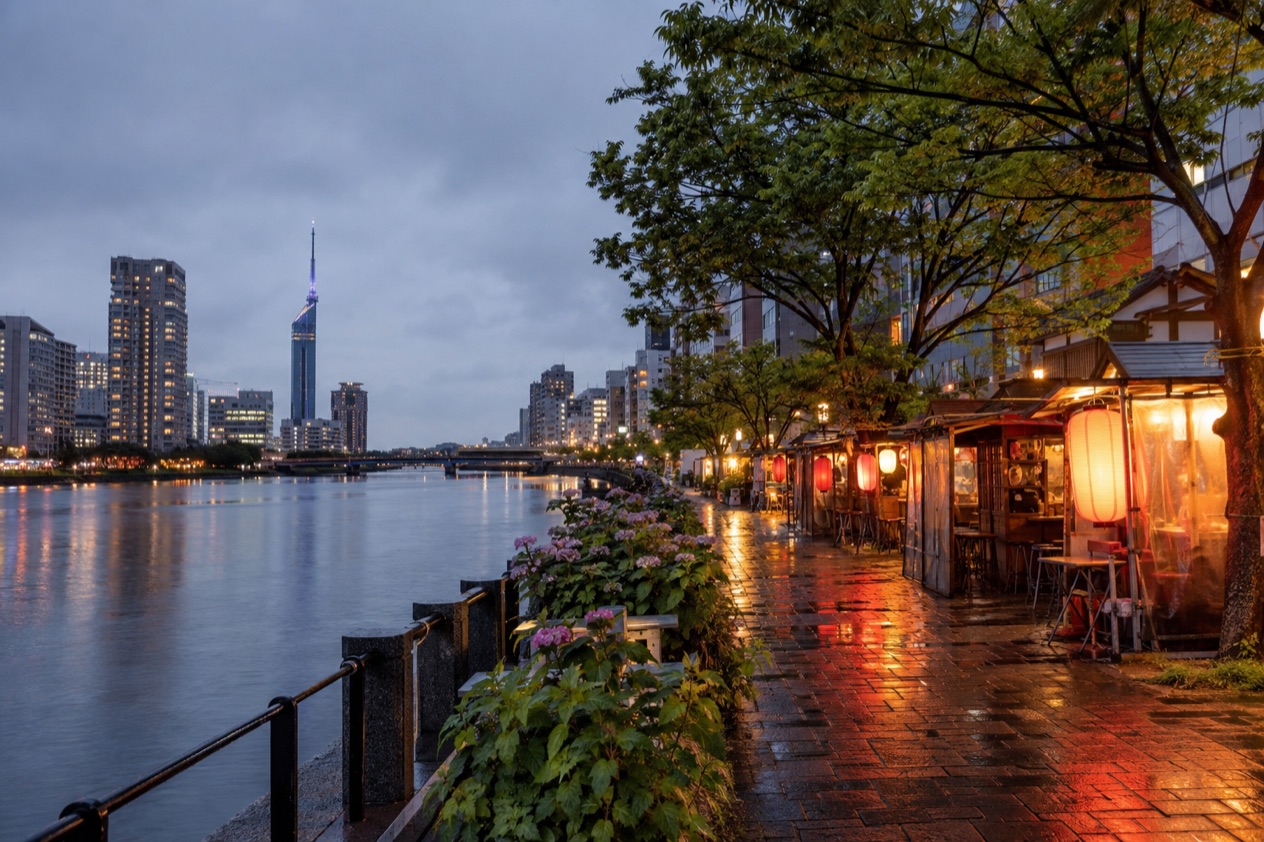
In June, rain taps on the awnings over the yatai, the open-air food stalls of Hakata, and steam from bowls of tonkotsu ramen drifts out into the wet evening air. Umbrellas bob along the river in Nakasu, and the city’s cooks keep working through the damp. Fukuoka in June is a port city on the north coast of Kyushu at the start of its humid summer, a month for noodles, covered arcades, parks and long, soft evenings.
What is the weather like in Fukuoka in June?
June in Fukuoka is warm, damp and gray more often than not, with noticeably less sunshine than May and the first real taste of summer heat.
| Month | Average high (°F) | Average low (°F) | Precipitation (in) | Days with 1 mm or more of precipitation | Hours of sunshine | Daylight on the 15th |
|---|---|---|---|---|---|---|
| May | 75.9 | 61.0 | 5.26 | 8.6 | 204 | 13 h 52 min |
| June | 81.0 | 68.5 | 9.83 | 11.6 | 145 | 14 h 22 min |
| July | 88.2 | 76.3 | 11.78 | 11.0 | 172 | 14 h 11 min |
Rain is the thing to plan around. Rain is the thing to plan around, so keep the day’s outdoor plans flexible. Honshu and Kyushu are known for hot, sultry summers, and in June that humidity is already settling in. Humidity sits at about three quarters, so even a mild afternoon feels close and clothes dry slowly.
Nights stay mild, which means you can walk to dinner in a short-sleeved shirt and carry only a compact umbrella or a light rain jacket. A heavy layer has no use here. What helps is clothing that dries fast, since a morning in the rain can leave shirts damp by lunch.
The days are long. Daylight stretches well into the evening, so you can fit a late stroll by the river or around a park after dinner. The sun appears less often than in May, and when the cloud is thick the light turns soft and silvery over the water.
What to do in Fukuoka in June
June in Fukuoka is a month for eating well and moving between covered places and green ones. The city was selected in the Food category of Lonely Planet’s Best in Travel 2023, and the dishes it is known for suit damp, warm weather: a hot bowl of pork-bone broth, a plate of gyoza, a pot of motsunabe (a stew of beef or pork offal with cabbage and garlic) or a mentaiko (spiced pollock roe) rice ball.
There is no big festival in June itself. The city’s two great celebrations bracket it, Hakata Dontaku in early May and Hakata Gion Yamakasa in July, so the month reads as a calmer stretch between them. That leaves room for neighborhoods, meals and a slower pace, and for hydrangeas, which are native to Japan and are a flower of the rainy months in many gardens, if you spot them in a park or temple courtyard.
Yatai nights along the river
Fukuoka’s yatai were chosen for The New York Times’ 52 Places to Go in 2023, and a rainy evening suits them. The stalls line up in the Hakata area, especially around Nakasu, with a handful of stools under a canvas roof, a cook working in the middle and a pot of broth steaming at his elbow. You sit shoulder to shoulder with strangers and order from a short menu.
Ramen is the obvious order, but a stall might also serve yakitori skewers, oden (simmered fish cakes and vegetables), grilled fish or a glass of local shochu. When they are operating, Fukuoka’s yatai make a convivial evening food stop. This is an evening plan for anyone who likes eating at close quarters, in a setting where the cook talks to the counter.
Ohori Park and an afternoon with art
Ohori Park is built around a large pond, with a path that circles the water, bridges across small islands and herons standing in the shallows. In June the surrounding greenery is thick, and on a gray day the park looks like a watercolor. One of Fukuoka City’s major art galleries stands here, which makes the park a good pairing of outdoors and indoors.
If the sky stays dry, walk the loop around the pond and stop at a tea house or a café on its edge. If rain comes in, the gallery gives you somewhere to wait it out, and the pond is worth a second look afterward, when the surface is dimpled and the lotus leaves shine.
Shrines and temples around Hakata
The old merchant quarter of Hakata holds a cluster of Buddhist temples and Shinto shrines, and the rainy light suits them. Kushida Shrine is closely associated with Hakata Gion Yamakasa, Fukuoka’s major July festival. Tochoji, a Buddhist temple nearby, is known for a large seated Buddha.
Walking between them takes you through narrow streets lined with old shops and small cafés. Wet stone, dripping eaves and the smell of incense make for a good atmosphere. Bring a compact umbrella and leave time for a stop in a tea room, where you can try a bowl of matcha and a seasonal sweet.
Beyond these, Fukuoka’s shopping arcades and underground malls give you plenty of covered ground for a wet afternoon. Tenjin, the main downtown district, is a good place for that, with department stores, food halls and small boutiques. Beyond central Fukuoka, Dazaifu is the classic cultural excursion, while Itoshima offers a coastal day out.
A two-day itinerary for Fukuoka in June
Day 1 belongs to old Hakata. Start in the morning with the temples and Kushida Shrine, then continue through the surrounding narrow streets. Late morning is a good moment for a bowl of ramen at a counter near the station, then a drift through the small shops and tea rooms. In the afternoon, head to Ohori Park for a loop around the pond if the sky is clear.
Use the long June evening for the yatai. Sunset is late, so you can stroll the Nakasu riverfront as the lights come on and then settle onto a stool at a stall for ramen, skewers and a glass of shochu. If rain sets in during the day, swap the park for the art gallery beside the pond and keep the temple visit short.
Day 2 starts downtown. Spend the morning in Tenjin, where covered arcades and underground passages keep you dry between department stores, bookshops and cafés. Lunch can be a set meal of grilled fish or a hot pot of mizutaki, chicken simmered in a clear broth, in a small restaurant.
In the afternoon, go out to the Momochi seaside for a look at the bay and the tower, ideally when the cloud has lifted. Finish in the Daimyo district, with its small bars and izakayas (casual pubs) for a relaxed dinner of small plates. If it pours, stay under the arcades and linger over dinner, since the long evening light carries on after the rain stops.
Is Fukuoka busy in June?
June is a gentler month in Fukuoka than the festival weeks on either side of it, with no big celebration of its own.
Hakata Dontaku fills the streets in early May, and Hakata Gion Yamakasa takes over in July, so June sits in the middle as a transition.
What changes is the mood. With rain in the air and humidity rising, many outings move indoors, and the pace turns more relaxed: long meals, slow walks under umbrellas, afternoons in arcades and galleries. Anyone looking for the energy of a festival should look at the months on either side.
What to pack for Fukuoka in June
Pack for warm, wet days and mild evenings, with a bias toward things that dry quickly and cope with a good deal of walking.
- A compact umbrella or light rain jacket, for the many rainy days of the month.
- Short-sleeved shirts in fabrics that dry fast, because the air stays humid.
- Shoes that handle wet pavement, since temple streets and park paths get slick.
- A small bag or dry pouch to protect your phone and papers on the yatai nights.
- One light layer for air-conditioned malls, arcades and trains.
Good to know before you go
Kyushu’s summers are hot and sultry, and June brings the early-summer rains that make the month wetter and grayer than May. Build slack into the plan so that a wet morning can be swapped with an indoor afternoon. Hakata Dontaku falls in early May and Hakata Gion Yamakasa in July, so neither festival is on in June, and the events you may have read about are on either side of your dates.
Keep indoor options close at hand: the art gallery at Ohori Park, the arcades of Tenjin and the covered areas around Hakata. Wet evenings are made for the yatai, which the New York Times singled out for its 52 Places to Go in 2023.
Fukuoka in June vs May and July
Moving the trip four weeks earlier brings you to May, which is drier and sunnier, with milder days and a lighter feel in the air. It also brings Hakata Dontaku, held on May 3 and 4, when the city turns to parades and street celebrations.
Four weeks later, July is hotter, with a heavier, more sultry feel. Hakata Gion Yamakasa, the big summer event of Fukuoka, is held that month, and it is the draw for anyone who wants to see the city at its most energetic. The rain does not ease much in July, so a trip then trades the quiet of June for heat and festival crowds.
Choose May for walking and parades, July for the summer festival and June if you want a calmer city and don’t mind the damp. June suits people who plan around food and indoor pleasures, and who like the feel of a rainy port city.
Is June a good time to visit Fukuoka?
Yes, for travelers who care more about food, neighborhoods and a relaxed pace than about sunshine and big festivals.
June will suit people who like a ramen counter on a wet evening, who enjoy browsing arcades and tea rooms, and who are happy to adapt the day to the weather. It is a good month for those who see rain as part of the atmosphere, with glossy streets, green parks and lantern-lit stalls. It is a poorer fit for anyone planning days of outdoor sightseeing, or for travelers who want a festival in the street.
On arrival, put the yatai first. Walk to the river around Nakasu as the evening begins, find a stall with a free stool and order a bowl of tonkotsu ramen. Everything else in the city can bend around the rain, but that first night of steam, broth and canvas is what sets the tone for Fukuoka in June.
Sources
- Japan Meteorological Agency (JMA), Normal values 1991-2020, monthly (https://www.data.jma.go.jp/stats/etrn/view/nml_sfc_ym.php?prec_no=82&block_no=47807), station Fukuoka, elevation 2 m, checked October 11, 2026
- Computed from the date and the latitude of the place (sunrise equation, solar elevation -0.833 degrees), October 11, 2026
- Japan National Tourism Organization, weather and seasons in Japan (https://www.japan.travel/en/plan/weather/), checked October 11, 2026
- Wikipedia, Climate of Japan (https://en.wikipedia.org/wiki/Climate_of_Japan), checked October 11, 2026
- Japan National Tourism Organization, flowers by season: cherry blossom, plum, wisteria, hydrangea, where and when (https://www.japan.travel/en/see-and-do/flowers/), checked October 11, 2026
- Wikipedia, Hydrangea (https://en.wikipedia.org/wiki/Hydrangea), checked October 11, 2026
- Japan National Tourism Organization, summer in Japan (https://www.japan.travel/en/guide/summer-guide/), checked October 11, 2026
- Fukuoka City official tourist guide (https://yokanavi.com/en/), checked October 11, 2026
- Wikipedia, Fukuoka (https://en.wikipedia.org/wiki/Fukuoka), checked October 11, 2026
- Wikivoyage, Fukuoka (https://en.wikivoyage.org/wiki/Fukuoka), checked October 11, 2026
- Japan National Tourism Organization, Fukuoka (https://www.japan.travel/en/destinations/kyushu/fukuoka/fukuoka-city/), checked October 11, 2026