
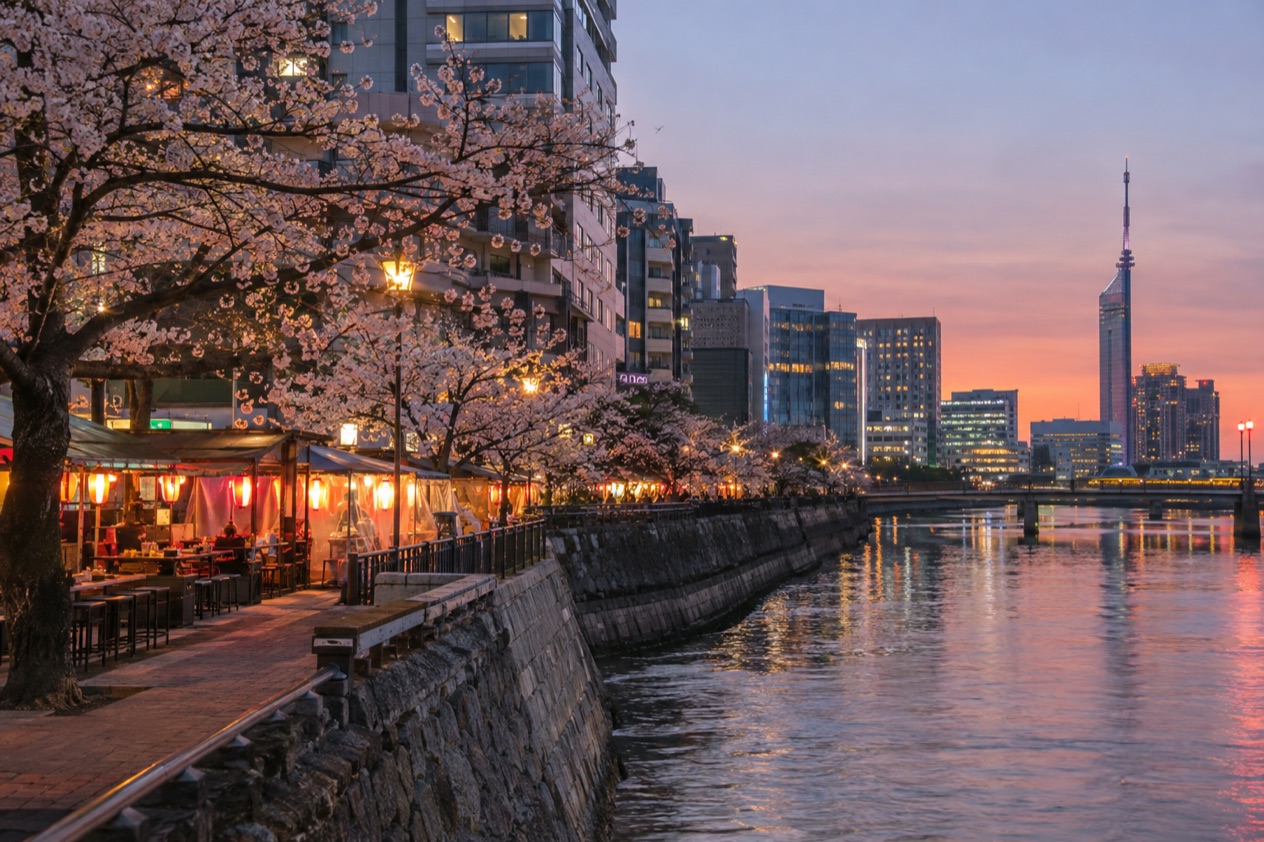
In April, pink petals drift onto the moat and the paths around the old castle grounds, and the evening air along the river carries the smell of pork-bone broth from the food stalls. The cherry trees have mostly finished their show, the days are lengthening, and the city has moved outdoors again. This is Fukuoka for anyone who wants spring walks, long evenings at the yatai and a port city on Kyushu’s north coast at an easy, open-air pace.
What is the weather like in Fukuoka in April?
April in Fukuoka is mild and spring-like, comfortable for walking in a light jacket by day and a layer more after dark, with some rain spread through the month.
| Month | Average high (°F) | Average low (°F) | Precipitation (in) | Days with 1 mm or more of precipitation | Hours of sunshine | Daylight on the 15th |
|---|---|---|---|---|---|---|
| March | 59.0 | 45.0 | 4.08 | 10.1 | 161 | 11 h 55 min |
| April | 67.8 | 52.7 | 4.65 | 9.7 | 188 | 12 h 59 min |
| May | 75.9 | 61.0 | 5.26 | 8.6 | 204 | 13 h 52 min |
Compared with March, April feels like a different season. The chill that kept coats buttoned has gone, and a cotton shirt under a thin sweater is usually enough for a day of sightseeing. Evenings still cool down, so a light jacket stays useful when you sit outside at a food stall or cross the river after dinner.
Rain arrives on a fair share of days, and often as a gray, soft spell rather than a downpour. It is the kind of weather that suits a folding umbrella in your day bag more than a full rain suit. Between the showers the sun comes out for a good stretch of hours, which is what turns the parks green and bright.
The light is generous now. Days are long enough to fit a late afternoon in a park, then dinner, and still have some glow in the sky when you head out. Sturdy walking shoes that can handle damp pavement are the one item that matters most.
What to do in Fukuoka in April
April is the month of cherry blossom afterglow here. At the Fukuoka station the first flowers usually open around the third week of March and full bloom usually falls around the end of March, so by April the trees are shedding.
That means pink-dusted paths, petals floating on the water and green leaves starting to show. The cherry blossom is Japan’s best-loved spring flower, and even after the peak it is one of the pleasures of the month.
Fukuoka rewards a loose, wandering approach. It is a port city on Kyushu’s north coast and has a long history of exchange with the Asian mainland, which still shows in its food and its temples. The city’s food scene earned it a place in Lonely Planet’s Best in Travel list for 2023, and April weather is just right for eating outside.
Ohori Park and the castle grounds
Ohori Park is built around a large pond, with a loop path, bridges over small islands and plenty of benches under trees. In April the cherry petals collect along the edges and the willows and new leaves turn the shoreline fresh green. It is a place for a slow circuit with a coffee in hand, stopping to watch the boats and the herons.
The park also holds one of Fukuoka City’s major art galleries, a useful stop if a shower rolls in. Close by, the stone walls and gate ruins of the old castle stand among trees that were planted for blossom viewing. Climbing to the high stone terraces gives you a view over the rooftops, and the grounds are a good spot to watch the petals fall.
Yatai stalls and the food of the season
The yatai are the small open-air food stalls that set up along the river and in the streets of Hakata and Nakasu, with a handful of stools around a counter and a cook working in the middle. The New York Times named them among its 52 Places to Go in 2023. In April the evenings are mild enough to sit comfortably with the curtain open to the street, which is when the stalls feel at their warmest.
Order tonkotsu ramen, the milky pork-bone noodle soup that Hakata made its own, or try yakitori skewers, gyoza and oden. Away from the stalls, spring brings sea bream, bamboo shoots and fresh greens to the menu, while mentaiko (spicy cod roe), motsunabe (a hot pot of beef offal) and mizutaki (chicken hot pot) keep their place year-round. Fukuoka’s izakaya, the casual Japanese pubs, serve all of it with local sake and shochu.
Shrines, temples and Dazaifu
Hakata, the old merchant side of the city, has Kushida Shrine, where the great floats of the summer Yamakasa festival are kept and shown, and Tochoji temple with its large seated Buddha. They are places for a slow wander, with the scent of incense and the sound of gravel underfoot. In April the shrine trees are fresh green and the lanes between the temples invite a longer stroll.
A trip out to Dazaifu Tenmangu, the shrine dedicated to the scholar-god of learning, is a popular outing from the city. The approach is lined with small shops selling umeganemochi, the toasted rice cakes filled with sweet bean paste, and the shrine grounds hold a pond with arched bridges and old camphor trees. After a morning there, return to the city for an evening in Tenjin or Nakasu.
A two-day itinerary for Fukuoka in April
Day 1 starts in old Hakata. Begin at Kushida Shrine in the morning, then walk to Tochoji temple, and have a bowl of Hakata udon, the soft, thick-bodied noodles, for lunch in one of the small shops nearby. April light is soft enough that you can stay outside through the middle of the day without needing to retreat.
In the afternoon, head to Ohori Park for a circuit of the pond and a visit to the castle ruins above it, watching the last petals fall. As the sky darkens, cross to Nakasu or the riverside and find a yatai stool for ramen, skewers and a drink. If it rains, the art gallery in Ohori Park is the indoor plan, and the covered shopping arcades of Hakata make a dry way to fill the day.
Day 2 goes to Dazaifu in the morning, with its shrine, pond and rice cake shops, then back to Tenjin for lunch among the shopping streets and department store food halls. Spend the afternoon browsing the shops and cafés, and have dinner at an izakaya or a motsunabe restaurant. If the weather turns, the department stores and underground malls of Tenjin keep you dry and fed.
Is Fukuoka busy in April?
April in Fukuoka is a month of transition rather than a rush: the cherry blossom peak has passed and Golden Week only begins at the very end of the month.
Because Fukuoka’s blossoms bloom early, the crowds that gather for the peak of the flowers belong mostly to the end of March. By April what you find is a city in spring mode, with parks full of people picnicking under the green leaves and the food stalls running at full swing in the evening. Fukuoka also has the fastest population growth of any city in Japan, so the streets have a young, busy energy in any month.
The end of April is different. Golden Week, a string of public holidays, begins then, and the city’s pace changes as people travel for the long break. If you plan to be in Fukuoka in the final days of the month, expect a more festive mood in the shopping streets and at the food stalls. Earlier in the month, the city runs at its everyday spring tempo.
What to pack for Fukuoka in April
Spring in Japan means a light jacket or a simple sweater is enough, and in Fukuoka the days are warm enough for shirt sleeves in the sun. Pack for changeable layers and some rain.
- A light jacket or sweater, for cooler evenings at the food stalls.
- A compact umbrella, because rain falls on a fair share of days.
- Comfortable walking shoes that handle damp paths around the park and temple grounds.
- Short-sleeved shirts to wear under layers on the warmer afternoons.
- Sunglasses or a hat, for the bright spring sun between showers.
Good to know before you go
The practical date to know is April 29, Showa Day, the first public holiday of Golden Week, which runs through early May. When a national holiday falls on a Sunday, the next working day becomes a holiday too, so the break can stretch.
In urban areas, shops are generally open from 10:00 a.m. to 8:00 p.m. every day, so a day of browsing in Tenjin and Hakata fits easily around meals and sightseeing.
Fukuoka in April vs March and May
Moving the trip four weeks earlier brings you to the cherry blossoms themselves, since first bloom usually comes around the third week of March and full bloom close to the end of the month. March is cooler and a touch grayer, with an occasional snow or sleet day, and the evenings at the yatai call for a proper coat. Choose March if flowers are the main goal.
Moving four weeks later means May, which is warmer and brighter, with the longest days of the three months. The Hakata Dontaku festival is held on May 3 and 4, when the city fills with parades and street performers during Golden Week. The trade-off is more rain in total and the beginnings of humid air as summer approaches.
Stay with April if you want the in-between: mild days, petals still on the ground, green leaves coming in and the stalls open in comfortable evening air. Shift earlier for blossoms, and later if you want warmer weather and a festival.
Is April a good time to visit Fukuoka?
Yes, April is a good time for travelers who want spring walks, mild weather and food eaten outdoors, and who are happy to catch the end of the blossom rather than the peak.
It suits food lovers, park wanderers and anyone who likes a city with an open-air heart. It is a weaker choice for those who must see the cherry trees in full flower, since that moment usually passes before the month begins, and for those who want true warmth, which arrives in May.
On arrival, start with a first evening at a yatai stall in Nakasu or Hakata, then spend the next morning at Ohori Park while your body clock adjusts. What makes April special in Fukuoka is the sight of the last pink petals on the pond, a bowl of ramen steaming under a stall curtain and the first evenings warm enough to linger outdoors.
Sources
- Japan Meteorological Agency (JMA), Normal values 1991-2020, monthly (https://www.data.jma.go.jp/stats/etrn/view/nml_sfc_ym.php?prec_no=82&block_no=47807), station Fukuoka, elevation 2 m, checked October 11, 2026
- Computed from the date and the latitude of the place (sunrise equation, solar elevation -0.833 degrees), October 11, 2026
- Japan Meteorological Agency, cherry blossom first-bloom dates 2021-2026 and 1991-2020 normal (https://www.data.jma.go.jp/sakura/data/sakura003_07.html), checked October 11, 2026
- Japan Meteorological Agency, cherry blossom full-bloom dates 2021-2026 and 1991-2020 normal (https://www.data.jma.go.jp/sakura/data/sakura004_07.html), checked October 11, 2026
- Japan Meteorological Agency, sakura2020.pdf (https://www.data.jma.go.jp/sakura/data/sakura2020.pdf), checked October 11, 2026
- Japan National Tourism Organization, spring in Japan (https://www.japan.travel/en/guide/spring-guide/), checked October 11, 2026
- Japan National Tourism Organization, flowers by season: cherry blossom, plum, wisteria, hydrangea, where and when (https://www.japan.travel/en/see-and-do/flowers/), checked October 11, 2026
- Wikipedia, Wisteria (https://en.wikipedia.org/wiki/Wisteria), checked October 11, 2026
- Japan National Tourism Organization, shop and attraction hours, national holidays (https://www.japan.travel/en/plan/business-hours-and-holidays/), checked October 11, 2026
- Wikipedia, Golden Week (Japan) (https://en.wikipedia.org/wiki/Golden_Week_(Japan)), checked October 11, 2026
- Wikipedia, Public holidays in Japan (https://en.wikipedia.org/wiki/Public_holidays_in_Japan), checked October 11, 2026
- Wikivoyage, Fukuoka (https://en.wikivoyage.org/wiki/Fukuoka), checked October 11, 2026
- Japan National Tourism Organization, Fukuoka (https://www.japan.travel/en/destinations/kyushu/fukuoka/fukuoka-city/), checked October 11, 2026
- Fukuoka City official tourist guide (https://yokanavi.com/en/), checked October 11, 2026
- Wikipedia, Fukuoka (https://en.wikipedia.org/wiki/Fukuoka), checked October 11, 2026