
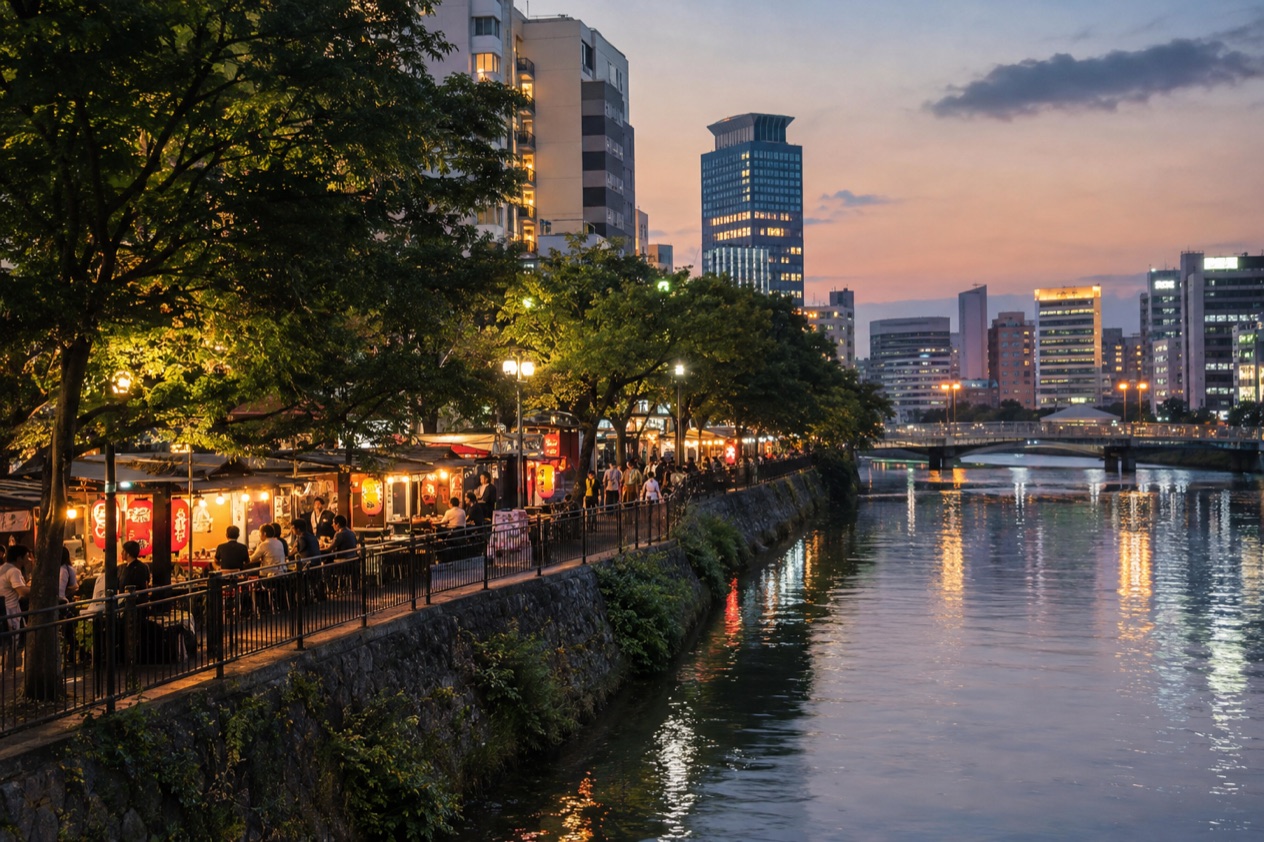
In August, the cicadas keep up their buzzing from the trees while Fukuoka waits for evening, when the yatai, the small open-air food stalls, hang their lanterns and steam from tonkotsu ramen rises into the warm night. The days are hot and heavy, so the city drifts toward shaded arcades, cold noodles, shaved ice and late dinners. August in Fukuoka suits travelers who like summer heat, a food-led trip and an unhurried pace.
What is the weather like in Fukuoka in August?
August in Fukuoka is hot and humid, a little drier than July and noticeably sunnier, with nights that barely cool off.
| Month | Average high (°F) | Average low (°F) | Precipitation (in) | Days with 1 mm or more of precipitation | Hours of sunshine | Daylight on the 15th |
|---|---|---|---|---|---|---|
| July | 88.2 | 76.3 | 11.78 | 11.0 | 172 | 14 h 11 min |
| August | 90.5 | 77.7 | 8.27 | 9.8 | 201 | 13 h 26 min |
| September | 83.5 | 70.9 | 6.89 | 9.7 | 165 | 12 h 26 min |
Nights stay warm enough that a jacket is never needed outdoors, and the humidity, which hovers around 72 percent, makes it feel warmer than the thermometer says. Shirts that dry quickly and fabrics that breathe matter more than any extra layer.
Rain still falls on roughly a third of the days, so a compact umbrella earns its place in the bag. A shower can be heavy, though August has far less of it than July, and the sunny stretches are long. Sunglasses and a hat belong in the daypack alongside the umbrella.
The light is generous at both ends of the day. Sunsets arrive later than in autumn, which leaves time for a walk after dinner, and the evenings are still warm when the stalls open. Indoor air conditioning is strong in malls, trains and museums, so a thin cardigan for those spaces is the only layer you may want.
What to do in Fukuoka in August
The best August plan in Fukuoka is to eat well and to move around the heat. Fukuoka City was selected in the Food category of Lonely Planet’s Best In Travel 2023, and the hot months show why: bowls of creamy tonkotsu ramen, spicy cod roe called mentaiko, chicken or offal hot pots, grilled skewers and cold noodles all suit the table here, often with a cold beer beside them.
Summer in Fukuoka is also a season of festivals, but the big one, Hakata Gion Yamakasa, is held in July, so by August the city has moved on to a calmer rhythm. What remains is the everyday summer: paper fans handed out at the entrances of shops, glass wind chimes ringing in doorways, and shaved ice in flavors from green tea to sweet red bean. Fukuoka is the largest city on Kyushu, and in August it feels like a city that has learned to live with the heat.
Shopping and strolling fit the weather well, because indoor malls and arcades give you hours out of the sun. Urban shops keep long, regular hours, which suits a late start.
| Place | Open |
|---|---|
| Shops in urban areas of Japan | 10:00 a.m. to 8:00 p.m., every day |
Yatai evenings in Hakata
Fukuoka’s yatai were chosen for The New York Times’ ’52 Places to Go in 2023′, and August evenings are a natural time to sit at one. These stalls are small counters under a canvas awning, with a handful of stools, a cook working in the middle and a pot of broth on the boil. The close counter seating puts diners beside the cook and other customers.
Expect ramen, grilled chicken skewers, oden (simmered fish cakes, radish and egg), gyoza and plenty of beer and shochu. Start with one stall for a snack, then move on to a second for the main dish, as many diners do.
Ohori Park and its art gallery
Ohori Park is a large park built around a pond, and it is where Fukuoka comes to walk, jog and sit on benches. It is also the location of one of Fukuoka City’s major art galleries, which makes it a practical stop in August: you can stroll the shaded paths, then step into the cool galleries when the sun feels heavy.
The park suits a slow outing when the day is bright, with tree cover over parts of the paths and open water that makes the air feel lighter. Take a cold drink from a vending machine, which you will find nearly everywhere in Japanese cities, and let the pace stay low. If a shower blows in, the gallery is your shelter.
Obon and the summer vacation mood
Obon is a Japanese Buddhist custom to honor the spirits of one’s ancestors, and it lasts three days. People return to ancestral family places, and they visit and clean their ancestors’ graves. In August, this means family travel across Japan and a gentler, more domestic mood in many neighborhoods.
For a visitor, Obon is something to notice rather than join: lanterns, incense at family altars, relatives walking to cemeteries. Be respectful around graves and temples, keep voices low and ask before photographing people. Some businesses change their hours during Obon, so check locally before heading out.
A two-day itinerary for Fukuoka in August
Day 1 starts in the morning at Ohori Park, with a walk around the pond followed by time in the art gallery. Walk the shore, then go into the art gallery as the temperature builds, and have a long lunch of cold noodles or a set meal in a nearby restaurant. The whole plan is built to keep you outside early and inside at midday.
In the afternoon, head to the big shopping arcades and department stores of the center, where the air conditioning is strong and a cup of shaved ice will cool you down. If a shower arrives, nothing changes: the day is already indoors. As the light softens, which in August comes late with more than thirteen hours of daylight, walk toward the river for the evening at the yatai.
Choose a stall for ramen and skewers, then another for a second round, and finish with a slow walk along the water. Dinner is the main event of the day.
Day 2 begins with a shrine or temple visit while the day is young, since the stone courtyards hold the heat as the sun climbs. Choose one that suits you and stay as long as the weather allows. Afterwards, look for a traditional breakfast or a coffee in a café with air conditioning, and bring a hand towel for your neck as locals do.
For lunch, try a hot pot or a mentaiko set meal, and for the afternoon choose a museum or a department store basement food hall, where you can taste sweets and buy gifts out of the sun. Rain card: use the covered arcades and the indoor galleries for the whole day. In the evening, go for grilled chicken or an izakaya, a casual pub where small plates arrive all night, to close the trip.
Is Fukuoka busy in August?
August in Fukuoka is a month of summer vacation and heat, and the city’s pace follows the weather: slower in the middle of the day, livelier after dark.
The city draws visitors for its food, and the evening is when that shows. Fukuoka has the fastest population growth of any city in Japan, so the streets always have a young, active feel, and shops in urban areas stay open every day. The weather asks you to shape your day around the sun rather than around a crowd.
Obon adds a family-travel mood to the calendar, with people returning to their home towns. When a national holiday falls on a Sunday, the next working day becomes a public holiday, and a day squeezed between two holidays also becomes one, so around holiday weekends you may find changes in how the city moves. Big July festival crowds, such as those for Hakata Gion Yamakasa, are behind you by the time August arrives.
If you want a calmer view of the city, choose the hours when others are indoors: the early part of the day and the late evening both leave you plenty of room in the parks and along the river. Restaurants and the yatai are where you will most likely meet other diners, which is part of the fun.
What to pack for Fukuoka in August
Pack for heat, humidity and the odd shower, with the day built around walking, eating and ducking into air-conditioned places.
- Light, quick-drying shirts and shorts or skirts, because the air stays humid.
- A compact umbrella that also works as a sunshade, for showers and bright hours.
- A hat and sunglasses for walks around Ohori Park and the shrines.
- A thin cardigan or scarf for the strong air conditioning in malls and trains.
- Comfortable sandals or shoes that dry fast, for long days of walking.
- A small towel or fan, which locals carry to deal with the sticky evenings.
Good to know before you go
The islands of Honshu and Kyushu have very humid, hot and sultry summers, and August in Fukuoka fits that description. Plan the busiest outdoor activities around the hours when you feel comfortable, drink regularly and use shops and cafés as cool breaks. Rural shops often close earlier, sometimes as early as 6:00 p.m., which matters if you head out of the city for the day.
The Japan National Tourism Organization provides a Japan Safe Travel Information page with safety tips and government information for travelers. The Japan Meteorological Agency issues Emergency Warnings to alert people to the significant likelihood of catastrophes linked to natural phenomena of extraordinary magnitude, a system it launched in 2013. Obon and public holidays can change how some businesses operate, so keep a little flexibility in your plans.
Fukuoka in August vs July and September
Moving the trip four weeks earlier brings you to July, which is wetter and a bit less sunny, with the heat building toward its peak. The major festival, Hakata Gion Yamakasa, is held in July, so those who want to see the city in full summer celebration should choose that month. Days are also longer then, which leaves extra evening light for the stalls and walks.
Four weeks later, September is noticeably cooler, with less rain and shorter days, and the sun is less intense for long walks. The festival calendar is quieter, though the food scene carries on as before. Sightseeing outdoors is more comfortable, and a light layer might feel welcome in the evening.
Choose July for the festival and the full summer mood, August for the sunniest and hottest stretch with the longest warm evenings after the rainy weeks, and September if the heat is the part of the trip you least look forward to. Travelers who like long, slow, food-centered days should stay with August, while those who want to walk for hours outside will be happier a few weeks later.
Is August a good time to visit Fukuoka?
Yes, August is a good time to visit Fukuoka for travelers who enjoy heat, sunshine and food, and who are happy to organize days around cool interiors and long evenings.
People who love eating at night will be happiest: yatai counters, izakaya, cold noodles and shaved ice are all at their natural moment. Travelers who like culture mixed with ordinary life will enjoy the Obon mood, and anyone who likes parks and galleries has Ohori Park to fill an easy morning. Those who dislike humidity or struggle in strong heat should choose a cooler month.
On arrival, start by finding a shaded spot for a drink and a first bowl of ramen, then plan your outdoor hours around the sun. What makes August in Fukuoka stand out is the way the city turns toward the night: the heat lifts a little, lanterns come on over the stalls, and a bowl of broth beside the river becomes the whole point of the day.
Sources
- Japan Meteorological Agency (JMA), Normal values 1991-2020, monthly (https://www.data.jma.go.jp/stats/etrn/view/nml_sfc_ym.php?prec_no=82&block_no=47807), station Fukuoka, elevation 2 m, checked October 11, 2026
- Computed from the date and the latitude of the place (sunrise equation, solar elevation -0.833 degrees), October 11, 2026
- Japan National Tourism Organization, shop and attraction hours, national holidays (https://www.japan.travel/en/plan/business-hours-and-holidays/), checked October 11, 2026
- Wikipedia, Obon (https://en.wikipedia.org/wiki/Obon), checked October 11, 2026
- Wikipedia, Public holidays in Japan (https://en.wikipedia.org/wiki/Public_holidays_in_Japan), checked October 11, 2026
- Japan National Tourism Organization, summer in Japan (https://www.japan.travel/en/guide/summer-guide/), checked October 11, 2026
- Japan National Tourism Organization, festivals and events (https://www.japan.travel/en/see-and-do/festivals-and-events/), checked October 11, 2026
- Wikipedia, Hanabi (https://en.wikipedia.org/wiki/Hanabi), checked October 11, 2026
- Japan Meteorological Agency, Emergency Warnings (https://www.jma.go.jp/jma/en/Emergency_Warning/ew_index.html), checked October 11, 2026
- Japan National Tourism Organization, safety information (https://www.japan.travel/en/japan-safe-travel-information/), checked October 11, 2026
- Japan National Tourism Organization, weather and seasons in Japan (https://www.japan.travel/en/plan/weather/), checked October 11, 2026
- Wikipedia, Awa Odori (https://en.wikipedia.org/wiki/Awa_Odori), checked October 11, 2026
- Wikipedia, Climate of Japan (https://en.wikipedia.org/wiki/Climate_of_Japan), checked October 11, 2026
- Japan National Tourism Organization, Mount Fuji guide (https://www.japan.travel/en/fuji-guide/), checked October 11, 2026
- Official website for Mt. Fuji climbing, about the climb (https://www.fujisan-climb.jp/en/about/), checked October 11, 2026
- Wikipedia, Nebuta (https://en.wikipedia.org/wiki/Nebuta), checked October 11, 2026
- Wikivoyage, Fukuoka (https://en.wikivoyage.org/wiki/Fukuoka), checked October 11, 2026
- Japan National Tourism Organization, Fukuoka (https://www.japan.travel/en/destinations/kyushu/fukuoka/fukuoka-city/), checked October 11, 2026
- Fukuoka City official tourist guide (https://yokanavi.com/en/), checked October 11, 2026
- Wikipedia, Fukuoka (https://en.wikipedia.org/wiki/Fukuoka), checked October 11, 2026