
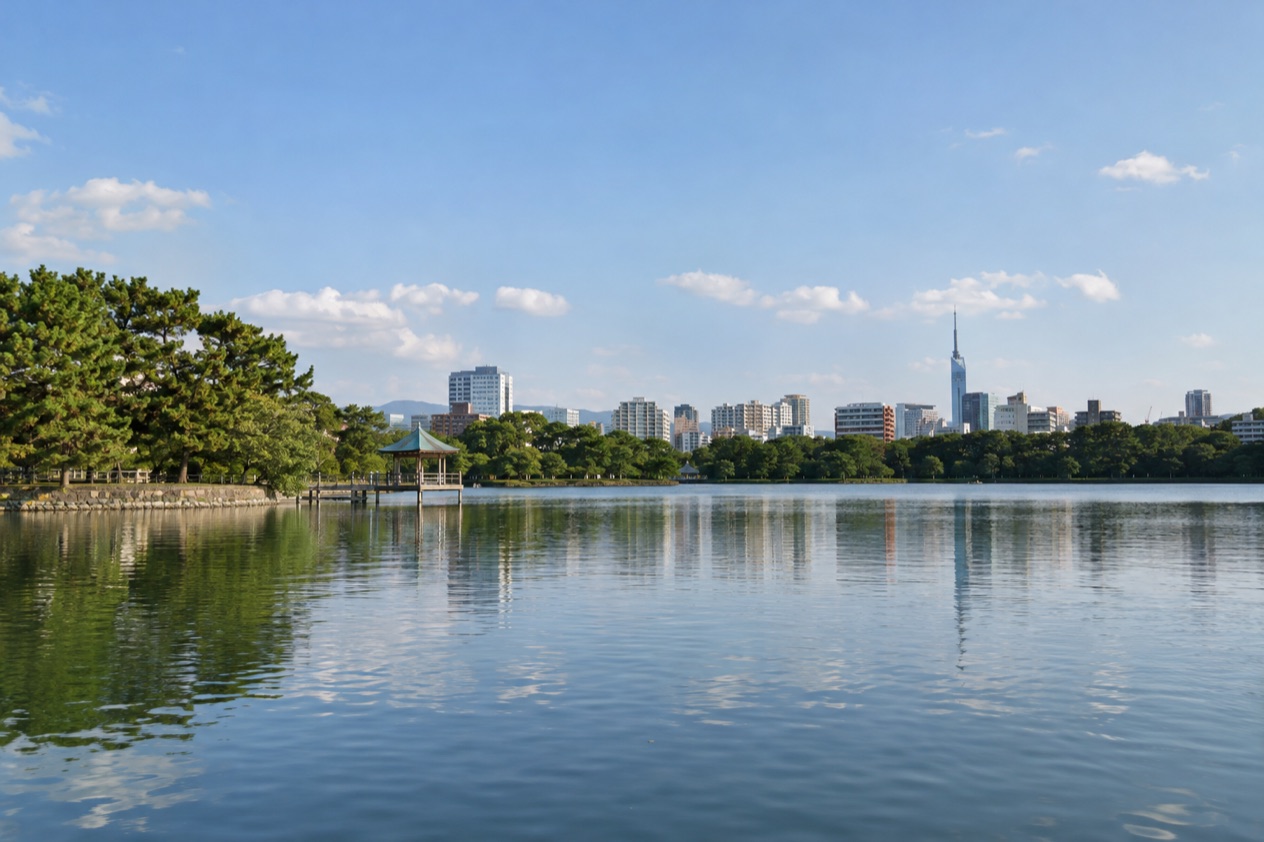
The water comes first at Ohori Park: a wide sheet of it, held in the bend of an old castle moat, with willows leaning over the edge and the city’s towers standing back behind the trees. Joggers, sketchers and people with a bag of bread for the ducks all drift along the shoreline at their own pace. This is Fukuoka’s great open space in Chuo-ku, a place to wander slowly, with a museum and the castle’s remains close at hand.
Is visiting Ohori Park worth it?
Yes, if you like cities that give you a stretch of water and trees in the middle of the day, and it suits travelers who enjoy walking, watching, and a little history without a ticketed attraction at every turn. It is a registered Place of Scenic Beauty, which tells you the landscape itself is the point rather than any single building.
What sets it apart from other city parks is its story. The name means a large moat, and it comes from the moat that Kuroda Nagamasa had made for Fukuoka Castle.
The park you walk today was reconstructed by Fukuoka City and opened in 1929, and its designers took the West Lake of China as their model.
Fukuoka has long looked toward the Asian mainland, and the park is a quiet reminder of that habit of borrowing and adapting. It also sits among other things worth a stop, from an art museum to the footprint of a vanished ballpark.
What to see at Ohori Park
The moat and the lake landscape
The heart of the park is the water itself, a broad expanse that began as part of the defenses of Fukuoka Castle. Look at how the shoreline curves and how the plantings frame the views, and you can see why the park earned its scenic designation. The design follows the idea of the West Lake of China, so the walk is meant to unfold as a series of pictures rather than a straight line.
Stop wherever the view opens and watch the surface: birds, reflections of the sky, boats pushed by a light wind. Bring a camera, or simply a bench-side snack, and let the loop take as long as you like. Rain changes the mood without ending the visit, since a wet day gives the water a soft gray sheen.
The Fukuoka Art Museum next door
Near the park stands the Fukuoka Art Museum, and Ohori Park is the location of one of the city’s major art galleries. It pairs naturally with a lakeside walk, because you can move from the open air into galleries and back out again to the water without leaving the neighborhood.
Plan the museum as a break in the middle of the walk. After an hour among paintings and objects, the return to the shoreline feels like a second park, with the light and the trees seen fresh.
Fukuoka Castle ruins and the old stadium site
The moat gets its name from Fukuoka Castle, and the castle’s story still surfaces around the park. When Heiwadai Stadium was renovated in 1987, ruins of an ancient facility turned up underneath the bleachers, and they proved to be from Fukuoka Castle. The ballpark stood on top of the castle’s past, a layering that says a lot about how Fukuoka has been rebuilt over time.
The stadium itself opened in 1949 and closed in 1997, and it was demolished the following year. It was home to the Nishi Nippon Pirates, then the Nishitetsu Clippers and Lions, and later the Fukuoka Daiei Hawks. Baseball fans will enjoy knowing that the sport’s history in the city is tied to this neighborhood, and that the team now plays at the Fukuoka PayPay Dome, which replaced the old stadium.
Hours, tickets and rules
Ohori Park is a public landscape in Chuo-ku, Fukuoka, and what you do there is mostly walk, look and linger, which is how a registered Place of Scenic Beauty is meant to be enjoyed. The park is built around a large moat, so the experience is shaped by its shoreline rather than by a gate and a ticket booth. Think of it as an outdoor room that the whole city shares.
Around the park, other places have their own arrangements. The Fukuoka Art Museum is a separate destination near the water, and the United States Consulate is also nearby, which is useful to know simply as a landmark when you are finding your way. Treat each building as its own stop with its own schedule.
The fireworks festival held in the park every August is the one event that changes how the grounds feel, bringing the lakeside to life after dark. Beyond that, think of your visit as unstructured time. Walk the shoreline, stop at the views that catch your eye, and let the day set its own length.
When to visit Ohori Park
Spring and autumn give mild afternoons for long walks, summer brings the fireworks and a lot of humidity, and winter gives cool, damp air with the occasional flurry.
| Month | Average high (°F) | Average low (°F) | Rain days | Sunshine (hours) |
|---|---|---|---|---|
| January | 50.4 | 39.0 | 9.3 | 104 |
| April | 67.8 | 52.7 | 9.7 | 188 |
| July | 88.2 | 76.3 | 11.0 | 172 |
| October | 74.7 | 60.8 | 6.8 | 176 |
April and October are the months for lingering outdoors: comfortable highs, enough sunshine to light the water, and cool evenings. October in particular has the fewest rain days of the four, so a lakeside stroll in early autumn rarely needs a plan B. Spring is the time to watch the plantings around the shoreline change from week to week.
July is hot and sticky, with the heaviest rain of the four months, and showers can come in long gray spells. It is also the month of Hakata Gion Yamakasa, a big summer event in Fukuoka, so the city has a festive mood even when the weather is heavy. August brings the fireworks to the park itself.
January is cold and damp rather than snowy, though the city does see a little snow or sleet on a good number of days. Dress in layers and expect the lakeside to feel breezy. The park suits a short winter walk followed by a warm break indoors, perhaps in the art museum.
Tips for your visit
Wear comfortable shoes and bring a light layer, since the open shoreline can feel cooler than the streets around it. In summer carry water and something to shade your head, and in the rainy stretches bring a compact umbrella. A camera is worth having, because the reflections and the framed views are the park’s signature.
If you like baseball, the story of Heiwadai Stadium and its successors makes a good thread to follow through the neighborhood. Leave room to simply sit by the water without a schedule.
Fukuoka City was also selected in the Food category of Lonely Planet’s Best In Travel 2023. A walk in the park followed by a meal in town makes a natural pairing for the day.
Families and travelers who prefer to move slowly can treat the park as a loose loop with plenty of places to stop.
Good to know before you go
Ohori Park sits in a big, growing city, and Fukuoka has the fastest population growth of any city in Japan, so the streets around it can be lively. Keep the usual travel habits: watch your belongings, carry what you need for the weather, and expect the wet days of summer to bring heavy rain. The park is the kind of place where a few relaxed hours are enough to feel you have seen something real.
Sources
- Wikipedia, Ōhori Park (https://en.wikipedia.org/wiki/%C5%8Chori_Park), checked October 11, 2026
- Japan National Tourism Organization, Fukuoka (https://www.japan.travel/en/destinations/kyushu/fukuoka/fukuoka-city/), checked October 11, 2026
- Fukuoka City official tourist guide (https://yokanavi.com/en/), checked October 11, 2026
- Wikipedia, Fukuoka (https://en.wikipedia.org/wiki/Fukuoka), checked October 11, 2026
- Japan Meteorological Agency (JMA), Normal values 1991-2020, monthly (https://www.data.jma.go.jp/stats/etrn/view/nml_sfc_ym.php?prec_no=82&block_no=47807), station Fukuoka, elevation 2 m, checked October 11, 2026
To plan your stay
- Best Time to Visit Japan: Cherry Blossoms, Autumn Colors, Weather and Festivals
- Where to Stay in Japan: Ryokan, Temple Stays, Capsule Hotels and the Best Cities to Base In
- Sending Luggage from the Airport in Japan: Hands-Free Travel, Hotel Delivery and Coin Lockers
- Know Before You Go to Japan: Entry, Money, Etiquette and Getting Around