
In March, the first pale pink flowers start to open on the cherry trees around Fukuoka’s castle ruins, and the steam from the ramen stalls hangs a little less heavily in the evening air. The city is shaking off winter.
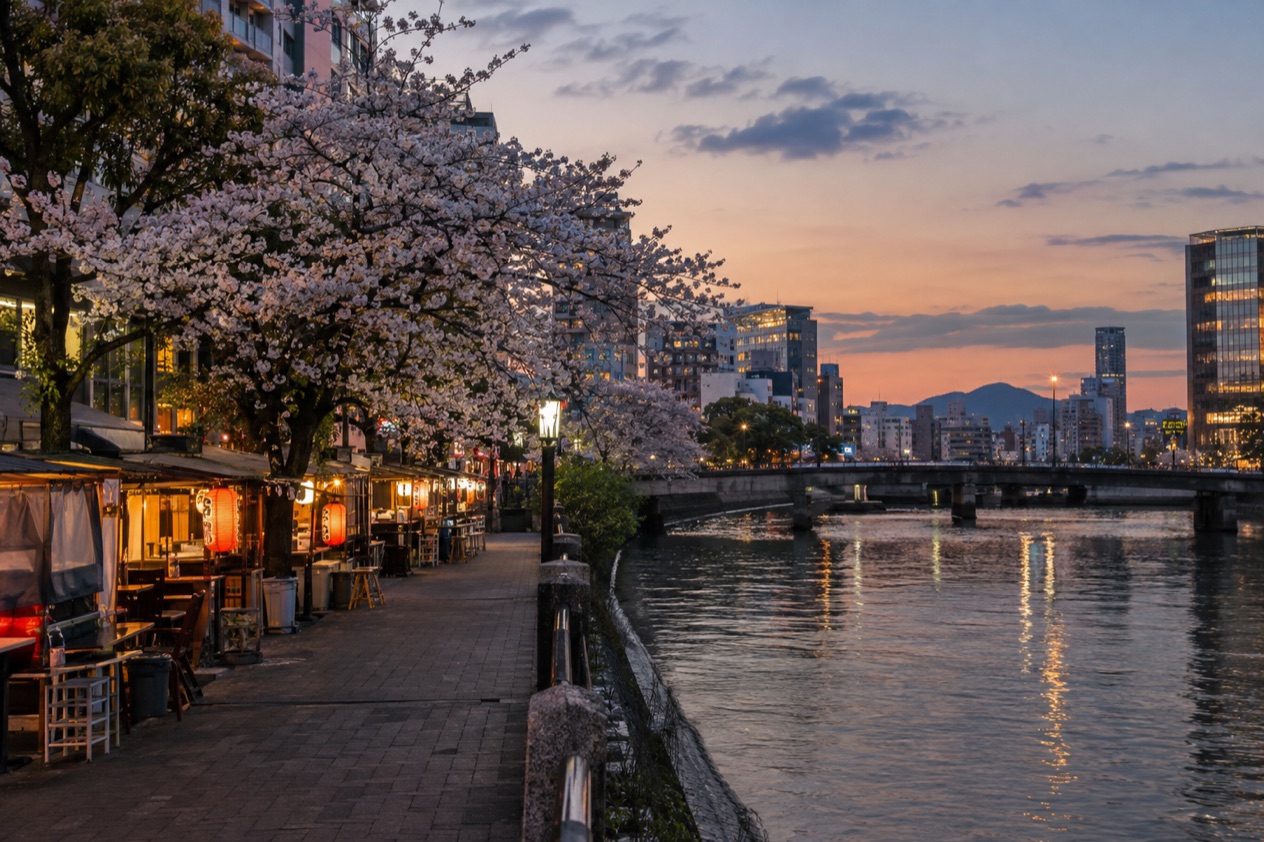
Jackets come off at lunchtime, picnic sheets appear under the branches, and the riverside food stalls fill again after dark. It is a month for blossom walks, bowls of pork-bone broth and a city that is beginning to feel like spring.
What is the weather like in Fukuoka in March?
March in Fukuoka is mild and clearly turning toward spring, with cool edges to the day, comfortable stretches in between and rain on roughly every third day.
| Month | Average high (°F) | Average low (°F) | Precipitation (in) | Days with 1 mm or more of precipitation | Hours of sunshine | Daylight on the 15th |
|---|---|---|---|---|---|---|
| February | 52.9 | 39.9 | 2.75 | 8.8 | 124 | 10 h 58 min |
| March | 59.0 | 45.0 | 4.08 | 10.1 | 161 | 11 h 55 min |
| April | 67.8 | 52.7 | 4.65 | 9.7 | 188 | 12 h 59 min |
What this means in practice is layers. Japan’s national tourism organization notes that in spring a light jacket or a simple sweater is enough for travel, and that fits Fukuoka well. Pair a sweater with a jacket you can take off and tie to your bag. Early mornings and evenings still ask for the extra layer, especially if you plan to eat at an open-air stall.
The rain comes in showery spells spread through the month rather than in one long wet stretch, and it is the kind of weather that suits a folding umbrella better than a heavy raincoat. Gray days do happen, and now and then a day of snow or sleet slips in, a last reminder of winter that rarely lingers. Sunshine hours are clearly up on February, so the bright days feel properly springlike.
The light is the quiet gift of the month. Day and night are almost even, so you can start a walk after breakfast and still have daylight for the evening stroll to dinner. Park paths and riverbanks are the places where this weather works best, with a dry stop planned nearby for the showers.
What to do in Fukuoka in March
The great event of the month in Fukuoka is the cherry blossom.
Those are usual dates, not a promise, and from one spring to the next the timing slides earlier or later. If you arrive early in the month you will likely find buds and bare branches, and if you come late you may meet the first falling petals.
Fukuoka is a port city on the north coast of Kyushu, and it has long traded and traded ideas with the Asian mainland. That openness shows in its food, in its shrines and in the way the city feels more relaxed than its size suggests. March suits the outdoor parts of that character: parks by day, stalls by night, and a few well-chosen indoor stops for the showers.
Cherry blossom walks at Ohori Park and the castle ruins
Ohori Park is built around a large pond, with a loop path, little bridges over the water and one of Fukuoka City’s major art galleries on its grounds. In blossom time it is a place for slow circuits, coffee in hand, with the trees reflecting in the water.
The old castle grounds in Maizuru Park are the other cherry address for many locals. Stone walls and gatehouses stand among the trees, and the mood in blossom season is of friends spreading out sheets and sharing bento boxes beneath the branches, a custom called hanami.
The walls lend themselves to photographs, and the climb to the old tower foundations gives a view over the city roofs. Pair the two parks on one day and you have the heart of a March visit.
Yatai evenings and the ramen of Hakata
A yatai is a small, mobile food stall, and in Fukuoka the yatai are a reason to plan the evening. The New York Times chose Fukuoka’s yatai in Hakata for its list of places to go in 2023, and Lonely Planet picked the city in its Food category for its Best in Travel list the same year. In March the mild evenings make a stool at a stall far more pleasant than in midwinter, though you will still want your jacket.
Tonkotsu ramen, the milky pork-bone broth that defines the region, originated in Kurume in Fukuoka Prefecture, and Hakata’s version has thin straight noodles you can top up with a second serving, a habit called kaedama. Around it sit the other local favorites: spicy cod roe called mentaiko, gyoza fried small and crisp, grilled skewers and, on a cool night, motsunabe, a hot pot of beef offal and cabbage. Between stalls, the izakaya (casual pubs) of the city offer the same dishes indoors when it rains.
Shrines for a gray day: Kushida and Dazaifu
Kushida Shrine sits in the old merchant quarter of Hakata and is tied to the Hakata Gion Yamakasa, the big summer festival held in July. In March you see the shrine without the festival, with its heavy roof, lanterns and quiet courtyards. It is a good stop between a morning in the old quarter and a lunch of noodles, and it fills the time when the sky is gray.
Dazaifu Tenmangu is a larger shrine outing, dedicated to the deity of scholarship, and students come to pray here. Renovations of its main hall, the honden, are expected to take about three years, so what you see may include work in progress. The approach lane and the surrounding grounds still give you a full outing, with sweet shops, tea stops and trees along the paths.
Beyond the headline sights, the shopping and dining districts of Tenjin and the Hakata station area fill rainy hours with department stores, underground arcades and food halls. Canal City, the big complex with a canal running through it, is another dry refuge. The riverside paths near Nakasu glow after dark and make a pleasant way to walk off dinner.
A two-day itinerary for Fukuoka in March
Day 1 belongs to the blossom and the old quarter. Start the morning at the castle ruins in Maizuru Park, where the stone walls and the first cherry flowers can be taken in at an unhurried pace.
Continue to Ohori Park for a loop around the pond and a visit to the art gallery, which also doubles as your shelter if the weather turns. Around midday, find a lunch counter for a bowl of ramen or Hakata-style udon, whose noodles are famously soft.
In the afternoon, head to the Hakata side of the city for Kushida Shrine and the lanes around it. The order matters in March because the parks come first, while you are fresh and the daylight is plentiful, and the covered shrine and arcades come when you might need a break.
For rain, swap the park walk for the gallery and a long lunch, and move the shrine visit earlier. In the evening, take a stool at a yatai for ramen, skewers and a cup of sake or beer.
Day 2 is for a shrine outing and the city’s shops. Spend the morning at Dazaifu Tenmangu, walking the approach lane, visiting the main grounds and stopping for tea and a sweet from one of the shops. Remember that its main hall is under renovation, so expect some of it to look different from the postcards. Return to the city by midday and eat a set lunch around Tenjin.
The afternoon is for Tenjin and Canal City, which makes sense because showers are common in March and these places have roofs. If the sky clears, add a stroll along the riverside paths. For dinner, try motsunabe or mizutaki, a chicken hot pot, in a small restaurant, and finish with a walk through Nakasu, where the lights reflect on the water.
Is Fukuoka busy in March?
March in Fukuoka is a month of rising activity, led by the cherry blossom, though the city is not caught in a single rush.
The blossom is the main draw, and its timing sets the rhythm. Early in the month the parks are still bare and the city carries on at a working pace.
Toward the end, when the trees reach full bloom, the grounds of Ohori Park and Maizuru Park fill with groups sitting under the branches, since hanami is as much a social ritual as a sight. The date shifts from one spring to the next, so the busiest days of the blossom are hard to pin to a single week.
Fukuoka is also a large, fast-growing city, with the fastest population growth of any city in Japan according to the national tourism organization. That means a living, working center rather than a place that empties out when the season turns. The yatai and the restaurants cater to locals first, so evenings carry a neighborhood feel even in blossom time.
Larger festivals fall outside the month. Hakata Dontaku comes in early May and Hakata Gion Yamakasa in July, so March has no big parade to shape the crowds. What March gives you is a calmer calendar with spring arriving in the parks and the food stalls running into the milder evenings.
What to pack for Fukuoka in March
Pack for changeable spring days and lots of walking between parks, shrines and food stalls.
- A light jacket, since a jacket or a sweater is enough for spring travel.
- A sweater or fleece for evenings at the yatai.
- A compact umbrella for the showers that come through the month.
- Comfortable shoes that can handle wet paths in the parks and stone steps at the shrines.
- A small sheet or scarf to sit on if you join a hanami picnic.
Good to know before you go
The rainy season does not arrive in March. The plum rain called meiyu comes around June and July, so spring showers are the pattern for this month.
Dazaifu Tenmangu’s main hall is under renovation, which may change what you see there. The cherry blossom timing moves from one spring to the next, so keep your plans flexible around the parks.
Fukuoka in March vs February and April
Moving the trip four weeks earlier means a colder city. February has fewer hours of sun, shorter days and snow or sleet more often. Plum blossom typically flowers from January until late February in East Asia, so it is the flower of that month, while the cherries are still dormant. You would trade the blossom walks for a quieter, cooler city and hot pots on cold evenings.
Moving four weeks later brings warmer days and longer light. April has the longest days of the three, and the highest temperatures, so it feels closer to summer than March does. The cherry trees have usually passed full bloom, although some springs push the peak into early April. You would be walking under green leaves and petals on the ground rather than in the bloom itself.
If the blossom is your reason to travel, March is the month to aim at, ideally the last week or so. If you prefer cold-weather food and fewer visitors, February fits. If you want comfortable warmth and the chance of sunny days for walking, April is the better choice.
Is March a good time to visit Fukuoka?
Yes, March is a good time for travelers who want blossom, food and mild weather in the same trip, with showers as the price.
It will suit anyone who enjoys parks, shrines and long evenings over street food. Hanami lovers will find the trees opening toward the end of the month, and ramen fans get their bowls in comfortable evening air. It is less suited to travelers who want guaranteed sun or beach weather, since showers come regularly and a chilly day is always possible.
On arrival, head first to the parks, because the blossom is the part of the month that moves with the weather. Then plan your evenings around the yatai in Hakata. The special thing about March in Fukuoka is the moment when a working port city turns toward spring and the whole town goes outside to look at its trees, with a bowl of tonkotsu ramen waiting at the end of the walk.
Sources
- Japan Meteorological Agency (JMA), Normal values 1991-2020, monthly (https://www.data.jma.go.jp/stats/etrn/view/nml_sfc_ym.php?prec_no=82&block_no=47807), station Fukuoka, elevation 2 m, checked October 11, 2026
- Computed from the date and the latitude of the place (sunrise equation, solar elevation -0.833 degrees), October 11, 2026
- Japan Meteorological Agency, cherry blossom first-bloom dates 2021-2026 and 1991-2020 normal (https://www.data.jma.go.jp/sakura/data/sakura003_07.html), checked October 11, 2026
- Japan Meteorological Agency, cherry blossom full-bloom dates 2021-2026 and 1991-2020 normal (https://www.data.jma.go.jp/sakura/data/sakura004_07.html), checked October 11, 2026
- Japan Meteorological Agency, sakura2020.pdf (https://www.data.jma.go.jp/sakura/data/sakura2020.pdf), checked October 11, 2026
- Japan National Tourism Organization, flowers by season: cherry blossom, plum, wisteria, hydrangea, where and when (https://www.japan.travel/en/see-and-do/flowers/), checked October 11, 2026
- Wikipedia, Prunus mume (https://en.wikipedia.org/wiki/Prunus_mume), checked October 11, 2026
- Japan National Tourism Organization, spring in Japan (https://www.japan.travel/en/guide/spring-guide/), checked October 11, 2026
- Japan National Tourism Organization, autumn in Japan (https://www.japan.travel/en/guide/autumn-guide/), checked October 11, 2026
- Japan National Tourism Organization, summer in Japan (https://www.japan.travel/en/guide/summer-guide/), checked October 11, 2026
- Wikipedia, Fukuoka (https://en.wikipedia.org/wiki/Fukuoka), checked October 11, 2026
- Wikivoyage, Fukuoka (https://en.wikivoyage.org/wiki/Fukuoka), checked October 11, 2026
- Japan National Tourism Organization, Fukuoka (https://www.japan.travel/en/destinations/kyushu/fukuoka/fukuoka-city/), checked October 11, 2026
- Fukuoka City official tourist guide (https://yokanavi.com/en/), checked October 11, 2026
- Wikipedia, Dazaifu Tenmangū (https://en.wikipedia.org/wiki/Dazaifu_Tenmang%C5%AB), checked October 11, 2026
- Wikipedia, Yatai (food cart) (https://en.wikipedia.org/wiki/Yatai_(food_cart)), checked October 11, 2026
- Wikipedia, Hakata ramen (https://en.wikipedia.org/wiki/Hakata_ramen), checked October 11, 2026
- Wikipedia, Ramen (https://en.wikipedia.org/wiki/Ramen), checked October 11, 2026