
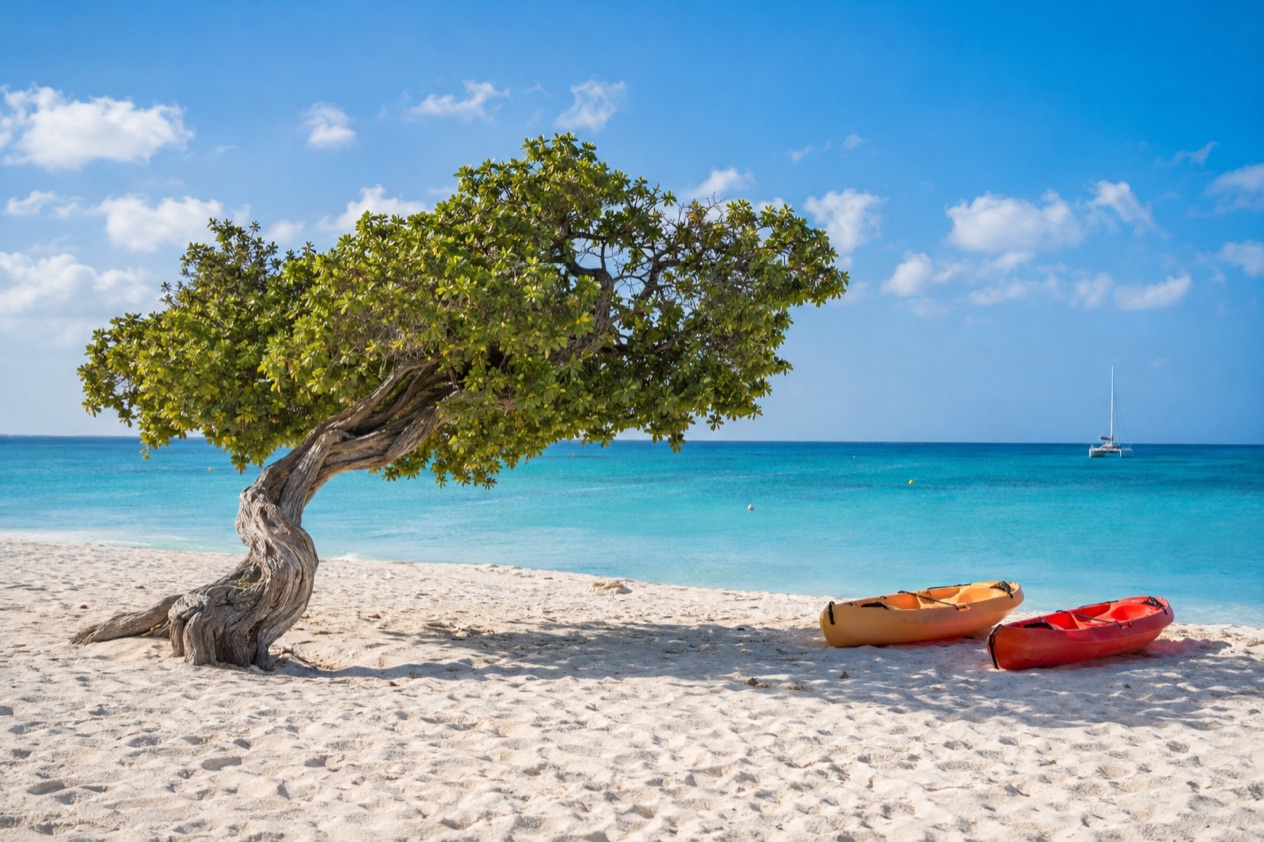
Late in the afternoon on Eagle Beach, the fofoti trees lean in one direction, bent by a trade wind that hardly ever rests, and the sky over the water turns pink and then orange. Behind the beach, the island is dry and spiky with cacti, and on the far side it ends in black cliffs and crashing surf. Aruba is a small, flat island with calm resort beaches on one coast and wild country on the other, made for beach lovers, wind sport fans and anyone who likes to spend a day bouncing over rocky tracks.
What are the best things to do in Aruba?
The best things to do in Aruba are the ones that use both faces of the island: a day or two on the sheltered western beaches, a day in the rugged north and east, and evenings spent around sunset, dinner and the casinos. The west and south coasts are calm and protected, while the east and north coasts bring stronger winds, crashing waves and scenic viewpoints. Plan around that contrast and the rest falls into place.
Mornings suit the outdoors, since the sun is already strong and hiking here takes endurance. Midday is for shade, a long lunch, or a boat. Evenings belong to the sea views and to a table somewhere with a plate of fresh fish. Here are the essentials, each one developed in the sections that follow.
- Spend a beach day on Palm Beach or Eagle Beach, where the western coast gives you the island’s classic white sand and warm water.
- Snorkel at Malmok, Boca Catalina, Mangel Halto or Baby Beach, or join a boat trip to the Antilla shipwreck.
- Explore Arikok National Park, with its caves, rock drawings, lava formations and hidden bays.
- Ride the rough north and east coasts on a jeep tour, past the ruins of the Bushiribana gold mill and the Natural Pool.
- Climb up to the California Lighthouse for a 360-degree view of the island.
- Take a sunset sail from Palm Beach, when the sky turns pink, purple and orange.
- Eat local: keshi yena, fresh fish, conch and a warm pastechi from a snack counter.
- Walk the street murals of San Nicolas, an open-air gallery that tells the story of the island’s second city.
Families, couples and solo travelers will each build a different version of the island from these pieces. Wind sport fans can skip most of the list and head straight for the water, since Aruba is one of the most popular spots on earth for windsurfers and kitesurfers. Travelers who prefer to hand over the planning can use the myAruba planner to save favorite places and experiences into a custom itinerary, or look at the itineraries that local experts put together under the name The Aruba Effect.
Sights and landmarks in Aruba
Aruba’s sights are compact and varied: a white lighthouse at the northwest tip, a pastel Dutch-colonial capital, ruins of a gold mill battered by the sea, and boulders that rise out of a flat landscape for no obvious reason. History here runs from the Amerindian people who lived on the island long before the Europeans to the Dutch era and the gold rush of the nineteenth century. Most of it can be visited in half-day outings between beach days.
California Lighthouse
The California Lighthouse is a famous landmark offering 360-degree views of Aruba, standing in the area known as Hudishibana near the island’s northwestern tip. The address is L.G. Smith Blvd, Noord. From the base you look back over the low, scrubby land and the surf breaking on the rocks below.
Arashi Beach lies just beyond Malmok on the road to the lighthouse, so the two fit naturally into one outing. Late afternoon is a good moment, when the light softens on the cacti and the hotel towers of Palm Beach glow in the distance. The surrounding terrain is open and windy, so a hat that stays on your head is a sensible companion.
Oranjestad: the fort and the museum
The capital is a harbor town of Dutch-style facades painted in candy colors, and its oldest stone building is Fort Zoutman. It is named after Dutch Rear Admiral Johan Arnold Zoutman, who never set foot on Aruba but defeated the English in the North Sea. The fort and its tower are a quick lesson in the island’s colonial past, with the cruise ships and the marina as a backdrop.
The Archaeological Museum is in downtown Oranjestad inside a restored townhouse. It preserves Aruba’s Amerindian heritage from 2500 BC to 1880 AD, so it is the place to put names and objects to the people who left drawings on the rocks. Pair it with a slow walk through the streets around it, ending at a café.
San Nicolas and its murals
San Nicolas is the island’s second largest city, in the south, and these days it is known as the street art capital of Aruba. Large murals cover walls along its main streets, painted by artists from the island and abroad, and the neighborhood has the easygoing feel of a place that lives for its own residents rather than for the resort crowd. Baby Beach and Boca Grandi are close by.
The mural tour starts at the ArtisA (Art is Aruba) gallery. Walking is the point here, with a guide to explain the stories behind the paintings and the history of the town.
| Tour | Departures | Meeting point |
|---|---|---|
| San Nicolas mural tour | Every day at 9:00 AM, 11:30 AM, 2 PM and 4 PM | ArtisA (Art is Aruba) gallery |
Bushiribana and the fallen Natural Bridge
On the northern coast stand the stone walls of the Bushiribana gold mill, a ruin from the island’s gold-mining days. The ruin looks like a small fortress facing the sea, and its dark masonry contrasts with the pale limestone and the blue water.
Natural bridges on this coast were formed by thousands of years of pounding waves and strong winds chiseling away at limestone cliffs. In 2005, the largest and best known of them, the Natural Bridge, collapsed, and the news was a shock to locals and guests alike.
What remains is the dramatic shoreline, and the smaller arches nearby show how the sea slowly does its work. Andicuri Beach lies on this windward coast, just south of the collapsed bridge.
Rocks, a hill and a chapel
In the middle of the island, Hooiberg rises from the flat plain, and it is easy to spot from almost anywhere. Its name means haystack in Dutch, which suits its rounded shape. Casibari’s boulders sit in a residential area just off the main road to Santa Cruz, near Oranjestad, and look like giant stones dropped by hand in the scrub.
The Ayo Rock Formation is a site of large tonalite boulders, and Arawak drawings and carvings can be seen at Ayo and in the Fontein cave in Arikok National Park. The small chapel at Alto Vista is particularly revered during the annual pilgrimage held on January 18th, known as the Feast of Santa Filomena. Even on an ordinary day its white walls and quiet setting make it a peaceful stop.
Beaches and outdoor things to do in Aruba
Aruba has more than 20 public beaches and coves, and every one of them is public, which means no hotel owns a stretch of sand. The ocean is warm year-round. The west and south coasts are calm and protected, perfect for swimming and snorkeling, while the east and north coasts have stronger winds and crashing waves, and are for looking rather than lounging.
Palm Beach and Eagle Beach
Palm Beach is a two-mile-long strip lined with resorts, beach bars and water sports kiosks, and this is where the island’s sailing boats and catamarans moor. It has the most going on, with music drifting from the bars at dusk and boats heading out to sea.
Eagle Beach, further south, is wider and quieter, with the fofoti trees bent by the wind and several low-rise hotels nearby or just across the road. It is the place for long walks along the waterline and for watching the sun drop into the sea. Between the two, the western coast offers plenty of room for a relaxed beach day.
Snorkeling and diving
The clear water allows snorkelers and scuba divers to explore vibrant reefs and wrecks. Some of the best beaches for snorkeling in Aruba are Malmok Beach, Boca Catalina, Mangel Halto and Baby Beach.
Baby Beach is in the south, close to San Nicolas, and Rodger’s Beach is about a minute’s drive away. On weekdays Boca Catalina’s bay can be all to yourself, while weekends bring a fun mix of local families and island guests.
For divers, there are several shipwrecks, the Spanish Lagoon and the Barcadera Reef. The area around Malmok has reefs and sunken wrecks nearby that afford excellent diving. The best known wreck is the Antilla, a WWII shipwreck that popular snorkel tours stop at.
Arikok National Park and the Natural Pool
Arikok National Park holds beaches, deserts, cacti and limestone cliffs. It also includes caves, Indian rock drawings, lava formations, quartz diorite and secluded bays such as Moro, Boca Prins and Dos Playa. Visitors need a ticket to enter, and the small entrance fee supports preservation, educational programs and the animals.
Inside the park, on the northeast coast, the Natural Pool is a tranquil pool formed by volcanic stone circling a small depression on a deserted stretch of coastline. Locals know it as Conchi or Cura di Tortuga. The site is inaccessible by regular car, because the rough, rocky terrain calls for a 4×4 vehicle, which is why many visitors reach it with a tour.
Hiking
Trails wind alongside cliffs, blue seas, natural pools and cacti. Hiking in Aruba can get hot and requires endurance, so hikers should pack plenty of water and SPF. The scenery changes quickly, from dusty scrub to a coast where waves hit the rocks. One guided option runs through Rooi Tambu to Dos Playa, a route that ends at one of the park’s secluded bays.
| Hike | Distance | Guided fee | Group size |
|---|---|---|---|
| Rooi Tambu & Dos Playa | 4.6 miles (7.5 km) | $25 | Maximum of 10 people |
Windsurfing and kiteboarding
Constant trade winds of 15 knots make Aruba one of the most popular spots on earth for windsurfers and kitesurfers. The island offers flat-water locations and challenging wave conditions, so the same wind that shapes the fofoti trees gives riders a choice of settings. Kiteboarding in Aruba requires skill and strength, and spectators can enjoy the colorful sails against the sky from the beach without ever getting wet.
Island tours and excursions in Aruba
The tours that show Aruba best go to places a rental car cannot easily reach, or put you on the water at the right hour. Several take most of a day, and combine scenery, snacks, a swim stop and local commentary. The guides are local experts, which makes a difference when the subject is geology, folklore or the history of a ruin.
Jeep and bus tours of the wild side
Jeep tour adventures involve groups of 10 or more 4×4 vehicles, including Jeeps and Land Rovers, and they head for the rough northeast and east coasts, where regular cars do not go. Expect rocky tracks, dust, pounding surf and viewpoints over the cliffs. The trip typically passes landmarks such as the Natural Pool, Bushiribana and the shore near the fallen Natural Bridge.
Bus tours are the alternative for those who prefer comfort, with air-conditioned vehicles. Both jeep and bus tours are guided by local experts. Travelers who do not like to be bounced around will find the bus a calmer way to hear the stories, while the jeep is for anyone who wants the full dusty adventure.
Sailing cruises from Palm Beach
Palm Beach harbors over a dozen catamarans and sailboats offering cruises. The types are varied: snorkel cruises, sunset sails, booze cruises and dinner cruises. A snorkel cruise gets you out to reefs and to the Antilla wreck, and a dinner cruise adds a table on deck.
The sunset sail is the classic, with the sun setting while the sky turns pink, purple and orange. Choose a snorkel trip for the daytime sea and a sunset sail for couples, friends and anyone who simply wants to watch the horizon from the water.
Underwater tours for non-swimmers
Underwater tours in Aruba are offered by semi-submarine, real submarine or sea trek. Non-swimmers can enjoy them through any of these, since the vessel or the helmet keeps you dry or breathing while you look at fish and wrecks. A semi-submarine has a hull partly below the surface with windows, a real submarine goes deeper, and the sea trek lets you walk on the seabed.
They suit travelers who love the sea but not the idea of a mask and snorkel, and they are an option for a mixed group in which some members swim and others do not.
Renaissance Island and De Palm Island
Aruba has two private islands, Renaissance Island and De Palm Island. Both are easily accessible by boat and can be enjoyed by purchasing day-passes. Complimentary water taxis to Renaissance Island leave every 15 minutes, which turns the crossing into part of the fun.
Each island has its own character, with sand, beach furniture and a view back toward the main island. They suit travelers who want a day of sun and water in a self-contained setting rather than a drive across Aruba.
Smaller stops around the island
- The Donkey Sanctuary in Bringamosa, a home for the island’s donkeys and a favorite with animal lovers.
- The ostrich farm, whose lodge has panoramic views of the island’s northern coast.
- The aloe factory and museum at Pitastraat 115 in Oranjestad, a look at the plant that grows across the dry landscape.
- Savaneta, a fishing village on the southwestern coast, about a 20-minute drive from Oranjestad.
- Boca Grandi Beach, a 5-minute drive from downtown San Nicolas, on the wild side of the island.
What to eat in Aruba
Aruba’s home-cooked food is influenced by Amerindians, European colonial settlers, African slaves, merchants, and Eastern and Asian immigrants, which is why a single table can hold Dutch cheese, Caribbean spices and Indonesian flavors. The first people on the island, the Caquetio natives from South America, ate freshly caught fish and conch, and both are still on today’s menus.
Local dishes to look for
Keshi yena is the signature dish, a hollowed wheel of Dutch cheese stuffed with spiced meat or chicken, then baked until the cheese melts. It is a good symbol of the island’s mixed heritage. Pastechi are fried turnovers filled with cheese, meat or fish, eaten at breakfast or as a snack, and they are the quick bite of the island.
Look also for funchi, a cornmeal side dish that comes with stews and fish, and for pan bati, a thin, griddled pancake bread. Stoba is a slow-cooked stew, and sopi di pisca is a fish soup. Conch may come in a stew or fried. Fresh fish from local waters, grilled or in a Creole sauce, is on almost every menu near the sea.
Drinks
Balashi is the local beer, a light lager that suits the heat. Rum cocktails are served on beaches and at sunset, and the Aruba Ariba, a fruity mix with rum and liqueurs, is the usual souvenir drink. The Blue Bar at Renaissance Marina Hotel serves a signature Blue Martini.
A bright-blue liqueur appears in many drinks around the island. Coffee and a pastry to start the day are easy to find near Oranjestad and Palm Beach.
Restaurants and the island’s food calendar
Aruba’s dining options are diverse, including traditional Dutch, Asian, African and Spanish cuisines. There are over 250 eateries on the island, and the scene features cuisine inspired by over 90 unique nationalities. That range means you can eat Indonesian rice dishes one night, Argentine grill the next and a Caribbean fish plate the day after.
Every year in October, the culinary event Autentico is held to sample Aruba’s fusion of flavors and authentic food. It is a chance to try dishes from the island’s home kitchens.
Things to do in Aruba at night
Evenings in Aruba start with the sunset and move to the table, then, for those who want it, to a bar, a casino or a dance floor. The pace is relaxed and the island is more about warm air and music than a hard-driving club scene. The legal drinking age is 18, and a valid ID might be required when purchasing alcoholic beverages.
Sunset and dinner by the sea
The best first act is the sun going down. From Eagle Beach, with the fofoti trees silhouetted, or from the deck of a sunset sail, the sky turns pink, purple and orange. Beach restaurants along the western coast set tables on the sand, and a dinner cruise puts a meal on the water.
After dark, Palm Beach and Oranjestad’s waterfront are the places to stroll. Restaurants and bars keep their lights on, and the sound of live bands drifts along the street. The air stays warm, so a walk after dinner needs no jacket.
Casinos
Aruba has twelve casinos and is often called the Las Vegas of the Caribbean. It is also the originator and home of Caribbean stud poker. Most of them sit in the big resort hotels, so after a dinner you can walk to a table, a row of slot machines or just watch the action over a drink. They suit travelers who like a few hours of games in air-conditioned rooms, and they are a rainy-evening or late-night option for a group with different tastes.
Bars and nightclubs
Gusto Night Club Aruba is considered one of the best bars on the island, and it is where the dancing happens after the restaurants close. The Blue Bar at Renaissance Marina Hotel is a quieter spot for a cocktail beside the harbor, with its signature Blue Martini.
For something lighter, beach bars on Palm Beach serve rum drinks with the sound of waves in the background. Booze cruises, one of the types of sailing excursion from Palm Beach, mix music, drinks and the sea.
Quieter evenings
Not every night needs a party. A long dinner of keshi yena or grilled fish, followed by a walk on the sand, is a fine way to end the day. Eagle Beach, with its wide stretch and the hotels set across the road, suits a slow stroll.
Oranjestad’s harbor area, with the colored facades lit up, is pleasant for photographs and window shopping. Aruba is called the shopping paradise of the Caribbean, with prices 10%-35% lower than in the United States and a wider selection of international brand-name products than anywhere else in the Caribbean or South America.
Things to do in Aruba with kids
Children in Aruba spend their days with animals, boats and sand, and the island has enough variety to keep them busy beyond the beach. The ‘Happy Kids, Happy Vacation’ itinerary, created by Jennifer Richardson, is designed for families and promises that your entire family will make memories that last a lifetime. It is a good model for a day: a morning with animals, a break at midday, water in the afternoon.
Butterfly Farm and morning outings
The Butterfly Farm is in the Palm Beach area, just across from the Aruba Divi Phoenix. Families can have fun there in the morning, walking among butterflies in a garden setting. Children get close to wings and colors, and the visit is a calm start to the day.
A nice breakfast at Salt & Pepper is recommended for the morning, so it makes sense to start with pancakes or eggs before heading out. The morning is the right slot for these stops, before the heat of the day builds.
Animals around the island
The Donkey Sanctuary in Bringamosa is a place where children can see the island’s donkeys up close. The ostrich farm, with its lodge and panoramic views of the northern coast, adds big birds to the list.
Both outings combine well with a drive across the island, so they work as a half-day on a tour or with your own plans. Children who love animals will find these stops more memorable than another hour on the beach.
On and under the water
A semi-submarine or real submarine lets children see fish and wrecks without getting wet, and non-swimmers can enjoy underwater tours this way. Snorkeling suits children who like to swim, and the west and south coasts are calm and protected.
The private islands add another day. Renaissance Island is reached by free water taxi every 15 minutes, and the crossing is itself an adventure for small travelers. De Palm Island is the other option, also reached by boat with a day-pass.
Keeping children comfortable
Aruba is hot and sunny, and the trade wind can make it feel cooler than it is, so sunscreen, hats and water matter. Hikers should pack plenty of water and SPF, and families should keep that in mind for any outing, from a short beach walk to a jeep ride.
The north and east coasts have crashing waves, so keep children on the rocks and viewpoints rather than at the water’s edge there. Plan the busiest outings for the morning and leave the middle of the day for rest and shade.
Good to know before you go
The U.S. State Department rates Aruba Level 1, ‘Exercise normal precautions,’ and says Aruba is generally a safe destination for travelers, with petty crime the main concern in popular tourist areas.
Aruba is a small island, so moving between the resort strip, Oranjestad and the wild side is a matter of short trips. The natural pool and the rough coasts need a 4×4, which is why many visitors go by guided jeep. Beaches are public, so you can set your towel down almost anywhere.
Arikok National Park requires a ticket, and a small fee supports the park. For planning, the myAruba planner lets you save places and activities to a custom itinerary, and The Aruba Effect offers custom itineraries from local experts.
Sources
- Aruba Tourism Authority, Beaches and coves (https://www.aruba.com/us/things-to-do/beaches-and-coves), checked October 9, 2026
- Aruba Tourism Authority, Natural wonders (https://www.aruba.com/us/things-to-do/natural-wonders), checked October 9, 2026
- Aruba Tourism Authority, Itineraries (https://www.aruba.com/us/things-to-do/itineraries), checked October 9, 2026
- Aruba Tourism Authority, On the water (https://www.aruba.com/us/things-to-do/on-the-water), checked October 9, 2026
- Aruba Tourism Authority, Scuba and snorkel (https://www.aruba.com/us/things-to-do/on-the-water/scuba-snorkel), checked October 9, 2026
- Aruba Tourism Authority, Sailing (https://www.aruba.com/us/things-to-do/on-the-water/sailing), checked October 9, 2026
- Aruba Tourism Authority, Kite and windsurfing (https://www.aruba.com/us/things-to-do/on-the-water/kite-windsurfing), checked October 9, 2026
- Aruba Tourism Authority, Hiking in Aruba (https://www.aruba.com/us/things-to-do/sports-and-golf/hiking-in-aruba-explore-the-best-hiking-trails), checked October 9, 2026
- Aruba Tourism Authority, Happy kids (https://www.aruba.com/us/things-to-do/happy-kids-happy-vacation), checked October 9, 2026
- Aruba Tourism Authority, Local Aruba cuisine (https://www.aruba.com/us/things-to-do/dining/local-aruba-cuisine), checked October 9, 2026
- Aruba Tourism Authority, Dining (https://www.aruba.com/us/things-to-do/dining), checked October 9, 2026
- Aruba Tourism Authority, Bars and lounges (https://www.aruba.com/us/things-to-do/nightlife/bar-lounge), checked October 9, 2026
- Aruba Tourism Authority, Casinos (https://www.aruba.com/us/things-to-do/nightlife/casinos), checked October 9, 2026
- Aruba Tourism Authority, Shopping (https://www.aruba.com/us/things-to-do/shopping), checked October 9, 2026
- Aruba Tourism Authority, Museums (https://www.aruba.com/us/things-to-do/arts-and-culture/museums), checked October 9, 2026
- Aruba Tourism Authority, Arikok National Park (https://www.aruba.com/us/explore/arikok-national-park), checked October 9, 2026
- Aruba Tourism Authority, Natural Pool (Conchi) (https://www.aruba.com/us/explore/natural-pool), checked October 9, 2026
- Aruba Tourism Authority, California Lighthouse (https://www.aruba.com/us/explore/california-lighthouse), checked October 9, 2026
- Aruba Tourism Authority, Bus and jeep tours (https://www.aruba.com/us/explore/bus-and-jeep-tours), checked October 9, 2026
- Aruba Conservation Foundation (ACF), experiences (https://acf.aw/experiences), checked October 9, 2026
- Aruba Tourism Authority, Underwater tours (https://www.aruba.com/us/things-to-do/on-the-water/underwater-tours), checked October 9, 2026
- Aruba Tourism Authority, Private islands (https://www.aruba.com/us/things-to-do/on-the-water/private-islands), checked October 9, 2026
- Aruba Tourism Authority, Aruba mural tours (San Nicolas) (https://www.aruba.com/us/explore/aruba-mural-tours), checked October 9, 2026
- Aruba Tourism Authority, Passports and visas (https://www.aruba.com/us/plan-your-visit/getting-to-aruba/passports-and-visas), checked October 9, 2026
- Aruba Tourism Authority, Baby Beach (https://www.aruba.com/us/explore/baby-beach), checked October 9, 2026
- Aruba Tourism Authority, Rodgers Beach (https://www.aruba.com/us/explore/rodgers-beach), checked October 9, 2026
- Aruba Tourism Authority, Bushiribana Gold Mill Ruins (https://www.aruba.com/us/explore/bushiribana-gold-mill-ruins), checked October 9, 2026
- Aruba Tourism Authority, Historic Gold Mines (https://www.aruba.com/us/explore/historic-gold-mines), checked October 9, 2026
- Aruba Tourism Authority, Natural Bridges (https://www.aruba.com/us/explore/natural-bridges), checked October 9, 2026
- Aruba Tourism Authority, Hooiberg (https://www.aruba.com/us/explore/hooiberg), checked October 9, 2026
- Aruba Tourism Authority, Casibari Rock Formations (https://www.aruba.com/us/explore/casibari-rock-formations), checked October 9, 2026
- Aruba Tourism Authority, Ayo Rock Formation trail (https://www.aruba.com/us/ayo-rock-formation-trail), checked October 9, 2026
- Aruba Tourism Authority, Alto Vista Chapel (https://www.aruba.com/us/explore/alto-vista-chapel), checked October 9, 2026
- Aruba Tourism Authority, Donkey Sanctuary (https://www.aruba.com/us/explore/donkey-sanctuary), checked October 9, 2026
- Aruba Tourism Authority, Aruba Ostrich Farm (https://www.aruba.com/us/explore/aruba-ostrich-farm), checked October 9, 2026
- Aruba Tourism Authority, Aruba Aloe museum and factory (https://www.aruba.com/us/explore/aruba-aloe-museum-and-factory), checked October 9, 2026
- Aruba Tourism Authority, Butterfly Farm (https://www.aruba.com/us/explore/butterfly-farm), checked October 9, 2026
- Aruba Tourism Authority, Arashi Beach (https://www.aruba.com/us/explore/arashi-beach), checked October 9, 2026
- Aruba Tourism Authority, Malmok Beach (https://www.aruba.com/us/explore/malmok-beach), checked October 9, 2026
- Aruba Tourism Authority, Boca Catalina (https://www.aruba.com/us/explore/boca-catalina), checked October 9, 2026
- Aruba Tourism Authority, Savaneta region (https://www.aruba.com/us/our-island/regions/savaneta), checked October 9, 2026
- Aruba Tourism Authority, Boca Grandi (https://www.aruba.com/us/explore/boca-grandi), checked October 9, 2026
- Aruba Tourism Authority, Andicuri Beach (https://www.aruba.com/us/explore/andicuri-beach), checked October 9, 2026
- Aruba Tourism Authority, Boca Prins (https://www.aruba.com/us/explore/boca-prins), checked October 9, 2026
- Wikipedia, San Nicolaas, Aruba (https://en.wikipedia.org/wiki/San_Nicolaas,_Aruba), checked October 9, 2026
- Aruba Tourism Authority, Fort Zoutman Historical Museum (https://www.aruba.com/us/explore/fort-zoutman-historical-museum), checked October 9, 2026
- Aruba Tourism Authority, Eagle Beach (https://www.aruba.com/us/explore/eagle-beach), checked October 9, 2026
- Aruba Tourism Authority, Palm Beach (https://www.aruba.com/us/explore/palm-beach), checked October 9, 2026
- Aruba Tourism Authority, Renaissance Island (https://www.aruba.com/us/explore/renaissance-island), checked October 9, 2026
- U.S. Department of State, Aruba Travel Advisory, Level 1, issued August 19, 2026 (https://travel.state.gov/content/tsg_aem/us/en/home/international-travel/travel-advisories/destination.abw.html), checked October 9, 2026
To plan your stay
- Best Time to Visit Aruba: Weather by Month, Peak Season and Festivals
- Where to Stay in Aruba: Palm Beach, Eagle Beach, Oranjestad and All-Inclusives
- Aruba Airport (AUA): Arrival, Getting to Your Hotel, U.S. Preclearance and Departure
- Know Before You Go to Aruba: Entry Forms, Money, Water and Local Customs