
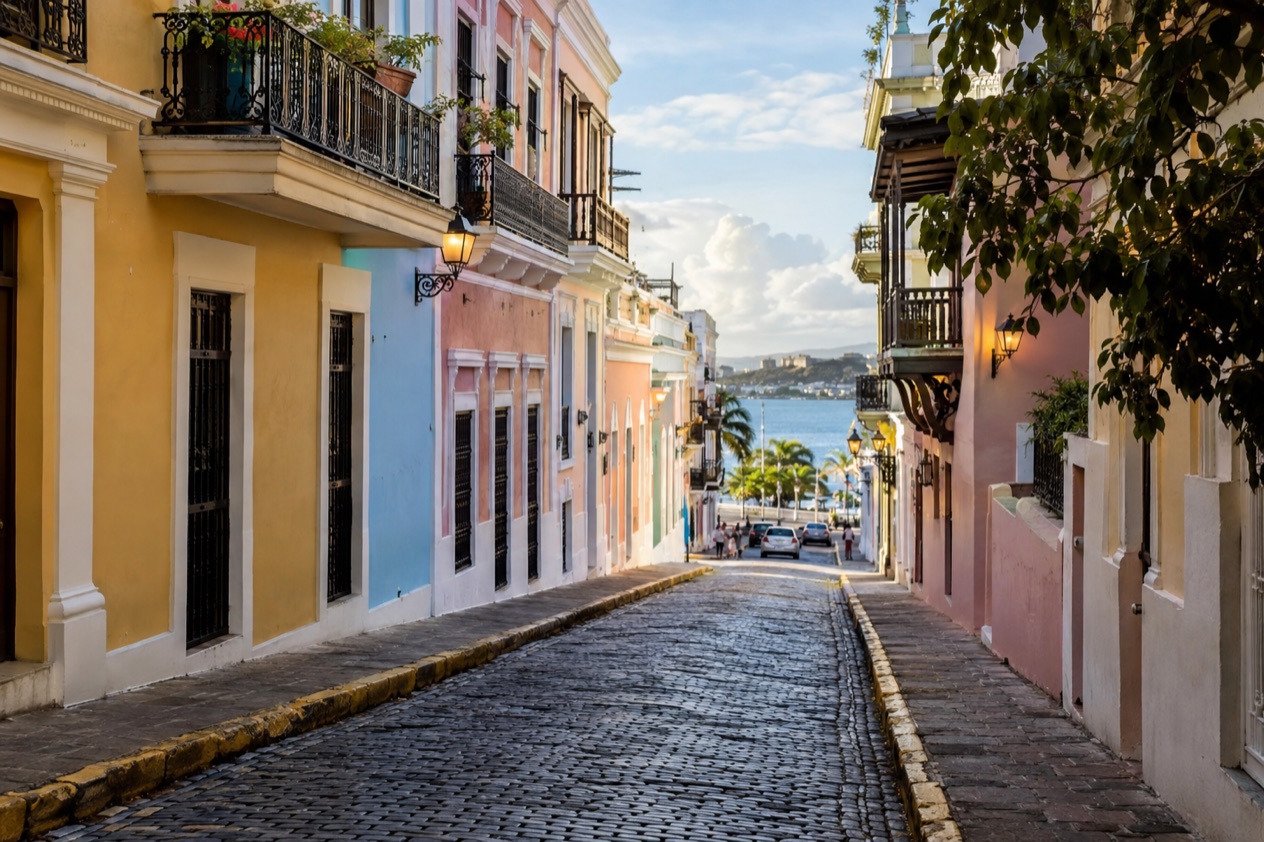
At dusk in Old San Juan, the blue-gray cobblestones hold the last of the heat, pastel townhouses turn amber, and the sound of a plena drum drifts out of a doorway near a plaza. Kites hang over the grassy field in front of El Morro while couples walk the old walls toward the bay. San Juan is a capital that works as a city break and a beach vacation at once, for travelers who like to wander, eat well and swim before dinner.
Where is San Juan and what is it like?
San Juan sits on the north coast of Puerto Rico, facing the Atlantic, and it is the island’s capital and its busiest gateway. The city is really several places in one: a walled colonial town on a small islet, two beach-and-hotel strips, an arts and food district, and a long run of residential neighborhoods behind them.
Old San Juan is the part people picture. It is linked to the mainland by causeways and bridges, and its narrow streets are paved in blue-gray cobblestones, lined with flat-roofed brick and stone buildings from the 16th and 17th centuries, and painted in every pastel you can name.
Two Spanish forts, El Morro and San Cristobal, guard the headland, and much of the old wall still stands. The forts and walls are part of a UNESCO World Heritage Site, and you feel that age as you walk the lanes between plazas, churches and balconies draped in plants.
Beyond the old city the mood changes. Condado is a polished beachfront district of hotels, restaurants and shops, with Ashford Avenue as its main street. Isla Verde, closer to the airport, is more of a resort strip with casinos, big hotels and a long beach. Santurce, around Calle Loiza, is where the murals, galleries, music bars and a lot of the city’s best eating live.
The pace is warm and unhurried in the old town and louder along the beach strips, with Spanish and English heard everywhere. San Juan suits travelers who want culture, food and a swim in one trip, and who are happy with a city that has traffic and urban edges. If you want a quiet, empty beach with nothing around, this is a base for day trips rather than the destination itself.
The city beaches face the Atlantic and get steady surf, so conditions change from day to day and from beach to beach. Where a flag, a sign or a lifeguard is present, follow it. Many visitors head to the Balneario de Escambron, a public beach park just outside Old San Juan, known for calmer water inside a reef.
What is there to do in San Juan?
San Juan gives you history, beaches, food and nightlife within a few miles of each other, which is what sets it apart from the quieter towns and islands around Puerto Rico. Most visitors blend all four.
Old San Juan and its forts
Castillo San Felipe del Morro is the main attraction of the old city, a Spanish fort on the point with wide lawns, thick walls and views over the Atlantic and the harbor entrance. San Cristobal, the second fort, sprawls across the eastern side with tunnels, outworks and long angled walls. Together they make up the San Juan National Historic Site.
Between forts, wander at street level. Walk the Paseo de la Princesa along the southern wall for views of the bay, pass through Puerta de San Juan, the only surviving city gate, and step into San Jose Church, reopened in 2021 after years of renovation.
Go early in the morning or late in the afternoon when the stone is cooler and the light turns gold. Just outside the wall, La Perla is a colorful neighborhood that draws curious visitors.
| Site | Admission |
|---|---|
| San Juan National Historic Site (El Morro and San Cristobal) | Standard pass valid for 24 hours, covers both forts; free under age 16; card payment only |
Beaches and the waterfront
Condado and Isla Verde are the two main beach strips, both on the Atlantic, with hotels right on the sand, beach bars and water sports. Escambron is the local favorite for families and for those who want a park setting, with picnic spots and a reef offshore.
Plan a swim around the day’s conditions rather than the guidebook. Surf can be steady, and the beach you chose yesterday may feel different today, so look at the water before you go in.
Eating your way through the city
Puerto Rican cooking is the real reason many people come back. Start with mofongo, mashed fried plantain often served with garlic, broth and meat or seafood, then try pasteles, tostones and lechon asado, the roast pork that anchors holiday tables. For something sweet there are piraguas, shaved ice with fruit syrup sold from carts, and tembleque, a wobbly coconut pudding.
Pinones, east of the airport, is a stretch of beachside kiosks selling alcapurrias and bacalaitos, fritters of taro and plantain or of salt cod, eaten with your fingers and a cold drink. Casual roadside restaurants called chinchorros and cafes around Santurce and Old San Juan fill in the rest. Santurce, around Calle Loiza, is the place for a long evening of food, murals and music.
How many days do you need in San Juan?
A long weekend covers the essentials, and a week lets you use San Juan as a base for the rest of the island. The city rewards slow days more than packed ones, so it helps to leave room for a long lunch.
With two or three days, give one full day to Old San Juan: a morning at El Morro, lunch in a plaza, an afternoon on the walls and in San Cristobal, and a sunset stroll along the bay. Spend the second on the beach in Condado or Isla Verde, then eat in Santurce in the evening. A third day can go to Pinones for fritters, a visit to Escambron, or simply more wandering in the old town.
With four or five days you can slow down and add the city’s less obvious corners: gallery hopping in Santurce or an evening without a plan in a plaza where locals gather. It is also enough to fit in a day trip or two outside the capital, such as El Yunque rain forest to the east.
A week lets you split the trip. Take the public ferry from Ceiba to Culebra or Vieques.
Where to stay in San Juan
Your choice of area shapes the whole stay, because each part of San Juan has its own rhythm. Old San Juan suits travelers who want to walk out the door into cobblestone streets, cafes and plazas. Rooms are in historic buildings, evenings are lively, and the forts and the bay are on foot. The trade-off is that the old city is compact and has no big beach of its own, though Escambron is close.
Condado is the best fit for travelers who want a beach, restaurants and shopping on a single walkable avenue. It is an upscale beachfront district a short ride from the old city, with the Atlantic to the north, and it has long been one of the island’s main tourist destinations. Two bus routes, T21 and D53, serve it.
Isla Verde, in neighboring Carolina, is a resort strip with big hotels, casinos, restaurants and a long beach, right beside the airport. It suits families, short stays and anyone who wants a classic beach vacation with an easy arrival and departure. It is a few miles east of Condado and Old San Juan, so you will use a ride for trips into the old city.
Santurce is for travelers who care more about food, art and nightlife than a hotel on the sand. Staying around Calle Loiza puts you near the murals, bars and restaurants, and beaches are a short ride away. If you only have a few nights, many visitors split them: one or two in the old city for atmosphere, the rest on the beach strip.
How do you get to San Juan and get around?
Most visitors arrive by air at Luis Munoz Marin International Airport, the island’s main airport, located in Isla Verde. Because Puerto Rico is a U.S. territory, flights from the mainland are domestic, and U.S. citizens need no passport and no visa. The airport sits a few miles east of Condado and Old San Juan.
Old San Juan is a place to walk. The streets are narrow and the cobblestones can be uneven, so comfortable shoes matter. The free trolley no longer serves Old San Juan, so get around on foot or by car.
Between neighborhoods you have choices. Condado is served by two Metropolitan Bus Authority routes, T21 and D53, and Condado and Isla Verde are close enough to the old city that many visitors link them by a short ride. The Teodoro Moscoso Bridge connects Isla Verde to Hato Rey, the financial center of the metro area.
If you plan to leave the city for El Yunque, the west coast or the southern towns, a rental car is the usual way to cover ground. For Culebra and Vieques, the public ferries leave from Ceiba, on the east coast. If you stay only in San Juan, you can easily do without a car.
When is the best time to visit San Juan?
The best months are generally December through April, the drier season, when the days are warm and sunny and the trade winds keep the humidity bearable. It is also the busiest stretch, with the long Christmas season running from late November into mid-January and Three Kings Day on January 6.
Events give the calendar its color. The Calle San Sebastian Street Festival fills Old San Juan with music, crafts and crowds in mid to late January. The Noche de San Juan Bautista on June 23 brings the tradition of a midnight dip in the sea. Holy Week moves every year and draws local families to the beaches.
May to November is the wetter season, with heat and humidity at their strongest, and showers that often arrive in the afternoon. The Atlantic hurricane season runs from June 1 to November 30, with most activity between mid-August and mid-October.
If you travel then, follow the National Hurricane Center and local official alerts, since forecasts can change quickly. Summer has its upsides, such as fewer visitors in some weeks and warm sea, but pack for rain and heat.
Good to know before you go
The currency is the U.S. dollar, and Spanish and English are both official, though a few words of Spanish are always appreciated. Puerto Rico uses Atlantic Standard Time and does not observe daylight saving time. Keep ordinary city habits with bags and phones, and bring a card for the forts, which do not accept cash.
On the beach, treat the sea with respect: the Atlantic surf can change from one day to the next, and flags and lifeguards, where they exist, come first. Wear sunscreen and carry water for long walks on the old walls.
Sources
- National Park Service, San Juan National Historic Site, Fees & Passes (https://www.nps.gov/saju/planyourvisit/fees.htm), checked October 8, 2026
- National Park Service, San Juan National Historic Site, Hours & Operating Seasons (https://www.nps.gov/saju/planyourvisit/hours.htm), checked October 8, 2026
- Wikipedia, Old San Juan (https://en.wikipedia.org/wiki/Old_San_Juan), checked October 8, 2026
- Wikipedia, Condado (https://en.wikipedia.org/wiki/Condado,_Puerto_Rico), checked October 8, 2026
- Wikipedia, Isla Verde (https://en.wikipedia.org/wiki/Isla_Verde,_Puerto_Rico), checked October 8, 2026
- NOAA National Hurricane Center, Climatology (https://www.nhc.noaa.gov/climo/), checked October 8, 2026
All our pages
When to go
- Best Time to Visit San Juan: Weather, Beaches, Festivals and Hurricane Season
- San Juan in January: Weather, Calle San Sebastian Festival and What to Do
- San Juan in February: Weather, Beaches, Old San Juan and a Two-Day Plan
- San Juan in March: Weather, Beaches, Old San Juan and a Two-Day Plan
- San Juan in April: Weather, Beaches, Old San Juan and a Two-Day Plan
- San Juan in May: Weather, Beaches, Street Food and a Two-Day Plan
- San Juan in June: Weather, Beaches, Old San Juan and a Two-Day Plan
- San Juan in July: Weather, Beaches, Old San Juan and Where to Eat
- San Juan in October: Weather, Beaches, Old San Juan and a Two-Day Plan
- San Juan in November: Weather, Sea Temperature, Old San Juan and Holiday Season Mood
- San Juan in December: Weather, Beaches, Christmas Season and What to Do
Things to do
- Things to Do in San Juan: Old San Juan Forts, City Beaches, Street Food and Nights Out
- Day Trips from San Juan: El Yunque, Bioluminescent Bays, Ponce and Island Ferries
- 3 Days in San Juan: Old San Juan, Santurce, Beaches and Where to Stay
- Condado, San Juan: Beach, Ashford Avenue, Where to Eat and Where to Stay
- Isla Verde, San Juan: Beach, Food, Hotels and Getting Around
- Santurce, San Juan: Calle Loiza, Art Museums, Street Food and Where to Stay