
Late in the afternoon, the wind comes off the Atlantic and snaps at the flags above El Morro while kids run kites across the wide green lawn below the fort. Down in the streets, the blue-gray cobblestones hold the last of the heat, and the balconies of pastel townhouses fill with people watching the evening start. Old San Juan is a walled colonial city on a small islet, made for wandering on foot, eating well and lingering over a coffee in a plaza.
Where is Old San Juan and what is it like?
Old San Juan sits on a small, narrow islet along the north coast of Puerto Rico, tied to the rest of the capital by bridges and causeways, with the Atlantic on one side and San Juan Bay on the other. Condado, Santurce and Isla Verde lie just across the water, and the airport is a short ride beyond them. It is the historic heart of the city, and the whole district is compact enough to cross on foot.
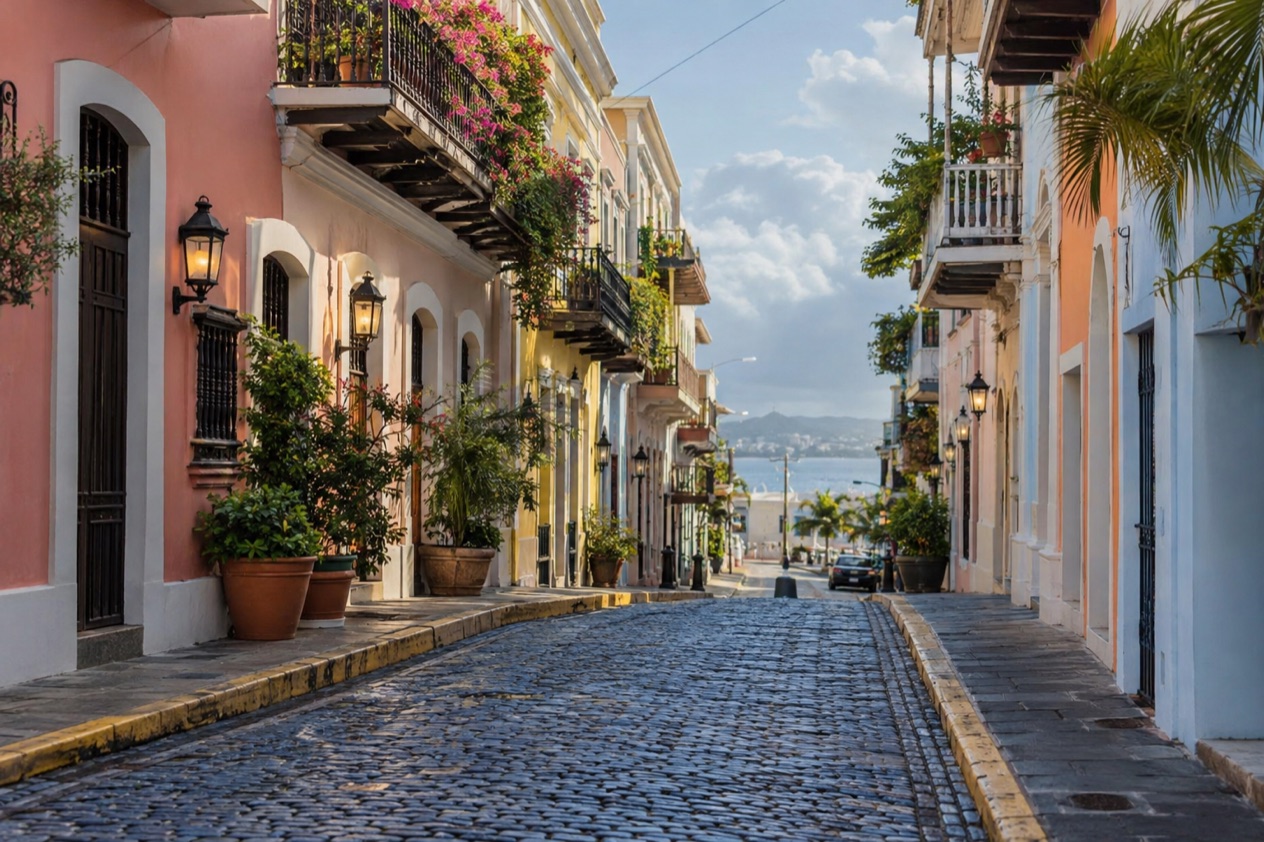
The character comes from the streets. They are narrow and paved in blue-gray cobblestones, lined with flat-roofed brick and stone buildings that date to the 16th and 17th centuries, painted in ochre, coral, mint and pink.
About three-quarters of the old city walls still stand, and the only surviving gate is the Puerta de San Juan, once called Puerta de Agua, where ships’ passengers used to step into the city from the bay. Wrought-iron balconies, shaded plazas and pigeons around the fountains give the place a Spanish-colonial look, while salsa drifts from doorways and green plants fill the stoops.
The pace is unhurried but lively. Mornings are quiet, with locals at the bakery counters and shopkeepers rolling up their shutters. By midday the streets fill with visitors and, on cruise days, with large groups moving between the forts and the souvenir shops. Evenings bring the best mood, as restaurants set out tables and live music drifts from bars.
It suits history lovers, food lovers, photographers and anyone who likes a walkable base. It is less suited to travelers who want a long beach day on the doorstep, since the city beaches are a short ride away, or to anyone who dislikes hills and cobblestones, which are hard on high heels and wheeled luggage.
What is there to do in Old San Juan?
The big reasons to come are the forts, the walk along the walls, La Fortaleza, San Juan Bautista Cathedral, the neighborhood of La Perla and Puerto Rican food. Together they separate Old San Juan from the beach strips next door, where the days are about sand and hotel pools. Here the city itself is the attraction.
The forts of the San Juan National Historic Site
Castillo San Felipe del Morro is the main draw, a Spanish fort on the headland with thick ochre walls, ramps, lookout posts and views over the ocean. Castillo San Cristobal, on the other side of town, is a sprawling network of tunnels, bastions and ramparts that guarded the city from land attacks. Both are part of the UNESCO World Heritage listing, which together with the walls has been in place since 1983.
The standard pass is valid for 24 hours and covers both forts, so you can split them across two days. Visitors over 16 need a pass, and the park does not accept cash, so bring a card. Check current opening hours before you go, and bring water and a hat for the exposed lawns.
Walking the walls and the waterfront
Paseo de la Princesa is a promenade along the southern city wall, with views of the stonework and San Juan Bay. It is a favorite for an evening stroll, when families, couples and vendors share the path under old-fashioned lamps. From there you can climb back into town through the Puerta de San Juan and wander toward the plazas.
Along the way you pass San Jose Church, a landmark that reopened for visitors and services in 2021 after years of renovation. Inside you find a quiet, vaulted space that makes a cool break from the sun. Keep going and you reach the lanes lined with galleries, craft shops and small cafes, a good place to spend an unplanned hour.
La Perla and its bomba music
La Perla is a colorful neighborhood tucked between the north wall of the old city and the ocean, and it became known around the world after the Despacito video was filmed there. The bright houses are the result of a 2017 initiative called La Perla pinta su futuro, which repainted hundreds of homes. Notable spots include El Bowl, a cemented bowl used for skateboarding on weekdays and filled with water as a pool on weekends.
It is a residential community, so visit with respect and keep cameras discreet around people’s homes. Community leaders organize a weekly gathering of bomba, the drumming and dancing tradition of Afro-Puerto Rican culture, on the neighborhood’s malecon. Listening to it is among the most memorable things you can do in town.
Eating your way through town
Puerto Rican cooking is built on mofongo (mashed fried plantain), pasteles, lechon asado (roast pork), tostones, alcapurrias, tembleque (coconut pudding) and piraguas, shaved ice with fruit syrup that is perfect on a hot afternoon. In and around the city you find them in cafes, kiosks and casual restaurants called chinchorros. For the beachside fritter kiosks of Pinones, you head east of the airport.
How many days do you need in Old San Juan?
A long weekend is enough to see the main sights of Old San Juan comfortably, and two full days is the minimum that avoids rushing. The old city is small, so the question is how much you want to add around it.
With one day, spend the morning at El Morro, walk down through the plazas and lunch on mofongo, then follow the Paseo de la Princesa at sunset. A second day lets you see San Cristobal, step into La Perla with a local guide or at least along its edge, browse the shops and galleries and linger over dinner. The pass for the forts lasts 24 hours, which fits neatly if you visit one in the afternoon and one the next morning.
With three or four days, you can balance the old city with the rest of San Juan. Spend a morning at the Balneario de Escambron, a public beach park just outside Old San Juan known for calmer water inside a reef, though conditions change from day to day.
Then explore Santurce, the arts and food district around Calle Loiza, or head to the Condado strip for its beach and restaurants. Fritter lovers can make the trip to Pinones for alcapurrias and bacalaitos.
A week lets you use the capital as a base for day trips across the island, from rainforest to the southern coast or the surf towns of the west. Pair the history of the old city with time on a beach, and you end up with a trip that has both pace and variety.
Where to stay in Old San Juan
Staying inside the walls puts you among the cobblestones, with restaurants, bars and the forts at your door. Mornings are the quietest time, before the day visitors arrive, and evenings are lively, so light sleepers should ask for a room away from the busy plazas. Expect steps, narrow sidewalks and no easy parking, since the district was built for horses, not cars. It suits couples, history lovers and anyone who wants to walk everywhere.
Condado is the closest beach-and-hotel strip, with an easier atmosphere, a sandy shoreline and plenty of restaurants. It works well for travelers who want a pool or ocean day and still want to reach the old city in a short ride. Isla Verde sits nearer the airport and suits families and beach lovers who prefer a classic resort feel.
Santurce is the creative neighborhood, known for street art, bars and a strong food scene around Calle Loiza. It suits younger travelers and food lovers who like a local feel over a postcard one. Whichever area you choose, remember that the old city is a place to wander by foot, so a base within a short ride keeps everything within reach.
If you arrive by cruise ship, you are already at the edge of town. Some cruise piers sit on the San Juan islet, where passengers can walk into Old San Juan.
How do you get to Old San Juan and get around?
Most visitors arrive through Luis Munoz Marin International Airport, which lies roughly 5 to 7 miles from the cruise docks, and continue to the old city by road. The islet is linked to the mainland by three bridges, so the approach is by car, taxi or ride share across the water. Cruise passengers simply step off at the piers and walk in.
Once inside, walking is the way to go. The streets are short, steep in places and full of things to look at, so comfortable shoes matter. The free trolley that once served the district is no longer available, so plan to walk or travel by car. A car is more of a burden than a help here, so many visitors leave it elsewhere and explore on foot.
For crossing the bay, the Catano Ferry makes multiple daily round-trips between San Juan and Catano. From the old city, Condado, Santurce and the beaches are all a short ride away.
| Site | Pass | Who needs it |
|---|---|---|
| El Morro and San Cristobal | Standard pass, valid 24 hours, both forts | Visitors over 16 |
| El Morro and San Cristobal | Free | Children under 16 |
When is the best time to visit Old San Juan?
The most comfortable months are December through April, when the island is in its drier season and the trade winds keep the walled streets pleasant for all-day walking. This is also the busiest stretch, with Christmas lights, Three Kings Day on January 6 and the Calle San Sebastian Street Festival in mid to late January drawing big crowds to the old city.
From May to November it is hotter and wetter, and afternoon showers can cut a walking day short, though the sun often returns. Streets are less crowded, and the city still has plenty to offer, including the Noche de San Juan Bautista on June 23, when locals head to the sea at midnight. Heat is the main challenge, so plan for early starts, shade and long lunches.
The Atlantic hurricane season runs from June 1 to November 30, with its peak around September 10 and most activity between mid-August and mid-October. Travelers in those months should follow the National Hurricane Center and local official alerts. Whatever the month, the forts open to wind and sun, so a hat and water are always worth carrying.
Good to know before you go
U.S. citizens need no passport and no visa to visit Puerto Rico, and the currency is the U.S. dollar. Keep a card handy, since the national park sites do not accept cash.
Wear shoes with grip for the cobblestones, carry water and, as in any busy historic center, keep an eye on your belongings in crowds. Puerto Rico uses Atlantic Standard Time and does not observe daylight saving time, so the clock matches the East Coast in winter and runs an hour ahead of it in summer.
| Pass | Amount | Who pays |
|---|---|---|
| America the Beautiful Annual Pass | $80 | U.S. citizens and residents |
| Senior Pass, annual | $20 | U.S. citizens and residents aged 62 and over |
| Senior Pass, lifetime | $80 | U.S. citizens and residents aged 62 and over |
| San Juan National Historic Site annual pass | $35 | Up to four adults, children 15 and under free |
Sources
- Wikipedia, Old San Juan (https://en.wikipedia.org/wiki/Old_San_Juan), checked October 8, 2026
- National Park Service, San Juan National Historic Site, Fees & Passes (https://www.nps.gov/saju/planyourvisit/fees.htm), checked October 8, 2026
- National Park Service, San Juan National Historic Site, Hours & Operating Seasons (https://www.nps.gov/saju/planyourvisit/hours.htm), checked October 8, 2026
- Wikipedia, La Perla, San Juan (https://en.wikipedia.org/wiki/La_Perla,_San_Juan,_Puerto_Rico), checked October 8, 2026
- Wikipedia, Port of San Juan (https://en.wikipedia.org/wiki/Port_of_San_Juan), checked October 8, 2026
- NOAA National Hurricane Center, Climatology (https://www.nhc.noaa.gov/climo/), checked October 8, 2026