
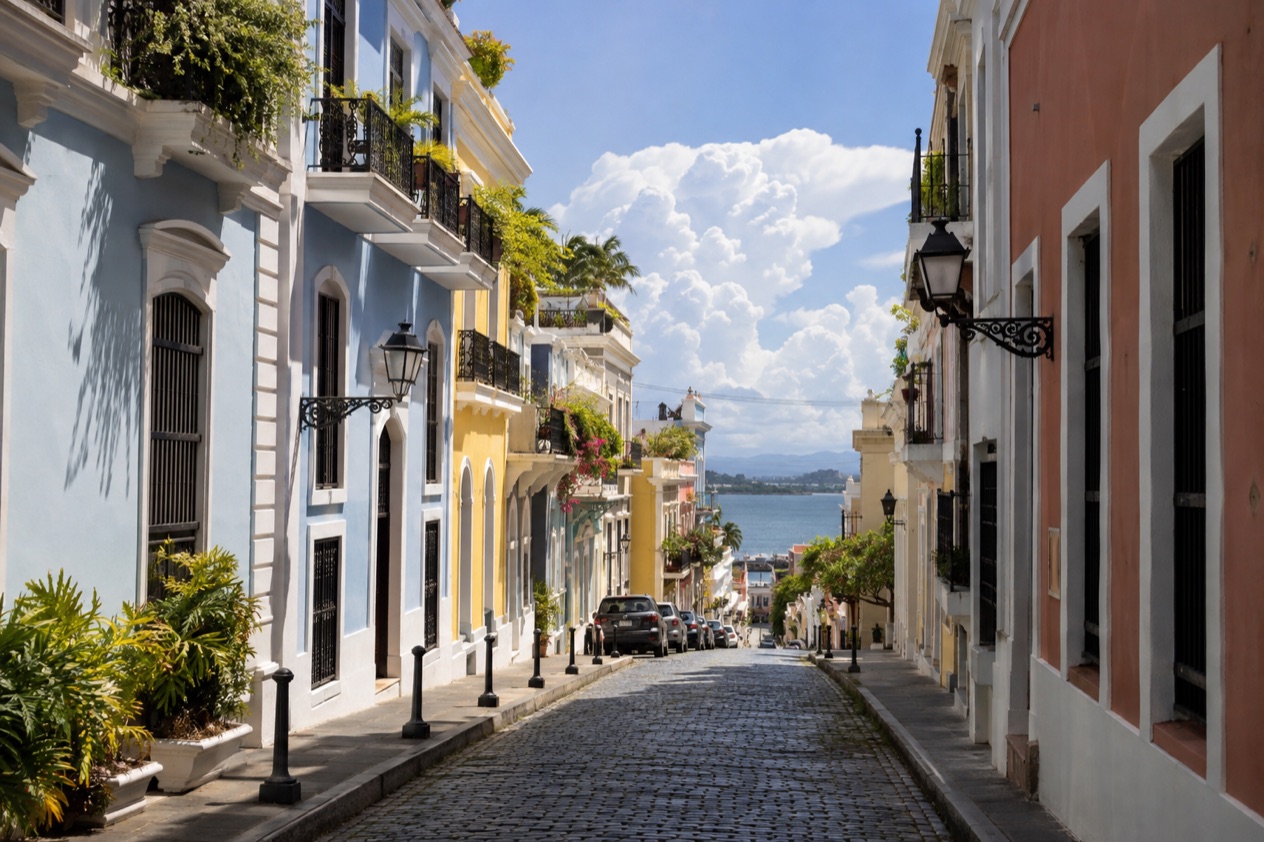
In Old San Juan on a June evening, neighbors crowd onto balconies, the blue-gray cobblestones keep the warmth of the day, and a street vendor somewhere scrapes ice from a block for a cherry piragua. The trade winds slide in off the Atlantic and the walls of El Morro turn gold at sunset. June is the first month of the hurricane season and the start of the island’s summer, a hot, bright, green stretch for beach days, fort walks and long dinners outside.
What is the weather like in San Juan in June?
June in San Juan brings heat and humidity, sunny starts to the day, a handful of brief showers, and water that feels just as warm as the air. What you feel here matches the coast just east of Old San Juan, not the mountains inland. The sea temperatures are daily highs for the waters off the city.
| Month | Average high (°F) | Average low (°F) | Rain days | Sea (°F) |
|---|---|---|---|---|
| May | 87.4 | 75.7 | 8.8 | 83.4 |
| June | 89.0 | 77.2 | 8.0 | 84.8 |
| July | 88.7 | 77.6 | 10.7 | 84.9 |
Mornings are the best hours for anything that involves walking. The sun is already strong by nine, but the breeze off the water keeps the old city bearable until late morning.
By early afternoon the humidity settles in, and that is the time for a museum, a long lunch or a swim. You can dine outdoors in a short-sleeved shirt because evenings remain warm, and mid-month brings long days with slightly more than thirteen hours of light.
Rain usually comes as a short, heavy shower that crosses the city in a quarter of an hour and leaves steam rising off the pavement. Rainy days are fewer than in May, and a day that brings a full inch or more is uncommon. On the island, the greatest rainfall lands on the central mountains and the north coast, which means an overcast afternoon in the city may turn out sunny at the beaches to the south.
Dress in light cotton or linen, wear a hat and sunscreen, and carry a small umbrella or a thin rain jacket in your bag. Sunglasses matter, because the light on white buildings and pale stone is fierce at midday.
Can you swim in San Juan in June?
Yes, the sea is usually warm in the mid-80s and needs no adjusting to, but conditions change from day to day and from one beach to the next. Facing the Atlantic, the city’s beaches receive consistent waves, which means the situation shifts daily and varies from one stretch of sand to another. Summer is usually gentler than winter, but a swell can still arrive, and a rip current can form on any open beach.
Just beyond Old San Juan lies a public beach park known as Balneario de Escambron, where the reef is famous for keeping the sea soft and still. Because of that, families and anyone who likes to ease into the water at their own pace love it, and on a calm morning it is a lovely spot to snorkel. Condado and Isla Verde are the long hotel beaches, with more wave action and plenty of space to walk the sand.
Wherever you go in, look for flags, signs and lifeguards and follow them, and ask at your hotel desk how the water looks that day. Bring a rash guard or a hat for the strong sun, water shoes if you plan to explore rocky edges, and a waterproof pouch for your phone. Surfers tend to look for other coasts in summer, while the city beaches suit swimmers, paddlers and people who simply want to float.
What to do in San Juan in June
The month’s biggest night is the Noche de San Juan Bautista on June 23, the eve of the feast of the city’s patron saint. Tradition says you walk into the sea at midnight and fall backward into the water three times for luck.
Beaches fill with families, music and picnics, and the mood in the city is festive and relaxed. Old San Juan is named for the saint, so the celebration feels especially close to home here.
June also opens the season of long beach days. Locals pack coolers, folding chairs and a speaker, and the sand becomes a social gathering by midday. Join in for an afternoon, then go back to your hotel for a shower before dinner. Mornings belong to sights, and the afternoons to the sea.
The forts and walls of Old San Juan
A UNESCO World Heritage Site designation belongs to the San Juan National Historic Site as well, and two Spanish forts, El Morro and San Cristobal, form its heart. You walk long ramparts, peer into sentry boxes and look out over the Atlantic from lawns where kites fly in the wind. El Morro sits on the tip of the islet, and San Cristobal guards the land side with tunnels and layered defenses.
Go early, before the heat builds on the open stone, and bring water and a hat since there is little shade on the walls. Both forts reward a slow visit, and the breeze at the top of El Morro is the best air conditioning in town. Cruise-ship days bring more people by late morning, so the first hours are quieter.
Streets, plazas and a cobblestone stroll
The blue-gray cobblestones and pastel townhouses are best explored on foot, drifting from plaza to plaza with a stop at every shaded bench. Look for balconies spilling with plants, small galleries, craft shops and cafes that serve strong coffee. In June the old city is lively but not crowded in the evening, and the soft light on the colored walls is made for photographs.
Walk down toward the harbor and the walls for the sea breeze, then climb back up through the narrow side streets. If a shower catches you, wait it out in a doorway or a cafe, because it rarely lasts. Wear shoes with grip, since the cobbles turn slick when wet.
Eating in Santurce, Pinones and the cafes
Santurce, the area near Calle Loiza, is the neighborhood to visit for art and food, filled with murals, bars and eateries that give traditional tastes a new twist. Head east from the airport along the water, and soon you reach Piñones, where stands by the roadside, with the beach right there, sell snacks like alcapurrias (fried dough filled with meat) and bacalaitos (salt cod fritters). Eat them hot with a cold drink, standing by the road or at a table with the sea behind you.
Tembleque, a coconut pudding that goes nicely with a mild evening, is another treat to hunt down, along with pasteles, tostones, mofongo (mashed fried plantain), and lechon asado (roast pork). Casual roadside restaurants called chinchorros are the places to try them. When you need to cool down, the classic June snack is a piragua, shaved ice topped with fruit syrup, which vendors sell from carts in the plazas. June is also the first month when sea turtles may be nesting on some island beaches, a quiet natural event that you may be lucky enough to hear about, but nothing to count on from the city itself.
A two-day itinerary for San Juan in June
Day 1 is for Old San Juan. Head to El Morro once breakfast is done, while the stone remains cool and low light stretches over the water. Walk on to San Cristobal, then drift through the plazas and cobbled streets toward lunch. Choose a shaded courtyard or a small restaurant with fans and order something simple, such as mofongo.
Spend the hottest hours indoors in a gallery or a cafe, then return to the streets in the late afternoon when the heat softens. The sun sets late in June, so there is time for a long walk along the walls before dinner. If rain arrives, step into a museum or settle at a bar for a drink until it passes.
Day 2 is for the beach and the neighborhoods. Go to the Balneario de Escambron in the morning for a swim in the calmer water, with a rest under the trees. Have lunch at a kiosk in Pinones or a chinchorro nearby, then slow down with a piragua on the way back.
In the late afternoon head to Santurce and Calle Loiza for murals, shops and a long dinner among the locals. If the sky turns gray, spend the afternoon among the galleries and cafes there and keep the beach for the next sunny stretch.
Is San Juan busy in June?
San Juan is moderately busy in June, lively without the crush of the winter high season. School ends on the mainland, so families begin to arrive, and the weeks around the Fourth of July are the busiest. The old city has steady foot traffic on cruise days, while the beaches fill on weekends with locals.
Rooms in Condado and Isla Verde are usually easier to find early in the month than late, and the quieter weeks give you better pick of tables at popular restaurants. Book flights and rooms early if your trip lands near a holiday week, and a little later if you are traveling in the calm first half of June. Rental cars tend to be tighter when families arrive, so reserve that early as well.
The Noche de San Juan Bautista brings crowds to the beaches on the night of June 23, and restaurants in the old city fill that evening. Dinner tables are worth reserving for that night and for weekends. Visiting the forts first thing in the morning keeps you ahead of the tour groups.
What to pack for San Juan in June
Pack for heat, sun and the occasional shower, with clothes that dry fast and shoes that grip stone.
- Light cotton or linen clothes, since the humidity does not lift even at night.
- A wide-brimmed hat and sunscreen for the open ramparts and the beach.
- Sandals with grip for wet cobblestones, plus walking shoes for the forts.
- A compact umbrella or thin rain jacket for the short afternoon showers.
- A swimsuit and a quick-dry towel for impromptu swims.
- A refillable water bottle, because walking days are hot.
Good to know before you go
June is the first month of the Atlantic hurricane season, which runs from June 1 to November 30 and peaks in September. During the season’s opening stretch, the danger is less than what comes later in the summer, yet as you plan, watch the National Hurricane Center along with alerts from local officials, and keep your reservations changeable.
U.S. citizens can fly from the mainland without a passport or visa, since those trips count as domestic travel, and all prices appear in U.S. dollars. In town, walking covers Old San Juan, while Condado, Isla Verde and Santurce are easier by short rides.
San Juan in June vs May and July
Moving the trip to May gives you slightly cooler air and a sea a shade cooler, with a little more rain overall. It is also before the start of the hurricane season and before the summer family crowds, so it suits people who want a quieter city and easier rooms.
July is a touch warmer and has more rainy days, with showers more frequent in the afternoons. Crowds are higher around the Fourth of July, and the Santiago Apostol festival in Loiza, usually in late July, gives the month its own cultural draw for anyone who wants a big celebration.
Choose June if you want the long days, the warm sea and the Noche de San Juan Bautista. Shift to May for a calmer pace, or to July if the festival in Loiza is the point of your trip and you do not mind a bit more rain.
Is June a good time to visit San Juan?
Yes, June is a good time for travelers who love warm water, long evenings and a lively street life, and who can handle heat. Beach lovers, families on school break and anyone drawn to the midnight traditions of the Noche de San Juan Bautista will be happy here.
It suits less well anyone who dislikes humidity or wants cool air for walking all day, and anyone unwilling to follow storm forecasts during hurricane season. Those travelers may prefer the drier, cooler months of winter.
On arrival, spend your first morning at El Morro while the stone is cool, then head to the water in the afternoon. June in San Juan means a city named for a saint celebrating that saint with a midnight dip in the Atlantic, and that tradition is something no other month offers.
Sources
- NOAA NCEI, monthly normals 1991-2020, station RQW00011641 (San Juan L M Marin International Airport), checked October 8, 2026
- Open-Meteo Marine API, average 2015-2024, checked October 8, 2026
- sunrise-sunset.org, sunrise and sunset calculated for the 15th of the month, checked October 8, 2026
- NOAA National Hurricane Center, Climatology (https://www.nhc.noaa.gov/climo/), checked October 8, 2026
To plan your stay
- Things to Do in San Juan: Old San Juan Forts, City Beaches, Street Food and Nights Out
- Where to Stay in San Juan: Old San Juan, Condado, Isla Verde and Santurce
- San Juan Airport to City: Taxis, Buses and Getting to Condado and Old San Juan
- Know Before You Go to San Juan: Entry, Forts, Money and Getting Around