
Late in the afternoon, the wind comes off the Atlantic and kites rise over the grass in front of El Morro while the old walls turn the color of honey. Down the hill, the blue-gray cobblestones of Old San Juan fill with people drifting toward a plaza, a plate of fritters or a rum drink. San Juan is a walled colonial city, a string of beach-and-hotel neighborhoods and a lively arts district all in one place, and it suits couples, families and food-minded travelers who want history and sand within a short ride of each other.
What are the best things to do in San Juan?
The best things to do in San Juan are to walk the Spanish forts and streets of Old San Juan, spend a beach afternoon in Condado or Escambron, eat your way through fritters and mofongo, and stay out for the music after dark. Everything below is easy to combine, because the main neighborhoods sit a short ride apart.
- Walk the grassy headland and thick stone walls of El Morro, the fort that defines the city skyline.
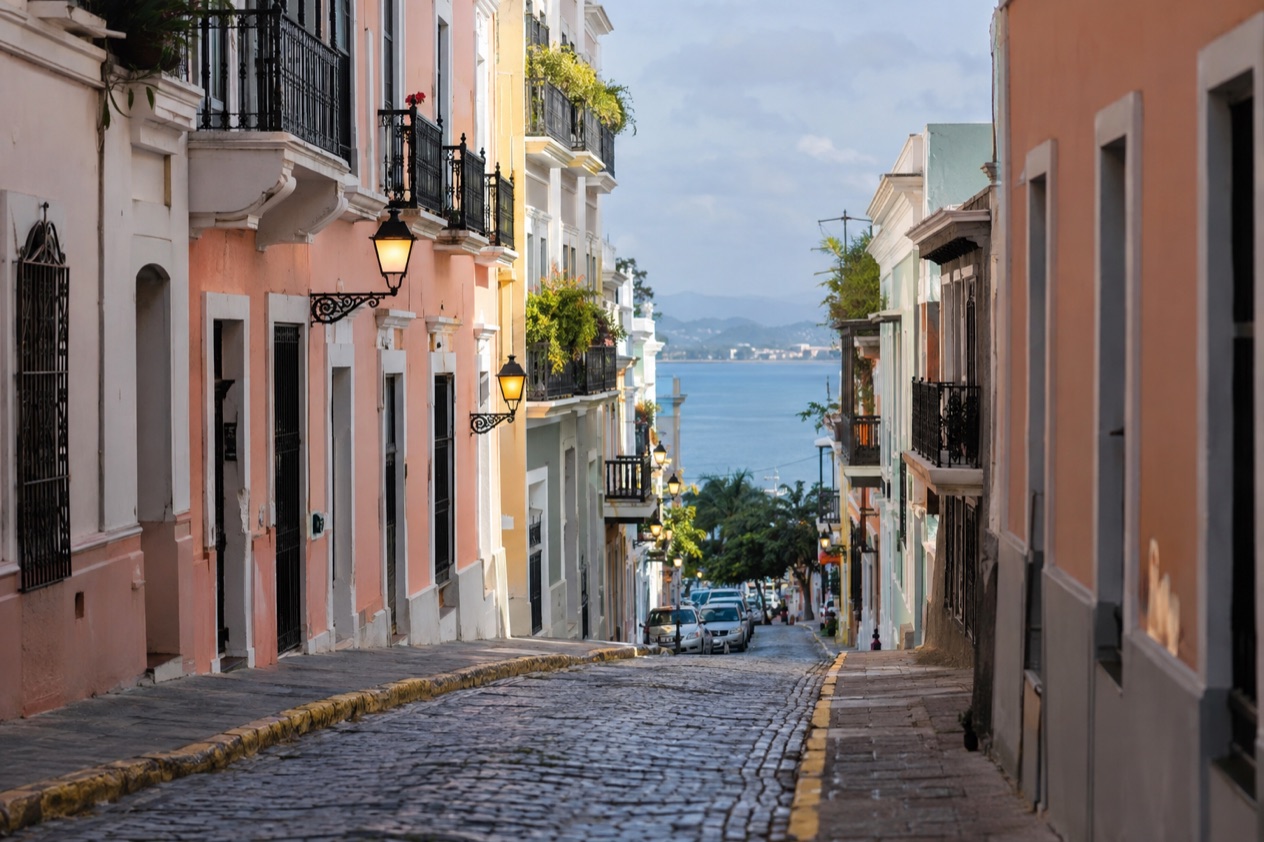
- Follow the cobblestone lanes of Old San Juan past pastel townhouses, balconies, chapels and small plazas.
- Stroll the Paseo de la Princesa at sunset, with the old city wall on one side and the bay on the other.
- Swim or just lounge at Balneario de Escambron, a public beach park known for calmer water inside a reef.
- Order alcapurrias and bacalaitos from the beachside kiosks of Pinones, east of the airport.
- Explore Santurce and Calle Loiza for murals, galleries, bars and some of the city’s most inventive cooking.
- Take a day trip to the rain forest of El Yunque or to the east coast for kayaking and bioluminescent water.
- Finish with live salsa, plena or a rooftop drink, because San Juan wakes up properly after dark.
If you only have a day or two, give the first to Old San Juan, from the forts down to the waterfront, and the second to a beach, a long lunch and an evening in Santurce or Condado. A longer stay leaves room for the mountains and the east coast.
The city is also easy to read. Old San Juan is the historic core on its narrow islet, Condado and Isla Verde are the two beach strips, and Santurce sits between them as the creative, food-loving district. Once you know which of these you are in, plans fall into place.
Sights and landmarks in San Juan
The core of any visit is Old San Juan, a historic district on a small, narrow island along the north coast, tied to the mainland by bridges. Its forts and walls form the San Juan National Historic Site, part of a UNESCO World Heritage Site inscribed in 1983. Wear comfortable shoes, because the cobblestones are uneven and the streets climb and drop all day.
El Morro
The top attraction in Old San Juan is Castillo San Felipe del Morro, and that reputation is well deserved. Built by the Spanish at the tip of the headland, it rises in layers of ramparts, ramps, dark vaulted rooms and sentry boxes that look out over open ocean. The wide lawn in front is where families fly kites, and it is the best place in town to feel how exposed and strategic this harbor once was.
Walk the walls slowly and look down at the waves breaking on the rocks. The late afternoon light is soft on the stone and the sea breeze keeps the heat bearable, while the middle of the day can be hot and bright on the open ramparts. Bring water and a hat, and leave time to wander the lower levels, where cannon positions and old barracks rooms are easy to picture in use.
San Cristobal and the city walls
San Cristobal is the second fort, a sprawling maze of tunnels, outworks and dry moats that guarded the city from attack by land. Where El Morro is about the view, San Cristobal is about the engineering: you move through passages, up stairways and across wide parade ground, and the angled walls make sense of how the old city was defended. It is a good choice for people who like to explore rather than just look.
A standard pass covers both forts and stays valid for twenty-four hours, so you can split them across two days if the heat is wearing. The park does not accept cash, so bring a card. Visitors over sixteen need a pass, and children under sixteen do not. The passes below cover the common cases.
| Pass | Price | Who it suits |
|---|---|---|
| America the Beautiful Annual Pass | $80 | U.S. citizens and residents |
| Senior Pass (annual) | $20 | U.S. citizens and residents aged 62 and over |
| Senior Pass (lifetime) | $80 | U.S. citizens and residents aged 62 and over |
| San Juan National Historic Site annual pass | $35 | Up to four adults for one year, children 15 and under free |
| Military annual pass | Free | Current U.S. military members and their dependents |
| Access Pass | Free | U.S. citizens and residents with a permanent disability |
| Fourth Grade Pass | Free | U.S. fourth graders, valid for one year |
Streets, plazas and the waterfront
The pleasure of Old San Juan is simply walking it. Blue cobblestone surfaces these slender streets, and the flat-roofed brick and stone buildings along them, painted coral, yellow, aqua and rose, go back to the sixteenth and seventeenth centuries. Balconies drip with plants, and every few blocks a small plaza opens up with benches, pigeons and a place for a coffee.
The Puerta de San Juan is the only city gate still standing, a red-painted arch in the wall near the bay where ships once unloaded. From there the Paseo de la Princesa runs along the southern wall as a tree-lined promenade with views of the bay, a fountain at its far end and artisans sometimes selling crafts.
San Jose Church, a landmark of early Spanish architecture, reopened to visitors and services in 2021 after years of renovation, and its quiet interior is a cool pause on a hot day. La Fortaleza, the governor’s residence, stands near the bay end of the old town.
Just outside the wall, on the seaward side, lies La Perla, a colorful neighborhood that draws visitors for its pastel houses and its view of the ocean.
Santurce, Condado and the modern city
Beyond the old city, Santurce is the arts and food district around Calle Loiza, full of murals that cover entire building sides, small galleries and a strong cooking scene. It rewards a slow wander in the daytime and a longer evening. The area also holds the Placita, a market square that becomes a social hub once the sun goes down.
Condado, a beachfront district within Santurce, has its own history. It began to urbanize in the early twentieth century as a streetcar suburb for the old city, and Ashford Avenue is its main boulevard, lined with hotels, shops and restaurants.
The Vanderbilt family built a summer home here that is now a grand hotel, and the Dos Hermanos Bridge at the district’s edge recalls the brothers who brought the tramway. A walk along Ashford, with the Atlantic just beyond the buildings, gives a good sense of how the city grew past its walls.
Beaches and outdoor things to do in San Juan
San Juan’s beaches are city beaches on the Atlantic, so they get steady surf and conditions change from day to day and from one stretch of sand to the next. Check the water first, then heed any flag, sign, or lifeguard on hand. Within that, there is a beach for nearly every mood, from calm and family-friendly to lively and wave-battered.
Balneario de Escambron
For a first stop that is simple to reach, Balneario de Escambron sits as a public beach park right beyond Old San Juan. It is known for calmer water inside a reef, which is why families and snorkelers gravitate to it, though conditions still vary. Palm trees give shade, and the park has the kind of relaxed, local atmosphere that the hotel strips sometimes lack.
Locals come on weekends with coolers, music and folding chairs, so it feels busiest then. Go earlier in the day for a quieter stretch of sand, and watch the water first to see how the waves are behaving. A small fort sits at the edge of the park, and the walk along the shore toward Old San Juan is pleasant when the weather is kind.
Condado and Isla Verde
Condado and Isla Verde are the two beach-and-hotel strips, and both face the Atlantic. Condado is the more urban of the two, with a long promenade of restaurants and shops behind the sand and a steady flow of joggers and walkers. Waves can be lively, so swimmers should read the water carefully, and many people come simply to sit, read and watch the surf.
Isla Verde, farther east near the airport, has wide sand and a more resort-style feel, with hotels, casinos and beach bars in a row. It takes its name from a small cay surrounded by a reef just off the shore. If you want a day with a chair, a cold drink and the sound of the ocean, either strip delivers, and both are easy to reach from Old San Juan by a short ride.
Pinones and the coast beyond
Pinones is a coastal stretch east of the airport where the city gives way to mangroves, dunes and long open beaches. It is better known for its beachside kiosks than for swimming, because the surf can be strong, but the setting is what draws people: palm-fringed sand, music from open-air stands and the smell of frying dough. Many people walk or ride bikes along the shoreline.
Come for the scenery and a snack, and enjoy the water from the shore unless conditions look gentle and signs say otherwise. In some springs and summers, sargassum seaweed can reach east and south coasts, so the beach you picture may look different on the day. A morning visit, with fritters in hand, is the classic way to do it.
Walks and green space
Not every outdoor plan needs sand. The lawns of El Morro and the long promenade along the old wall are good for walking, picnics and watching the light change. In Condado, a stroll along the shore at sunrise or late afternoon is a simple pleasure, with the Atlantic on one side and the city waking up on the other. Pack sunscreen and water, since shade is scarce on the open walkways.
Day trips from San Juan
The most popular day trips from San Juan head east and southeast to the rain forest and the coast, and a few go farther to the south or to the islands. Roads and traffic vary, so plan to leave early and start the drive before the day heats up.
El Yunque
El Yunque is the island’s famous rain forest, a mountain wrapped in clouds east of the city. You walk among tall tree ferns, hear tiny coqui frogs after dusk and find waterfalls and viewpoints along the forest roads. The air is cooler and wetter than on the coast, and showers can arrive suddenly, so a light rain layer is more useful than a heavy jacket.
Start in the morning, when the clouds are often thinner and the paths less crowded. It suits active travelers and families with older children who like to hike, and it pairs well with a kiosk lunch on the way back toward the coast. Check current access and any reservation requirements with the park before you set out.
Pinones and Loiza
A short ride east of the airport, Pinones and the neighboring town of Loiza give you a taste of the island’s Afro-Puerto Rican heritage. Loiza is known for its music, its mask-making tradition and a deep cultural identity that shows up in the food and festivals, especially the Santiago Apostol celebrations in late July.
The route works as a half day or a full day. Eat first, wander the beach, then continue to Loiza for a look at its crafts and its church. It suits food lovers and anyone curious about culture beyond the resort strips.
Fajardo and the bioluminescent bay
Fajardo, on the northeast corner of the island, is the gateway for kayaking, boat trips and nighttime tours of Laguna Grande, one of the island’s bioluminescent bays. The water can glow where it is disturbed, and the effect is best on moonless nights, though it is always a chance rather than a promise.
Many visitors combine a daytime outing with an evening tour, which makes for a long day. It suits couples and adventurous families, and it is a good option if you have already seen the forts and want something quieter and more natural. Vieques and Culebra are reached by public ferry from Ceiba (the main terminal), and they are better as an overnight than a rushed day.
Other options
Ponce, on the south coast, is a longer outing with its own colonial plaza, museums and a famous red-and-black firehouse. The west coast, around Rincon, is a stronger choice for a night or two than for a single day. In the metropolitan area, the town of Catano, across the bay, is known for its rum distillery, and the short ferry across the water is a fun way to see the skyline from the harbor.
What to eat in San Juan
Eating in San Juan means fried, savory, garlicky and often served with a cold drink, and it ranges from roadside shacks to white-tablecloth dining rooms. Puerto Rican cooking is built on mofongo, pasteles, lechon asado, tostones, alcapurrias, piraguas and tembleque, and you find them at casual roadside restaurants called chinchorros, at kiosks and in cafes.
The dishes to know
Mofongo is mashed fried plantain, shaped into a mound and flavored with garlic, often with pork cracklings, shrimp or chicken. It is hearty and filling, so share one if you plan to eat again soon. Tostones are twice-fried plantain discs, crisp and salty, and they appear alongside nearly every meal.
Lechon asado is roast pork with crackling skin, a celebration dish served at gatherings and in roadside restaurants in the hills. Pasteles are parcels of grated green banana and meat wrapped in leaves and boiled, most associated with the Christmas season but found in many places. For dessert, tembleque is a wobbly coconut pudding dusted with cinnamon, light and cool after a heavy plate.
Fritters, kiosks and chinchorros
The kiosks of Pinones, east of the airport, are the classic spot for alcapurrias and bacalaitos. Alcapurrias are fritters of grated root vegetables and plantain stuffed with seasoned meat, while bacalaitos are crisp, salty codfish fritters. You eat them with your fingers, hot from the oil, with the sound of the ocean behind you.
A chinchorro is a casual, local-style roadside restaurant, often open-air, with a short menu, cold beer and music. Go with an appetite and no dress code. The same food appears in small cafes around Old San Juan and Santurce, so you do not need to leave the city to try it, though the setting at the kiosks is part of the pleasure.
Sweets, coffee and drinks
Piraguas are shaved ice piled into a paper cone and drenched in fruit syrup, sold from carts and a favorite in the heat. Puerto Rican coffee is strong and often served with hot milk, and a sweet roll with powdered sugar is the usual breakfast partner. In Old San Juan, small cafes with shaded tables are good for a slow morning.
Rum is a point of pride, and a cold rum drink on a terrace is a sensible response to the afternoon sun. The piña colada has strong local claims on its origin, which makes ordering one feel almost obligatory. In Santurce, a wave of chefs reinterpret island dishes with modern techniques, so the district is the place to try a tasting menu or a creative take on the classics.
Things to do in San Juan at night
At night, San Juan spreads across several neighborhoods, each with its own tone, so the best plan depends on whether you want music, a quiet drink or a late meal. Old San Juan is atmospheric and walkable, Santurce is creative and loud, and Condado and Isla Verde offer hotel bars and casinos.
Old San Juan after dark
When the day visitors leave, Old San Juan changes. The lanterns come on, and the cobblestone streets fill with locals and travelers heading to small bars, restaurants and live-music rooms. Calle San Sebastian is the best known street for a lively evening, with crowds spilling out of doors and a good chance of hearing salsa or plena.
For something quieter, walk the Paseo de la Princesa after dinner, when the wall is lit and the bay is dark. Plaza squares are good for a drink and people-watching, and a late stroll to the edge of the city, with the sea wind in your face, is a gentle way to end the night. The streets are steep and uneven, so shoes with grip are a good idea.
Santurce and Calle Loiza
Santurce is where many residents go out. Calle Loiza and the streets around it hold bars, music venues and restaurants with a younger, more local feel, and the Placita becomes a lively square where people gather with drinks and music. Expect crowds on weekend nights, with sound spilling into the street.
It is a good choice if you want to eat late, listen to a live band or simply see how the city plays. Murals look different after dark, and the mix of food stands and bars gives you a lot of options within a few blocks. Take a ride to and from instead of wandering far on foot at night.
Condado and Isla Verde evenings
Condado is a polished choice for dinner, with seafood and steakhouse restaurants, rooftop bars and hotel lounges within a stroll of each other along Ashford Avenue. A walk along the shore after dinner, listening to the surf, is a calm way to wrap up the day.
Isla Verde, closer to the airport, is the resort-minded option, with casinos, beach bars and hotel pools that stay lively into the night. It suits travelers who want everything within a short walk of their room. If you would rather skip the crowds, many hotels have quiet terraces where a drink and the sound of the waves are enough.
Things to do in San Juan with kids
Children usually enjoy San Juan most when the plan mixes a little history with a lot of open space, water and snacks. The forts feel like castles, the lawns invite running and kite flying, and the beaches and frozen treats give everyone a reward.
Forts, lawns and kites
El Morro is the easy winner for kids. They can run through tunnels, peer out of sentry boxes and imagine pirates and soldiers, and the open lawn out front is ideal for flying a kite in the sea breeze. Children under sixteen do not need an entrance pass, which helps a family budget.
San Cristobal rewards curious children with its passages and wide spaces. Keep an eye on little ones near the edges of the walls and the steep drops, and carry water, since the ramparts offer little shade. A good rhythm is one fort in the morning, lunch somewhere shaded, then a break before a second outing.
Beaches, parks and treats
Balneario de Escambron is a natural family stop, a public beach park known for calmer water inside a reef. Even so, the Atlantic can be unpredictable, so stay close to children in the water, check the conditions and follow any flag, sign or lifeguard that is present. Shaded areas and facilities in the park make it easier to stay for a few hours.
Piraguas are a favorite treat, and a paper cone of shaved ice is often all it takes to turn a tired afternoon around. In Old San Juan, feeding pigeons in a small plaza is a simple pleasure, and a ferry ride across the bay brings the skyline into view. Alcapurrias and tostones are friendly first foods for young eaters who like fried snacks.
What to keep in mind
San Juan is hot and humid, so sun protection, hats and plenty of water matter more than anything else. Plan outdoor activities, including the beach, for the morning or late afternoon, and keep midday for lunch, a museum or a rest in the room. Cobblestones are tough on strollers, so a carrier or a lightweight stroller with good wheels is easier in Old San Juan.
Distances between neighborhoods are short but add up with tired legs, so a ride is often better than a long walk. Take breaks in shaded plazas, cafes and the cool interiors of churches and museums.
Good to know before you go
Because San Juan belongs to the United States, travelers with U.S. citizenship can skip both a passport and a visa, everything is priced in U.S. dollars, and mainland flights count as domestic. Both languages, Spanish and English, hold official status, so even a small bit of Spanish goes a long way.
Old San Juan is best explored on foot or by car, since the free trolley that once ran there is no longer in service, and the Condado area is served by the metropolitan bus system. The Atlantic hurricane season runs from June 1 to November 30, with its peak in September, so follow the National Hurricane Center and local official alerts if you travel in that window.
Sources
- National Park Service, San Juan National Historic Site, Fees & Passes (https://www.nps.gov/saju/planyourvisit/fees.htm), checked October 8, 2026
- National Park Service, San Juan National Historic Site, Hours & Operating Seasons (https://www.nps.gov/saju/planyourvisit/hours.htm), checked October 8, 2026
- Wikipedia, Old San Juan (https://en.wikipedia.org/wiki/Old_San_Juan), checked October 8, 2026
- Wikipedia, Condado (https://en.wikipedia.org/wiki/Condado,_Puerto_Rico), checked October 8, 2026
- Wikipedia, Isla Verde (https://en.wikipedia.org/wiki/Isla_Verde,_Puerto_Rico), checked October 8, 2026
- NOAA National Hurricane Center, Climatology (https://www.nhc.noaa.gov/climo/), checked October 8, 2026