
SAGRES · BEST TIME TO VISIT · IPMA NORMALS 1991-2020
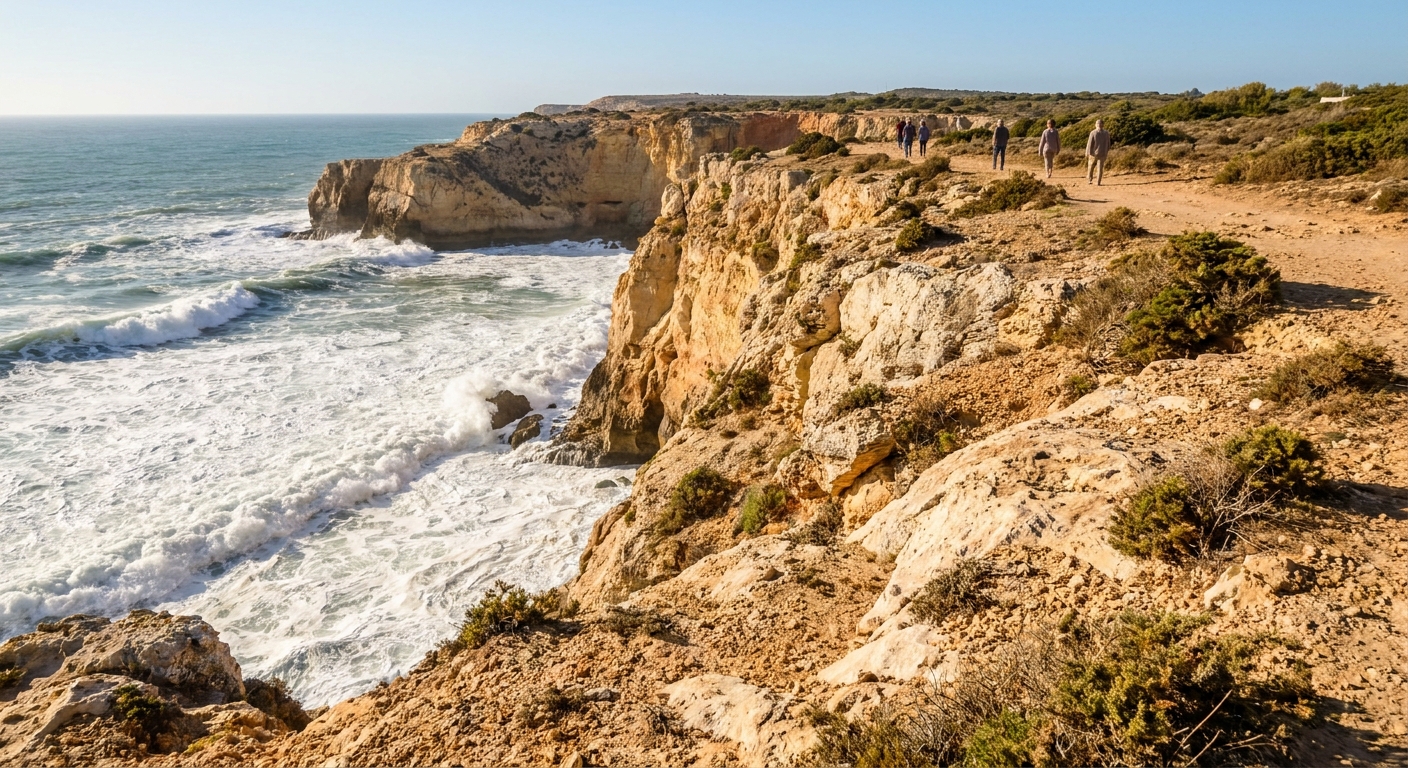
Sagres is where Portugal stops. Past the village the land flattens into a wind-combed plateau, and two headlands push out into open ocean: Ponta de Sagres under its fortress wall, Cabo de São Vicente under its lighthouse. Four coves face four directions, so there is usually one beach out of the wind and one that is unusable.
Timing matters more here than along the sheltered stretch east of Lagos, because the cape faces west into the Atlantic and the water never really warms. Its own station records August highs of 78.6°F, a sea that peaks at 66.3°F in October, and 3.23 inches of rain in November. Those three numbers decide most Sagres trips.
THE YEAR AT A GLANCE · SAGRES
September is Sagres at its best: 76.8°F days, 2.5 rain days, and a sea at 64.2°F, 2.1 degrees warmer than August’s.
BEST: SEPTEMBER · WARMEST SEA: OCTOBER, 66.3°F · WETTEST: NOVEMBER, 3.23 IN
Go for: the cliff walk to Cabo de São Vicente, four beaches facing four directions, and a September that gathers only 0.73 inches of rain across the whole month.
Think twice before: building the trip around swimming. No month averages above 66.3°F at the surface, and March reads 60.2°F.
Normals: IPMA station 533, 1991-2020 · Sea: Open-Meteo Marine, 2015-2024 · Daylight: sunrise-sunset.org · full sources at the end
On this page
- Month-by-month weather tableHighs, lows, rain days, sea and daylight
- The single best monthSeptember, with its numbers
- Sea temperature for swimmingFrom 60.2°F in March to 66.3°F in October
- The quietest weeks in SagresJanuary and February, by the calendar
- Which month to skipNovember, and for whom
- May or October instead of AugustThe two shoulder months, with figures
Sagres sits at the far south-west corner of the Algarve, past Lagos, where the coast turns north and the wind arrives with nothing in front of it. Reaching it takes a car for most American visitors, and our rental guide covers the tolls. The village is small and the plateau is bare, so weather counts for more in a Sagres week than in a Faro one.
Sagres weather month by month: highs, lows, rain and sea
| Month | Avg high | Avg low | Rain | Days ≥ 1 mm | Sea | Daylight (15th) |
|---|---|---|---|---|---|---|
| January | 61.0°F | 47.3°F | 2.10 in | 7.4 | 61.4°F | 9 h 57 min |
| February | 61.3°F | 47.8°F | 1.91 in | 6.3 | 61.1°F | 10 h 53 min |
| March | 64.0°F | 51.1°F | 1.92 in | 6.3 | 60.2°F | 12 h 00 min |
| April | 66.4°F | 53.6°F | 1.37 in | 5.7 | 61.8°F | 13 h 13 min |
| May | 70.7°F | 57.0°F | 0.87 in | 3.9 | 62.2°F | 14 h 13 min |
| June | 75.0°F | 61.2°F | 0.15 in | 0.7 | 65.3°F | 14 h 45 min |
| July | 77.4°F | 62.6°F | 0.04 in | 0.2 | 63.3°F | 14 h 30 min |
| August | 78.6°F | 63.3°F | 0.06 in | 0.4 | 62.1°F | 13 h 37 min |
| September | 76.8°F | 62.1°F | 0.73 in | 2.5 | 64.2°F | 12 h 27 min |
| October | 72.3°F | 59.0°F | 2.42 in | 6.7 | 66.3°F | 11 h 18 min |
| November | 66.2°F | 53.1°F | 3.23 in | 8.4 | 64.4°F | 10 h 14 min |
| December | 62.6°F | 49.8°F | 2.96 in | 8.0 | 63.2°F | 9 h 41 min |
The thermostat is narrow and the rain gauge is lopsided. Average highs travel only from 61.0°F in January to 78.6°F in August, a spread of 17.6 degrees across an entire year. Rain does the seasonal work instead: November, December and January collect 8.29 inches between them, while June, July and August collect 0.25 inches. Sagres has a wet half and a dry half rather than four seasons.
Two months do the switching. May cuts rain to 0.87 inches over 3.9 days at 1 mm or more, down from April’s 1.37 inches over 5.7 days, and daylight stretches to 14 h 13 min. October turns it back: 2.42 inches over 6.7 days, against September’s 0.73 inches over 2.5 days. October also holds the warmest sea of the year, 66.3°F, three months after the air peaked.
November is the hardest month, and it is hardest for one kind of traveler: the one whose plan is beaches and cliff paths. It records 8.4 days with at least 1 mm of rain, 2.6 of them with 10 mm or more, 3.23 inches in total, and just 10 h 14 min of daylight on the 15th. December follows closely at 2.96 inches, 8.0 rain days and 9 h 41 min.
A word on where these readings come from. IPMA station 533 stands at Sagres itself, 22.9 m above the sea on the exposed south-west cape, a real thermometer rather than a model grid square. It does not describe the region as a whole: the hills inland run colder and far wetter, and the south-facing coast around Faro keeps its own weather. The rain-day counts use the Portuguese service’s thresholds, 1 mm (0.04 inch) and 10 mm (0.39 inch), not the 0.10-inch cutoff of American tables, so the two sets of counts cannot be swapped.
When is the best time to visit Sagres?
September, without much hesitation. Average high 76.8°F, average low 62.1°F, 0.73 inches of rain spread over 2.5 days at 1 mm or more, sea surface at 64.2°F, and 12 h 27 min of daylight on the 15th. Summer air holds on, the ocean sits within 2.1 degrees of its annual best, and roughly one day a week arrives wet.
August is 1.8 degrees warmer by day, 78.6°F against 76.8°F, and drier on paper at 0.4 rain days. It also runs 2.1 degrees colder in the water, 62.1°F against 64.2°F, and it is the month Europe’s schools are all out at once. October flips the trade the other way: the year’s warmest sea at 66.3°F, bought with 4.2 more rain days and 1 h 09 min less daylight.
Two practical consequences. Pack for a cape rather than a resort, since 62.1°F nights with wind off the water want a layer, and the packing guide handles the rest. Then place Sagres inside a bigger plan: the Algarve guide covers the coast east of here, the national calendar covers the country, and Lagos is the usual base for travelers who want a town around them.
When can you swim in Sagres? Sea temperature month by month
No month here reaches 68°F, the bar most American swimmers use for going in without a wetsuit, and that bar is ours rather than a measurement. October comes closest at 66.3°F, then June at 65.3°F, November at 64.4°F and September at 64.2°F. The cold end is late winter and spring: March averages 60.2°F, February 61.1°F, January 61.4°F. August reads 62.1°F, a full 3.2 degrees colder than June.
Those sea figures are the mean of daily maxima from 2015 to 2024, so they sit a shade above a true 24-hour average, and they describe the surface. An 8 a.m. swim feels colder than the average suggests. Air normals come from a different exercise entirely, IPMA’s 1991-2020 period at a fixed station, so the two series are neighbors and not twins.
When is Sagres quietest?
January and February are the empty weeks, and the calendar says so rather than any price list. They fall after the Christmas and New Year travel window, well before Easter, and a clear five months from the July-August peak that empties Europe’s schools onto this coast. We hold no price series for Sagres, so no month gets called the cheapest.
What the quiet weeks give you is workable weather. February records only 6.3 days with 1 mm of rain or more, which leaves roughly three weeks of the month without a wet day, and highs of 61.3°F over lows of 47.8°F make the walk from the fortress toward Cabo de São Vicente a fleece-and-hat affair. January is fractionally cooler and wetter at 2.10 inches.
You lose daylight and water. On January 15 the sun clears the horizon at 7:46 a.m. and drops at 5:43 p.m., 9 h 57 min in all, 4 h 48 min short of mid-June’s 14 h 45 min. The sea reads 61.4°F. Seasonal restaurants and surf outfits cut their hours out of season too, so call before driving out to the cape for lunch.
Which month should you avoid in Sagres?
November, for the traveler whose itinerary needs dry cliffs and beach afternoons. Its 3.23 inches are the annual maximum, a third more than October’s 2.42, and 2.6 days deliver 10 mm (0.39 inch) or more. Daylight is down to 10 h 14 min. Surfers and storm-watchers get a different month out of the same figures, which is why nobody should call November bad in the absolute.
What redeems it: the sea still holds 64.4°F, 2.3 degrees above August, and afternoons average 66.2°F, within a fifth of a degree of April’s 66.4°F. Even at 8.4 rain days, better than twenty days of the month record no rain at all. A November trip built on walking, seafood and a rain shell works. One built on swimsuits does not.
Sagres shoulder season: weather and crowds
The shoulder here is May and October. May averages 70.7°F, 7.9 degrees under August’s 78.6°F. October averages 72.3°F, 6.3 degrees under it. Neither sits inside the July-August holiday peak, and neither collides with Easter week, so the cape roads and the fort car park belong to a smaller crowd on the same coast.
May’s gift is light and dryness: 14 h 13 min of daylight on the 15th, 36 minutes more than August manages, with only 0.87 inches of rain over 3.9 days. October’s gift is the water, 66.3°F at the surface, the year’s best, paired with 72.3°F afternoons. High summer offers neither combination.
Each takes something back. May’s sea reads 62.2°F, 4.1 degrees below October’s, cold enough that most swims last minutes. October’s rain returns hard: 6.7 days at 1 mm against August’s 0.4, with 1.8 days at 10 mm or more, and daylight falls to 11 h 18 min, 2 h 19 min shy of August.
The split is clean enough to book on. Take May for walking, coast paths and long evenings. Take October for the water, with a rain jacket in the trunk. Forced to one week and one priority, swimmers should choose October on 4.1 degrees of sea temperature, and hikers should choose May on 3.9 wet days against 6.7.
The last word
Sagres does not reward August, which brings the year’s hottest air, 78.6°F, over water at 62.1°F, 4.2 degrees below October’s 66.3°F. That lag is the whole character of the cape: the sea bottoms out in March at 60.2°F, two months after the air does in January, and peaks in October, two months after the air does in August. Book September if you want the full set at once, October if you came to swim, and check the Algarve guide before deciding whether Sagres is your base or a long day out from Lagos.
Sources & data for this guide
- Monthly highs, lows, precipitation and rain-day counts at 1 mm and 10 mm · IPMA station 533 Sagres, altitude 22.9 m, 1991-2020 normals · checked Sep 9, 2026
- Sea surface temperatures, mean of daily maxima 2015-2024 · Open-Meteo Marine API · checked Sep 9, 2026
- Daylight, sunrise and sunset on the 15th of each month, UTC converted to Europe/Lisbon · sunrise-sunset.org · checked Sep 9, 2026
- Quiet-month claims rest on the school and holiday calendar. We hold no occupancy or price series for Sagres, so no month is ranked by cost.
- The 68°F swimming bar, the winter opening-hours note and the air-to-sea lag reading are editorial · confirm hours with operators before driving out to the cape.