
EVORA · JANUARY · INLAND ALENTEJO
January gives Évora 9 hours 49 minutes of daylight on the 15th, with the sun up at 7:46 am and gone by 5:35 pm. Days average 57.4°F, nights 40.1°F, and 2.70 inches of rain fall across the month. Inside the 17th-century wall, that adds up to fleece-and-raincoat weather on medieval streets, with the Alentejo summer four months off in either direction.
Most American trips reach Évora as a two-night stop out of Lisbon on a wider loop, and January reshapes those two nights: one solid outdoor session instead of two, dinner walked in full dark, and a wet morning that needs a fallback. Getting there and the rest of the region sit in our getting-around guide and the Alentejo pages, and the country-wide calendar is in best time to visit Portugal.
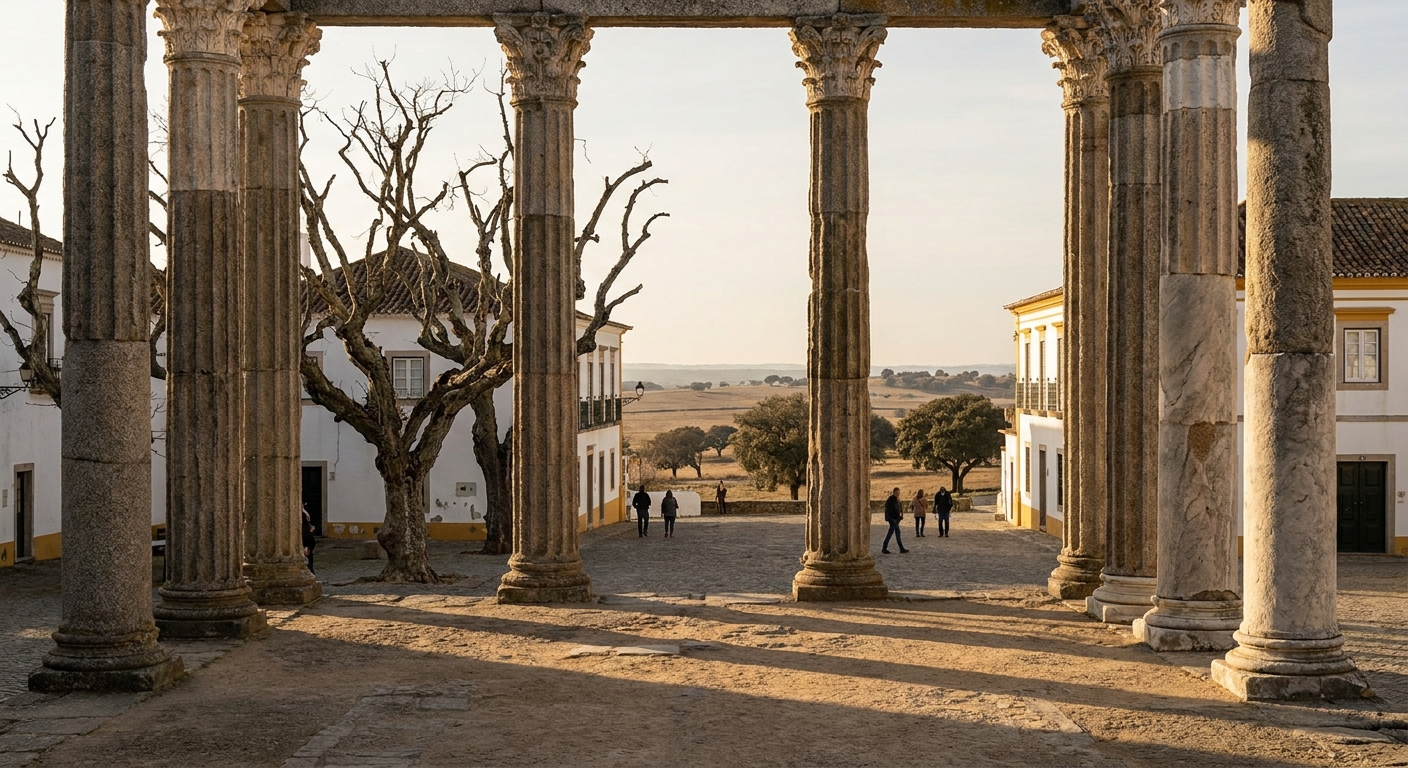
THE MONTH AT A GLANCE · EVORA · JANUARY
January buys you a walled UNESCO city at 57.4°F with no heat to plan around, and charges you in daylight: under ten hours of it, and rain on 8.6 days.
IPMA STATION 558 · 1991-2020 NORMALS · 2 NIGHTS OUT OF LISBON · INLAND, NO SWIMMING
Go for: walking a whole walled city at 57.4°F, Roman columns and a 13th-century cathedral without queueing in heat, and two nights that slot neatly out of Lisbon.
Think twice before: planning two outdoor sessions a day. On January 15 the sun is gone at 5:35 pm, and 2.4 days in the month deliver 0.39 inch of rain or more.
Climate: IPMA station 558, 1991-2020 · Light: sunrise-sunset.org · Monuments: UNESCO file 361 · full sources at the end
On this page
- Évora weather in JanuaryHighs of 57.4°F and 8.6 rain days
- How cold the nights getA 40.1°F normal low
- Crowds and prices in JanuaryWhat we verified, and what we could not
- Things to do in Évora in JanuaryTemple of Diana, the Cathedral, Os Loios
- A two-day plan for a January weekendDay one by the clock, plus a rain day
- January vs December and FebruaryHow the three months compare
- Is January a good time to visit Évora?Yes for walkers, no for long afternoons
The normals below come from IPMA’s station 558, a real thermometer inside Évora at 247.6 m of altitude, not a model grid cell. They describe this city and nowhere else. Higher ground in the Alentejo runs colder and far wetter, and a coast has its own weather, so a reading taken here is a poor basis for packing for a hill trail.
Évora weather in January: average highs, lows and rain days
| January at Évora, station 558 | 1991-2020 normal |
|---|---|
| Average high | 57.4°F |
| Average low | 40.1°F |
| Precipitation | 2.70 in |
| Days with 0.04 in (1 mm) or more | 8.6 |
| Days with 0.39 in (10 mm) or more | 2.4 |
| Daylight, January 15 | 9 h 49 min · 7:46 am to 5:35 pm |
Over the 1991-2020 period published by IPMA, Portugal’s national weather service, Évora’s January normal high is 57.4°F and the normal low 40.1°F, with 2.70 inches of precipitation across the month. Those readings come from the same instrument year after year, which makes them a record rather than an estimate. A 57.4°F afternoon is a cool New England spring day: warm enough for five hours of walking, too cool to sit still on a square once the sun drops behind the rooftops.
Rain reaches the gauge on 8.6 days in an average January, and 2.4 of those days bring 0.39 inch (10 mm) or more. Measurable rain about two days in seven, then, and a genuine soaking a little over twice in the month. One caution before you set that against an American table: IPMA counts from 0.04 inch (1 mm), while US summaries usually start at 0.10 inch, so the two day-counts are not interchangeable.
Between the 40.1°F night and the 57.4°F afternoon sits 17.3°F, and stone streets hold the low end well past breakfast. Pack for both: a warm layer that comes off by eleven, a rain shell rather than an umbrella, and shoes with grip, because the polished calçada cobbles turn slick within minutes of a shower. Our packing guide carries the full winter list.
On January 15 the sun rises at 7:46 am and sets at 5:35 pm, 9 hours 49 minutes of daylight, and Portugal keeps UTC through the winter, so those are the times on your phone. Put the outdoor half of the day between ten and four. After 5:35 pm the walled center runs on streetlight, which flatters whitewash and does nothing for a photograph of the Roman columns.
How cold does Évora get in January? Daytime highs and overnight lows
Two numbers govern the month: 57.4°F by day, 40.1°F by night, an average spread of 17.3°F. Both are thirty-year means rather than a forecast. The 57.4°F figure is the average of daily maximum temperatures, not an average across 24 hours, so the day taken as a whole sits below it, and the hour either side of dawn sits below 40.1°F more often than the round number suggests.
At eight in the morning you want a real coat and possibly gloves. By two in the afternoon, walkers in the sun are down to a shirt and a fleece. Shade never gets the message: the narrow alleys of the medieval layout keep their cold all day, so the sunny side of a square is worth crossing for, and an indoor lunch at one loses you nothing.
We could not verify a frost-night count for Évora, so we give no number of nights below freezing. What the normal supports is this: 40.1°F is the average, a fair share of nights land under it, and an unheated room in an old stone house is genuinely cold at 7 am. No sea or river water temperature came out of our sources either, and the city sits inland in the Alentejo, so the January swimming question belongs to the Algarve coast.
How busy is Évora in January? Crowds, prices and the tourist tax
We found no occupancy series and no monthly room-rate series for Évora, so we crown no month cheapest and no month dearest. What we can date with a source is the weather and the light: 57.4°F days, 8.6 rain days, 9 hours 49 minutes of daylight on the 15th. Budget questions for the country as a whole live in our trip-cost guide.
Because that rate data is missing, we will not tell you to book eleven weeks ahead. The practical shape stands on its own: two nights cover the walled center at a January pace, three if you want a day out in the wider Alentejo, and reserving early is mostly about choosing a room for its heating rather than its azulejos. Where to sleep across Portugal is mapped in the accommodation guide.
We could not verify a lodging-tax rate for Évora, so we give no percentage. Where such a charge exists in Portugal it is levied per person per night and lands on the final bill rather than inside the quoted room rate, which is a good reason to ask the property what the total will be when you reserve.
The one line where paying more changes the month is heat. The low whitewashed houses UNESCO singles out, with their Dutch tiles and wrought-iron balconies under tiled roofs, were designed against Alentejo summers. A beautiful 18th-century room with 40.1°F outside at dawn is a cold room unless somebody fitted heating, so check the listing for that word before you check it for the beams.
Things to do in Évora in January: the Temple of Diana, the Cathedral and Os Loios
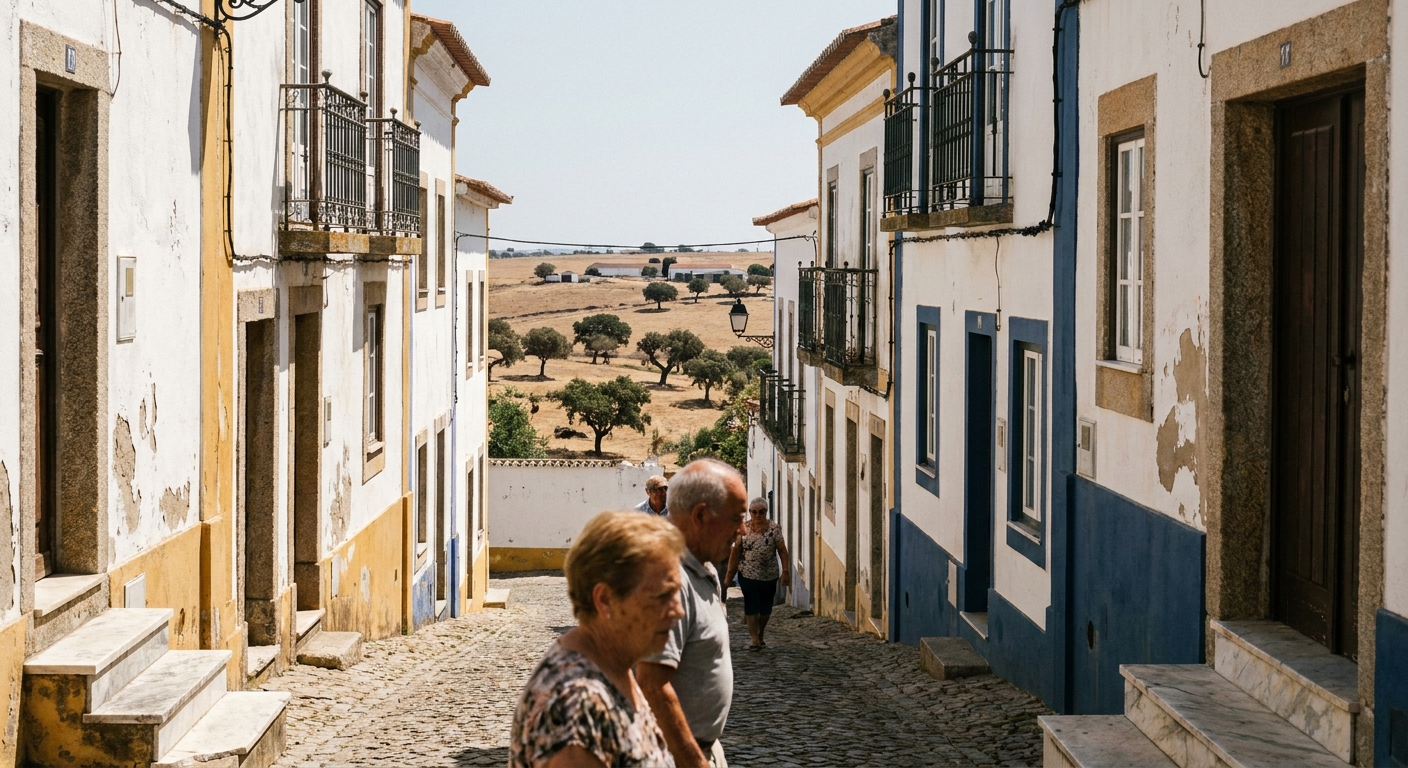
January is the month that lets you walk the Alentejo all day. A 57.4°F afternoon means the full circuit of the walled center on foot with no shade planning at all, and the ring road built around the walls in the 20th century keeps traffic outside the historic streets. The cost is light: with sunset at 5:35 pm on the 15th, you get one long outdoor session, not two.
The fixtures start with the Temple of Diana, whose Roman columns survive from a city inhabited since the 2nd century BC, and the Cathedral, completed in the 13th century. Then the golden age that opened in the 15th century, when Portuguese kings began living here: the royal church and convent of São Francisco, the Convent of Os Loios with its church of São João Evangelista, the Convent of St Claire. The Jesuits taught at the University of the Holy Spirit from 1553 until the order was expelled in 1759.
Cold changes those interiors more than the calendar does. A 13th-century cathedral keeps the night temperature well into the afternoon, so the layer you shed outdoors goes back on at the door, and the low sun that reaches the Roman columns around three fades fast. A warning we owe you: we could not verify an opening hour or an admission price for a single monument in Évora, since UNESCO describes the property and does not run the ticket desks. Confirm times and fees with each site before you build a morning around it.
We could not verify any free-admission day in January either, so we name none. What costs nothing is the thing UNESCO actually cites: the coherence of the minor architecture of the 16th, 17th and 18th centuries, whitewashed walls, Dutch tiles, iron balconies, along streets of medieval layout. Walk the Vauban-style wall drawn in the 17th century by the French engineer Nicolas de Langres and classified under national law in 1920, find the Moorish gate left by rule that ended in 1165, and look up at the Cordovil house and the house of Garcia de Resende.
Évora in January: a two-day itinerary
Day one runs on the light. Coffee at eight while the air is still near 40°F. The Temple of Diana and the Cathedral from nine to noon, as the thermometer climbs toward 57.4°F. A long indoor lunch at one, when nothing outdoors is improving. São Francisco and Os Loios from two thirty to four thirty, then back onto the street for the last half hour before the 5:35 pm sunset, when the whitewash turns orange. Dinner afterward is a dark-street walk, so keep the grippy shoes on.
Day two opens on the wall: the Vauban ring first, then down into the medieval streets for the patrician houses, with the afternoon left loose for a drive into the wider Alentejo if you have a car. If the sky turns, invert the order. With 2.4 days a month at 0.39 inch or more, a soaked morning is a live possibility, and the church-and-convent sequence absorbs three hours indoors while the wall walk moves to the dry half of the day.
Évora in January vs December and February
| December | January | February | |
|---|---|---|---|
| Average high | 58.3°F | 57.4°F | 60.3°F |
| Average low | 41.5°F | 40.1°F | 41.0°F |
| Precipitation | 3.35 in | 2.70 in | 2.06 in |
| Days with 0.04 in or more | 8.7 | 8.6 | 7.0 |
| Water temperature | Not verified | Not verified | Not verified |
Set the three side by side and January is the cold middle. Its 57.4°F days run 0.9°F under December and 2.9°F under February, and its 40.1°F nights are the coldest of the trio, 1.4°F below December. Rainfall separates them more clearly than temperature does: 2.70 inches in January against 3.35 in December and 2.06 in February, with rain days at 8.6, 8.7 and 7.0. No water temperature exists in our sources for any of the three, the nearest sea being a drive away.
Push the trip four weeks forward and February hands you 2.9°F warmer afternoons, 0.64 inch less rain and 1.6 fewer rain days, plus later sunsets we did not measure. Pull it four weeks back and December costs you 0.65 inch more rain across essentially the same number of wet days, in exchange for Christmas lights and a 58.3°F afternoon. February is the only one of the three that stays under eight rain days.
Is January a good time to visit Évora?
For a traveler who came for the architecture, yes. A 57.4°F afternoon is the temperature that makes a walled city pleasant instead of punishing, and the 2.70 inches of rain arrive on 8.6 days, which leaves roughly three dry weeks at the gauge. Two nights, a coat, a rain shell, and the whole UNESCO center is yours on foot.
If the trip is built around long afternoons, terrace dinners or a swim, January is the wrong pick and February is the cheap correction: 2.9°F warmer days, 0.64 inch less rain, 1.6 fewer rain days, identical monuments. For water, the answer is not Évora at all but the Algarve, and Lisbon is the base if you want a city that stays lit after dinner.
What January alone offers among the three: 40.1°F nights, days still at 57.4°F, and a rain total already 0.65 inch below December’s.
The last word
Book the two nights, take the coat and the shoes with grip, and spend your outdoor hours between ten and four where the light actually is. One fact worth carrying through the gate: Évora came through the great earthquake of 1755 mainly undamaged, while the same shock destroyed much of Lisbon, and that is why a golden-age city is still standing here to be walked in January. UNESCO listed the historic center in 1986, under criteria (ii) and (iv).
Sources & data for this guide
- January normals (57.4°F / 40.1°F, 2.70 in), rain-day counts and the 247.6 m station altitude · IPMA, Normais Climatológicas 1991-2020, station 558 Évora · checked Sep 23, 2026
- December and February normals, same station and same 1991-2020 period · IPMA · checked Sep 23, 2026
- Daylight of 9 h 49 min, sunrise 7:46 am and sunset 5:35 pm on January 15, converted to Europe/Lisbon · sunrise-sunset.org · checked Sep 23, 2026
- Monuments, dates (2nd century BC, 1165, 13th century, 1553, 1759, 1755, 1920) and the 1986 inscription under criteria (ii) and (iv) · UNESCO World Heritage Centre, file 361, Historic Centre of Évora · checked Sep 23, 2026
- Rain-day thresholds are IPMA’s own (0.04 in and 0.39 in), not the 0.10-inch threshold of US tables · checked Sep 23, 2026
- We could not verify opening hours, admission prices, a lodging-tax rate or any occupancy series for Évora, so we give no ticket price, no percentage and no ranking of months by cost · noted Sep 23, 2026