
ÉVORA · MARCH · ALENTEJO
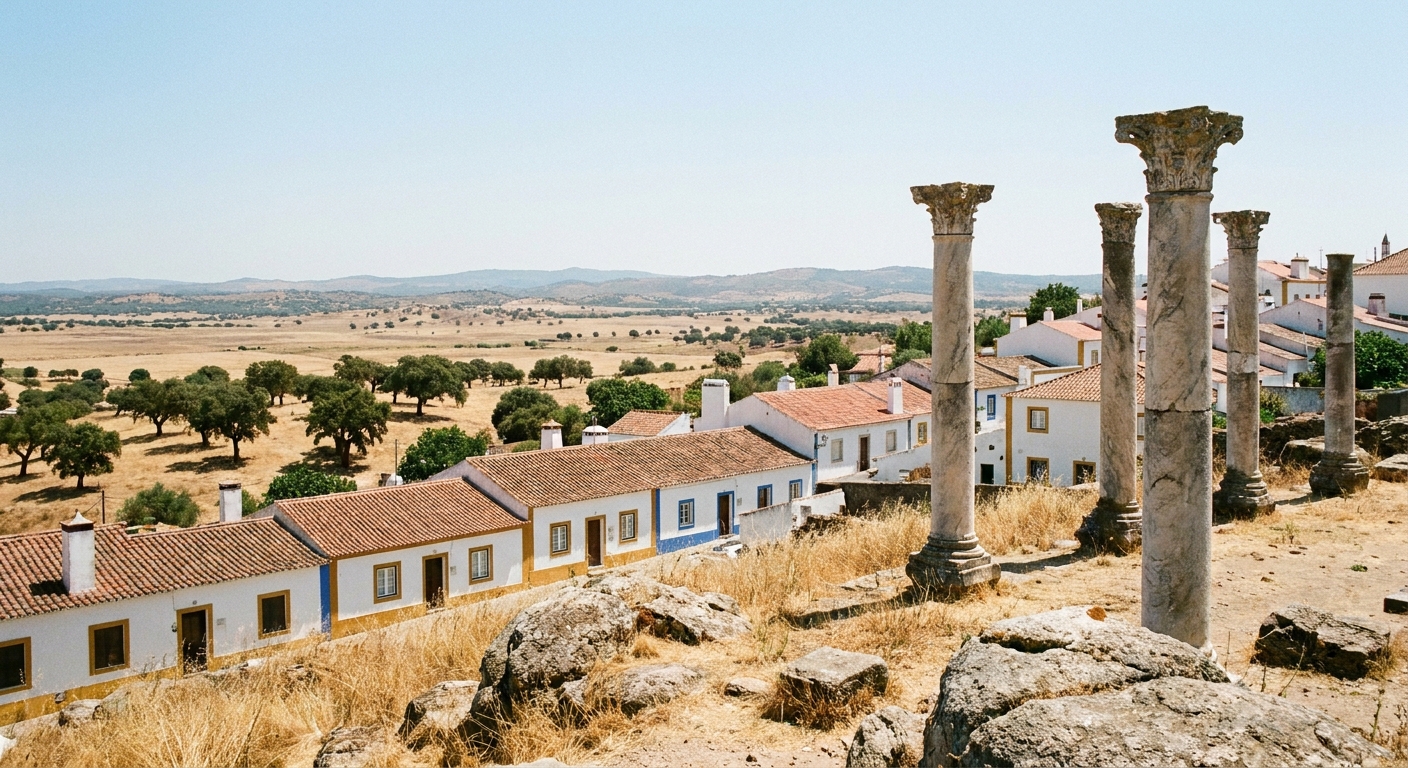
A March afternoon in Évora runs to a normal 65.7°F, the day reaches a full twelve hours by the middle of the month, and the entire UNESCO-listed center sits inside a 17th-century wall. That combination is what the date buys you: Roman stone, a 13th-century cathedral and whitewashed streets, all walkable between breakfast and sunset without fighting the weather.
What the date takes back is the night and a share of the sky. Dawn averages 44.4°F, and 7.5 days in an average March record measurable rain. If you are still choosing the city rather than the month, our Évora guide does that job, and the 12-month verdict for Portugal sets March against the rest of the country.
THE MONTH AT A GLANCE · ÉVORA · MARCH
March gives Évora 65.7°F afternoons, twelve hours of daylight and roughly one wet day in four: go, and pack for the 21.3°F swing between dawn and mid-afternoon.
IPMA NORMALS 1991-2020 · STATION 558, 247.6 M · 7.5 WET DAYS · NO ADMISSION PRICES VERIFIED
Go for: walking the walled center at midday, Roman, medieval and golden-age stone within a few minutes of each other, and a month whose day length crosses twelve hours.
Think twice before: booking March on a promise of dry, warm evenings: 2.0 days in an average March deliver 0.39 inch of rain or more, and the nights average 44.4°F.
Climate: IPMA station 558, normals 1991-2020 · Heritage: UNESCO World Heritage Centre, file 361 · full sources at the end
On this page
- Évora weather in March65.7°F highs, 2.39 in of rain, 7.5 wet days
- How cold the nights getA 44.4°F low and a 21.3°F daily swing
- Crowds, prices and when to bookWhere March sits, and what we could not verify
- Things to do in Évora in MarchTemple of Diana, the Cathedral, Os Loios
- A two-day plan for a March weekendHour by hour, 6:40 to 6:40
- March or April in Évora?How February, March and April compare
- Is March a good time to visit Évora?Who should go, who should wait
Every figure here comes from one thermometer: IPMA’s station 558, standing at Évora itself, 247.6 m above sea level, averaged over 1991-2020. That matters, because the Alentejo is not one climate. High ground is colder and a good deal wetter, and a coast has its own weather at its own end. Pack for Évora from Évora’s numbers.
Évora weather in March: average highs, lows and rain days
| Évora, March (1991-2020) | Normal |
|---|---|
| Average high | 65.7°F (18.7°C) |
| Average low | 44.4°F (6.9°C) |
| Precipitation | 2.39 in |
| Days with 0.04 in or more | 7.5 |
| Days with 0.39 in or more | 2.0 |
| Daylight on March 15 | 12 hours (6:40 a.m. to 6:40 p.m.) |
The numbers come from IPMA, Portugal’s national weather service, at its Évora station over the 1991-2020 normal period: an average high of 65.7°F, an average low of 44.4°F and 2.39 inches of precipitation. That is a real instrument on the ground at 247.6 m, not a model grid cell averaged over a square of countryside, and for an inland town on a plateau the difference between the two is not academic.
Rain falls on 7.5 days of an average March, about one day in four, leaving something like 23 days that record less than 0.04 inch. Two of those wet days bring 0.39 inch or more, the kind that cancels an afternoon rather than interrupting it. One caution on the counts: IPMA measures against 1 mm and 10 mm thresholds, not the 0.10-inch threshold American tables use, so these figures and the ones on a US weather site are not interchangeable.
Day to night, March opens up 21.3°F between the two normals. February’s gap is 19.3°F and April’s is 22.0°F, so March is where the spread starts to widen into its spring shape. In practice it means one suitcase doing two jobs: a jacket that survives a 44.4°F dawn and a shirt that works at three in the afternoon. Our packing guide has the full list.
On March 15 the sun rises at 6:40 a.m. and sets at 6:40 p.m. local time, a clean twelve hours, and the day is still lengthening through the month. That gives you a usable block from about nine, once the chill lifts, to the last light on the walls just after 6:30. Nothing here needs a headlamp, and nothing here needs a 5 a.m. start.
How warm is Évora in March, and how cold do the nights get?
The month’s two poles are 65.7°F and 44.4°F, 18.7°C and 6.9°C, and they are thirty-year averages rather than a forecast for your week. Évora is an inland city, so there is no sea temperature to quote and we found no water series for it. The only temperature that structures a day here is the air, and it moves 21.3°F between dawn and mid-afternoon.
So the morning is a coat morning until the sun has been up a couple of hours, and the middle of the day is shirtsleeves in the squares. Then the buildings reverse it: a church or a convent holds the night’s cold well into the afternoon, and the layer you took off at eleven goes back on the moment you step through a 13th-century door. Anyone who has stood in a stone nave in early spring knows this already.
We found no count of freezing nights at station 558, so we give none. What the normal says is that 44.4°F is an average of daily minima, so individual nights land well below it, and a clear night on a plateau at 247.6 m cools faster than a coastal one. Treat the low as a midpoint, not a floor, and book a room with heating you can actually operate.
How busy is Évora in March? Crowds, prices and booking
By the calendar March is a shoulder month here, sitting between February’s 60.3°F afternoons and April’s 69.3°F. We found no occupancy series and no monthly room-rate series for Évora, so we crown no month cheapest and none most expensive. What can be said without inventing anything: the weather stops being the obstacle in March, while the city has not yet reached the length of day or the warmth that April brings.
With no rate data to read, we will not hand you a booking window dressed up as a fact. Our editorial rule of thumb for a March weekend inside the walls is four to six weeks (est.), and more if a flight has already fixed your dates. The beds that go first are the small ones a few minutes from the Cathedral, and there are not many of them.
We could not verify a lodging-tax rate for Évora, so we quote no percentage. Ask the property for a total with tax included when you reserve rather than trusting a booking-page subtotal, and keep the confirmation. The same applies to any monument ticket you buy ahead: we have no published price for any of them, a point we come back to below.
One upgrade changes March more than any other. Sleeping inside the 17th-century Vauban wall, the one built to Nicolas de Langres’s plans, turns a wet afternoon into a two-minute walk back to your room. The ring road laid around the walls in the 20th century helped preserve them, and it also means a cheaper bed outside can put a drive between you and the historic center exactly when the rain arrives.
Things to do in Évora in March: the Temple of Diana, the Cathedral and Os Loios
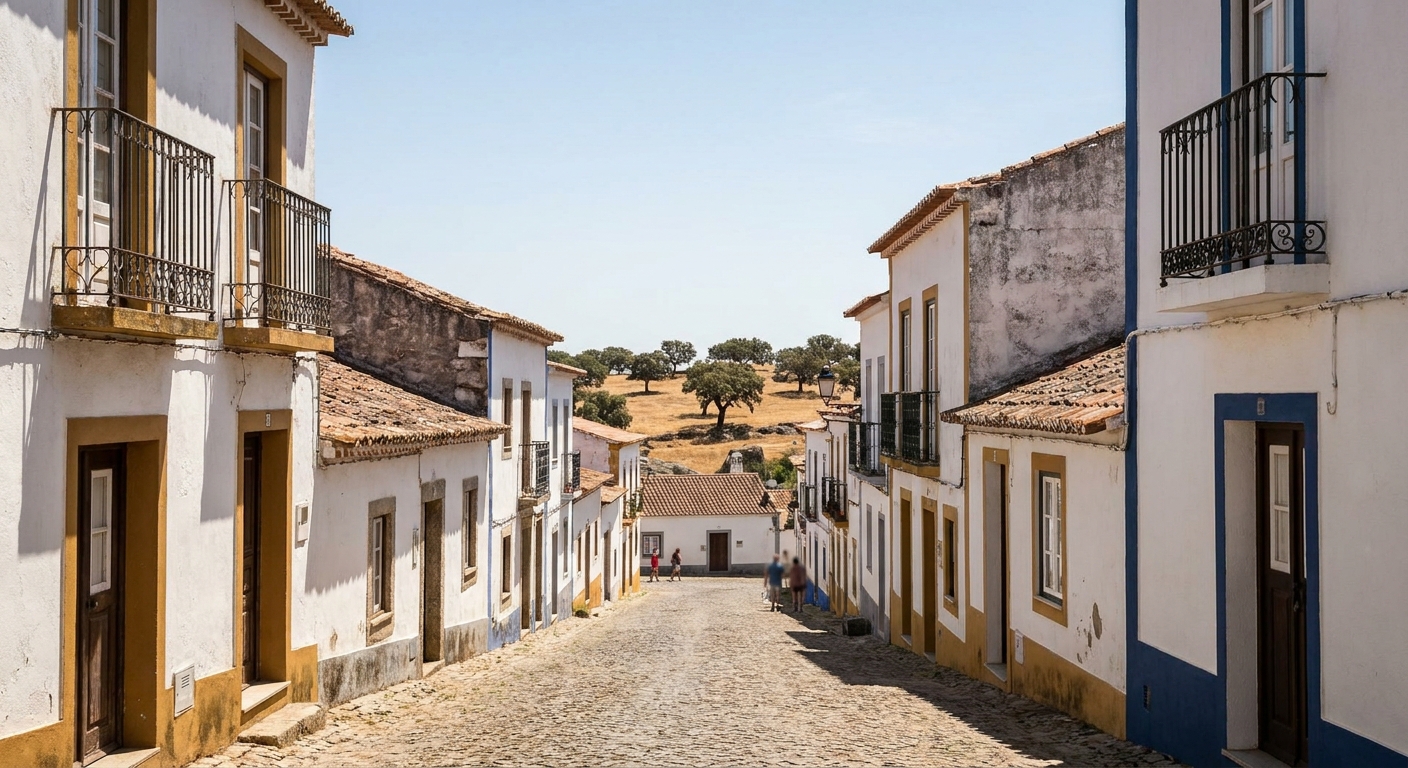
March buys a full outdoor day that February cannot quite deliver: 5.4°F more afternoon warmth for 0.33 inch more rain across the month, and a day that hits twelve hours by the 15th. That is enough to cross the walled center on foot, stop for lunch outdoors, and still have the late light for the ramparts. In February the same itinerary is a colder, shorter version of itself.
The center is compact and stacked in layers. The Temple of Diana still stands in the upper town, Roman stone in a city inhabited since the 2nd century BC, with stretches of the Roman wall beside it, reworked in the Visigothic period. Moorish rule ended in 1165 and left a fortified gate and the remains of the Kasbah. The Cathedral was completed in the 13th century. From the golden age that began in the 15th: São Francisco, the Convent of St Claire, and Os Loios with the church of São João Evangelista.
None of that stone changes with the month. The air around it does, and the 21.3°F swing is the whole of the season: a nave that feels like the 44.4°F night it just held, a square outside at 65.7°F. Plan interiors for the cold hours and streets for the warm ones, and note that we could not verify a single opening hour or admission price for any Évora monument. UNESCO describes the property, it does not run the visits, so check each door before you build an afternoon around it.
The free part of March is the part UNESCO singles out: not one monument but the coherence of the minor architecture of the 16th, 17th and 18th centuries, low whitewashed houses with Dutch tiles and wrought-iron balconies along streets of medieval layout. Two 16th-century patrician houses are named in the listing, the Cordovil house and the house of Garcia de Resende. Walking past them costs nothing. We found no published free-admission day, so we name none.
Évora in March: a two-day itinerary
Sunrise is 6:40 a.m. mid-month, and the hour after it sits closer to 44.4°F than to anything comfortable. Start around nine, indoors: the Cathedral first, then Os Loios and the church of São João Evangelista next door. By noon the air has climbed most of the way to 65.7°F, so give the early afternoon to the Temple of Diana and the Roman wall. Keep four to six for the whitewashed streets themselves, when the light is low on the tiles. Sunset is 6:40 p.m.
Day two belongs to the golden age: São Francisco, the Convent of St Claire, the Cordovil house and the house of Garcia de Resende, then the circuit of the 17th-century wall. Two days in an average March bring 0.39 inch or more, and if yours is one of them, invert the order. Interiors from mid-morning through mid-afternoon, walls and ramparts when the sky lifts. Reaching all of it from Lisbon is a road-and-rail question, and our getting-around guide handles it.
Évora in March vs February and April
| Normal (1991-2020) | February | March | April |
|---|---|---|---|
| Average high | 60.3°F | 65.7°F | 69.3°F |
| Average low | 41.0°F | 44.4°F | 47.3°F |
| Precipitation | 2.06 in | 2.39 in | 2.44 in |
| Days with 0.04 in or more | 7.0 | 7.5 | 8.0 |
The three months climb in an almost straight line at Évora: 60.3, 65.7 and 69.3°F by day, 41.0, 44.4 and 47.3 at night. Rain barely separates them at 2.06, 2.39 and 2.44 inches, on 7.0, 7.5 and 8.0 wet days. No sea temperature enters the comparison, since the city is inland and we found no water series for it. Where a coastal page does quote one, read it as an average of daily maxima, a little warmer than a 24-hour mean.
Shift four weeks forward and April pays you 3.6°F on the afternoon and 2.9°F on the night, for 0.05 inch and half a wet day more rain. That is the difference between a terrace at eight in the evening and a jacket. Shift back and February saves you almost nothing on rain, half a day, while costing 5.4°F of afternoon and a shorter day to spend it in.
Is March a good time to visit Évora?
Yes, for a trip built on walking. A 65.7°F afternoon and twelve hours of light are as much as a compact walled city asks for, and one day in four with rain is a manageable tax. No, if your picture of Portugal involves dinner outdoors without a coat or a week you can plan rigidly: 44.4°F nights and 2.0 soaking days a month do not support either.
If that is you, take April. It runs 69.3°F by day and 47.3°F at night, the rain rises only to 2.44 inches, and evening in the squares becomes a real proposition instead of a hopeful one. February is the wrong correction in the other direction, colder by 5.4°F with no dividend on the rain count.
March alone hands you the balance point of the year, twelve hours of daylight on the 15th, with an afternoon already 5.4°F above February’s and a center you can cross on foot between nine and sundown.
The last word
Book the bed inside the wall, carry the layer you will take off at eleven and put back on at six, and let the 21.3°F swing write the day for you: stone interiors in the cold hours, streets in the warm ones. And the reason there is a golden-age city here to walk through at all is an accident of geology. Évora came through the earthquake of 1755 largely undamaged, while the same shock destroyed much of Lisbon. Its 13th-century cathedral and its 16th-century houses never had to be rebuilt.
Sources & data for this guide
- March normals (high 65.7°F, low 44.4°F, 2.39 in) · IPMA, Instituto Português do Mar e da Atmosfera, climatological normals 1991-2020, station 558 Évora, altitude 247.6 m · checked Sep 24, 2026
- Wet-day counts (7.5 days at 0.04 in or more, 2.0 days at 0.39 in or more) · same IPMA normals · IPMA measures against 1 mm and 10 mm thresholds, not the 0.10-inch threshold of US tables, so the counts are not interchangeable · checked Sep 24, 2026
- February and April normals · same IPMA station, same 1991-2020 period, not estimates · checked Sep 24, 2026
- Sunrise 06:40 and sunset 18:40 on March 15, converted to Europe/Lisbon · sunrise-sunset.org · checked Sep 24, 2026
- Inscription in 1986 under criteria (ii) and (iv), Temple of Diana and Roman wall, end of Moorish rule in 1165, 13th-century Cathedral, São Francisco, St Claire, Os Loios, Cordovil and Garcia de Resende houses, Vauban-style wall by Nicolas de Langres, 1920 classification, the city spared by the 1755 earthquake · UNESCO World Heritage Centre, file 361 · checked Sep 24, 2026
- Opening hours and admission prices: we could not verify a single one for any Évora monument. UNESCO describes the property, it does not run visits · check each monument before you go
- Crowds, room rates and lodging tax: we found no occupancy series and no verified tax rate for Évora, so we crown no month and quote no percentage