
ÉVORA · DECEMBER · IPMA STATION 558
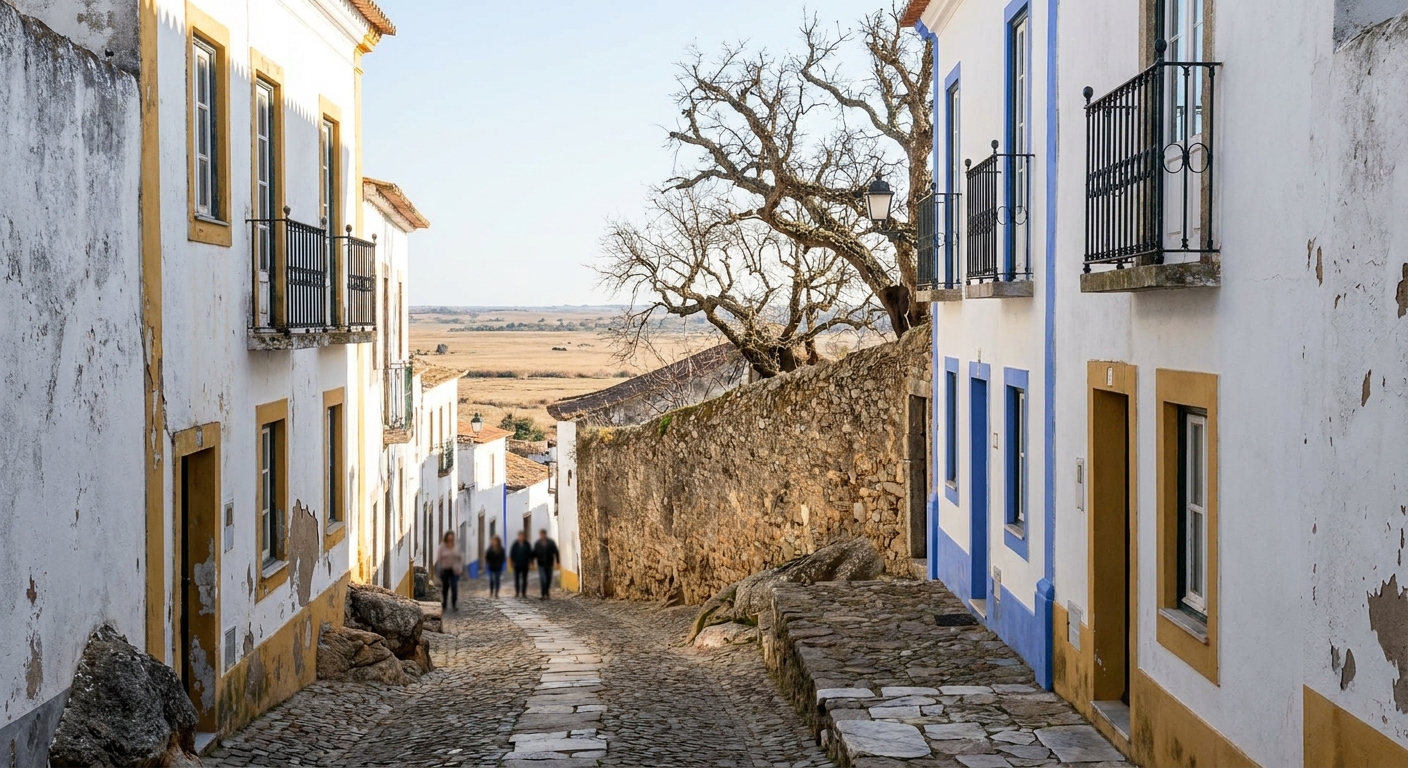
The granite columns of a Roman temple still stand at the top of Évora, a cathedral finished in the 13th century sits a few steps away, and the lanes running down from both are medieval, lined with low whitewashed houses under Dutch tiles and wrought-iron balconies. UNESCO put the whole center on the World Heritage List in 1986, calling it the finest example of a city of Portugal’s golden age after the 1755 earthquake flattened Lisbon. Évora came through that same shock mostly undamaged, and December is one of the better months to walk the proof.
The date costs you hours of light. On December 15 the town gets 9 hours 32 minutes of daylight and the sun is gone by 5:13 p.m., and 8.7 days in an average December record measurable rain. What the date hands back is an afternoon normal of 58.3°F, cool enough to climb every street twice without thinking about shade.
THE MONTH AT A GLANCE · ÉVORA · DECEMBER
December gives Évora cool walking weather near 58.3°F and a UNESCO-listed center you can cross on foot, inside 9 hours 32 minutes of daylight and around nine days of rain.
AVG HIGH 58.3°F · 8.7 RAIN DAYS · SUNSET 5:13 P.M. ON DEC 15
Go for: walking a golden-age town in 58.3°F air, the Roman Temple of Diana and its stretch of Roman wall, the 13th-century Cathedral, and cloisters that make sense when the rain arrives.
Think twice before: planning long evenings outdoors, with the sun down at 5:13 p.m. and 3.2 days in the month bringing 0.39 inch of rain or more.
Normals: IPMA station 558, 1991-2020 · Sun times: sunrise-sunset.org · Heritage: UNESCO file 361
On this page
- Évora weather in December58.3°F highs, 3.35 inches, 8.7 rain days
- How cold the mornings getA 16.8°F swing between low and high
- Crowds, prices and the lodging taxWhat our sources carry, and what they do not
- Things to do in Évora in DecemberTemple of Diana, the Cathedral, Os Loios
- A two-day plan for ÉvoraHour by hour inside 9h32 of daylight
- December vs November and JanuaryHow the three months compare, degree by degree
- Is December a good time to visit Évora?Yes for walkers, no for long evenings
Anything that isn’t set by the date lives elsewhere: the city’s full sights and history in our Évora guide, the surrounding plain in the Alentejo, the twelve-month view in the best time to visit Portugal, and trains, buses and the drive from Lisbon in getting around.
Évora weather in December: average highs, lows and rain days
| December in Évora | Normal, 1991-2020 |
|---|---|
| Average high | 58.3°F (14.6°C) |
| Average low | 41.5°F (5.3°C) |
| Precipitation | 3.35 inches |
| Days with 0.04 in (1 mm) or more | 8.7 |
| Days with 0.39 in (10 mm) or more | 3.2 |
| Daylight on December 15 | 9 hours 32 minutes |
Every figure here comes from IPMA, Portugal’s institute for the sea and the atmosphere, and from a single instrument: station 558 at Évora, 247.6 m above sea level, averaged over 1991-2020. That is a real thermometer standing in the town, not a model grid cell spread over the Alentejo, and the difference is worth knowing before you pack. It also means these normals describe Évora and nothing wider. High ground elsewhere in Portugal runs colder and far wetter in December, and the coast keeps its own weather.
An average December records at least 0.04 inch (1 mm) of rain on 8.7 days, so measurable rain falls roughly two days in seven, and 3.2 of those days bring 0.39 inch (10 mm) or more. Call it three proper soakings in the month, the kind that turn a cloister into the plan for an hour. One caution on the counting: IPMA starts at 1 mm, American tables usually start at 0.10 inch, and the two sets of rain days cannot be swapped. The monthly total is 3.35 inches.
Between the 41.5°F normal low and the 58.3°F normal high sits 16.8°F of daily swing, and in a town you cross on foot you feel all of it. Pack a morning layer you can carry by two o’clock rather than a coat you will regret at noon. Add shoes with grip, because Évora’s lanes are stone and they get slick, and a compact shell beats an umbrella in streets this narrow. Our packing guide covers the rest of the list.
On December 15 the sun rises at 7:40 a.m. and sets at 5:13 p.m., Portugal staying on UTC through the winter, for 9 hours 32 minutes of daylight. Sightseeing has to start at nine to get a full day out of that. From about four the light comes in sideways and turns the whitewash gold, and by half past five you are eating dinner rather than walking.
How warm is Évora in December?
The month averages 58.3°F by mid-afternoon and 41.5°F before dawn, 16.8°F apart. That afternoon figure runs 5.4°F below November and 0.9°F above January, so December sits at the top of the cold stretch rather than at the bottom of it. Nothing here is freezing on average, and nothing here is warm.
In practice you leave the hotel in a fleece and a shell at nine, and you are carrying one of them by one o’clock on a clear day. Sun on whitewashed walls makes a south-facing square feel warmer than the reading; a shaded lane on the north side of the Cathedral does the opposite. Evenings go back to the morning kit as soon as the sun drops.
We could not verify a count of frost nights at station 558, so we give no number, and the 41.5°F normal is a monthly average with individual nights falling well under it. As for swimming, Évora sits inland in the Alentejo and we hold no sea-surface reading for it. Where Portuguese sea temperatures are published they are averages of daily maxima, a shade warmer than a 24-hour mean, and the water trip is a different one: the Algarve guide has it.
How busy is Évora in December? Crowds, prices and the lodging tax
December falls outside the Portuguese summer by the calendar, and that is as far as we will take it: we found no monthly occupancy series and no room-rate series for Évora, so we crown no month cheapest and no month busiest. What we can date is the light and the weather. Nine and a half hours of daylight and 8.7 rainy days are the two constraints that actually shape a December visit here.
Without a rate series we give no lead time in weeks either. The structural fact is size: the historic center is held inside a 17th-century wall drawn in the Vauban manner by the French engineer Nicolas de Langres, and the ring road built around it in the 20th century still marks the edge of the walkable town. Beds inside that ring are a small pool. Country-wide budgets sit in our Portugal trip-cost guide.
We could not verify a municipal lodging-tax rate for Évora, so we give no percentage. Ask the property to state any per-person, per-night charge at the time of booking rather than discovering it at checkout.
The upgrade that changes a December stay is a room inside the wall with heating you can control. With the sun gone at 5:13 p.m. and nights averaging 41.5°F, the walk home from dinner should be ten minutes on stone, not a drive across the ring road, and the morning should start at the Cathedral rather than in a parking lot.
Things to do in Évora in December: the Temple of Diana, the Cathedral and Os Loios
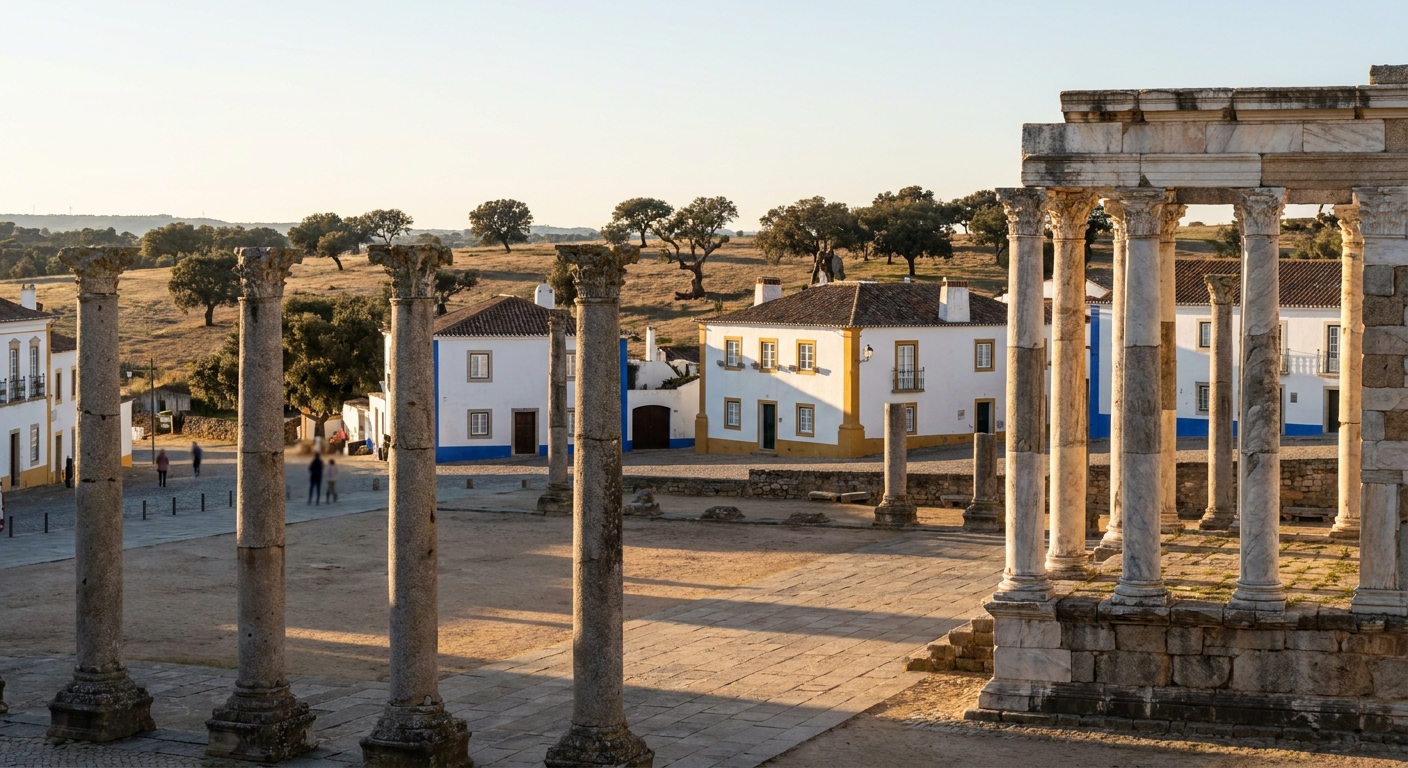
Cool air is the month’s gift. At 58.3°F you can do the full circuit of a walled town on foot, uphill sections included, in a way an Alentejo summer afternoon simply does not allow. The same 9h32 of daylight that shortens the day also keeps the sun low all of it, and low sun on whitewash and granite is what photographers come here for.
The list is compact and it is all within the walls. The ruins of the Temple of Diana stand at the high point, with stretches of Roman wall nearby that were reworked in the Visigothic period, on a site inhabited since the 2nd century BC. The Cathedral, completed in the 13th century, is the best known of the medieval buildings. Moorish rule ended in 1165 and left a fortified gate and remains of the Kasbah. From the 15th-century golden age come the Convent of St Claire, São Francisco, and Os Loios with its church of São João Evangelista.
None of those buildings change through the year, but the air around them does, and in December that reverses their role. A cloister that is a cool refuge in August is a cold stop in December, so plan interiors for the middle of the day and the walking for either side of it. On the 3.2 days that bring 0.39 inch or more, the order flips entirely and you spend the wet hours indoors. We hold no opening hour and no admission fee for any Évora monument, so confirm both with the site before you set out.
The free half of the visit is the one UNESCO singles out: not a single monument, but the coherence of the minor architecture from the 16th, 17th and 18th centuries. Walk the medieval street plan past the low whitewashed houses with their Dutch tiles and iron balconies, and stop at the two 16th-century patrician houses named in the listing, the Cordovil house and the house of Garcia de Resende. Since we could not verify which sites charge, we quote no admission anywhere.
Évora in December: a two-day itinerary
Day one starts with coffee at 8:30, twenty minutes before the town is properly light, and the Temple of Diana at 9:00 while the columns still have shadow in them. The Cathedral follows at mid-morning, then lunch inside the walls when the thermometer is closest to 58.3°F. Give the afternoon to Os Loios and São Francisco, be back outside by 4:00 for the gold light on the whitewash, and accept that the sun is gone at 5:13 p.m. and the day is now about dinner.
Day two goes to the houses and the defenses: the Cordovil house, the house of Garcia de Resende, the Moorish gate, and a loop of the 17th-century Vauban wall in the warmest part of the afternoon. If one of the month’s 3.2 heavy-rain days lands on you, drop the wall circuit, double the interior stops, and call ahead, since we carry no hours. A wet December morning in Évora is not a lost one; it is simply spent under vaults.
Évora in December vs November and January
| Month | Average high | Average low | Precipitation | Days 0.04 in or more |
|---|---|---|---|---|
| November | 63.7°F (17.6°C) | 46.2°F (7.9°C) | 3.39 in | 8.8 |
| December | 58.3°F (14.6°C) | 41.5°F (5.3°C) | 3.35 in | 8.7 |
| January | 57.4°F (14.1°C) | 40.1°F (4.5°C) | 2.70 in | 8.6 |
Afternoons fall 5.4°F from November to December, then only 0.9°F more into January, so the real step down happens before the holidays rather than after them. Nights follow the same shape: 46.2°F, then 41.5°F, then 40.1°F. The number of rainy days barely moves across all three months, 8.8 then 8.7 then 8.6, but the volume does, with January running 0.65 inch drier than December. Évora is inland, so none of the three offers a sea temperature to weigh.
Shift four weeks earlier and you buy warmer afternoons and longer days for the same count of wet ones: November in Évora makes that case. Shift four weeks later and you trade 1.4°F off the nights for a genuinely drier month and a day length that is growing again, which is the argument in January. December sits between the two, closer to January on the thermometer and closer to November on the rain gauge.
Is December a good time to visit Évora?
Yes, if your trip is built on walking and architecture. A compact walled town, 58.3°F afternoons and roughly two dry days out of three add up to a strong short break, and the interiors give the wet hours somewhere to go. No, if you want long evenings outside, warm nights or any kind of water: the sun is down at 5:13 p.m., and 41.5°F is the average night, not the cold one.
If that verdict lands on no, November is the better swap for most people, with afternoons at 63.7°F and nights at 46.2°F for an almost identical 8.8 rainy days. Pick January instead only if dryness outranks warmth, since it delivers 2.70 inches against December’s 3.35 while giving back nothing on temperature.
What December alone puts on the table is the shortest days of the year over a golden-age town that the 1755 earthquake left standing, with sideways light on the whitewash from four o’clock and no need to hide from the sun at any point.
The last word
Book two nights inside the wall, plant yourself at the Temple of Diana at nine on the first morning, and let the 5:13 p.m. sunset decide when dinner starts. One piece of the town’s survival rarely gets mentioned at the ticket desk: the walls were classified under national law in 1920, and the ring road laid around them in the 20th century is a large part of why the medieval street plan inside is still intact enough to get lost in. Do that getting lost in daylight, because you only have 9 hours 32 minutes of it.
Sources & data for this guide
- December normals (58.3°F / 41.5°F, 3.35 in) and rain-day counts (8.7 at 1 mm, 3.2 at 10 mm) · IPMA, 1991-2020 normals, station 558 Évora, altitude 247.6 m · checked Sep 24, 2026
- November and January normals · same IPMA station and same 1991-2020 period, not estimates · checked Sep 24, 2026
- Sunrise 7:40 a.m., sunset 5:13 p.m. and 9 hours 32 minutes of daylight on December 15 · sunrise-sunset.org, converted to Europe/Lisbon · checked Sep 24, 2026
- 1986 inscription under criteria (ii) and (iv), Roman temple and wall, 1165, 13th-century Cathedral, golden-age convents, 1553 university, Nicolas de Langres wall, 1920 classification · UNESCO World Heritage Centre, file 361 · checked Sep 24, 2026
- We could not verify opening hours or admission fees for any Évora monument, we found no occupancy or room-rate series for the city, and we could not verify a municipal lodging tax, so we quote no price and rank no month · check each site and your hotel when you book.