
ÉVORA · FEBRUARY · 1991–2020 NORMALS
Évora spends February in the 60s by day and the low 40s at night: 60.3°F when the afternoon peaks, 41.0°F before sunrise, 2.06 inches of rain across about seven days. Inside the walls that is walking weather with a sweater. The historic center is a UNESCO World Heritage property, inscribed in 1986 under criteria (ii) and (iv), and UNESCO calls it the finest example of a city of the golden age of Portugal after the 1755 earthquake destroyed Lisbon.
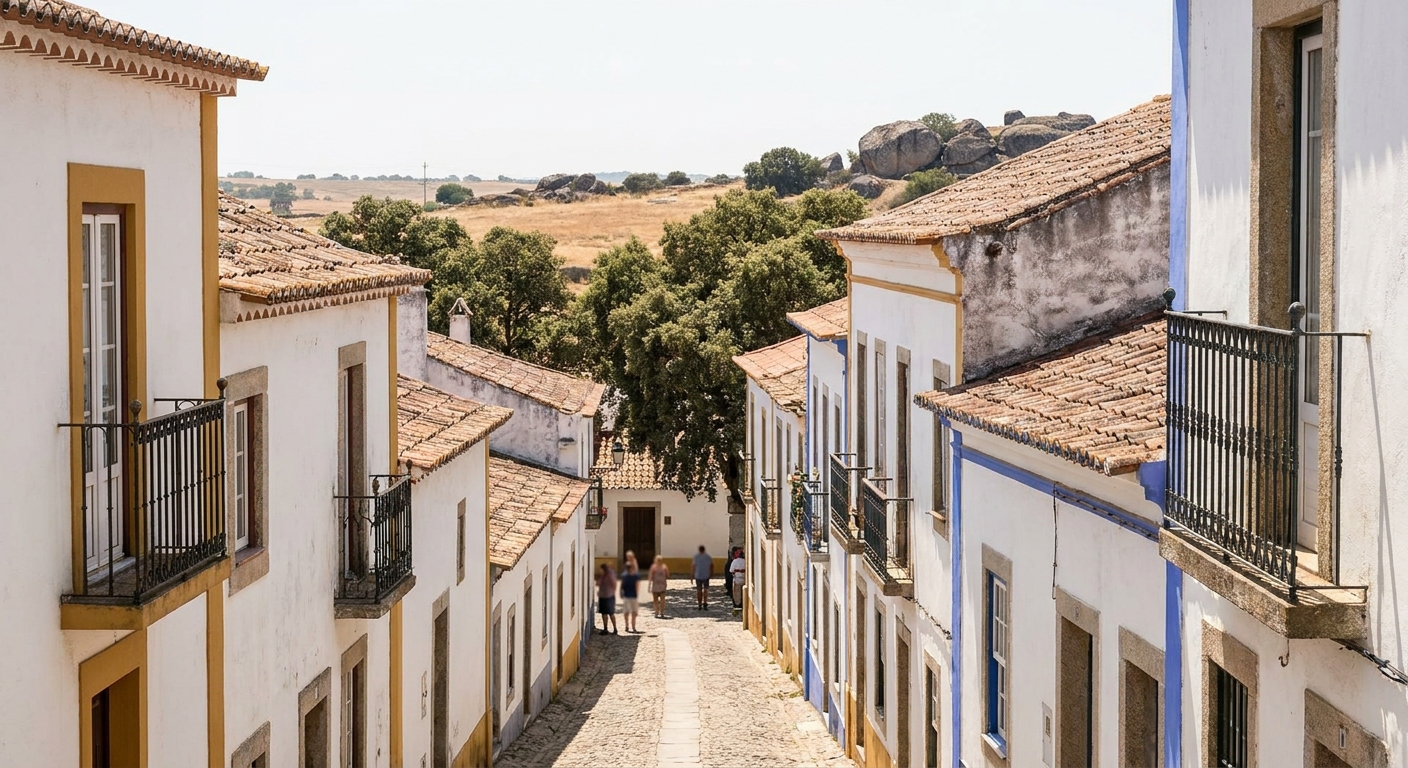
What the month withholds is warmth after dark. On February 15 the sun clears the horizon at 7:21 a.m. and drops at 6:10 p.m., for 10 hours 49 minutes of usable light, and the temperature falls with it. Dinner happens indoors, in a city of low whitewashed houses and narrow medieval streets. For the city outside the calendar, our Évora guide does that job.
FEBRUARY AT A GLANCE · ÉVORA
Évora in February is a walking city at 60.3°F with a 41.0°F morning attached: pack layers, sleep inside the walls, and expect rain on roughly one day in four.
IPMA 1991–2020 NORMALS · 7 WET DAYS · 10 H 49 MIN OF DAYLIGHT ON FEB 15
Go for: a walled golden-age center you can cross on foot at 60.3°F, Roman columns and a 13th-century cathedral, and afternoons that stay usable until 6:10 p.m.
Think twice before: packing for spring. Mornings sit at 41.0°F, and 7.0 February days in an average month record measurable rain.
Normals: IPMA station 558 Évora · Daylight: sunrise-sunset.org · Heritage: UNESCO property 361 · full sources at the end
On this page
- Évora weather in February60.3°F days, 2.06 inches, 7 wet days
- How cold the mornings get41.0°F nights and what to wear
- Crowds, prices and booking in FebruaryWhat we verified and what we could not
- Things to do in Évora in FebruaryTemple of Diana, the Cathedral, Os Loios
- A two-day plan for the old cityDay one and day two, hour by hour
- February vs January and MarchHow the three months compare
- Is February a good time to visit Évora?Who should go, who should shift
Every figure here comes from one thermometer: IPMA, the Portuguese national weather service, station 558 at Évora, altitude 247.6 m, normals for 1991 to 2020. Those numbers describe inland Alentejo and nothing else. High ground runs colder and far wetter, and the Algarve coast keeps its own weather, so nobody should pack for a mountain trail on an Évora reading.
Évora weather in February: average highs, lows and rain days
| February at Évora station (1991–2020) | Normal |
|---|---|
| Average high | 60.3°F (15.7°C) |
| Average low | 41.0°F (5.0°C) |
| Precipitation | 2.06 in |
| Days with 1 mm (0.04 in) or more | 7.0 |
| Days with 10 mm (0.39 in) or more | 1.7 |
| Daylight on February 15 | 10 h 49 min |
IPMA puts February at 60.3°F for the average high, 41.0°F for the average low and 2.06 inches of precipitation. That comes off a working station at 247.6 m inside the city, not a model grid cell averaged over a square of landscape, and the distinction is worth a sentence: a reanalysis cell and a real thermometer can differ by several degrees on the overnight minimum.
Seven days in an average February record at least 1 mm of rain, 0.04 inch, and 1.7 days record 10 mm or more, 0.39 inch. Those are IPMA’s own thresholds, not the 0.10-inch mark US tables use, so the two counts do not swap. Translated into a trip: roughly one February day in four gets measurable rain, most of it the sort you walk through, and a genuine soaking lands once or twice in the month.
Between the 41.0°F night and the 60.3°F afternoon sit 19.3 degrees, and you feel every one of them between breakfast and lunch. Pack a warm layer you can take off rather than a coat you are stuck inside, add something waterproof for that one day in four, and keep the shoes serious for cobbles. Our Portugal packing guide handles the rest of the suitcase.
On February 15 sunrise falls at 7:21 a.m. and sunset at 6:10 p.m., local clocks running on UTC at this time of year, for 10 hours 49 minutes of daylight. Low sun across whitewash is reason enough to be outdoors by mid-afternoon instead of lingering over lunch. By 6:30 the streets are dark and the evening belongs to a table.
How warm is Évora in February?
The month averages 60.3°F at its daily peak and 41.0°F at its overnight floor, 19.3 degrees apart. Both are thirty-year averages rather than forecasts, so single days land on either side: a run of still, sunny afternoons can sit above the normal, and an Atlantic front can hold the whole day in the forties.
In practice you dress twice. At 9 a.m. the air is barely off its minimum and a fleece plus a windproof layer is honest kit; by 3 p.m., with the sun on pale stone, most people are carrying the fleece rather than wearing it. Sitting still outside is a different calculation from walking, and February rewards the walking.
We could not verify a count of nights at or below freezing at station 558, so no frost figure appears in our numbers. What we can say is that the monthly average low sits 9.0 degrees above freezing, which leaves genuinely cold nights entirely possible. Évora is inland, so we carry no water temperature at all. For sea readings, that question belongs on the Algarve.
How busy is Évora in February? Crowds, prices and the booking window
February falls in the quiet stretch of the Portuguese travel calendar, after the Christmas holidays and before the spring run. That is a calendar fact, not a price one. We found no occupancy series and no monthly room-rate series for Évora, so we crown no month cheapest and none dearest. For what a Portuguese trip costs across the board, our trip cost guide carries the national picture.
Book the room before the car. We could not verify any booking lead-time data for Évora, so we give no number of weeks, only the order of operations: a bed inside the walls first, then the rental that turns the city into the wider Alentejo. Tolls and insurance are covered in our rental guide, and the transatlantic side sits in flights from the US.
On tourist tax, we could not verify a rate for Évora, so no percentage appears in our numbers and none should appear in your budget until the property confirms it. Ask at booking whether a municipal charge applies and how it is collected, the same question worth asking anywhere in Portugal.
The one upgrade that changes February is location, not thread count. With daylight gone by 6:10 p.m. and rain on roughly one day in four, the walk between your bed and the Cathedral decides whether you see a monument before dark or negotiate a ride. Our where to stay guide sets the regional frame for the rest of the trip.
Things to do in Évora in February: the Temple of Diana, the Cathedral and Os Loios
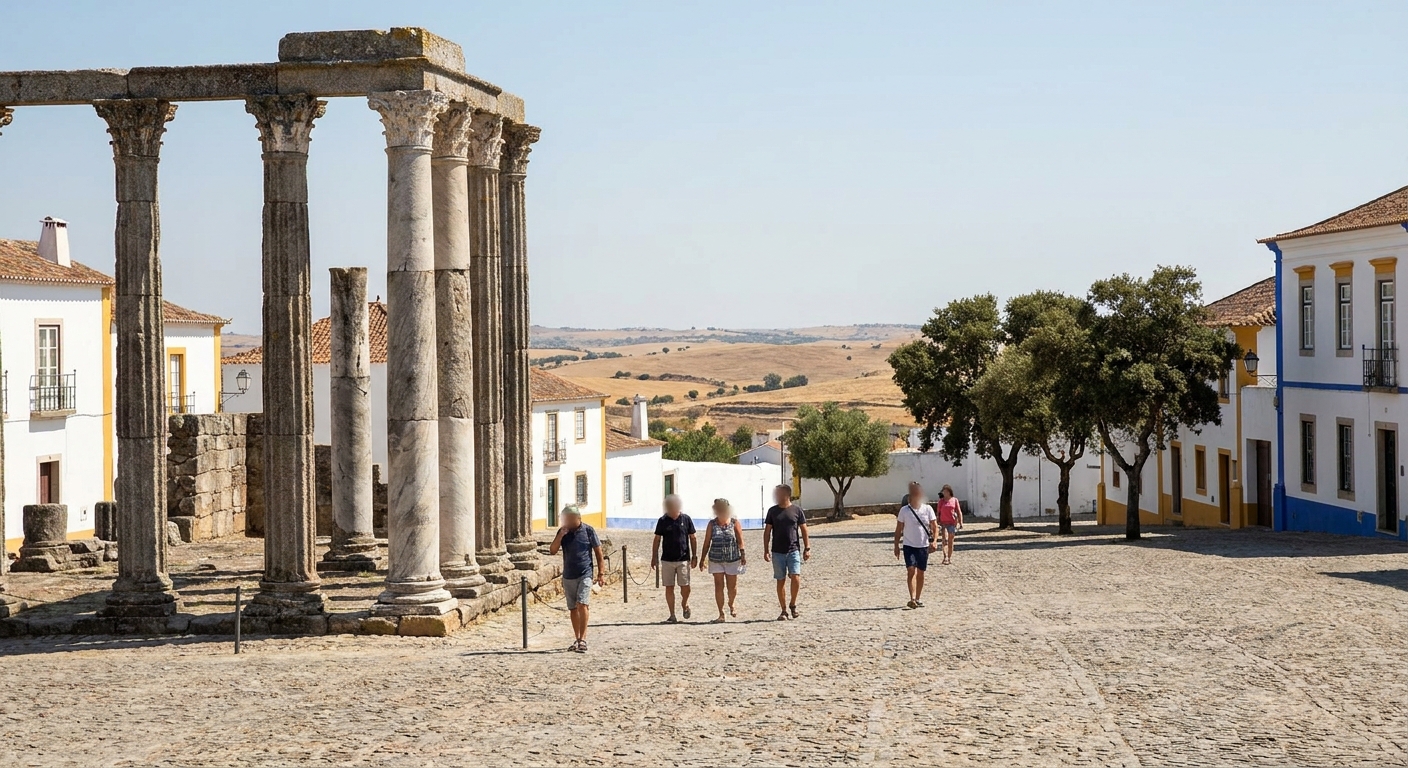
February hands Évora the lowest rainfall of the three winter months, 2.06 inches against 2.70 in January and 2.39 in March, and the fewest wet days of the three at 7.0. In a city whose pleasure is a slow walk between Roman columns and a medieval cathedral, that counts for more than a couple of degrees on the thermometer.
The ruins of the Temple of Diana still stand, together with parts of the Roman wall later reworked under the Visigoths. Moorish rule ended in 1165 and left a fortified gate and the remains of the Kasbah. The Cathedral was completed in the 13th century. From the 15th century the golden age added the Convent of St Claire, the royal church and convent of São Francisco, and the Convent of Os Loios with its church of São João Evangelista.
None of that stone shifts with the calendar; the air does. February afternoons run 2.9 degrees above January’s and 5.4 below March’s, and the low sun of the month does generous things to whitewash, Dutch tiles and wrought-iron balconies along streets laid out to a medieval plan. The two 16th-century patrician houses UNESCO names, the Cordovil house and the house of Garcia de Resende, sit on that same walk.
No admission fee for any Évora monument turned up in our sources, so we will not tell you which doors are free and which are ticketed. The walking needs no ticket either way: the Vauban-style wall drawn by the French engineer Nicolas de Langres in the 17th century, classified under national law in 1920, rings squares and lanes that cost nothing to cross.
Évora in February: a two-day itinerary
Sunrise comes at 7:21 a.m., and little is gained by beating it: the air is still near its 41.0°F floor. Start around 9:30 at the Temple of Diana with the warm layer on, take the Cathedral next, then let the morning wander the narrow streets toward lunch indoors at one. By three the thermometer is close to 60.3°F, which is the hour for the wall ring and the views off it. Be at a table by 6:10 p.m., when the light goes.
Day two belongs to the golden age: Os Loios and São João Evangelista, São Francisco, the Convent of St Claire, and the quarter around the university where the Jesuits taught from 1553 until the Company was expelled in 1759. Rain turns up on about one day in four, and 1.7 days a month bring 10 mm or more, so keep the order loose. Interiors first, a two-hour lunch, outdoor loop pushed to whichever half of the day dries out.
Évora in February vs January and March
| Month | Average high | Average low | Precipitation | Days ≥ 1 mm (0.04 in) |
|---|---|---|---|---|
| January | 57.4°F (14.1°C) | 40.1°F (4.5°C) | 2.70 in | 8.6 |
| February | 60.3°F (15.7°C) | 41.0°F (5.0°C) | 2.06 in | 7.0 |
| March | 65.7°F (18.7°C) | 44.4°F (6.9°C) | 2.39 in | 7.5 |
February runs 2.9 degrees warmer by day than January, 60.3°F against 57.4°F, and 5.4 cooler than March at 65.7°F. Nights barely move across the three: 41.0°F here, 40.1 in January, 44.4 in March. Rain is where the month separates itself, 2.06 inches over 7.0 wet days against January’s 2.70 over 8.6. None of the three carries a water temperature, since the city sits inland.
Shift four weeks forward and March pays 5.4 degrees of afternoon and 3.4 of night, at a cost of 0.33 inch more rain and half a wet day. Shift back to January and you drop 2.9 degrees by day and take on 1.6 extra wet days plus 0.64 inch. The full readings sit on our January page and March page.
Is February a good time to visit Évora?
Yes, if a good day means five or six hours on foot inside a walled city with a sweater in the bag. The month delivers 60.3°F afternoons, 7.0 wet days and monuments that owe nothing to the season. No, if you want warm evenings on a terrace or any kind of swimming: 41.0°F nights shut the outdoor day down at 6:10 p.m., and the coast is a separate trip.
If the answer is no, March is the correction: 65.7°F by day and 44.4°F at night, bought for 0.33 inch more rain and half a wet day. Read it in Évora in March. Anyone weighing the whole country rather than this city should start at our best time to visit Portugal verdict.
Among January, February and March, only February combines the lowest rainfall total, 2.06 inches, with the fewest wet days, 7.0, and afternoons that have already cleared 60°F.
The last word
Take the bed inside the walls, put a warm layer and a rain shell in the day bag, and start walking at 9:30, once the 41.0°F morning has loosened. One reason the walk repays the effort more here than almost anywhere in Portugal: the great earthquake of 1755 flattened much of Lisbon and left Évora mainly undamaged, so the golden-age city the kings lived in from the 15th century is still standing, medieval street plan and all.
Sources & data for this guide
- February normals (60.3°F, 41.0°F, 2.06 in), wet-day counts and station altitude · IPMA, climate normals 1991–2020, station 558 Évora, 247.6 m · checked Sep 24, 2026
- January and March normals used in the comparison · same IPMA 1991–2020 series, station 558 · checked Sep 24, 2026
- Sunrise 7:21 a.m., sunset 6:10 p.m. and 10 h 49 min of daylight on February 15, converted to Europe/Lisbon · sunrise-sunset.org · checked Sep 24, 2026
- Inscription in 1986 under criteria (ii) and (iv), Roman and Moorish remains, the 13th-century Cathedral, the golden-age convents, the Cordovil and Garcia de Resende houses, the Vauban-style wall by Nicolas de Langres and the 1920 classification · UNESCO World Heritage Centre, property 361 · checked Sep 24, 2026
- We found no opening hour and no admission price for any Évora monument, and no occupancy, room-rate or tourist-tax figure for the city · confirm hours, tickets and local charges with each monument and your property before you book.