
COIMBRA · JANUARY · THE MONDEGO VALLEY
Winter in Coimbra is a hill problem. The old university stands on high ground above the Mondego, the lanes that reach it are steep, and in January measurable rain falls on about eleven days out of thirty-one. Afternoons average 59.0°F. Mornings start near 41.4°F. By the middle of the month the light is gone at 5:33 p.m.
Which is convenient, because the part of Coimbra people travel for is mostly indoors and mostly uphill: 36.2 hectares of inscribed university buildings, the Royal Palace of Alcáçova, St Michael’s Chapel, the Joanine Library, all a few minutes from one another. A wet January day costs you the Botanical Garden, not the visit.
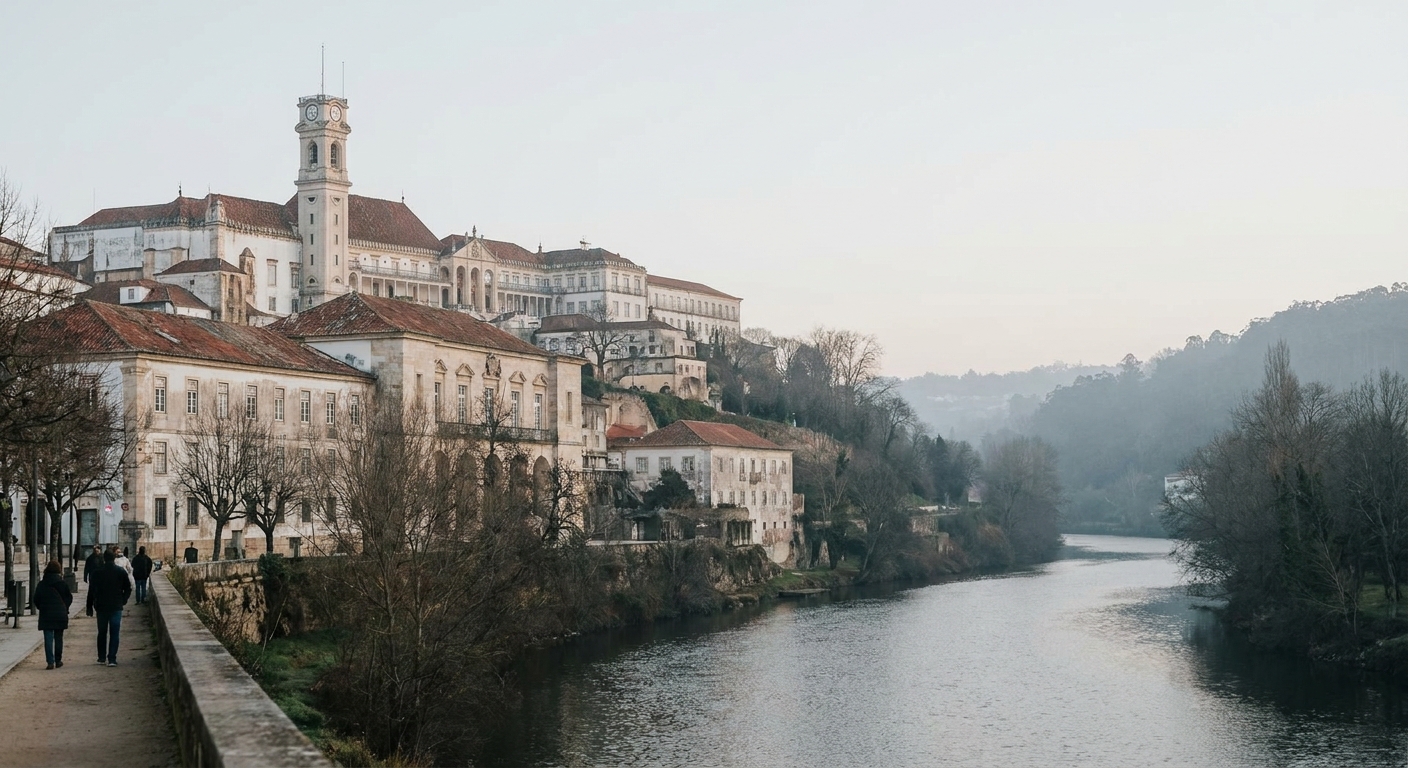
JANUARY AT A GLANCE · COIMBRA
January is Coimbra’s indoor month: 59.0°F afternoons, 11.3 days of measurable rain and 9 hours 40 minutes of daylight, which suits a heritage visit and frustrates a garden one.
OFF PEAK · 11.3 WET DAYS · SUNSET 5:33 P.M. · TWO NIGHTS MINIMUM
Go for: the inscribed Alta and Sofia Street at a walking pace, long interiors on the wet days, and afternoons that still reach 59.0°F on the hill.
Think twice before: building the trip around the Botanical Garden or the riverbank, with rain on roughly one day in three and the light closing at 5:33 p.m.
Normals: IPMA station 707 Coimbra Bencanta, 1991-2020 · Daylight: sunrise-sunset.org · Heritage: UNESCO file 1387bis
On this page
- Coimbra weather in JanuaryHighs of 59.0°F and 11.3 wet days
- How cold it gets, and what to wearLows of 41.4°F and a 17.6°F swing
- Crowds, room prices and the lodging taxWhat we verified, and what we did not
- Things to do in Coimbra in JanuaryThe Joanine Library, Sofia Street, the Botanical Garden
- A two-day plan for JanuaryTwo days paced to 9 h 40 min of daylight
- January vs December and FebruaryHow the three months compare
- Is January a good time to visit Coimbra?Our answer, and the month to swap to
Coimbra’s addresses, beds and buses sit in our city guide. January’s own contribution is narrower: 59.0°F afternoons, 11.3 days of measurable rain, and daylight that closes at 5:33 p.m. at mid-month. Those three figures set the order of the days below, and the national picture runs month by month in when to visit Portugal.
Coimbra weather in January: average highs, lows and rain days
| Coimbra, January (1991-2020) | Normal |
|---|---|
| Average high | 59.0°F (15.0°C) |
| Average low | 41.4°F (5.2°C) |
| Day-night spread | 17.6°F |
| Precipitation | 4.47 in |
| Days with 0.04 in (1 mm) or more | 11.3 |
| Days with 0.39 in (10 mm) or more | 4.3 |
| Daylight, January 15 | 9 h 40 min · sunrise 7:52 a.m., sunset 5:33 p.m. |
These normals come from IPMA, Portugal’s national weather service, station 707 at Coimbra Bencanta, a real thermometer sitting 26.6 meters above sea level, averaged over 1991 to 2020. January’s average high is 59.0°F, the average low 41.4°F, and normal precipitation 4.47 inches. Every figure here was measured on the valley floor. High ground east of the city runs colder and far wetter, and the coast keeps its own weather, so do not pack for a mountain trail on a Bencanta reading.
In an average January, 11.3 days record at least 0.04 inch (1 mm) of rain and 4.3 of them reach 0.39 inch (10 mm) or more. Translated: something falls roughly one day in three, and about one day in seven is a soaking rather than a shower. Those are IPMA’s thresholds, not the 0.10-inch threshold American tables use, so the counts do not line up with a US city’s rain-day figure. Most wet days here are twenty minutes you sit out over coffee.
Between the 41.4°F morning and the 59.0°F afternoon lies 17.6 degrees of swing, and that spread is what goes in the bag: a warm layer you can shed by noon, a waterproof shell rather than an umbrella for the steep lanes, and shoes with grip, since the Alta’s cobbles run downhill and wet. Our Portugal packing guide has the full kit.
On January 15 the sun rises at 7:52 a.m. and sets at 5:33 p.m. local time, Portugal running on UTC through the winter, for about 9 hours 40 minutes of daylight. Useful hours therefore run from a late breakfast to roughly four in the afternoon, and any viewpoint plan belongs before five, not after dinner.
How warm is Coimbra in January?
The month’s two anchor numbers are the 59.0°F average high and the 41.4°F average low, 17.6 degrees apart. Neither is extreme for a European winter, and neither describes the inside of a 16th-century college, where the stone lags well behind the street. Both are thirty-year means, so individual days land on either side.
At eight in the morning, with the thermometer near its 41.4°F floor and the sun not yet over the ridge, you want a real jacket and a hat for the climb. By two on a dry afternoon, 59.0°F with sun on the façades is shirt-plus-one weather, and the jacket becomes the thing you carry. Anyone walking the hill twice a day will do that undressing routine twice a day.
We could not verify a count of frost nights at Bencanta: IPMA’s published January normals give the mean minimum and no frequency of days at or below freezing, so we name no number. What the mean does say is that a typical night sits about nine degrees above freezing. Bencanta is also an inland valley station, and we verified no sea-surface temperature for the nearest coast, so we quote none.
How busy is Coimbra in January? Crowds, room prices and the lodging tax
January sits in the off-peak part of the calendar, after New Year and long before Easter. That is a statement about dates, not about rates: we found no occupancy series and no monthly room-rate series for Coimbra, so we crown no month the cheapest and none the dearest.
Without a rate series we will not invent a number of weeks to book ahead. What the month does change is which room is worth having. With 11.3 wet days and a hill between the riverside and the university, a bed inside the Alta removes two climbs a day from the itinerary, and that convenience is worth more in January than in May. Our where-to-stay guide sets out the trade-offs city by city.
We could not verify a municipal lodging-tax rate for Coimbra, so no percentage and no per-night figure appear here. Ask the property at booking whether one is added on arrival, and build the rest of the budget with our Portugal cost guide.
One upgrade genuinely changes this month: heating. Ask whether the room has it, whether it runs at night, and whether the bathroom is on an outside wall. An average low of 41.4°F outside a building designed for a different century is the difference between a good trip and one spent under a duvet at nine in the evening.
Things to do in Coimbra in January: the Joanine Library, Sofia Street and the Botanical Garden
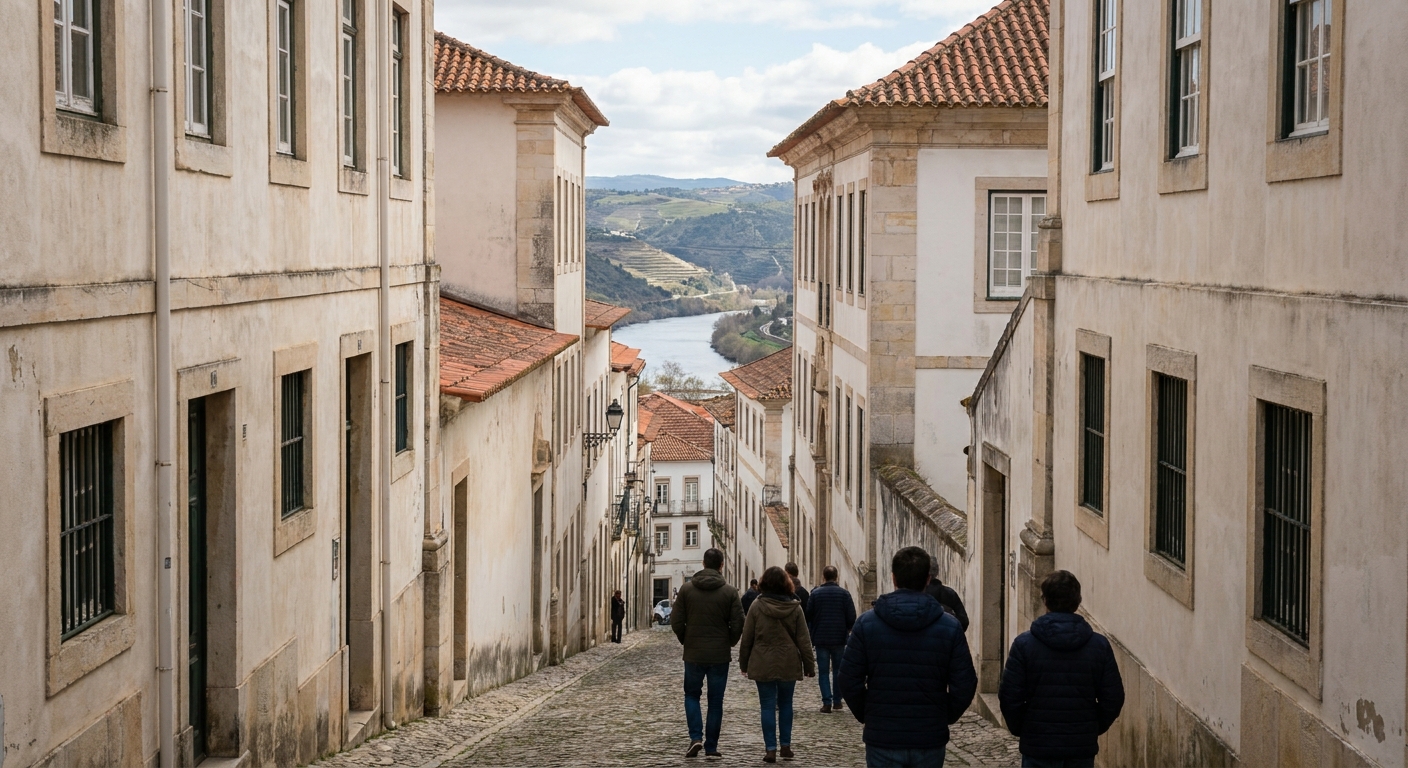
A 5:33 p.m. sunset moves the viewpoint hour into the afternoon: in January you climb for the view over the town after lunch, not after dinner. UNESCO flags that view as fragile, noting that the university reads as a citadel of learning only thanks to its hilltop position and that large-scale building around it has already modified the authenticity of the setting. The far bank of the Mondego remains the standard vantage point.
The inscribed property covers 36.2 hectares, with an 80.8-hectare buffer zone, and comes in two components. Up top, the Alta: the Royal Palace of Alcáçova, occupied by the university in 1537, St Michael’s Chapel, the Joanine Library and its baroque interior, plus six colleges from Jesus to St Rita. The 18th century added the chemistry laboratories, the Botanical Garden and the University Press. Downhill, Sofia Street carries nine more colleges, including the old Royal College of the Arts, used by the Inquisition.
Stone interiors have no season, and the Joanine’s rooms in January look as they do in July. The air outside does the changing: 41.4°F at dawn against 59.0°F after lunch, with rain on eleven days of the month. Sequence accordingly, interiors on the wet days, the Botanical Garden and the open-air University City built in the 1940s on the dry ones. We verified no opening hour and no admission price for the Joanine Library or any other building named here, so check the university’s own ticket page before you climb.
What costs nothing in January is the walking: Sofia Street and its college façades, the lanes of the Alta inside the buffer zone, the exterior of the 12th-century Santa Cruz that UNESCO lists among the university buildings, and the riverbank angle on the hill. Whether any museum runs a free winter slot we could not confirm, so we list none.
Coimbra in January: a two-day itinerary
Day one is paced to 9 hours 40 minutes. Coffee at 8:30, while the street is still near its 41.4°F low. Up the hill by 9:30 and stay under a roof through the cold half of the morning: Alcáçova, St Michael’s Chapel, the Joanine Library, with hours confirmed the night before. Eat at the top. Come out around two, when the average says 59.0°F, and walk Sofia Street downhill façade by façade. Be on the far bank by five for a 5:33 sunset.
Day two: Santa Cruz and the lower town in the morning, the Botanical Garden and the 1940s University City after lunch, the riverside path linking them. If one of the month’s 4.3 heavy-rain days lands on you, invert the order, keep both halves indoors, hold the garden for the next dry window, and use the train as a plan B with our getting-around guide.
Coimbra in January vs December and February
| Normal (1991-2020) | December | January | February |
|---|---|---|---|
| Average high | 60.1°F (15.6°C) | 59.0°F (15.0°C) | 61.5°F (16.4°C) |
| Average low | 43.2°F (6.2°C) | 41.4°F (5.2°C) | 41.9°F (5.5°C) |
| Precipitation | 4.38 in | 4.47 in | 3.19 in |
| Days with 0.04 in or more | 11.1 | 11.3 | 8.6 |
| Station | IPMA 707 Bencanta | IPMA 707 Bencanta | IPMA 707 Bencanta |
Across the three, January is the coldest at both ends: 59.0°F days against December’s 60.1 and February’s 61.5, and 41.4°F nights against 43.2 and 41.9. It is also the wettest, by a hair over December, 4.47 inches to 4.38, and by a clear margin over February in frequency, 11.3 wet days to 8.6. No sea temperature enters the comparison, since Bencanta is an inland valley station and we verified none for the coast.
Push the trip four weeks forward and February hands back 2.5°F on the afternoons, 1.28 inches of rain and 2.7 wet days, which on a five-day visit is roughly one dry day recovered. Slide back to December instead and you gain 1.8°F on the nights while losing almost nothing in rainfall, 0.09 inch, but the days are shorter and Christmas and New Year sit in the middle of the month.
Is January a good time to visit Coimbra?
Yes, if your Coimbra is the university. Thirty-six hectares of inscribed buildings, most of them roofed and within minutes of each other, is a strong hand to hold when rain falls one day in three. No, if you came for terraces, long river afternoons or the Botanical Garden as the main event, because 11.3 wet days and a 5:33 p.m. sunset will trim that trip before you start.
If the answer is no, February is the nearest fix and the easiest swap: 61.5°F afternoons, 3.19 inches of rain, 8.6 wet days, roughly three fewer soakings across the month, with the same hill, the same interiors and the same short walk between them.
If one argument belongs to January alone among the three, it is the arc of the day: dawn near 41.4°F on a hill of cold stone, then 59.0°F sun on the same stone by two in the afternoon, a 17.6°F swing against December’s 16.9.
The last word
Take the room on the hill, save the Joanine Library and St Michael’s Chapel for the first wet morning, and treat the Botanical Garden as an option rather than a fixture. And know what you are climbing toward: UNESCO credits Coimbra with training the elite for every territory under Portuguese administration and with setting the institutional and architectural model for universities across the Lusophone world. Seven centuries of it, from a late-13th-century academy to the University City built in the 1940s, fit inside a core you can cross in one January afternoon.
Sources & data for this guide
- January normals, highs, lows, precipitation and rain-day counts · IPMA, normais climatológicas 1991-2020, station 707 Coimbra Bencanta, altitude 26.6 m · checked Sep 23, 2026
- December and February normals, same station and same 1991-2020 period · IPMA · checked Sep 23, 2026
- Sunrise 07:52 and sunset 17:33 on January 15, converted to Europe/Lisbon · sunrise-sunset.org · checked Sep 23, 2026
- Inscription in 2013, criteria (ii), (iv) and (vi), minor boundary modification in 2019, 36.2-hectare property, 80.8-hectare buffer zone, components and buildings · UNESCO World Heritage Centre, file 1387bis · checked Sep 23, 2026
- IPMA counts rain days at 1 mm and 10 mm thresholds, not the 0.10-inch threshold used in US tables · the counts are not interchangeable
- We could not verify opening hours or admission prices for the Joanine Library or any other building named here, nor a municipal lodging-tax rate, nor any occupancy or room-rate series for Coimbra · checked Sep 23, 2026