
Every October the Japanese weather news adds a new map to the evening broadcast, with a red front creeping down the archipelago and a date pinned to each city. Travelers pick up on it fast, and the first question is usually whether a Kyoto trip in early November is too soon. The short answer is that the maples redden from the far north in the weeks of mid-autumn, and the big southern cities, Kyoto among them, turn last, around the start of December.
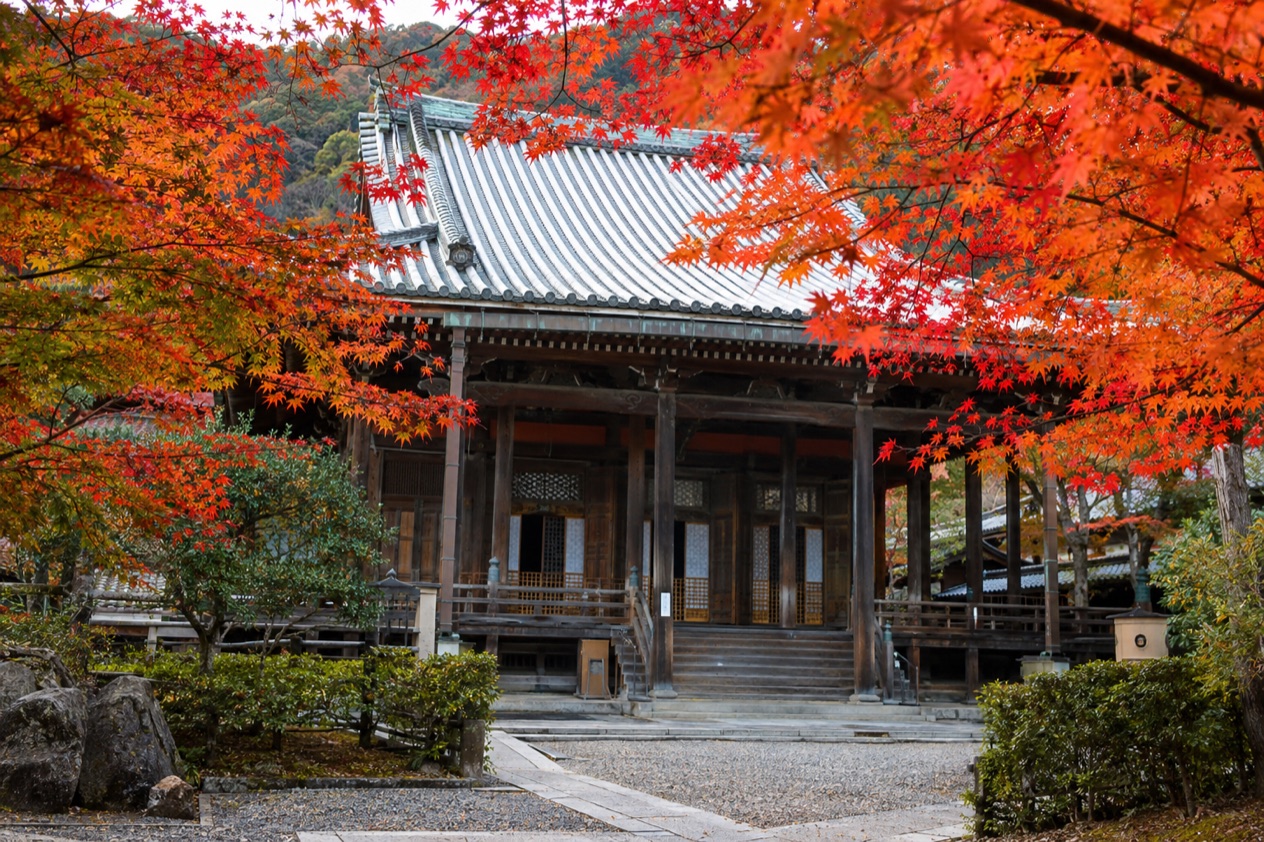
When do the leaves change color in Japan?
The maples change color from mid-October in eastern Hokkaido to early or mid December on the Pacific coasts of the main island and in southern Kyushu, so the answer depends entirely on where you stand. Japan treats this as a moving front, and the Japan Meteorological Agency tracks it each year with a date for each station city, called kaede koyo, the maple color change.
The custom of going out to look at red leaves has its own word, momijigari, literally leaf hunting. It sits next to hanami, the cherry blossom picnic, as one of the two great seasonal outings, and it is why the usual dates matter so much to anyone planning a trip around them.
What the date actually measures
The agency defines the color change day as the first day on which, looking at the whole of a sample tree, most of its leaves have turned red. That is a precise marker, and it is worth reading correctly. It does not mean the first red leaf of the season, and it does not mean the last day a tree holds its color. It marks the point when a tree has gone mostly red.
Because the marker is one sample tree in one city, treat each date as a landmark for the area, not a guarantee for every garden or hillside. From one autumn to the next the day can slide by several days in either direction, sometimes arriving early in a city and late in the next. The dates below are the usual ones for each city.
The usual day for sixteen cities
| City | Usual maple color change day |
|---|---|
| Sapporo | October 28 |
| Hakodate | November 2 |
| Nagano | November 12 |
| Aomori | November 13 |
| Nara | November 21 |
| Sendai | November 21 |
| Hiroshima | November 22 |
| Kanazawa | November 24 |
| Tokyo | November 28 |
| Nagoya | November 28 |
| Osaka | December 1 |
| Kobe | December 1 |
| Fukuoka | December 1 |
| Kyoto | December 5 |
| Yokohama | December 14 |
| Kagoshima | December 15 |
Read down the list and a few things stand out. Sapporo comes first of all the cities, with Hakodate close behind, while Kagoshima and Yokohama sit at the very end. Tokyo reddens ahead of Osaka, Kobe and Kyoto, which surprises visitors who assume the more southern city is simply warmer and therefore earlier, or that the old capital leads the way.
What the list says about popular cities
Nara and Kyoto are a good example of how two places in the same region can differ. Nara reaches its color change days before Hiroshima and Kanazawa, while Kyoto arrives about two weeks after Nara. Anyone who pairs the two cities in a single trip will see the leaves at different stages, and the earlier city may already be past its first red by the time the later one starts.
Tokyo and Nagoya share the same usual day, and so do Osaka, Kobe and Fukuoka. Yokohama, a short step on the map from Tokyo for travelers, falls in a quite different part of the calendar, at the end of the autumn leaf season. Nagano and Aomori, meanwhile, come in the middle of November, ahead of Sendai and Nara.
How does the season move across the country?
The color travels from the cool far north and the high ground down toward the warm Pacific coasts and the south, which means red leaves can be found somewhere in Japan across a stretch of several weeks. The agency describes the progress in broad bands, and the table gives them in order.
| Area | When the color change reaches it |
|---|---|
| Eastern Hokkaido | Starts in mid-October |
| Tohoku region and eastern Hokuriku | Around November 20 |
| Kanto, Hokuriku, Tokai, Chugoku, Shikoku and northern Kyushu | Around November 30 |
| Pacific coasts of Kanto and Tokai, the Kinki region and southern Kyushu | Early to mid December |
Hokkaido and Tohoku: the first red
Autumn opens in eastern Hokkaido, and the city dates agree with that picture, since Sapporo and Hakodate are the two earliest on the list. For a visitor this is the start of the season, and a trip aimed at the far north catches the color before the main island has begun to turn.
Tohoku, the northern part of the main island, comes next. Aomori and Sendai give two readings in that region, and they are not far apart from the regional band.
The middle band: Kanto, Tokai, Chugoku and beyond
A very wide band of the country, from Kanto to Hokuriku, Tokai, Chugoku, Shikoku and northern Kyushu, reaches its color change at about the same time, at the end of November. For travelers it means that a late-November trip can land in the red in several regions at once.
This is the part of the season that rewards a flexible mind. A city that looks early or late in the table may well come in a different order from one year to the next, so the regional band is a better guide to the general window than any single date in it.
The last to turn: coasts, the Kinki region and the south
The warm Pacific coasts of Kanto and Tokai, the Kinki region and southern Kyushu close the season, from early to mid December. In city terms that means Kyoto, Osaka and Kobe in the Kinki region, plus Yokohama on the Kanto coast and Kagoshima in the south of Kyushu. A visitor arriving in those places in early November would be early for the maples, and one in mid-December may find the color still arriving.
This is also why a single date for the whole country does not exist. The same fortnight can find Hokkaido bare, the middle of the main island at full red, and the south still green, and the plan has to follow that sequence.
How do you plan around it?
Plan by city, not by country: pick the places you want to see, look up their usual color change day, and arrange the trip so that each stop falls close to that date.
Choose a window first, then the cities
If your dates are fixed, let them decide the destination. A trip in the early part of November points toward Hokkaido, Nagano and Aomori, where the leaves are already red or close to it. A trip in early December suits Osaka, Kobe, Fukuoka and Kyoto.
If instead you are set on one city, work in the other direction and place your arrival a little ahead of its usual day. The agency marks the moment when most leaves are red, so a stay that begins just before and runs through it covers the lead-up as well as the peak color.
Stringing cities together by date
The calendar itself suggests a sequence. Start in the north when the leaves are first red, move into the middle band as the month ends, and finish among the Kinki cities as December opens. Done in that order, a long trip can follow the front down the country and keep meeting leaves at about their best.
A shorter trip works the same way on a smaller scale. Nara and Kyoto, for example, are two weeks apart in the table, so an itinerary that visits Nara first and Kyoto later puts each close to its own date. Tokyo and Yokohama are far apart in the calendar too, which makes Yokohama a candidate for the end of a trip, not for a day added to the Tokyo stay.
Leaving room for a shifting calendar
The date for any city moves by days from one autumn to the next, and the move can go either way. Kyoto, Sapporo and Nagano have all come later than their usual day in recent years, while Nara, Tokyo and Kobe have come earlier. That is the strongest argument for an itinerary with some room in it, such as an extra night in a city instead of a tightly timed hop.
It also helps to keep a second option in the plan. If a city seems to be running late, a neighbor with an earlier usual day can take its place, and the reverse is true when the color comes ahead of schedule. Reading the leaf news in the weeks before departure is the habit that Japanese travelers follow, and it is easy to copy.
Good to know before you go
Autumn leaves are a matter of timing more than of rules, so most of the planning is in the calendar. The usual days are landmarks, and the real day can arrive earlier or later from one autumn to the next. Build in a few spare days, keep the order of your cities in line with the table, and treat every date as a good estimate for a sample tree, not a promise for a particular temple garden or mountainside.
Sources
- Japan Meteorological Agency, maple color-change dates 2025-2026 with difference from the 1991-2020 normal (https://www.data.jma.go.jp/sakura/data/phn_014.html), checked October 11, 2026
- Japan Meteorological Agency, kaede2020.pdf (https://www.data.jma.go.jp/sakura/data/kaede2020.pdf), checked October 11, 2026
To plan your stay
- Japan Rainy Season (Tsuyu): Dates, Regions and How to Plan Your Trip
- Seasons in Japan: Blossoms, Fall Color, Snow Festivals and Summer Matsuri
- Typhoon Season in Japan: When It Hits, Which Regions Take the Brunt and How the Warning Alerts Work
- Autumn Leaves Dates by City: Usual Maple Dates, 2025 Results and How Much They Shift