
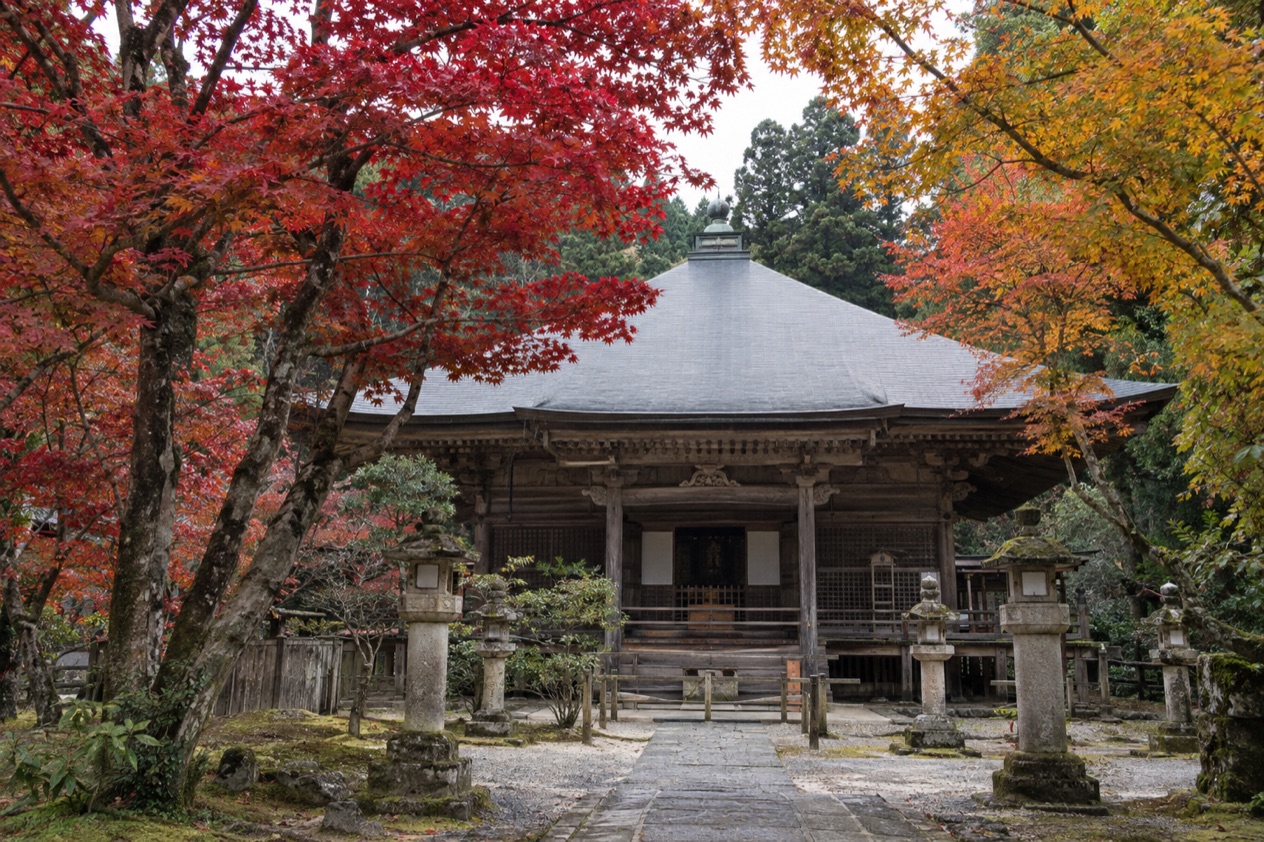
Under the red lacquer of the Shinkyo bridge, the Daiya River runs past slopes where maples go from green to orange to a deep wine red, and the cedar avenues around the shrines make the colors look even brighter. Nikko, in Tochigi Prefecture, is a place people plan an autumn trip around. The leaves usually turn in late autumn, and the nearest official reference date points to the second half of November.
When do the leaves change color in Nikko?
The leaves usually change color in the second half of November around the city, though the date shifts from one year to the next and the slopes do not all turn together. There, the usual date for the maple color change is November 20.
That date is a landmark, not a forecast for the shrines or the lake. In 2025 the change was observed at Utsunomiya on November 28, a little later than the usual date, which shows how much a single autumn can drift. Treat the reference as the middle of a window and leave room on either side, since a warm spell or an early cold snap moves the color.
How to read the Utsunomiya date
Kaede kōyō is the Japanese term for the reddening of maple leaves, and it is the date Japan’s weather agency records at its observation points. Nikko lies about 22 miles west of Utsunomiya, according to the Wikipedia entry for the city, and that is why the Utsunomiya date serves as a guide for the region. It does not tell you the color of a particular hillside on a particular morning.
In practice, a traveler reads it as a signal. When the Utsunomiya date comes near, the Nikko hillsides are generally somewhere in the middle of their change, with some branches still green and others already dropping leaves. Japanese news and tourism sites publish color reports through the season, and those are the better guide in the week you leave.
What the weeks around it feel like
In October the air in the mountains turns crisp, the cedar groves stay dark green, and the first yellows and oranges show on isolated trees. By the second half of November the maples stand in full color in some spots and have already shed in others. Fallen leaves collect on stone steps and lanterns, and the red carpet underfoot is part of the picture as much as the trees.
A trip planned for the second half of November fits the reference date best. An earlier visit can still catch color, though you may find more green than you expect. A later one may arrive as the leaves fall, which has its own appeal: bare branches, red-covered paths and the shrine roofs showing through.
Where can you see them in Nikko?
The leaves can be seen in three clusters: around the shrine and temple grounds in town, along the Daiya River gorge, and up at Lake Chuzenji with its waterfall and winding approach road. Each gives a different kind of autumn, so travelers combine them.
The shrines and temples in town
Toshogu is where most visits begin. Its gates, carvings and painted halls sit among tall cedars, and when maples near the paths turn red the gold and vermilion look different against them. Taiyuin, the mausoleum nearby, has a quieter, darker feel, with black and gold halls reached by a flight of stone steps and surrounded by trees.
Rinno-ji and the Futarasan shrine are close neighbors, and wandering between the sites is part of the pleasure. The Shinkyo bridge, a red arch over the river, is a classic place to photograph the water and the colored slopes together. Hours change between summer and winter, and the cutoff moves earlier from November onward, which matters in leaf season.
| Site | Open April to October | Open November to March |
|---|---|---|
| Toshogu Shrine | 08:00-16:30 | 08:00-15:30 |
| Taiyuin | 08:00-16:30 | 08:00-15:30 |
Because the November reference date for the color change falls in the winter schedule, a visit at the height of the leaves means the gates close an hour earlier than in October. Plan the shrines first and leave the afternoon for places that have no closing time.
The Daiya River and Kanmangafuchi
A path follows the Daiya River to Kanmangafuchi, a gorge of dark volcanic rock where the water rushes between boulders and a long row of small stone Jizo statues, many wearing red bibs, stand beside the path. In autumn, maples lean over the stone and the water, and the contrast between the rock and the leaves is the draw. It is a place for a slow walk and for photographs of moss, stone and color together.
Lake Chuzenji and Kegon Falls
Lake Chuzenji sits in the mountains above town and is reached by the Irohazaka, a road of tight hairpin bends that climbs through forest. The slopes along the road are among the places visitors come to see turn color. At the lake, the shoreline trees reflect in the water, and Kegon Falls drops from a cliff nearby with maples and mixed forest around its viewing areas.
Beyond the lake lie Senjogahara, a marshland of grass that turns golden, and Yu-no-ko, a smaller lake with a hot spring village. The Oze direction is also linked to Nikko: buses run from Oze to Nikko between mid-spring and mid-autumn, so that connection belongs to October and earlier rather than the later leaf weeks.
What should you know before you go?
Know three things: Nikko is about 2 hours by train from Tokyo, the leaf date moves from one year to the next, and the temple hours are shorter in November. Everything else is a matter of pacing the day.
Getting there from Tokyo
Tobu-Nikko Station is about 2 hours from Asakusa Station and from Shinjuku Station in Tokyo. Nikko lies roughly 87 miles north of the capital, in the Kanto region, so a day trip is possible, though a night in town gives more time among the trees and removes the pressure of the return train.
Asakusa and Shinjuku are both departure points, which means you can leave from whichever neighborhood you are staying in. The rest of the journey, from station to shrines and onward to the lake, is by local transport that the town arranges around the main sights.
Matching the trip to the leaves
Since the reference color date at Utsunomiya is November 20, a trip in the second half of November is the one that matches it best. The observed date in 2025 was later, so a flexible plan helps.
Spring has its own timetable in this region. The usual first cherry bloom at Utsunomiya is March 30 and full bloom is April 6, which is a separate trip from the autumn one and not a substitute for it.
What to do beyond the trees
Nikko is known for yuba, the delicate skin lifted from warm soy milk and served in many forms, from sashimi style to simmered in broth. Soba noodles and tofu dishes also suit the cool mountain weather, and a lunch of any of them gives a break between shrine halls and forest paths.
At the shrines, shoes come off at the entrance of some halls, voices drop, and photography follows posted signs. A stroll in the grounds in late autumn is as much about stone, moss and cedar as about red leaves, so there is something to look at even when a hillside is still green or already bare.
Good to know before you go
Autumn in the mountains brings cooler air and changing light, so the same trail can feel quite different from one week to the next. Carry yen for small purchases at shrines, food stalls and local shops, and give yourself time at each stop instead of racing from gate to gate. With the shrines closing earlier from November, a loose plan that puts the lake and the river walk after the shrine visit tends to work well.
Sources
- Japan Meteorological Agency, maple color-change dates 2025-2026 with difference from the 1991-2020 normal (https://www.data.jma.go.jp/sakura/data/phn_014.html), checked October 11, 2026
- Japan National Tourism Organization, Nikko (https://www.japan.travel/en/destinations/kanto/tochigi/nikko-area/), checked October 11, 2026
- Wikipedia, Nikkō, Tochigi (https://en.wikipedia.org/wiki/Nikk%C5%8D,_Tochigi), checked October 11, 2026
- Wikivoyage, Nikko (https://en.wikivoyage.org/wiki/Nikko), checked October 11, 2026
- Japan Meteorological Agency, cherry blossom first-bloom dates 2021-2026 and 1991-2020 normal (https://www.data.jma.go.jp/sakura/data/sakura003_07.html), checked October 11, 2026
- Japan Meteorological Agency, cherry blossom full-bloom dates 2021-2026 and 1991-2020 normal (https://www.data.jma.go.jp/sakura/data/sakura004_07.html), checked October 11, 2026
- Japan Meteorological Agency, biological season observations (https://www.data.jma.go.jp/sakura/data/index.html)
To plan your stay
- Japan Rainy Season (Tsuyu): Dates, Regions and How to Plan Your Trip
- Seasons in Japan: Blossoms, Fall Color, Snow Festivals and Summer Matsuri
- Typhoon Season in Japan: When It Hits, Which Regions Take the Brunt and How the Warning Alerts Work
- Autumn Leaves Dates by City: Usual Maple Dates, 2025 Results and How Much They Shift