
In late autumn a ginkgo on a Nagoya side street turns the pavement beneath it yellow, and the maples in the castle grounds start to go red at the tips. Japanese has two words for the season, kōyō for the turning of the leaves and momiji for the maples themselves, and the city treats both as a reason to get outside. Nagoya’s maples usually turn around the end of November, which makes it a city for travelers who arrive after the mountain color has faded elsewhere.
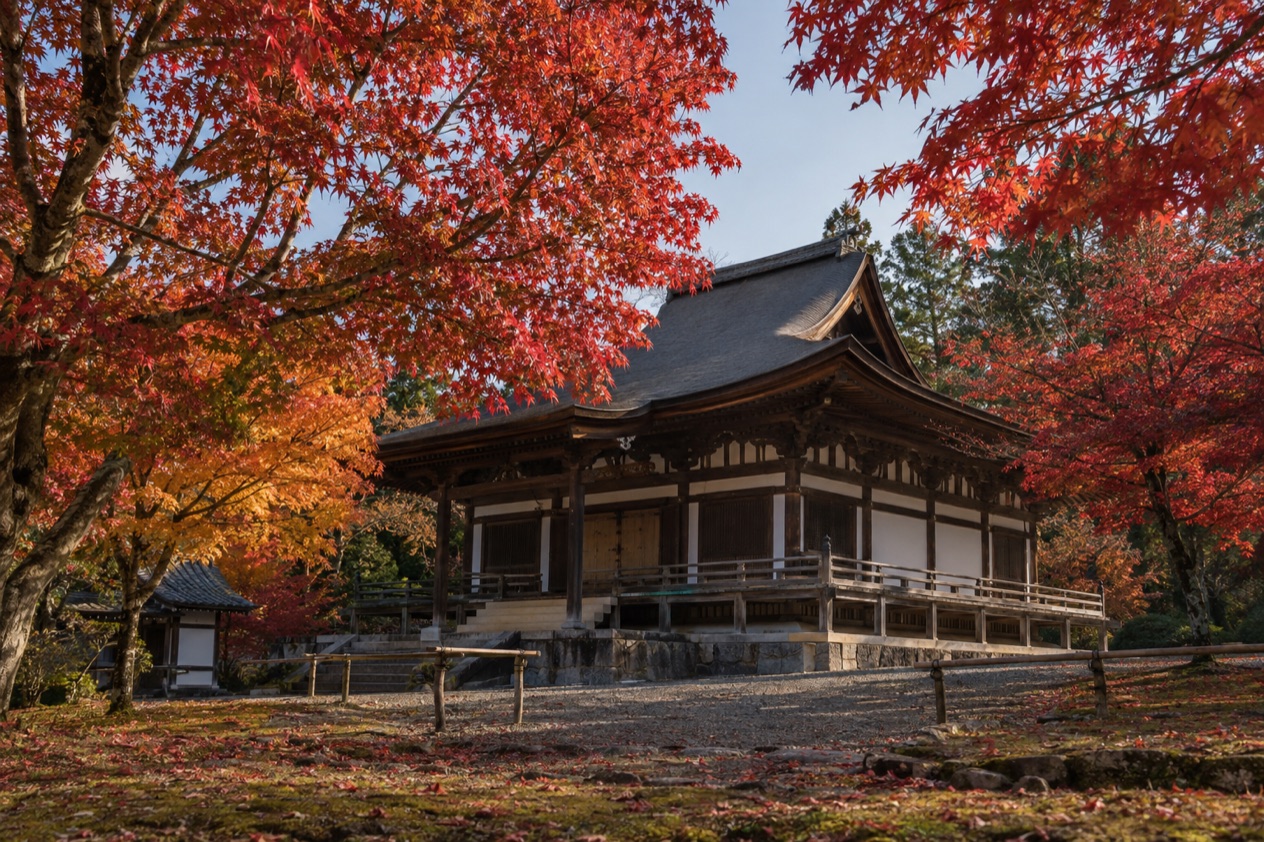
When do the leaves change color in Nagoya?
In Nagoya the maple leaves usually change color around the end of November. That makes late November the center of your window, with the days on either side of it the ones worth keeping free.
| Maple color change in Nagoya | Date |
|---|---|
| Usual date | November 28 |
| Observed in 2025 | November 25 |
What the dates tell you
The usual date is an average, and autumn does not follow it to the day. Treat the date as the middle of a stretch, not as an appointment.
Color in a city also arrives in layers. Some trees begin to turn before the date and others hold their green a little longer, so a walk in the days around it often shows reds, oranges and yellows side by side. The first cold nights push the change along, and a mild spell slows it.
Planning a trip around the date
If your dates are flexible, aim for the last week of November and the first days of December, so that a slightly early or late year still falls inside your stay. If they are fixed, plan a few indoor stops as well, because a trip that lands a week early may find the maples only half turned, and one that lands late may find leaves already on the ground, which is its own kind of beauty.
Nagoya is the capital of Aichi Prefecture, on the Pacific coast in central Honshu, and it is Japan’s fourth-largest city. That scale shapes the season. Color here comes in parks, temple and shrine precincts, castle grounds and street trees, not in one valley with a single viewpoint, so the days when the leaves are at their peak spread across the city instead of gathering in one place.
Maples, ginkgo and what you see
Maples give the reds and oranges that travelers usually picture, from bright scarlet to a deep wine color, often on the same branch. Ginkgo trees, which line many city avenues and shrine approaches in Japan, turn a clear yellow and then drop their leaves in a short burst, so the ground under them can glow for a day or two.
Look at the light through the leaves as well as at the leaves themselves. A maple with the sun behind it looks lit from inside, and a red leaf floating on a pond doubles itself in the water. Visitors spend more time photographing these small scenes than the wide views.
Where can you see them in Nagoya?
The places to look are Nagoya Castle, the Higashiyama Zoo and Botanical Gardens, and Atsuta Shrine, three of the landmarks the city is known for. A leaf walk in Japan usually means a garden, a shrine precinct or the grounds of a castle, and Nagoya has all three within the city.
Nagoya Castle and its Autumn Festival
Nagoya Castle holds an Autumn Festival, and during it the Honmaru Palace stays open to visitors, with admission running until an hour before the gate closes. The palace is a building to walk through slowly, and the castle grounds around it give you a place for trees and open sky between visits to the interior.
The festival turns the castle into more than a sightseeing stop. It suits a travelers who want the season and some history in the same visit, and it works well as the anchor of a day. Pair it with a lunch of local dishes afterward, such as miso katsu (a pork cutlet under a dark miso sauce) or kishimen, the flat wheat noodles of the region.
Higashiyama Zoo and Botanical Gardens
The Higashiyama Zoo and Botanical Gardens combine animal enclosures with planted gardens in a single visit, which makes them a good fit for a mixed group. Some people in a family want the animals, and others want the trees, and here both get what they came for.
The gardens are where a visit in the leaf season pays off. Planted grounds of this kind are laid out so that something is always turning, and a slow loop past the trees gives you the season in miniature, with a stop for the animals as a break from looking up.
Atsuta Shrine
Atsuta Shrine is another of the city’s landmarks, and a Shinto shrine in autumn has its own look. Tall trees stand over the approach, the gravel is raked, and fallen leaves gather at the edges of the path. Visitors usually walk the grounds in a quiet, unhurried way, pausing at the main hall and at the smaller sub-shrines.
Go for the setting more than a list of sights. The pleasure of a shrine in this season is the gentle pace and the contrast of red and yellow against dark wood and stone, and it fits well on a day that also includes the castle.
When the leaves are not enough
If rain arrives or the maples have not yet turned, Nagoya has other stops. The Port of Nagoya Public Aquarium and Chubu Electric Power MIRAI TOWER are both among the attractions covered by the NAGOYA Sightseeing Pass, which Nagoya’s official tourist information describes as a great-value way to enjoy the city’s major attractions. The pass also covers Nagoya Castle and the Higashiyama Zoo and Botanical Gardens.
Think of these as a second half of the day, with the leaves in the morning or afternoon and one of the indoor stops around them. That way a gray day or an early or late year does not empty the plan.
What should you know before you go?
The main thing to know is that the leaf date moves from one autumn to the next, so build the trip around a window, not a single day. The usual date falls near the end of November, and the festival at the castle gives you a fixed event to plan around inside that window.
| Site | Last admission |
|---|---|
| Nagoya Castle, Honmaru Palace (during the Autumn Festival) | Until 1 hour before gate closing |
Getting to the city
Chubu Centrair International Airport is Japan’s third major international gateway, and it sits on an artificial island 30 minutes south of central Nagoya. For travelers flying in for the leaf season, that puts the city within reach as soon as you land.
The city itself anchors a metropolitan area of about 10 million people, a population surpassed only by Osaka and Tokyo. Nagoya is therefore a large base, with plenty of restaurants and hotels, and the leaf sights are part of a working city, not a resort.
Eating through the season
A day of looking at leaves calls for a good meal, and Nagoya has a regional cuisine of its own. Besides miso katsu, there is hitsumabushi, grilled eel over rice that you eat in several stages, first plain, then with condiments, then as a broth. There are also tebasaki, fried chicken wings with a peppery glaze, and the morning habit of coffee with toast and sweet red bean paste.
None of these needs a plan, and each fits neatly between a castle visit and a garden walk. They also make a pleasant reason to end the day indoors, once the daylight fades and the leaves are behind you.
Building a day around the leaves
A workable day starts at the castle, where the grounds and the Honmaru Palace take a good part of the morning, then moves to lunch, then to either the botanical gardens or Atsuta Shrine for the afternoon. Keep the other stop for a second day, and keep an aquarium or the tower in reserve for rain.
Leave room to wander. The best moments in this season are often unplanned, a ginkgo at the end of a street, a maple over a temple wall, a carpet of yellow in a corner of a park. A loose plan lets you stop for them.
Good to know before you go
Late autumn sits between the leaf season and winter, and the weather can change from one day to the next, so a plan with indoor alternatives is a comfortable one. Keep some yen for small purchases at shrines, snack stalls and cafés, and remember that the color date is an average that shifts a little each year.
Sources
- Japan Meteorological Agency, maple color-change dates 2025-2026 with difference from the 1991-2020 normal (https://www.data.jma.go.jp/sakura/data/phn_014.html), checked October 11, 2026
- Visit Nagoya, the Nagoya city guide (https://www.nagoya-info.jp/en/), checked October 11, 2026
- Wikipedia, Nagoya (https://en.wikipedia.org/wiki/Nagoya), checked October 11, 2026
- Wikivoyage, Nagoya (https://en.wikivoyage.org/wiki/Nagoya), checked October 11, 2026
- Japan Meteorological Agency, cherry blossom first-bloom dates 2021-2026 and 1991-2020 normal (https://www.data.jma.go.jp/sakura/data/sakura003_07.html), checked October 11, 2026
- Japan Meteorological Agency, cherry blossom full-bloom dates 2021-2026 and 1991-2020 normal (https://www.data.jma.go.jp/sakura/data/sakura004_07.html), checked October 11, 2026
To plan your stay
- Japan Rainy Season (Tsuyu): Dates, Regions and How to Plan Your Trip
- Seasons in Japan: Blossoms, Fall Color, Snow Festivals and Summer Matsuri
- Typhoon Season in Japan: When It Hits, Which Regions Take the Brunt and How the Warning Alerts Work
- Autumn Leaves Dates by City: Usual Maple Dates, 2025 Results and How Much They Shift