
In Kyoto the maples around Kiyomizu-dera turn from green to amber to red, and the visitors on the temple terrace lean over the railing to look down at the treetops. The same scene repeats across the country, but never on the same week, because the color travels from one end of Japan to the other. A good autumn itinerary is built on that movement: start where the leaves turn first, and follow them toward the south and the Pacific coasts.
How do you plan an autumn leaves trip?
You plan it by following the calendar of the color change, not by picking a single week for the whole country. Japan’s autumn is a slow wave, and the Japan Meteorological Agency tracks it with a precise yardstick: the maple color-change day is the first day on which, looking at the whole sample tree, most of its leaves have turned red.
That definition is a useful reminder that a tree is not “in color” the moment the first branch blushes. It is in color when most of it has turned.
The wave starts in mid-October in eastern Hokkaido. It then moves into the Tohoku region and eastern Hokuriku, and on to the rest of Honshu, Shikoku and Kyushu. These are the usual dates for each area, and they are a guide to the order of things rather than a promise for any single autumn. Colors can come a little earlier or later from one year to the next.
| Area | Maple color change around |
|---|---|
| Eastern Hokkaido | Mid-October |
| Tohoku region and eastern Hokuriku | November 20 |
| Kanto, Hokuriku, Tokai, Chugoku, Shikoku and northern Kyushu | November 30 |
| Pacific coasts of Kanto and Tokai, the Kinki region and southern Kyushu | Early to mid December |
Reading the calendar
The table gives you the skeleton of a trip. If you land in October, the north is where the color is, and Hokkaido is the island to look at.
If you arrive in late November, you are in the zone of Honshu’s big cities and gardens. If you can only travel in early December, the Kinki region and the Pacific coasts are the places where the maples are still turning, which is where Kyoto sits.
Japan’s national tourism office describes the display on the islands as running from mid-November to early December, when the trees go through red, yellow and orange. Think of that as the heart of the season for the main tourist cities, with the north starting well before and the southern coasts finishing after.
Weather and what to wear
Autumn is the season when Japan eases out of summer. Temperatures become moderate, which suits long days on foot through garden paths, temple grounds and old streets. Honshu and Kyushu are pleasant in October and November, so a light layer is enough for most days of a city itinerary.
Hokkaido is the exception. A coat is comfortable there for much of the autumn season, so pack accordingly if the northern leaves are part of your plan. Pairing Hokkaido in October with Honshu later in the trip means carrying both a warm coat and lighter layers, and it is worth deciding early whether the extra luggage is worth it.
Building the trip around events
Autumn is also festival season, and a few dates can anchor an itinerary. The Nagasaki Kunchi, created in 1634, celebrates the autumn harvest and is held in early October.
In Kyoto, the Jidai Matsuri takes place later in October and commemorates the founding of the Heian Jingu Shrine and the 1100th anniversary of the capital’s relocation to Heian. In mid-November, the Kobe Marathon brings nearly 20,000 runners and more than 600,000 supporters and spectators into the streets.
These events do not coincide with the full color of the maples in the same city, which is useful to know. A trip that opens with a festival in October and closes with illuminated gardens in late November or early December gives the days a shape that foliage alone would not.
Which cities fit the season?
Tokyo, Kyoto and the area around Mount Fuji fit the season well, and Kyushu adds a different kind of autumn evening. Each one has a named place that the national tourism office points to, so you can build a day around a specific garden, temple or lakeshore rather than a vague idea of “going to see leaves”.
Tokyo and Rikugien Garden
In Tokyo, Rikugien is a traditional Japanese garden that is radiant with beauty in autumn. It is a garden designed to be walked, with a pond at its center and paths that open onto a new composition of trees at each turn. In color season the reds and oranges are reflected in the water, which is part of the pleasure of walking slowly.
The garden’s illuminations take place from mid-November to early December. That gives you a reason to schedule Tokyo within the second half of the season, in the window when the Kanto maples are turning, and to see the same trees under lights after seeing the colors in daylight. It suits travelers who like a city stay with one strong evening in it, and it fits easily into a trip where the other days are spent in shops, museums and neighborhoods.
Kyoto and Kiyomizu-dera
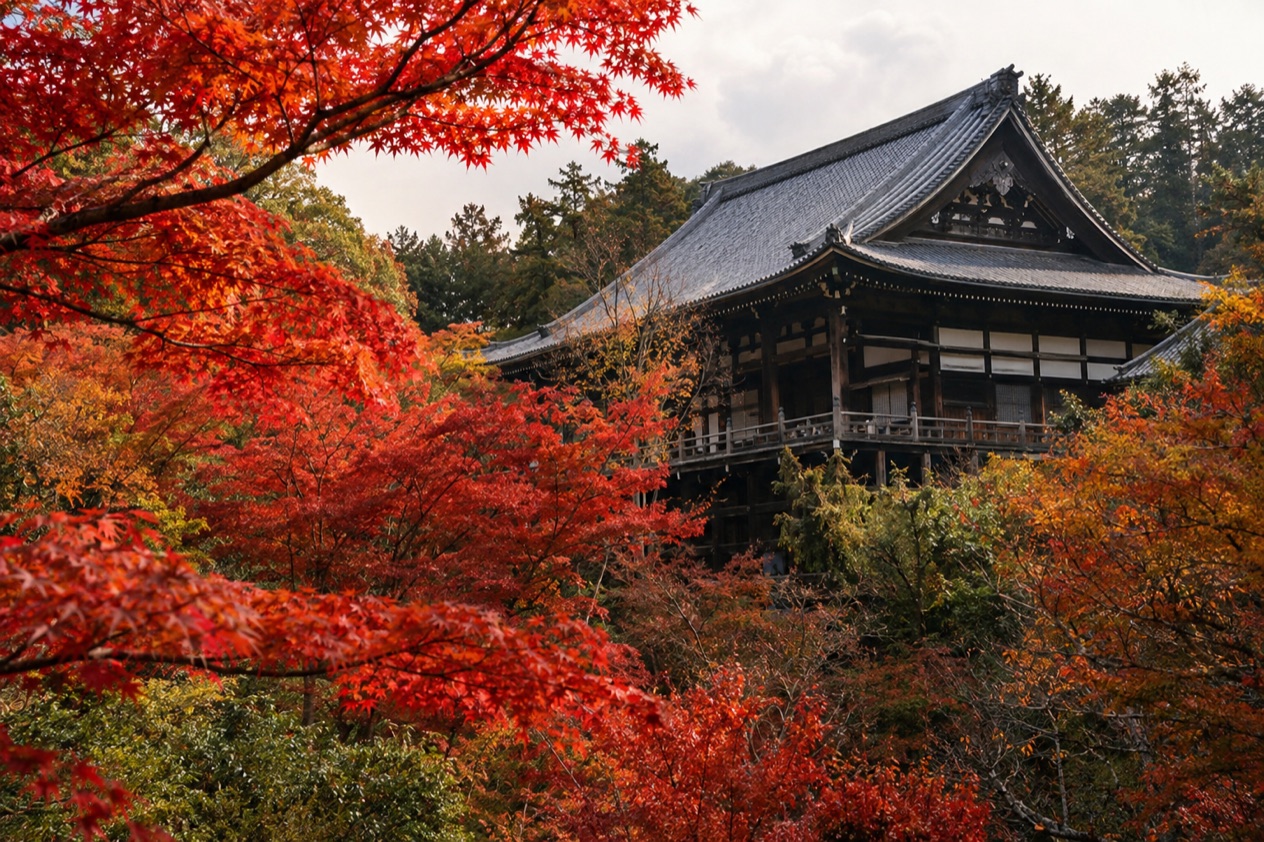
Kyoto’s Kiyomizu-dera offers stunning landscapes in autumn, with the wooden temple buildings set against a hillside of turning trees. The temple is the kind of place where the architecture and the foliage complete each other, and where you stand at a rail and look out across the canopy. Kyoto is in the Kinki region, where the color change comes later, in early to mid December on the Pacific side of the country.
That later timing is useful for planning. Kyoto works as the last stop of a leaf-chasing trip, after the north and after Tokyo. It also means a late-October visit may find the Jidai Matsuri parade in the streets but the maples still mostly green. Decide whether you want the festival or the color, and arrange the dates for the one you care about more.
Lake Kawaguchiko and Mount Fuji
Spending a night at Lake Kawaguchiko, at the foot of Mount Fuji, lets you admire the mountain’s reflection on calm waters, framed by purple trees. The point of staying overnight is to be there for the morning and evening, rather than passing through between two other stops. Whether the mountain shows itself on a given day is a matter of weather, so treat the reflection as a chance, not a guarantee.
The lake belongs to the Fuji area, and its leaves follow their own calendar, which the regional dates above can only approximate. A night here adds a landscape to a trip that is otherwise made of gardens and temples, and it breaks up a run of city stays with a quieter stretch beside the water.
Kyushu and the Kingdom of Light
On Kyushu, Huis Ten Bosch is a theme park recreating the Netherlands, and its Kingdom of Light is a spectacular illumination. The park has seasonal illuminations throughout the year, so the lights are not specific to autumn, but they make a change of pace for an evening if the leaves are not your only interest. Nagasaki, with its harvest festival in early October, sits well with a Kyushu leg at the start of the season.
Northern Kyushu changes color around the end of November and southern Kyushu in early to mid December, so a Kyushu stop can come either early, for the festival, or late, for the leaves, depending on how you order your trip.
How many days do you need?
You need as many days as you have regions to cover, since the color moves across the country instead of arriving everywhere together. A stay built around one city, such as Tokyo or Kyoto, can be short and still full. A trip that follows the wave from north to south needs more room, because each stage has its own dates and its own landscape.
One base, one set of leaves
If your travel dates are fixed, pick the region whose color falls in them. A visit in the last third of November suits the Kanto area, where Tokyo and Rikugien are, and the date of the garden illuminations from mid-November to early December supports that choice. A visit in early December suits Kyoto and the Kinki region.
Mushrooms, chestnuts, persimmons and sweet potatoes appear on menus and in markets at this time of year, and kaiseki meals often follow the seasons closely, so a stay in a single city leaves time to eat as well as look.
A route that follows the color
A longer itinerary can follow the order in the table. Begin in Hokkaido in October, when the color change begins in the east of the island, and bring a coat. Finish in Kyoto in early December, when the Kinki region is turning.
Such a route covers three very different landscapes: northern forest, the Fuji lakes and a capital’s gardens, and an old city of temples. It asks for more days than a single-city trip, and the order is dictated by the leaves rather than by geography, so do not worry if it seems to double back on the map.
Adding a festival or a stop in Kyushu
A festival can be the opening or the closing day of a trip. The Nagasaki Kunchi in early October opens a Kyushu-first itinerary, and the Jidai Matsuri in Kyoto later in October gives a different start. The Kobe Marathon in mid-November suits anyone who runs or who likes the atmosphere of a city given over to spectators.
Each of these adds a day or two, and each pushes the leaf stops to a different part of the calendar. Write down the festival dates first and then see how many of the regional color dates fit around them. The pairing that works is usually the one you can get to without trying to cover every region at once.
Good to know before you go
Autumn in Japan is gentle on the traveler, with moderate temperatures in October and November on Honshu and Kyushu, and a coat for Hokkaido. The color dates are averages and the trees follow the weather of each season, so leave a little slack in the plan.
Think of your trip as a handful of anchor points, one garden, one temple, one lakeshore night and perhaps one festival, with the days between them left open for wandering. Rikugien’s lit paths in late November or the view of Fuji’s reflection at Kawaguchiko can be those anchors.
Sources
- Japan Meteorological Agency, kaede2020.pdf (https://www.data.jma.go.jp/sakura/data/kaede2020.pdf), checked October 11, 2026
- Japan National Tourism Organization, autumn in Japan (https://www.japan.travel/en/guide/autumn-guide/), checked October 11, 2026
To plan your stay
- Japan Rainy Season (Tsuyu): Dates, Regions and How to Plan Your Trip
- Seasons in Japan: Blossoms, Fall Color, Snow Festivals and Summer Matsuri
- Typhoon Season in Japan: When It Hits, Which Regions Take the Brunt and How the Warning Alerts Work
- Autumn Leaves Dates by City: Usual Maple Dates, 2025 Results and How Much They Shift