
Along the river that passes the Atomic Bomb Dome, the trees begin to turn from green toward amber as November wears on, and travelers start asking when the maples in Hiroshima will really change. This is the season to pair the city’s memorials and the shrine standing in the sea with the wooded hills of the prefecture.
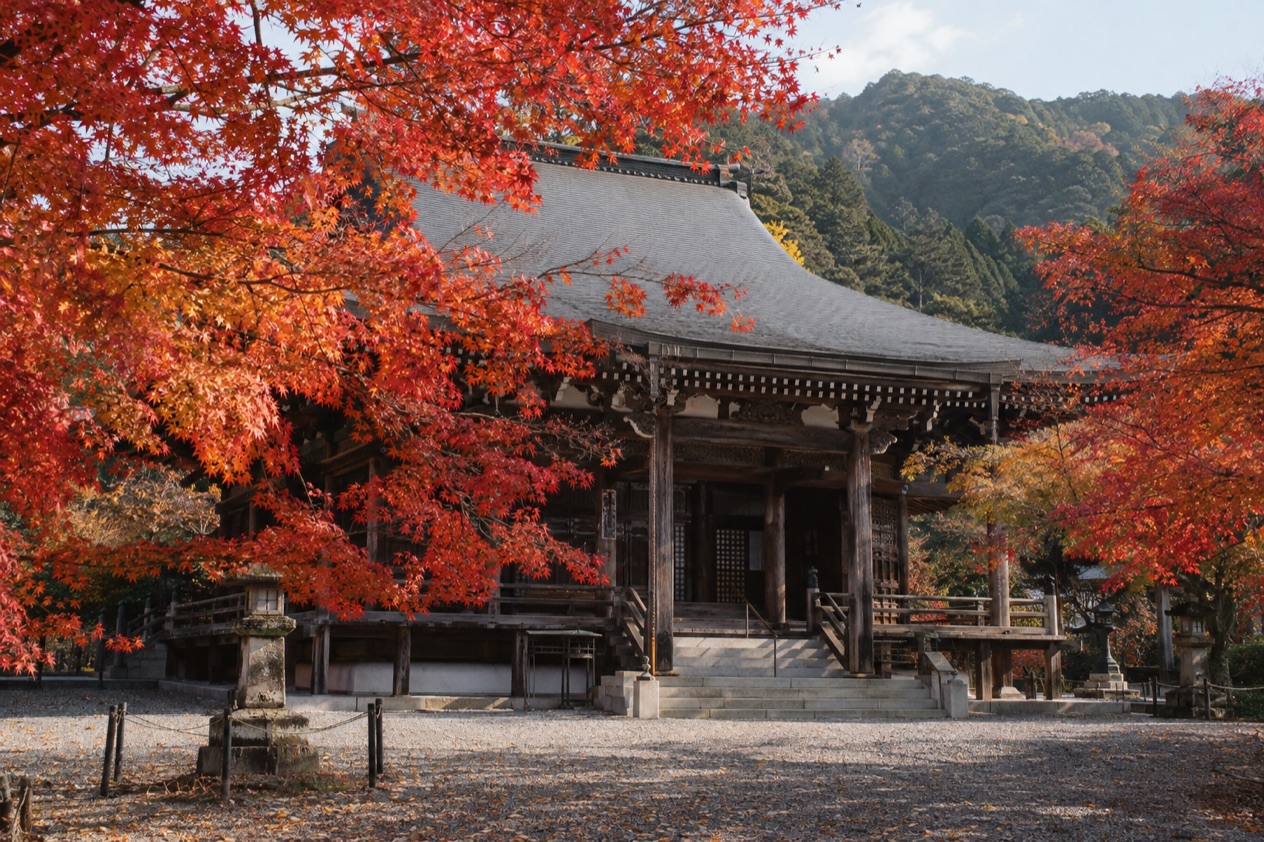
When do the leaves change color in Hiroshima?
Maple leaves in Hiroshima change color in late November, which makes this a late-autumn city rather than an early one. Japanese calendars follow the maples with a specific word, kaede kōyō, and the Japan Meteorological Agency records the day the maple leaves change at its Hiroshima station. That record is the clearest guide to when the city itself turns red and orange.
| Maple color change in Hiroshima | Date |
|---|---|
| Usual date | November 22 |
| Observed in 2025 | November 27 |
The usual date and a recent autumn
That is the pattern to expect: the color does not arrive on a fixed day, it drifts with how the season has run. A warm autumn tends to push the change later, a cooler one lets it come sooner, which is why one year’s date is a landmark and never a promise.
For a visitor, the practical reading is that the first days of the change can fall at the very end of November, and the richer color follows. A trip that straddles the end of November and the first days of December gives you room on both sides of the date, whichever way the season leans.
How leaf-viewing works in Japan
Watching the leaves has its own name, momijigari, literally hunting for red leaves, and it is the autumn cousin of cherry blossom viewing. People go out on purpose to walk under the color, to photograph it, to sit near it with a warm drink. The maples carry most of the attention, and in a city the effect often comes from a single tree against a stone lantern or a temple roof rather than from a whole hillside.
Because the date in Hiroshima refers to the city’s maples, it describes what you can expect on streets, in parks and in gardens within the urban area. Hillsides and islands can run on their own timing, and the color there is something you find by looking rather than by reading a date. Treat the city date as the center of a season that stretches before and after it.
Why Hiroshima turns later than spring suggests
Hiroshima is a place where spring comes early and autumn comes late, and that contrast shapes a trip. Cherry blossoms open in the second half of March, yet the maples wait until the end of November. In between lies a long, green stretch, so a trip in early or mid-November may find the trees still green or just beginning to blush.
That is not a drawback, only a calendar fact worth knowing. If your dates fall earlier in the month, you can still spend them on the memorials, the food and the island, and treat any color you find as a bonus. If your dates fall in the final week, the leaves become the reason to look up as you walk.
Where can you see them in Hiroshima?
You can look for autumn color in the city’s parks and along its riverside, on Miyajima Island, and in the wooded mountains and clear waters that define the prefecture. Hiroshima Prefecture is known for the Seto Inland Sea, wooded mountains and clear waters, as well as for peace-related sites, shrines and museums, and those same places are where a leaf-viewing day naturally takes shape.
Peace Memorial Park and the Atomic Bomb Dome
The Peace Memorial Park and the Atomic Bomb Dome are the two UNESCO World Cultural Heritage sites in Hiroshima, and they sit next to each other, which lets you take them in on one walk. The Dome can be viewed only from the outside, since visitors cannot enter it, so the experience is one of standing, looking and moving slowly around the ruin.
In late November, the season gives the walk an extra layer. Trees along the river and across the park may be changing, and any color adds a muted, human-scale warmth to a place that asks for reflection.
The river itself carries the lanterns floated on August 6, when thousands of people write peace messages on them, so in autumn the same water takes on a calmer meaning. Come with the memorials as the reason and the leaves as a companion.
Miyajima Island and Itsukushima Shrine
Miyajima is the excursion from Hiroshima that most trips build in, with its deer and its floating shrine. Itsukushima Shrine, registered as a World Heritage Site in 1996, has a red torii gate standing in the sea, and a red gate beside green and orange trees is the picture many leaf-viewers hope to take home.
Whether the maples on the island have turned depends on the autumn, so go for the shrine, the gate and the deer, and let the color be what you find. Along the lanes, the maple-leaf-shaped cakes called momiji manju, filled with sweet red bean paste, are the island’s seasonal snack and a fitting way to mark a day under the trees. Fresh from a griddle, they are a small warm stop between sights.
Mountains, sea views and a rabbit island
Beyond the city, the prefecture’s wooded mountains and the Seto Inland Sea give the landscape its character, with hills rolling down to water that is described as clear. In autumn, a hillside seen across the water is where color can read at scale, a contrast to the single trees of a city park.
Okunoshima, known for its wild rabbits, has one rule that matters to visitors: do not chase or pick up the rabbits, and give them appropriate food in a safe place if you feed them. Treat the island as a visit shaped by the animals, and any leaves overhead as a pleasant extra.
After the walk: okonomiyaki
It is a savory griddle pancake built in layers, with cabbage, noodles and egg, topped with a sweet-savory sauce. A plate of it at a counter, with the cook working the hot iron in front of you, is a natural way to end a day of walking among the leaves.
In late autumn, when the air has cooled, a hot griddle and a steaming plate suit the mood. The dish also gives the day a clear shape: color in the afternoon, a long, unhurried dinner after.
What should you know before you go?
Know that the leaf date moves, that the main sights are close to each other in the city, and that Hiroshima connects by shinkansen to the big cities. With those three points settled, a trip is mostly a matter of choosing which days to give to the memorials, the island and the table.
Reaching Hiroshima by shinkansen
Hiroshima is accessible by shinkansen, the high-speed train, and the rail times from the two big hubs are well established.
| From | By shinkansen |
|---|---|
| Tokyo | About four hours |
| Osaka | About 90 minutes |
A rail ride from Osaka fits into a leaf-viewing circuit through western Japan, and a ride from Tokyo makes a full travel day. Either way, you arrive in a city whose main memorials and riverside are the first things to see.
Matching your dates to the color
Since the maples change around the end of November, the best use of a flexible trip is to center your Hiroshima days on that stretch. If you arrive earlier, fill the time with the memorials, the museums and the island, and let the trees catch up. If you arrive in the first days of December, the season may be at or just past its turn, and the lingering color along the river and in gardens still makes the walks worth taking.
Think of the date as a window. Giving yourself several days in the city, rather than a single afternoon, is the way to meet the color on the right day.
Manners at the sights
At the Atomic Bomb Dome, the habit is simple: you look from the outside and keep a respectful pace, since the building cannot be entered. In the Peace Memorial Park, visitors tend to speak softly and move slowly, and a camera is used with the same care.
At the shrine on Miyajima, the habits are those of any Shinto shrine: a bow at the gate, a pause before the main hall, and a light touch with the deer, which are part of the island’s daily life. With the rabbits of Okunoshima, the rule is set out plainly, and it is the same spirit of restraint: watch them, feed them only as allowed, and never grab or chase them.
Good to know before you go
Late November is cool and often bright in western Japan, so a layer for the evening goes well with a day of walking among the trees. Carry some yen for small purchases at the island’s stalls and for a plate of okonomiyaki at a counter.
Sources
- Japan Meteorological Agency, maple color-change dates 2025-2026 with difference from the 1991-2020 normal (https://www.data.jma.go.jp/sakura/data/phn_014.html), checked October 11, 2026
- Japan National Tourism Organization, Hiroshima (https://www.japan.travel/en/destinations/chugoku/hiroshima/), checked October 11, 2026
- Visit Hiroshima, the official guide (https://visithiroshima.net/), checked October 11, 2026
- Japan Meteorological Agency, cherry blossom first-bloom dates 2021-2026 and 1991-2020 normal (https://www.data.jma.go.jp/sakura/data/sakura003_07.html), checked October 11, 2026
- Japan Meteorological Agency, cherry blossom full-bloom dates 2021-2026 and 1991-2020 normal (https://www.data.jma.go.jp/sakura/data/sakura004_07.html), checked October 11, 2026
To plan your stay
- Japan Rainy Season (Tsuyu): Dates, Regions and How to Plan Your Trip
- Seasons in Japan: Blossoms, Fall Color, Snow Festivals and Summer Matsuri
- Typhoon Season in Japan: When It Hits, Which Regions Take the Brunt and How the Warning Alerts Work
- Autumn Leaves Dates by City: Usual Maple Dates, 2025 Results and How Much They Shift