
In Osaka the first cold evenings of the season send people to the takoyaki stands along the canal, and talk turns to momiji, the red maple leaves that signal autumn all over Japan. Here the color comes late, well into the last stretch of the year, so the timing matters more than anywhere else on a fall itinerary.
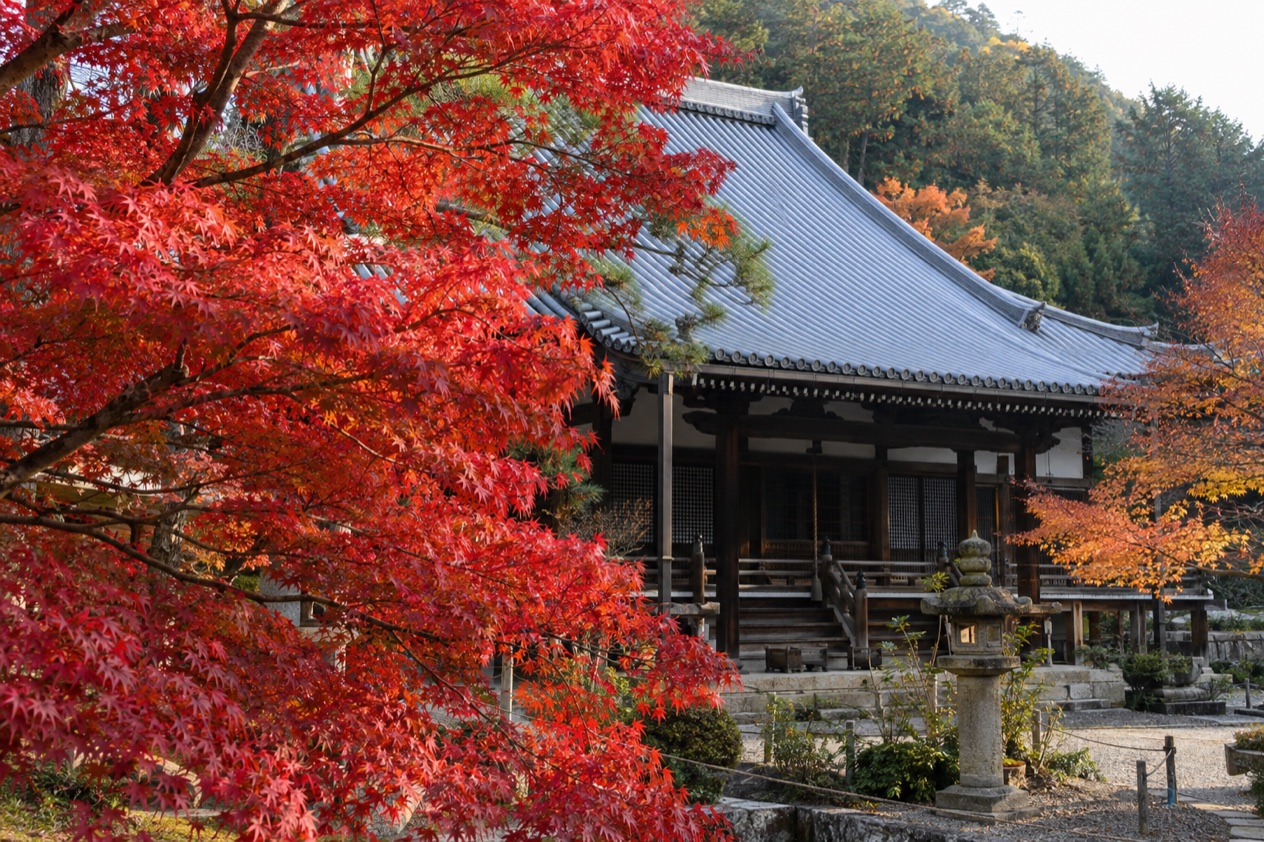
When do the leaves change color in Osaka?
Maple leaves in Osaka usually change color around December 1, placing the city’s usual color change late in the fall season.
The date is an average, and trees do not read calendars. From one autumn to the next it moves around, so a trip planned for the end of November may find the trees still turning, while a trip in early December has a good chance of catching the color.
| Event | Date at the Osaka station |
|---|---|
| Maple color change, usual date | December 1 |
| Maple color change, observed in 2025 | December 4 |
How to read the date
In Japan the color change is declared when the leaves on a reference tree have turned noticeably, and it is the start of the show, not the end. The reds and golds then deepen over the following days. A traveler can think of the date as the moment the city starts to look like autumn, with the best viewing following from it.
Leaf watching has its own word, momijigari, literally hunting for red leaves. It is a seasonal outing in the same spirit as hanami in spring, with picnics, photographs and a slow walk beneath the branches. Planning around the date above lets you treat it as a real part of the trip rather than a lucky accident.
Planning a trip around the color
Because Osaka colors so late, it fits well at the end of a longer Japan trip, after other regions have passed their peak. A route that starts elsewhere and finishes in Osaka around the turn of the month lines up with the usual date. From Tokyo the Tokaido-Sanyo shinkansen reaches Shin-Osaka Station in about two and a half hours, so the city can also be a stop on a Tokyo-based itinerary.
If your dates fall earlier in the autumn, the city is still a pleasure for its food and nightlife, and the leaves become one more thing to look for instead of the reason for the trip. Keep the plan flexible, and let the days of December guide the best moments for the trees.
Where can you see them in Osaka?
Osaka is a city of districts, and the places that structure a visit are Dotonbori and Shinsaibashi, the area around Osaka and Umeda stations, and the Osaka Bay waterfront. A leaf-viewing day here is best built as a walk through those districts with an eye on the trees you pass, followed by the food Osaka is known for.
Dotonbori and Shinsaibashi
Osaka is described as a charming and relaxed city known for its food, entertainment and nightlife, and this is where that description comes to life: neon, food stalls, and the canal running through it all.
From Osaka or Umeda Station, the Midosuji Line runs to Shinsaibashi Station, which puts you at both districts. Staying on the same line until Namba Station is the other way to reach Dotonbori. In late autumn the cooler air suits the standing-and-eating style of the area, with hot snacks in hand and a stroll along the water after dark.
Pair a morning among the trees with an evening here. The contrast of red leaves by day and lit signs by night gives an Osaka autumn day its own rhythm.
Osaka and Umeda stations
Osaka Station is the point where many visits begin. From Shin-Osaka Station, where the shinkansen arrives, the JR local line goes on to Osaka Station, and from there the Midosuji Line leads south to the entertainment districts. Umeda Station sits in the same part of the city and shares the Midosuji Line.
Treat this area as your base and your launch point. It is where the rail lines meet, so a day of leaf hunting can start here and fan out in whatever direction the season’s color pulls you, returning to the same stations for dinner.
The Osaka Bay area
Osaka Bay lies in Osaka, a major port city in the Kansai region. It can be reached from Osaka or Umeda stations by the JR Loop Line and the Chuo subway line, which makes it a natural change of scene from the central districts.
On a cool late-autumn day, the bay waterfront and the park give you something to do that does not depend on the trees.
What should you know before you go?
The main thing to know is that Osaka’s leaf season is a late one, so the calendar matters more than any other detail of the trip. Everything else, from the trains to the districts, is a matter of fitting the city’s pleasures around a date in early December.
Timing and flexibility
If you can stay in the city or the surrounding region over several days, you give the trees time to turn and give yourself a choice of when to go out.
Do not count on a single day. Keep a loose schedule and let the morning’s look at the trees decide whether the afternoon goes to a leaf walk or to the food streets. That kind of flexibility suits Osaka, a city that rewards wandering.
Getting there and moving around
From Tokyo, the Tokaido-Sanyo shinkansen runs to Shin-Osaka Station, a ride of about two and a half hours. From Shin-Osaka, the JR local line continues to Osaka Station, where the city proper begins. Once there, the Midosuji Line links Osaka and Umeda stations with Shinsaibashi and Namba, and the JR Loop Line and Chuo subway line lead to the bay.
Seeing these few lines in your head before you arrive helps the city feel less large. Most of what a first visit holds, from the stations to Dotonbori to the waterfront, hangs on them.
What to do around the leaves
Osaka is known for its food, entertainment and nightlife, and a leaf trip is better for leaning on all three.
If the leaves have not yet turned when you arrive, the city still gives you a full trip. If they have, the color adds a layer to places you were going to see anyway. Either way, the districts above carry the days.
Good to know before you go
Osaka is a city where much of the pleasure is outdoors in the evening, so a warm layer is useful when the days shorten toward December. Keep some yen in your pocket for the street stalls of Dotonbori, where small snacks are bought one at a time as you walk. Eating while standing near the stall is the local habit, and the canal path fills with people after dark, so a little patience in the crowds goes a long way.
Sources
- Japan Meteorological Agency, maple color-change dates 2025-2026 with difference from the 1991-2020 normal (https://www.data.jma.go.jp/sakura/data/phn_014.html), checked October 11, 2026
- Japan National Tourism Organization, Osaka (https://www.japan.travel/en/destinations/kansai/osaka/), checked October 11, 2026
- Japan Meteorological Agency, cherry blossom first-bloom dates 2021-2026 and 1991-2020 normal (https://www.data.jma.go.jp/sakura/data/sakura003_07.html), checked October 11, 2026
- Japan Meteorological Agency, cherry blossom full-bloom dates 2021-2026 and 1991-2020 normal (https://www.data.jma.go.jp/sakura/data/sakura004_07.html), checked October 11, 2026
To plan your stay
- Japan Rainy Season (Tsuyu): Dates, Regions and How to Plan Your Trip
- Seasons in Japan: Blossoms, Fall Color, Snow Festivals and Summer Matsuri
- Typhoon Season in Japan: When It Hits, Which Regions Take the Brunt and How the Warning Alerts Work
- Autumn Leaves Dates by City: Usual Maple Dates, 2025 Results and How Much They Shift