
The early light over Miami’s runways gives way to a strip of blue-green water, and the sandbars and cays of the Abacos start to appear below the wing. There is no road between Florida and these islands, so the trip is a short hop by air and then a change of pace on arrival. This is how travelers from Miami reach Marsh Harbour and the island settlements around it, and what to see once they land.
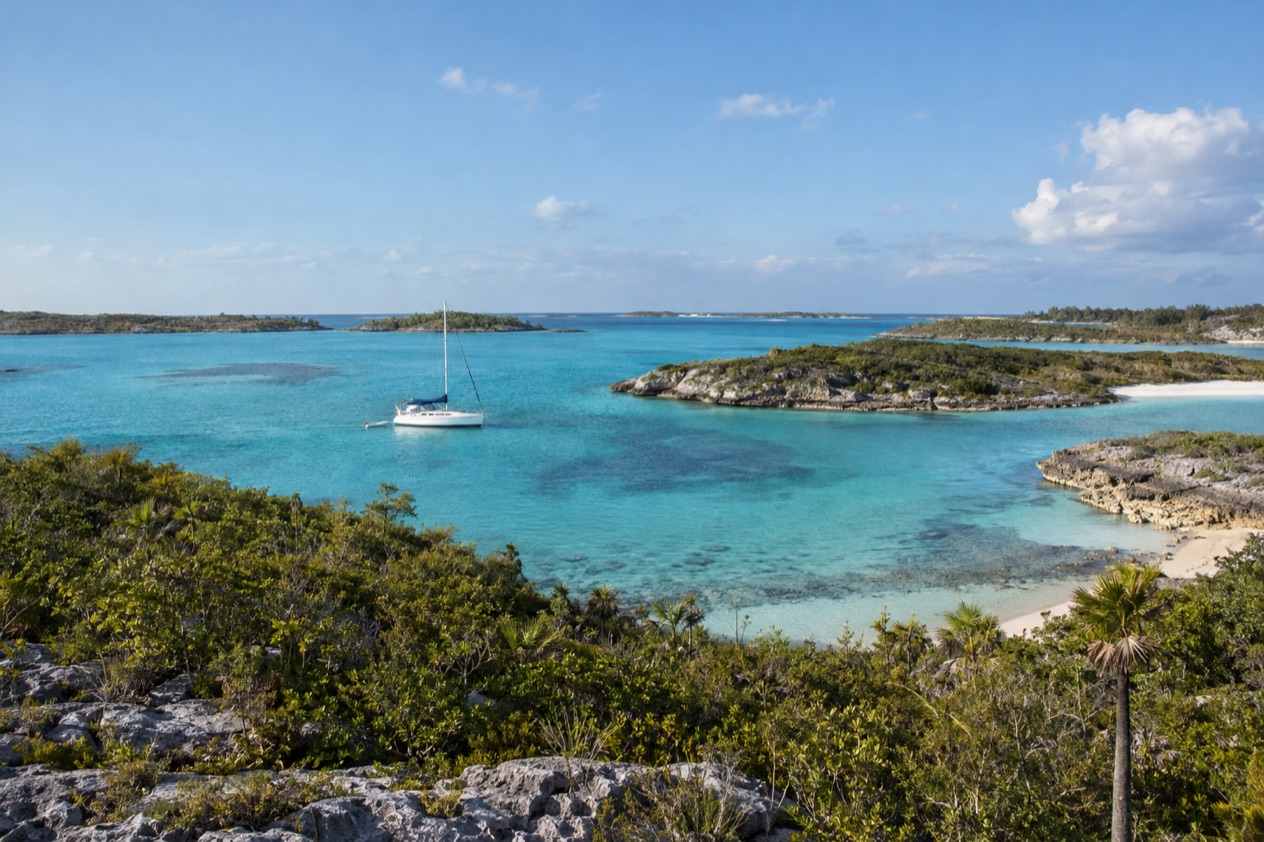
How do you get to the Abacos from Miami?
The Abacos lie about 193 miles east of Miami, and the straightforward way across is by air: American Airlines flies daily from Miami to Marsh Harbour on Great Abaco. Nothing connects the two coasts by land, and no bus or private driver can take you there, so the question is which airport you land at and how you reach your island afterward.
Marsh Harbour is the commercial hub of the chain and the third-largest city in the Bahamas. Its airport, Leonard M. Thompson International, is the gateway most visitors use, and from the terminal you are already in the heart of Great Abaco. The chain is an archipelago, stretching along a long arc and divided into North, Central and South Abaco, so where you stay matters as much as how you arrive.
Three things decide the route. The first is where you sleep. Marsh Harbour is where the airport sits, while Hope Town is the only settlement on Elbow Cay, a small island of its own, and Treasure Cay has an airport of its own on Great Abaco.
The second is your departure point, since Miami has the American Airlines service, while Fort Lauderdale and Orlando Sanford have other carriers. The third is how flexible you want to be. Flying through Nassau opens up scheduled and chartered hops between islands, but it adds a connection that a Miami flight straight to Marsh Harbour avoids. One habit to settle before you land: Bahamian drivers keep to the left side of the road, which surprises many Americans on the first drive out of the terminal.
Ways to get to the Abacos from Miami
The tour, bus, rental car and private driver of a mainland transfer have no place here, because the sea sits between Miami and every Abaco settlement. What you choose from is a flight, a flight with a connection, or a slower island link once you are in the Bahamas.
Flying from Miami to Marsh Harbour
American Airlines flies from Miami to Marsh Harbour every day, and the same airline also links Charlotte to the island. You touch down at Leonard M. Thompson International Airport, in the town that serves as the commercial center of the Abacos. From the curb you are within reach of the harbor, the shops, the marinas and the waterfront restaurants that give Marsh Harbour its working-port feel.
This route suits travelers who want to land at the middle of the chain and move outward from there, whether to Elbow Cay and Hope Town or to the beaches farther along Great Abaco. Before the airport opened in 1959, fishing and shipwreck salvage were the main livelihoods on Elbow Cay, and it is hard to look at the runway now without seeing how much it changed the islands. One tip: if your final stop is Hope Town, plan your arrival so you are not trying to cross the water late in the day.
Flying from Fort Lauderdale or Orlando Sanford
If Miami does not fit your plans, Aztec Airways flies from Fort Lauderdale to Marsh Harbour every day, and it also serves Treasure Cay on Wednesdays, Fridays and Sundays. Air Unlimited connects Sanford Orlando to both Marsh Harbour and Treasure Cay on Tuesdays, Thursdays, Fridays and Saturdays.
These flights make sense for visitors based in Broward County or central Florida, and for anyone whose lodging is closer to Treasure Cay than to Marsh Harbour. Treasure Cay Airport is an international airport on Great Abaco, in the settlement of Treasure Cay. Since the Treasure Cay schedules run only on certain days, pick your travel dates around them rather than the other way around.
Connecting through Nassau
Nassau is the country’s gateway, and the Bahamas is built around hopping from there to an Out Island by scheduled or chartered air service. American Airlines serves Lynden Pindling International Airport in Nassau, and so do Air Canada and Alaska Airlines. From Nassau you can continue to the Abacos by air, as certified domestic and international carriers fly between Bahamian islands.
Going through Nassau suits travelers combining several islands in one trip, or those whose home airline reaches Nassau and not Marsh Harbour. For most people heading only to the Abacos from Miami, the direct service to Marsh Harbour keeps things simpler. Keep in mind that Nassau sits about 100 miles in a straight line from the Abacos, so it is a detour in the geography as well as the schedule.
Ferries and mailboats in the islands
Bahamas Ferries runs passenger service from Nassau to Spanish Wells and Harbour Island on its high-speed M/V Bo Hengy III, leaving at 8:00 a.m. on Wednesdays, Fridays and Saturdays. Marsh Harbour appears on the company’s freight list, not its passenger one, so the ferry is not a way to reach the Abacos as a visitor. Regularly scheduled mailboats also link the major islands, and they are the slow, traditional way of moving between them.
These sea links matter if you are building a longer island-hopping trip and want to understand how the country connects. For a trip from Miami to the Abacos, the sea route is not the one to plan around.
Options compared
| Option | Departs from | Best for | What to know |
|---|---|---|---|
| American Airlines to Marsh Harbour | Miami (daily) | Landing at the commercial hub of the Abacos | Leonard M. Thompson International Airport, Great Abaco |
| Aztec Airways to Marsh Harbour | Fort Lauderdale (daily) | Visitors starting in Broward County | Also flies to Treasure Cay on Wednesdays, Fridays and Sundays |
| Aztec Airways to Treasure Cay | Fort Lauderdale (Wednesdays, Fridays, Sundays) | Staying at Treasure Cay | Treasure Cay Airport is on Great Abaco |
| Air Unlimited | Sanford Orlando (Tuesdays, Thursdays, Fridays, Saturdays) | Central Florida travelers | Serves both Marsh Harbour and Treasure Cay |
| Fly via Nassau | Miami or another gateway | Combining several islands | Onward hop by scheduled or chartered air service |
| Bahamas Ferries | Nassau | Harbour Island and Spanish Wells | Passenger service does not list the Abacos |
Reading across the table, the simplest line runs from Miami straight to Marsh Harbour, and everything else is a variation on where you start or where you want to end up. The Fort Lauderdale and Orlando flights give you a second chance if Miami does not suit your dates, and Treasure Cay gives you a different base on Great Abaco, with its own airport and its own character. Nassau is the connection to choose when the Abacos are one stop among several, since from there the hopping between islands is built into how the country works.
A last point on timing: several of these services fly only on certain days of the week, so the weekday you pick can decide which airport and which airline are on offer. Treasure Cay in particular runs on three days or four, depending on the carrier, which makes the calendar the first thing to settle.
Making a day of it
The Abacos reward a slow first day, and the most natural way to spend it is to move from the airport to the water. Marsh Harbour is the place to get your bearings. It is the largest settlement in the chain, with a harbor full of boats, and it has the practical side of island life: the shops, the docks and the restaurants where fishermen and visitors share the same waterfront.
From there, the classic outing is Hope Town on Elbow Cay. The village is the only settlement on the island, and it is small enough to take in on foot.
Its landmark is the Elbow Reef Lighthouse, built in 1862 and in service two years later, one of the last operational kerosene-fueled lighthouses in the world. Climbing it is not something to promise, but its red and white stripes dominate the harbor and show up in nearly every photograph of the village.
In the village itself, the Wyannie Malone Museum keeps the settlement’s story through old photographs, artifacts, documents and memorabilia. Wyannie Malone was a widow from South Carolina who arrived with her four children after the American Revolution and helped found Hope Town in 1785.
The community has also kept the cholera graveyard and the tradition of building Abaco dinghies, boats you see racing at regattas throughout the Bahamas. Cars and golf carts are allowed on the outskirts of the village, and the heart of town is for walking.
For a different kind of day, Abaco National Park protects the northern breeding grounds of the Bahama Parrot. It was established in 1994 and covers 20,500 acres of pine forest on Great Abaco. Birdwatchers are the ones who will want this stop, and sightings are a chance, never a promise. Treasure Cay is the other base worth a look, with its own airport and its own stretch of Great Abaco.
What to bring is simple: shoes you can walk in on village lanes, something to shade you from the sun on the water, and a light layer for the boat. As for how long to stay, the Abacos span a long arc of islands, which is reason enough to give them more than a single night. If you land at midday, you can settle in at Marsh Harbour and save Hope Town for the next morning, when the harbor is quiet.
Good to know before you go
The U.S. State Department rates the Bahamas Level 2, “Exercise increased caution”, and says most crime occurs in Nassau on New Providence and in Freeport on Grand Bahama.
The Atlantic hurricane season runs from June 1 to November 30, so an October trip falls inside it and a late-season flight can be affected by weather. The Bahamian dollar is the local currency.
Jitneys, the licensed privately operated minibuses, are identified by the route and number on the vehicle, and Bahamas Ferries takes only cards for its tickets, with no cash accepted. Remember to look right first when crossing, since traffic keeps to the left.
Sources
- Wikipedia, Marsh Harbour Airport (https://en.wikipedia.org/wiki/Leonard_M._Thompson_International_Airport), checked October 10, 2026
- Wikipedia, Hope Town (https://en.wikipedia.org/wiki/Hope_Town), checked October 10, 2026
- Bahamas Ministry of Tourism, Investments & Aviation (bahamas.com), Hope Town (https://www.bahamas.com/natural-wonders/hope-town), checked October 10, 2026
- Bahamas Ministry of Tourism, Getting here (https://www.bahamas.com/getting-here), checked October 10, 2026
- Bahamas Ministry of Tourism, Island hopping (https://www.bahamas.com/getting-here/island-hopping), checked October 10, 2026
- Bahamas Ministry of Tourism, Flying to the Bahamas (https://www.bahamas.com/getting-here/flying), checked October 10, 2026
- Wikipedia, Transport in the Bahamas (https://en.wikipedia.org/wiki/Transport_in_the_Bahamas), checked October 10, 2026
- Bahamasair, home (https://www.bahamasair.com/), checked October 10, 2026
- Bahamas Ferries, Your travel (https://bahamasferries.com/your-travel/), checked October 10, 2026
- Bahamas Ferries, FAQ (https://bahamasferries.com/faq/), checked October 10, 2026
- Bahamas Ferries, Our fleet (https://bahamasferries.com/about-us/our-fleet/), checked October 10, 2026
- Bahamas Ferries, Our company (https://bahamasferries.com/about-us/our-company/), checked October 10, 2026
- Lynden Pindling International Airport, Airlines (https://nassaulpia.com/flights/airlines/), checked October 10, 2026
- Bahamas Ministry of Tourism, Investments & Aviation (bahamas.com), The Abacos (https://www.bahamas.com/islands/abacos), checked October 10, 2026
- Wikipedia, Abaco Islands (https://en.wikipedia.org/wiki/Abaco_Islands), checked October 10, 2026
- Bahamas National Trust, Abaco National Park (https://bnt.bs/explore/abaco/abaco-national-park/), checked October 10, 2026
- Great-circle distance computed from the GPS coordinates of the two places, October 10, 2026
- U.S. Department of State, The Bahamas Travel Advisory, Level 2 (https://travel.state.gov/), checked October 10, 2026
- NOAA National Hurricane Center, Climatology (https://www.nhc.noaa.gov/climo/), checked October 10, 2026
To plan your stay
- Best Time to Visit the Abacos: Weather by Month, Sea Temperatures, Crowds and Festivals
- Things to Do in the Abacos: Hope Town Lighthouse, Tahiti Beach, Cays and Conch
- Where to Stay in the Abacos: Treasure Cay, Hope Town, Green Turtle Cay and Marsh Harbour
- Know Before You Go to the Abacos: Entry Papers, Money, Getting Around and Health