
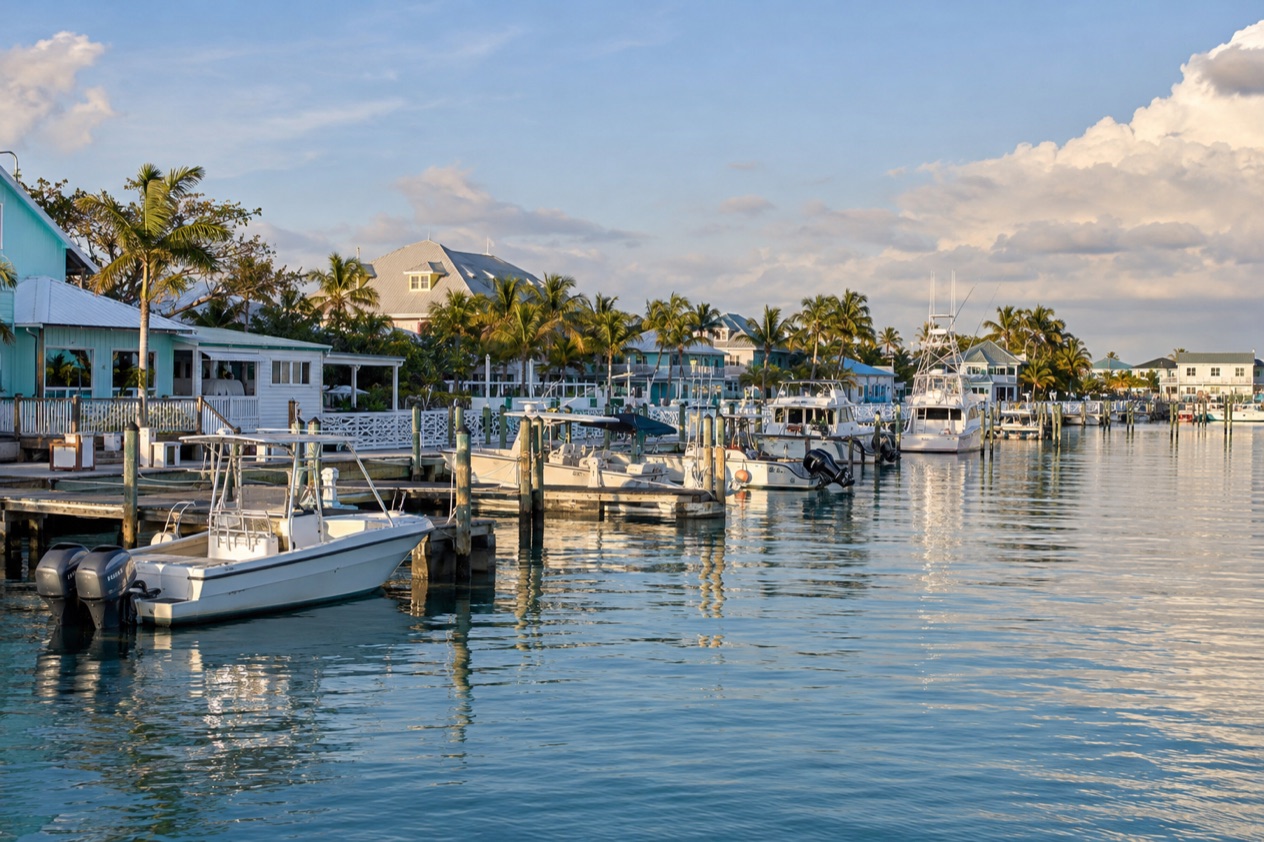
Early in the morning, the docks of Marsh Harbour fill with the sound of outboard motors warming up, ropes being coiled and boaters trading news over coffee before they head out to the cays. Along the waterfront, sailboats swing at their moorings and small ferries slip out toward the candy-striped lighthouse on Elbow Cay. Marsh Harbour is the working heart of the Abacos, a harbor town for sailors, anglers and anyone who wants a base for island hopping.
Where is Marsh Harbour and what is it like?
Marsh Harbour sits on Great Abaco Island, in the north of the Bahamas, and it is the commercial center of the Abacos. The island chain lies about 193 miles east of Miami, Florida, and Marsh Harbour is its largest settlement and the third-largest city in the country, with a population of 5,314.
The town is a place of practical errands and easy harbor life rather than a resort strip. It has the only stop light in the Out Islands, which tells you something about the pace: a town large enough to need one, small enough that it remains a curiosity.
Boaters come for the full-service marinas and the well-stocked stores that can supply nearly anything a vessel needs, from provisions to parts. Others arrive simply because Marsh Harbour is where the airport is, and the cays are a short hop by water.
Marsh Harbour suits travelers who like to be near the water and to move by boat, who want a real working town with grocery stores and restaurants instead of a gated resort, and who plan to spend their days on the nearby cays. It may disappoint anyone looking for a long, polished beach-resort stay right on the doorstep. The postcard images of the Abacos, the pastel cottages and the lighthouse, are mostly found a ferry ride away.
The wider chain stretches a long way and is split into North, Central and South Abaco, with Great Abaco and Little Abaco as the larger islands. Marsh Harbour sits in the middle of it all, which is why so many itineraries begin and end here. The hurricane that struck the Abacos in September 2019 is part of the island’s recent story, and the town’s rhythm today is that of a community that keeps working and welcoming boats.
What is there to do in Marsh Harbour?
The big reasons to come are boating, the ferry ride to Hope Town on Elbow Cay, and the harbor itself. Marsh Harbour differs from its neighbors because it is the place where you can organize all of it: the cays are the scenery, and the town is the supply base.
Boating from the marinas
Marsh Harbour’s full-service marinas let boaters dock their own vessel or rent live-aboard sailboats and powerboats. Walking along the docks, you see charter crews loading coolers, sailors checking charts and dinghies tied up three deep. The stores in town stock what a boater needs, so a few hours of shopping can turn into a week on the water.
If you prefer a day boat, one outfitter, Abaco Dorado, lists a rate of $215 per day off-season and $310 per day in season. A boat gives you the freedom to anchor your own day around a cay, a snack and a swim stop of your own choosing. It suits travelers who are comfortable at the helm and want to set their own pace.
Elbow Cay and Hope Town
Elbow Cay can be reached from Marsh Harbour by private boat or a regularly scheduled ferry. The village of Hope Town, a district on the cay with a population of 458 in 2010, is known for its lighthouse, the Elbow Reef Lighthouse, a candy-striped tower built in 1862 and the last manually operated one of its kind in the Bahamas. It is one of the last kerosene-fueled lighthouses in the world still working.
In the village, cars and golf carts are permitted on the outskirts, and the harbor view from the lighthouse is the picture most travelers carry home. The ferry ride itself, with the wind and the shifting color of the water, is part of the outing. It is a good day for couples, families and photographers.
A guided day on the water
For those who would rather not drive the boat, the Cruise Abaco day trip leaves from Marsh Harbour, runs from 9:30am to 4pm and takes a maximum of 12 people. It costs $1,520.00 for the boat, which works out to $126.67 each when twelve share it. A shared day like this suits groups of friends or extended families who want the cays without the navigation.
How many days do you need in Marsh Harbour?
A long weekend is enough to see the essentials, and a week lets you use Marsh Harbour as a real base for the Abacos. Most of what draws travelers sits on the water around town, so the number of days depends on how many cays you want to reach.
With three or four days, you can walk the harbor and its docks, stock up at the stores if you are boating, and take the ferry to Elbow Cay for a day in Hope Town. Add a second water day, either a rented boat or a guided trip, and the stay feels full without being rushed. Evenings are for dinner by the harbor and watching the boats return.
With a week, the rhythm changes. You can spend one day in Hope Town, another on a boat of your own, and keep a lazy day for the town. Boaters often stay longer, treating Marsh Harbour as the place to provision between stops along the 120-mile chain.
More time opens up the rest of Great Abaco. Treasure Cay, on the same island, has its own airport and is the setting each March for the Great Abaco Family Fitness Weekend, which draws visitors from the Bahamas and abroad. The chain also divides into North, Central and South Abaco, so a longer trip can follow the islands one by one.
Where to stay in Marsh Harbour
The practical choice is between staying in Marsh Harbour itself, on a boat at one of its marinas, or across the water on Elbow Cay. Staying in town puts you close to the airport, the stores and the ferry docks, which suits anyone who wants to come and go easily.
The marinas offer a different kind of stay. Boaters can dock their own boat, or rent a live-aboard sailboat or powerboat and make the vessel their lodging. This suits couples and groups who want to wake up on the water and travel from cay to cay without unpacking.
Hope Town on Elbow Cay is the quieter alternative, a small village with the lighthouse as its landmark and cars and golf carts limited to its outskirts. Travelers who stay there trade the convenience of the commercial center for the atmosphere of the harbor village, and reach Marsh Harbour by the scheduled ferry or by private boat.
Treasure Cay, elsewhere on Great Abaco, is another base, with its own international airport. It makes sense for those whose flight arrives there or who want to be on the northern part of the island, away from the harbor bustle of Marsh Harbour.
How do you get to Marsh Harbour and get around?
Most travelers arrive by air at Leonard M. Thompson International Airport (MHH) in Marsh Harbour, the larger of the two international airports in the Abacos. The other is Treasure Cay Airport (TCB), in the settlement of Treasure Cay on Great Abaco. Flights to the Abacos connect or originate in Florida or Atlanta.
From Grand Bahama, Pinder’s Ferry operates twice a day from McLean’s Town to the Abacos. That makes a sea route possible for travelers already on Grand Bahama Island.
Getting around the water is the heart of it. A regularly scheduled ferry links Marsh Harbour with Elbow Cay, and private boats make the same crossing. Boaters can dock at the marinas or rent a live-aboard sailboat or powerboat, and day boats are available from outfitters. On Elbow Cay, cars and golf carts are permitted on the outskirts of Hope Town.
When is the best time to visit Marsh Harbour?
The most comfortable months run from winter into spring, roughly December through April. Nassau’s January highs reach the high 70s with lows in the mid-60s, and the sea there is around 77 degrees, so the air is mild and the water is cool but pleasant for those who like it. Rain is light in that season, with only a few showery days.
Summer is hot and wetter. In July, Nassau’s highs reach about 91 degrees and rain falls on a dozen days or so, often as heavy afternoon showers. The sea warms to the high 80s, which suits those who want to spend hours in the water. Boaters in particular pick their season: the day-boat rate listed by one outfitter is higher in season than off-season.
The Atlantic hurricane season runs from June 1 to November 30, and December falls just after it ends. March brings the Great Abaco Family Fitness Weekend in Treasure Cay, a draw for visitors from the Bahamas and abroad. Spring is also a popular time for boating, with comfortable air and the sea warming.
Good to know before you go
The U.S. State Department rates the Bahamas Level 2, “Exercise increased caution”, and says most crime occurs in Nassau on New Providence and in Freeport on Grand Bahama.
The Atlantic hurricane season runs from June 1 to November 30, and the Abacos were hit hard by Hurricane Dorian, which made landfall on Great Abaco Island on September 1, 2019. Plan dates with the season in mind, especially for boating. Distances here are best thought of in water miles, since the cays are separated by sea and the ferry or a boat links them. Marsh Harbour’s stores stock plenty for boaters, so most supplies can be bought in town before you head out to the cays.
Sources
- Bahamas Ministry of Tourism, Investments & Aviation (bahamas.com), Marsh Harbour (https://www.bahamas.com/natural-wonders/marsh-harbour), checked October 10, 2026
- Wikipedia, Marsh Harbour Airport (https://en.wikipedia.org/wiki/Leonard_M._Thompson_International_Airport), checked October 10, 2026
- Wikipedia, Abaco Islands (https://en.wikipedia.org/wiki/Abaco_Islands), checked October 10, 2026
- Bahamas Ministry of Tourism, Investments & Aviation (bahamas.com), The Abacos (https://www.bahamas.com/islands/abacos), checked October 10, 2026
- Bahamas Ministry of Tourism, Investments & Aviation (bahamas.com), travel blog, island hopping in the Abacos (https://www.bahamas.com/blog/the-ultimate-guide-to-island-hopping-in-the-abacos-without-breaking-the-bank), checked October 10, 2026
- Wikipedia, Hope Town (https://en.wikipedia.org/wiki/Hope_Town), checked October 10, 2026
- Wikipedia, Hurricane Dorian (https://en.wikipedia.org/wiki/Hurricane_Dorian), checked October 10, 2026
- Wikipedia, Geography of the Bahamas (https://en.wikipedia.org/wiki/Geography_of_the_Bahamas), checked October 10, 2026
- NOAA NCEI, GHCN-Daily station BF000078073 (Nassau Airport), normals 1991-2020 computed from the daily record (https://www.ncei.noaa.gov/access/services/data/v1?dataset=daily-summaries&stations=BF000078073), checked October 10, 2026
- Open-Meteo Marine API, average 2015-2024, checked October 10, 2026
- U.S. Department of State, The Bahamas Travel Advisory, Level 2 (https://travel.state.gov/), checked October 10, 2026
- NOAA National Hurricane Center, Climatology (https://www.nhc.noaa.gov/climo/), checked October 10, 2026
To plan your stay
- Best Time to Visit the Bahamas: Weather, Hurricane Season, Sea Temperatures and Junkanoo
- Where to Stay in the Bahamas: Best Islands, Resorts, Boutique Stays and How to Choose
- Getting Around the Bahamas: Flights, Ferries, Mailboats and Taxis in Nassau
- Know Before You Go to the Bahamas: Entry Rules, Money, Getting Around and Local Customs