
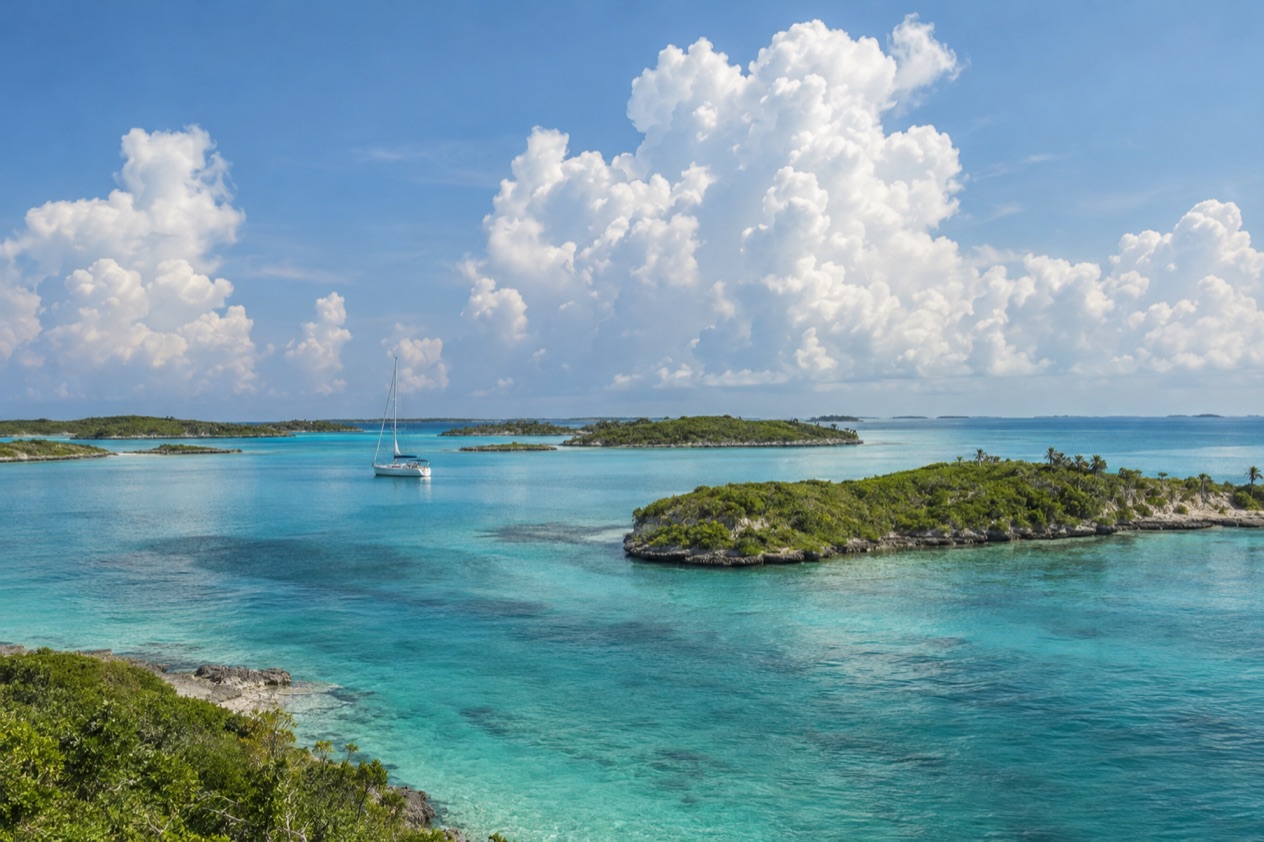
In September the harbor at Hope Town is quiet in the early morning, the red-and-white lighthouse stands over still boats, and the first bike bells ring along the lanes of Elbow Cay. The summer rush has thinned, the crawfish season is under way, and the sea is still as warm as bathwater. This is the Abacos in the heart of the Atlantic hurricane season, a month for travelers who like small settlements, boats and slow days.
What is the weather like in the Abacos in September?
September brings heat, humidity, and passing showers, and the ocean remains so warm it seems to merge with the atmosphere. Days run long, though they are already shortening as the month moves toward the autumn equinox.
| Month | Sea at the Abacos (°F) | Daylight on the 15th (hours and minutes) |
|---|---|---|
| August | 86.7 | 13 h 06 min |
| September | 86.1 | 12 h 20 min |
| October | 83.9 | 11 h 34 min |
In Nassau, highs average about 90°F in September, and rain falls on a good share of the days. Treat that as a picture of the heat and humidity of the region: mornings are warm before the sun is high, and by midday the air feels heavy. In the Abacos, expect the same kind of summer pattern, with showers that blow through and then give way to bright sky, and the occasional gray, soggy day when a tropical system passes nearby.
What this means for you: plan outdoor things early or late. Walks around Hope Town, bike rides and boat runs feel best in the first hours after sunrise and again toward evening, when the light turns gold on the water and the white sand. Midday is for the shade of a porch, a long lunch or a swim.
Daylight lasts a little over twelve hours in mid-September, so dinner is usually outdoors in the warm dusk. Packable rain gear for those sudden squalls on the water is worth bringing, along with clothes that are light and dry fast.
Can you swim in the Abacos in September?
Yes, the sea is very warm in September, warm enough that a long swim is more about the heat of the day than the water itself.
The Abacos are a chain of barrier islands and cays, so there is a sheltered side along the Sea of Abaco and an Atlantic side facing open ocean. Soft white sand meets coconut trees at Tahiti Beach, which curves into clear water at the southern tip of Elbow Cay and can be reached only by foot, bike or boat. Day to day and shore to shore, the Atlantic side can kick up more, especially once a system has passed through.
Bring a mask and snorkel, reef-friendly sunscreen and a rash guard for the long sun. Even in the sheltered spots, September is a month to look at the sky and listen to forecasts before heading out in a boat.
What to do in the Abacos in September
The big September theme is food and the sea. Crawfish season, which runs from August 1 to March 31, is in full swing, and on many menus in the Bahamas the words crawfish and lobster are used interchangeably.
Seek out crawfish salad, which combines diced lobster with onions, sweet peppers and lime juice, offered over greens, plain, or now and then inside a sandwich. Stew lobster, simmered in a rich brown gravy, is the other classic.
September is also the month when the islands feel like themselves. The summer boaters have thinned, tables on the waterfront open up and the pace is slow. The hurricane peak falls on September 10, with most activity between mid-August and mid-October, so the mood on the docks is one of watching the sky, and plans stay flexible.
Hope Town and Elbow Cay
Elbow Cay has just one settlement, Hope Town, co-founded in 1785 by Wyannie Malone, a South Carolina widow who came with her four children following the American Revolution. Before Marsh Harbour Airport opened in 1959, fishing and shipwreck salvage kept the island going. These days the candy-striped lighthouse marks the spot as you stroll or pedal by beachside cafés, art galleries, small shops and colorful cottages.
Bikes are the way to cover the lanes, and the waterfront restaurants serve fresh local seafood, a good place to order that crawfish. Go early in the morning or late in the afternoon in September, and keep the hottest hours for the water. Tahiti Beach at the southern end makes a good picnic stop, soft sand and gentle waves for beach games on a good day.
Green Turtle Cay
Green Turtle Cay is one of the barrier islands off mainland Great Abaco, and it can be reached only by ferry from the mainland or by boat, because there is no airport on the island. Roughly three miles long and half a mile wide, it takes its name from the many green turtles in these waters. The settlement is known for its New England style architecture, with shops, restaurants and outstanding beaches.
It suits a slow day of strolling the lanes, stopping for lunch and finding a beach. September’s quiet makes it feel unhurried. Go for the old clapboard houses and the water views rather than a checklist.
Man-O-War Cay and Marsh Harbour
Three churches serve Man-O-War Cay, where only a few hundred people live, and in 1798 residents began farming as the start of its early Loyalist settlement. A shipwrecked sailor named Benjamin Albury married Eleanor Archer in 1821, and their descendants, today’s Albury families, run family-owned businesses on the cay. It is a place to walk slowly and see how a small community lives and works.
The Abacos’ commercial hub is Marsh Harbour on Great Abaco, home to the bigger of the region’s two international airports. Locals enjoy a small joke: theirs is the only stop light in the Bahamas’ Out Islands. Use it as the base for supplies, a meal and the boats out to the cays. Rain days work well here for errands and a long lunch.
A two-day itinerary for the Abacos in September
Day 1 starts in Hope Town on Elbow Cay while the air is still cool. Sunrise comes with a little over twelve hours of daylight in the month, so the early hours are the pleasant ones. Reach Hope Town in the morning, walk the lanes by the harbor and take your time with the cottages, galleries and shops before the heat builds.
At midday, have lunch at a waterfront restaurant, then rent a bike for the afternoon and ride south to Tahiti Beach. Spend the hottest hours there with a picnic and a swim, then roll back for the golden light on the harbor. Dinner in town finishes the day, and a candlelit table by the water suits the evening.
If rain turns the day gray, stay under cover in the galleries and shops and let the showers pass over a long meal. They often move quickly.
Day 2 heads to Green Turtle Cay by ferry from the mainland. Plan the crossing for the morning, when the air is cooler, and spend the day walking the settlement with its New England style houses, then finding a beach for a swim in the warm water.
Have lunch in a local restaurant, then a slow afternoon in the shade or by the sea. Return by boat and end in Marsh Harbour with dinner. On a wet day, shops, a long lunch and some quiet time on a porch do the job, and the boat can wait for the weather to settle.
Is the Abacos busy in September?
No, September is one of the quieter months in the Abacos, with the summer vacation crowds gone and the islands settling into a slower rhythm.
With school back in session, fewer families travel, and the people you meet on the docks are more often boaters, return visitors and those drawn by the quiet. Restaurant tables in Hope Town and Green Turtle Cay are easier to come by than in the busiest weeks, and rooms are generally easier to find. That said, the Abacos are small, with a limited number of places to stay on the cays, so book early as a habit, especially if you want a specific spot on Elbow Cay or Green Turtle Cay.
The peak of hurricane season is also in September, so many travelers hold back. If you go, keep plans flexible and watch the forecast. Hurricane Dorian struck the Abaco Islands on September 1, 2019, and the Abacos and Freeport have been rebuilding since, a reminder of how the season shapes life here.
What to pack for the Abacos in September
Pack for heat, sun, and sudden showers on the water. Think light, quick-dry layers and gear for boats and beaches.
- Lightweight rain jacket, for squalls on the ferry and the lanes.
- Swimsuits and a rash guard, for long days in the warm sea.
- Mask and snorkel, for the clear water around the cays.
- Reef-friendly sunscreen and a hat, for the strong sun.
- Sandals that can get wet, for boats, docks and beaches.
- Insect repellent, for warm, humid evenings outdoors.
Good to know before you go
The U.S. State Department rates the Bahamas Level 2, “Exercise increased caution”, and says most crime occurs in Nassau on New Providence and in Freeport on Grand Bahama.
September falls inside the Atlantic hurricane season, which runs from June 1 to November 30, and the peak is September 10. Travelers should look at the Bahamas.com hurricane page often for updates, since the Bahamas Ministry of Tourism & Aviation keeps watch on Atlantic tropical storms and hurricanes. Hurricane Dorian made landfall on Great Abaco Island on September 1, 2019, and the Abacos are among the islands that have been rebuilding.
Getting around is by boat and on foot. Green Turtle Cay is accessible solely by boat or by ferry from the mainland, while Tahiti Beach is reachable only by boat, bike or on foot.
The Abacos in September vs August and October
Moving the trip four weeks earlier, to August, brings a slightly warmer sea and longer days, with more families on vacation and a busier feel in the harbors. Crawfish season has just opened on August 1, so the menus are fresh with it. Heat and showers are similar, and the hurricane season is already running, building toward the peak.
Moving four weeks later, to October, the sea cools a little and the days shorten, with a bit less rain in Nassau’s record. The hurricane season is still running until November 30, with most activity fading from mid-October. The islands are quiet, and the light turns softer in the late afternoon.
Choose August if you want the longest days and the liveliest summer mood. Stay with September for emptier lanes and the warm sea. Pick October if you prefer a slightly cooler edge to the water and quiet docks, while keeping an eye on the forecast.
Is September a good time to visit the Abacos?
Yes, for travelers who like quiet settlements, warm water and flexible plans, and who are comfortable with the season’s weather uncertainty.
It suits couples, boaters and anyone who would rather have a bike lane and a harbor table to themselves than a lively crowd. It is less suited to travelers who need fixed dates and firm plans, since the peak of hurricane season falls this month and a passing system can change a schedule.
On arrival, settle into Hope Town or Marsh Harbour, check the forecast and get on the water early while the air is cool. Then order crawfish, ride out to Tahiti Beach and watch the light turn gold over the harbor. September in the Abacos is the quiet end of summer, with a warm sea, fresh crawfish and the red-and-white lighthouse standing over a calm morning.
Sources
- Open-Meteo Marine API, average 2015-2024, checked October 10, 2026
- sunrise-sunset.org, sunrise and sunset calculated for the 15th of the month, checked October 10, 2026
- NOAA NCEI, GHCN-Daily station BF000078073 (Nassau Airport), normals 1991-2020 computed from the daily record (https://www.ncei.noaa.gov/access/services/data/v1?dataset=daily-summaries&stations=BF000078073), checked October 10, 2026
- Bahamas Ministry of Tourism, crawfish season (https://www.bahamas.com/blog/its-crawfish-season), checked October 10, 2026
- NOAA National Hurricane Center, Climatology (https://www.nhc.noaa.gov/climo/), checked October 10, 2026
- Bahamas Ministry of Tourism, Investments & Aviation (bahamas.com), Hurricane and storm information (https://www.bahamas.com/hurricane-storm-information), checked October 10, 2026
- Wikipedia, Hurricane Dorian (https://en.wikipedia.org/wiki/Hurricane_Dorian), checked October 10, 2026
- Bahamas Ministry of Tourism, Investments & Aviation (bahamas.com), travel blog, Abacos and Grand Bahama after Hurricane Dorian (https://www.bahamas.com/blog/things-to-know-when-visiting-the-bahamas-after-dorian), checked October 10, 2026
- Bahamas Ministry of Tourism, Investments & Aviation (bahamas.com), Hope Town (https://www.bahamas.com/natural-wonders/hope-town), checked October 10, 2026
- Bahamas Ministry of Tourism, Investments & Aviation (bahamas.com), travel blog, Hope Town (https://www.bahamas.com/blog/the-top-5-most-romantic-things-to-do-in-hope-town-abaco), checked October 10, 2026
- Wikipedia, Green Turtle Cay (https://en.wikipedia.org/wiki/Green_Turtle_Cay), checked October 10, 2026
- Bahamas Ministry of Tourism, Investments & Aviation (bahamas.com), Green Turtle Cay (https://www.bahamas.com/natural-wonders/green-turtle-cay), checked October 10, 2026
- Bahamas Ministry of Tourism, Investments & Aviation (bahamas.com), Marsh Harbour (https://www.bahamas.com/natural-wonders/marsh-harbour), checked October 10, 2026
- Bahamas Ministry of Tourism, Investments & Aviation (bahamas.com), Man O War Cay (https://www.bahamas.com/natural-wonders/man-o-war-cay), checked October 10, 2026
- Bahamas Ministry of Tourism, Investments & Aviation (bahamas.com), Tahiti Beach (https://www.bahamas.com/natural-wonders/tahiti-beach), checked October 10, 2026
- Wikipedia, Geography of the Bahamas (https://en.wikipedia.org/wiki/Geography_of_the_Bahamas), checked October 10, 2026
- Bahamas Ministry of Tourism, Investments & Aviation (bahamas.com), Island FAQ (https://www.bahamas.com/plan-your-trip/island-faq), checked October 10, 2026
- Bahamas Department of Immigration, Entry requirements (https://www.immigration.gov.bs/entry-requirements/), checked October 10, 2026
- Bahamas Department of Immigration, Before your arrival (https://www.immigration.gov.bs/entry-requirements/before-your-arrival/), checked October 10, 2026
- U.S. Department of State, The Bahamas Travel Advisory, Level 2 (https://travel.state.gov/), checked October 10, 2026
To plan your stay
- Things to Do in the Abacos: Hope Town Lighthouse, Tahiti Beach, Cays and Conch
- Where to Stay in the Abacos: Treasure Cay, Hope Town, Green Turtle Cay and Marsh Harbour
- The Abacos from Miami: Flights to Marsh Harbour, Island Connections and Hope Town
- Know Before You Go to the Abacos: Entry Papers, Money, Getting Around and Health