
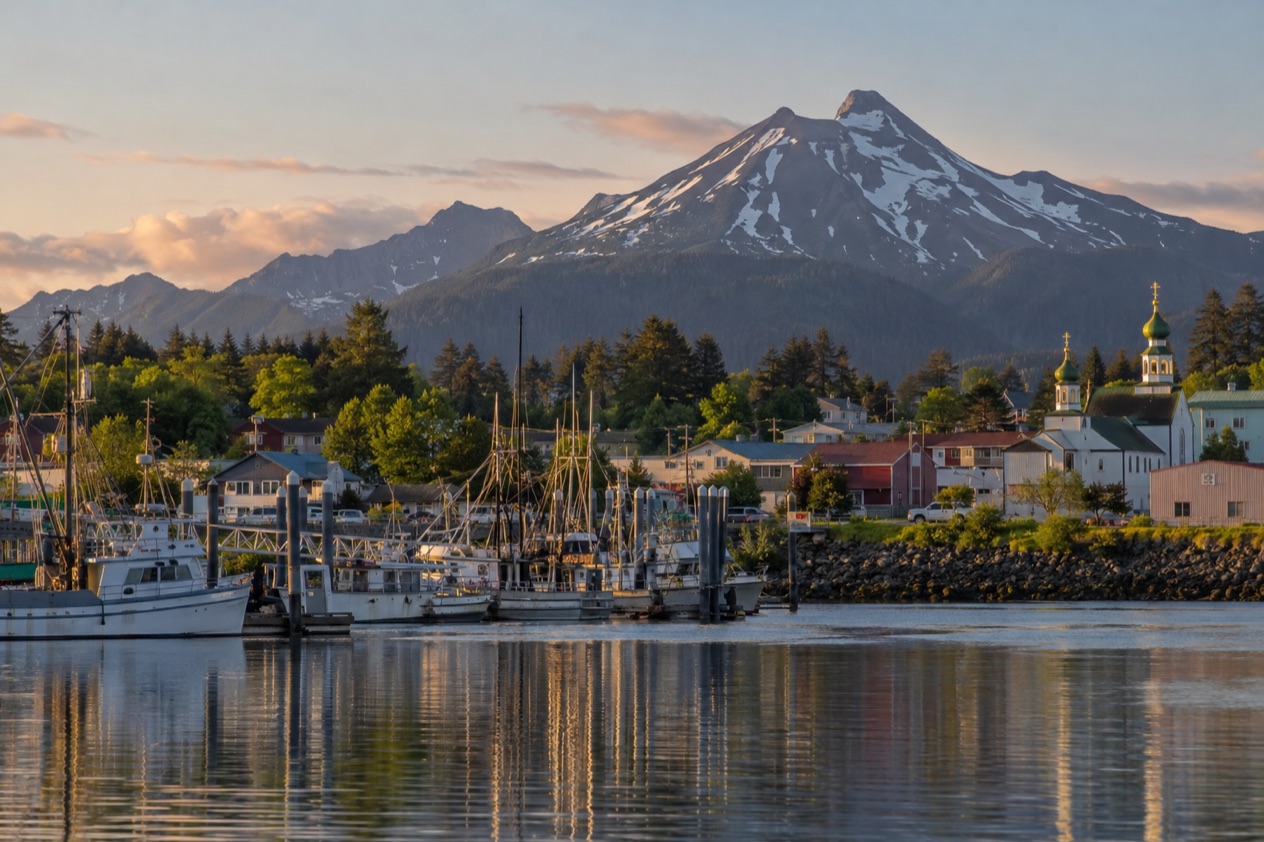
In August, Sitka wakes to wet spruce and hemlock, with mist lifting off the water of Sitka Sound and the onion dome of St. Michael’s Cathedral appearing and disappearing in the drizzle. Fishing boats move through the harbor, and the town’s street corners smell of rain, salt and wood smoke. It is a month for walking in the rain forest, reading the totem poles of the national park and watching the weather change over the islands.
What is the weather like in Sitka in August?
August in Sitka is cool, damp and changeable, with mild afternoons, chilly nights and rain on more days than not. The figures are those of Sitka’s airport and sit between a drier July and a much wetter September.
| Month | Average high (°F) | Average low (°F) | Precipitation (in) | Days with precipitation | Daylight on the 15th |
|---|---|---|---|---|---|
| July | 60.4 | 52.5 | 4.62 | 11.4 | 17 h 19 min |
| August | 61.8 | 52.9 | 7.25 | 13.3 | 15 h 19 min |
| September | 57.9 | 48.5 | 11.69 | 17.5 | 12 h 54 min |
Afternoons reach the low 60s, which feels pleasant when you are walking and chilly when you stand still on a boat deck. Nights stay in the low 50s, so a sweater is useful for dinner, and you will not need heavy winter gear. The park service describes Sitka’s climate as humid and maritime, with heavy precipitation and a small temperature range between seasons.
Rain comes on a good share of the days, sometimes as a fine drizzle that hangs over the town all morning and sometimes as a steady downpour. Waterproof layers matter more than an umbrella, because the rain is soft and the trails are wet either way.
The days are still long, with light well into the evening, though noticeably shorter than in July. That leaves room for a late walk after dinner, and the soft gray light is good for photographs of the harbor and the forest. The water of the Sound is cold, so the sea is something to look at and to travel on, not to swim in.
What to do in Sitka in August
August in Sitka is about weather you dress for and a town whose best sights work well in gray light. The rain forest is at its greenest and wettest, the tidelands are exposed at low water, and the museums and churches give you somewhere dry when a shower settles in. The pace is unhurried, and most of what you do here is on foot.
Downtown Sitka is compact, with the harbor on one side and the old Russian-era buildings on the other. St. Michael’s Cathedral, with its green onion dome, is the landmark you keep seeing from the waterfront. Wandering between the shops, the harbor floats and the small cafés is a fine way to spend a drizzly morning, since you can duck inside whenever the rain picks up.
Sitka National Historical Park
The park preserves a landscape that drew Tlingit, Russians and Americans, and sometimes led to conflict between them. You wander among totem poles obtained from Haida and Tlingit, set along a path through a temperate rain forest of towering spruce and hemlock. In the wet air of August the moss glows green, and the poles take on a deep, dark sheen.
The path also follows Kaasdahéen (Indian River) and reaches tidelands where sea stars and crabs show at low water. In the visitor center you can explore ceremonial and traditional objects from Tlingit and Russian Orthodox cultures. Many of the artifacts there are owned by Tlingit clans and are still used for ceremonial purposes, which gives the displays a living weight.
A rain jacket is all you need for the forest paths, and the trees themselves soften a light shower. The park suits a slow morning, when mist often hangs among the trunks, and it suits anyone who wants culture and nature in the same walk.
The Russian Bishop’s House
Part of the national historical park, the Russian Bishop’s House holds museum exhibits and a furnished second floor that shows Russian activities in Alaska. Walking through the rooms is a good wet-weather choice, because the story of Sitka as a Russian outpost comes alive in the furnishings and the exhibits.
Pair it with a stroll to the cathedral and the town’s other old buildings. Together they make a half day that works whether the sky is clear or leaking, and it gives context for the totem poles you see in the park.
Sitka Sound and the harbor
Sitka Sound is bordered by Baranof Island and Kruzof Island, with the open Pacific to the southwest, and in the early 19th century it was a major center of the maritime fur trade. From the waterfront you look out over islands that rise straight from the water, their tops often lost in cloud. Even if you never leave shore, the changing light on the Sound is a main attraction of an August visit.
Fishing boats and small craft come and go in the harbor, and watching them from the docks is a relaxed way to pass an hour. Dress warmly, because the wind off the water makes the low 60s feel cooler.
Seafood is the natural thing to eat here. Salmon and halibut are staples of Alaska menus, and a bowl of hot chowder is welcome after a damp walk. Cafés and small restaurants downtown fill with people drying off between showers.
A two-day itinerary for Sitka in August
Day 1 starts in the forest, while the morning mist still lingers among the trees. Spend the first hours at Sitka National Historical Park among the totem poles and along Kaasdahéen (Indian River), then follow the tidelands if the water is low. Take lunch in a downtown café, where chowder or a fish sandwich dries you out. In the afternoon walk the harbor and the old streets, ending at St. Michael’s Cathedral.
For the evening, eat seafood near the harbor and walk the waterfront while the light lasts, since August still gives a long evening of about fifteen hours of daylight. If the rain sets in for good, shift the park to the afternoon and spend the morning in the visitor center’s displays, then return to the trails when the shower eases.
Day 2 turns to history and the water. Begin at the Russian Bishop’s House, whose exhibits and furnished second floor tell the Russian side of Sitka’s story, and take your time with the rooms. Spend midday at a harbor-side table, then look out over Sitka Sound from the shore, watching boats and clouds move across the islands.
Use the afternoon for browsing small shops and a slow coffee, then give the evening to a last long walk by the waterfront. In heavy rain, the Bishop’s House and the cafés carry the whole day, and the gray light suits the quiet mood of the town.
Is Sitka busy in August?
August is a visiting month in Sitka, and cruise ships are among the ways people arrive, since Norwegian’s Alaska cruises list Sitka among their ports of call. On days when ships are in, the downtown streets and the park paths feel livelier, and on other days the town returns to its quiet pace.
Air service runs year-round with Alaska Airlines into a single-terminal airport, and the Alaska Marine Highway System offers a Sailing Calendar and a Sailing Search tool to look up ferry schedules by month, port or vessel. The rain keeps many people indoors in the same few places, so early mornings in the park tend to feel the calmest.
What to pack for Sitka in August
The park service advises rain gear and layered clothing at any time of year, and August bears that out. Pack for wet, cool days in the low 60s and chilly nights in the low 50s.
- A waterproof jacket with a hood, because showers come on most days.
- Water-resistant shoes for the wet forest paths and tidelands.
- A warm mid-layer or fleece for evenings and for wind on the water.
- A hat and light gloves for boat decks and breezy docks.
- A dry bag or waterproof cover for your camera and phone.
Good to know before you go
Sitka is reached by air or by water. The airport has a single runway on a causeway off Japonski Island, and the Alaska Marine Highway System publishes its ferry schedules in a monthly Sailing Calendar. Weather forecasts for the national historical park are available from the National Weather Service.
In Alaska, people must keep all human sources of food secure from bears. Keep that in mind if you carry snacks on trails outside town.
Sitka in August vs July and September
Moving four weeks earlier brings a drier month with the longest evenings, and fewer rainy days to plan around. July suits travelers who want to be outdoors for most of the day and who like very long light. August is a little warmer on average but noticeably wetter.
Four weeks later, September is cooler and much wetter, with rain on most days and daylight closing in. It suits travelers who do not mind rain, who like moody skies and who prefer to spend their time in museums, cafés and under the trees. The forest looks its richest, but plans for the water need more flexibility.
Choose July for the best odds of dry hours and the longest days. Choose August as the middle path, with long enough evenings and a good mix of rain and breaks. Choose September if rain does not bother you and you want a quieter, softer mood.
Is August a good time to visit Sitka?
Yes, for travelers who enjoy damp forests, history and cool air, and who are happy to dress for rain. August gives you long evenings, mild afternoons and a compact town where totem poles, a Russian bishop’s house and an island-ringed sound are all within reach.
It is a poorer fit for anyone who wants guaranteed sun or warm weather, since rain falls on a large share of the days and the water is far too cold for swimming. People who need a dry vacation should look elsewhere.
On arrival, head first to Sitka National Historical Park, because the poles and the rain forest set the tone for everything else. What stays with you from August here is the green: wet moss, dark spruce and a gray sky over the water of Sitka Sound.
Sources
- NOAA NCEI, U.S. Climate Normals 1991-2020, monthly (https://www.ncei.noaa.gov/access/services/data/v1?dataset=normals-monthly-1991-2020&stations=USW00025333), station Sitka Airport, elevation 14 feet, checked October 11, 2026
- Computed from the date and the latitude of the place (sunrise equation, solar elevation -0.833 degrees), October 11, 2026
- Alaska Department of Transportation, Alaska Marine Highway System, Schedules (https://dot.alaska.gov/amhs/schedules.shtml), checked October 11, 2026
- Princess Cruises, Alaska cruises (https://www.princess.com/en-us/cruise-destinations/alaska-cruises), checked October 11, 2026
- Holland America Line, Alaska cruises (https://www.hollandamerica.com/en/us/cruise-destinations/alaska-cruises), checked October 11, 2026
- Norwegian Cruise Line, Alaska cruises (https://www.ncl.com/cruise-destinations/alaska-cruises), checked October 11, 2026
- Royal Caribbean, Alaska cruises (https://www.royalcaribbean.com/cruise-destinations/alaska-cruises), checked October 11, 2026
- National Park Service, Lake Clark National Park & Preserve, plan your visit: conditions (https://www.nps.gov/lacl/planyourvisit/conditions.htm), checked October 11, 2026
- National Park Service, Katmai National Park & Preserve, plan your visit (https://www.nps.gov/katm/planyourvisit/index.htm), checked October 11, 2026
- Alaska Department of Fish and Game, Living with bears (https://www.adfg.alaska.gov/index.cfm?adfg=livingwithbears.main), checked October 11, 2026
- Wikipedia, Sitka Rocky Gutierrez Airport (https://en.wikipedia.org/wiki/Sitka_Rocky_Gutierrez_Airport), checked October 11, 2026
- Wikipedia, Sitka Sound (https://en.wikipedia.org/wiki/Sitka_Sound), checked October 11, 2026
- National Park Service, Sitka National Historical Park, plan your visit (https://www.nps.gov/sitk/planyourvisit/index.htm), checked October 11, 2026
- Wikipedia, Climate of Alaska (https://en.wikipedia.org/wiki/Climate_of_Alaska), checked October 11, 2026
To plan your stay
- Things to Do in Sitka: Russian History, Totem Parks, Wildlife and Fresh Seafood
- Where to Stay in Sitka: Downtown, the Historical Park Side and the Airport Island
- Sitka from Juneau: Ferry, Flights and What to Do on Arrival
- Day Trips from Sitka: Totem Park, the Russian Bishop's House, the Raptor Center and Sitka Sound