
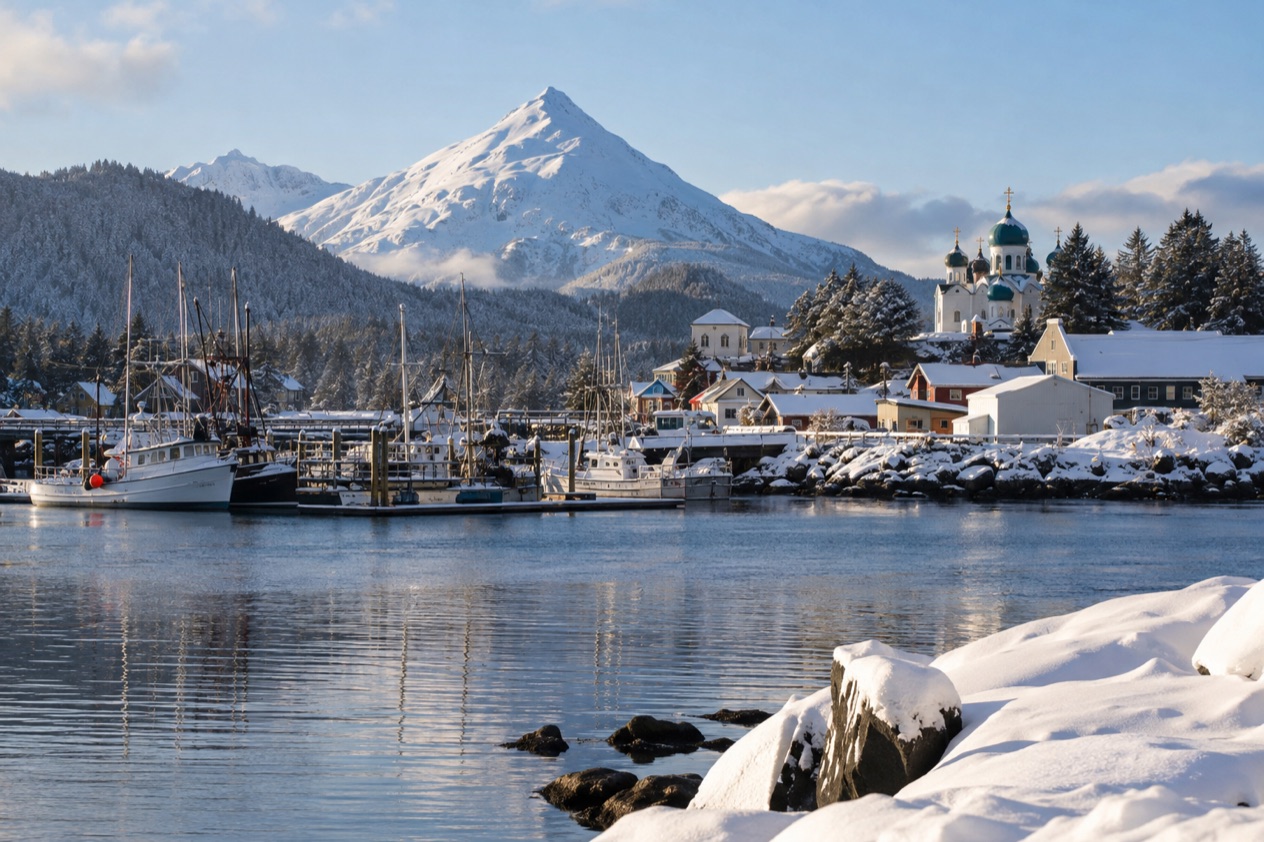
In March, the harbor in Sitka sits under low cloud, and the onion dome of St. Michael’s Cathedral rises above the wet street like a landmark in a watercolor. Fishing boats rock at their slips, spruce-scented mist hangs on the mountains of Baranof Island, and the town moves at the pace of a place between seasons. It is a month for quiet museums, forest walks and long, unhurried meals on Sitka’s edge of the Pacific.
What is the weather like in Sitka in March?
March in Sitka is cool, damp and changeable, with temperatures that stay above freezing in the afternoon and dip to near freezing at night. The days are lengthening quickly, and rain falls on a good share of them.
| Month | Average high (°F) | Average low (°F) | Precipitation (in) | Days with precipitation | Daylight on the 15th |
|---|---|---|---|---|---|
| February | 41.2 | 32.1 | 5.93 | 11.6 | 9 h 27 min |
| March | 42.5 | 32.5 | 5.60 | 12.6 | 11 h 42 min |
| April | 48.1 | 37.2 | 4.31 | 10.5 | 14 h 12 min |
Rain here often arrives as a steady drizzle or a passing band of showers rather than a single big downpour, and on colder spells the same system can turn to wet snow. The town has an oceanic climate with abundant precipitation, and a dry day is a pleasant surprise rather than something to count on.
The light is the real news of the month. Daylight stretches to nearly twelve hours by mid-March, a big gain from the short winter days, so you can plan a full day outdoors and still be back for dinner before dark.
Evenings are cold and damp, good for a hot bowl of chowder or a seat near a wood stove, and the sea air feels sharp at the waterfront. Even on a gray day the mountains and the water give the town a soft, silvery look that photographs well.
What to do in Sitka in March
March is a quiet, close-to-the-ground month in Sitka, and the best things to do are the ones that suit a cool, wet day: a historic house with a stove inside, a path through old spruce, a harbor walk, a good local meal.
There is no big festival to plan around this month. What March offers instead is the town itself, without the crowds of a summer afternoon, and the chance to see it the way residents do.
Sitka National Historical Park
The park sits on Baranof Island at the edge of town, and it is the natural first stop. Its two miles of wooded pathways wind among tall spruce and past many replica totem poles, which stand out against the dark trunks and the green moss. The walking is quiet and atmospheric in damp weather, when the forest smells of wet cedar and the Indian River runs beside the trail.
The park also includes the Russian Bishop’s House, restored by the National Park Service, which once served partly as a schoolhouse. Stepping inside gives you a warm, indoor chapter of Sitka’s story on a cold day. Salmon can be seen in the Indian River during spawning season, but that is a later-year sight, so in March you come for the poles, the trees and the history.
The harbor and the downtown streets
Downtown Sitka rewards slow walking. St. Michael’s Cathedral, with its onion dome, anchors the main street, and the harbor below is full of working boats rather than tour vessels at this time of year. Gift shops, bookstores and small cafés line the blocks, and the pace is relaxed enough that you can duck in and out as the showers come and go.
Look out over Sitka Sound from the waterfront and you see islands and open Pacific beyond them. The sound was a major center of the maritime fur trade in the early 19th century, and you can feel that seafaring past in the working harbor. A walk along the water is best when the clouds lift and the mountains show their snowy upper slopes.
Food in Sitka leans on the sea. Look for fresh fish, chowders and seafood plates in the small restaurants near the harbor, and for strong coffee and baked goods in the cafés where locals gather on wet mornings. Dinner is a cozy affair in March, with the evenings cold enough to make a warm dining room feel like part of the day’s plan.
A rainy afternoon is the moment for the museums, the bookstores and a long coffee stop. When the weather clears, even for an hour, head back to the forest path or the waterfront, because the light after a shower can be remarkable.
A two-day itinerary for Sitka in March
Day 1 begins at Sitka National Historical Park, the best use of a fresh morning when the forest is quiet. Walk the wooded pathway past the replica totem poles and along the Indian River, then step into the Russian Bishop’s House to warm up. By midday the cold will have found you, so head into town for a bowl of chowder or a fish lunch at a harbor-side restaurant.
In the afternoon, stroll the downtown streets around St. Michael’s Cathedral, browsing the bookstores and small shops. Daylight lasts nearly twelve hours in mid-March, so there is time for a long walk before dusk. Dinner can be a seafood plate in a warm dining room, and the evening is best spent unhurried.
Day 2 is for the water’s edge. Start with coffee and a pastry at a local café, then walk the harbor to watch the working boats and look out across Sitka Sound toward the islands. If the clouds lift, linger here, since the view of the mountains is worth the wait.
If rain settles in, spend the day indoors: a long lunch, a bookstore or two, and a second look at the town’s historic buildings. In the late afternoon, return to the waterfront if the weather opens up, then end with a quiet dinner of local fish before an early night.
Is Sitka busy in March?
No, March is a quiet month in Sitka, and the town feels like itself rather than a stop on a visitor circuit. The streets are calm, the harbor belongs to the fishing boats, and you can walk the forest path without much company.
The air service by Alaska Airlines runs year-round to Sitka’s single-terminal airport, so reaching the town does not depend on the season. Beyond that, the pace is set by the weather and the light, and that suits a traveler who likes unhurried days and local places.
What to pack for Sitka in March
Pack for cold, wet days with changing conditions, and favor layers you can add and remove as you move between forest, street and warm dining rooms.
- A waterproof jacket with a hood, since rain falls on many days.
- Waterproof shoes or boots for wet forest paths and damp sidewalks.
- Warm base layers, because mornings sit near freezing.
- A wool or fleece mid-layer for cold evenings by the harbor.
- A hat and light gloves for the wind off the water.
- A small day pack with a dry bag for a camera or phone.
Good to know before you go
March in Sitka is about weather and daylight more than schedules. Days are growing longer, but the evenings are still cold and damp, so plan your outdoor time for the middle of the day and keep indoor options ready. Alaska Airlines serves the airport year-round, and the airport’s single runway sits on a causeway off Japonski Island, which gives your arrival a memorable view of the water.
Sitka in March vs February and April
Moving the trip earlier, to February, means shorter days and slightly colder air, with daylight under ten hours in mid-month. The town is just as quiet, but you have less time outdoors, so the plan leans toward museums and cozy meals.
Moving later, to April, brings noticeably warmer afternoons and daylight stretching past fourteen hours, which opens up more time on the forest paths and the waterfront. Rain falls on a few fewer days, and the town begins to feel the pull of spring.
If you want the long evenings and a milder feel, April is the better choice. If you prefer the quiet of the cold months with enough daylight for a full day out, March is a good middle ground.
Is March a good time to visit Sitka?
Yes, March suits travelers who like quiet towns, moody weather and history, and who are happy to dress for rain. It is a month for the forest path, the Russian Bishop’s House and the harbor, not for big events or warm afternoons.
Anyone hoping for sunshine, long evenings or a lively festival calendar should choose another month. On arrival, start at Sitka National Historical Park while the morning is fresh, since the walk among the totem poles sets the tone for everything else.
What is special about March in Sitka is the stillness. The town is between seasons, the light is returning day by day, and the mist on the spruce makes the whole place feel like a quiet secret shared with the people who live there.
Sources
- NOAA NCEI, U.S. Climate Normals 1991-2020, monthly (https://www.ncei.noaa.gov/access/services/data/v1?dataset=normals-monthly-1991-2020&stations=USW00025333), station Sitka Airport, elevation 14 feet, checked October 11, 2026
- Computed from the date and the latitude of the place (sunrise equation, solar elevation -0.833 degrees), October 11, 2026
- Wikipedia, Southeast Alaska (https://en.wikipedia.org/wiki/Southeast_Alaska), checked October 11, 2026
- Wikipedia, Sitka, Alaska (https://en.wikipedia.org/wiki/Sitka,_Alaska), checked October 11, 2026
- Wikipedia, Sitka National Historical Park (https://en.wikipedia.org/wiki/Sitka_National_Historical_Park), checked October 11, 2026
- Wikipedia, Sitka Rocky Gutierrez Airport (https://en.wikipedia.org/wiki/Sitka_Rocky_Gutierrez_Airport), checked October 11, 2026
- Wikipedia, Sitka Sound (https://en.wikipedia.org/wiki/Sitka_Sound), checked October 11, 2026
- Wikipedia, Climate of Alaska (https://en.wikipedia.org/wiki/Climate_of_Alaska), checked October 11, 2026
To plan your stay
- Things to Do in Sitka: Russian History, Totem Parks, Wildlife and Fresh Seafood
- Where to Stay in Sitka: Downtown, the Historical Park Side and the Airport Island
- Sitka from Juneau: Ferry, Flights and What to Do on Arrival
- Day Trips from Sitka: Totem Park, the Russian Bishop's House, the Raptor Center and Sitka Sound