
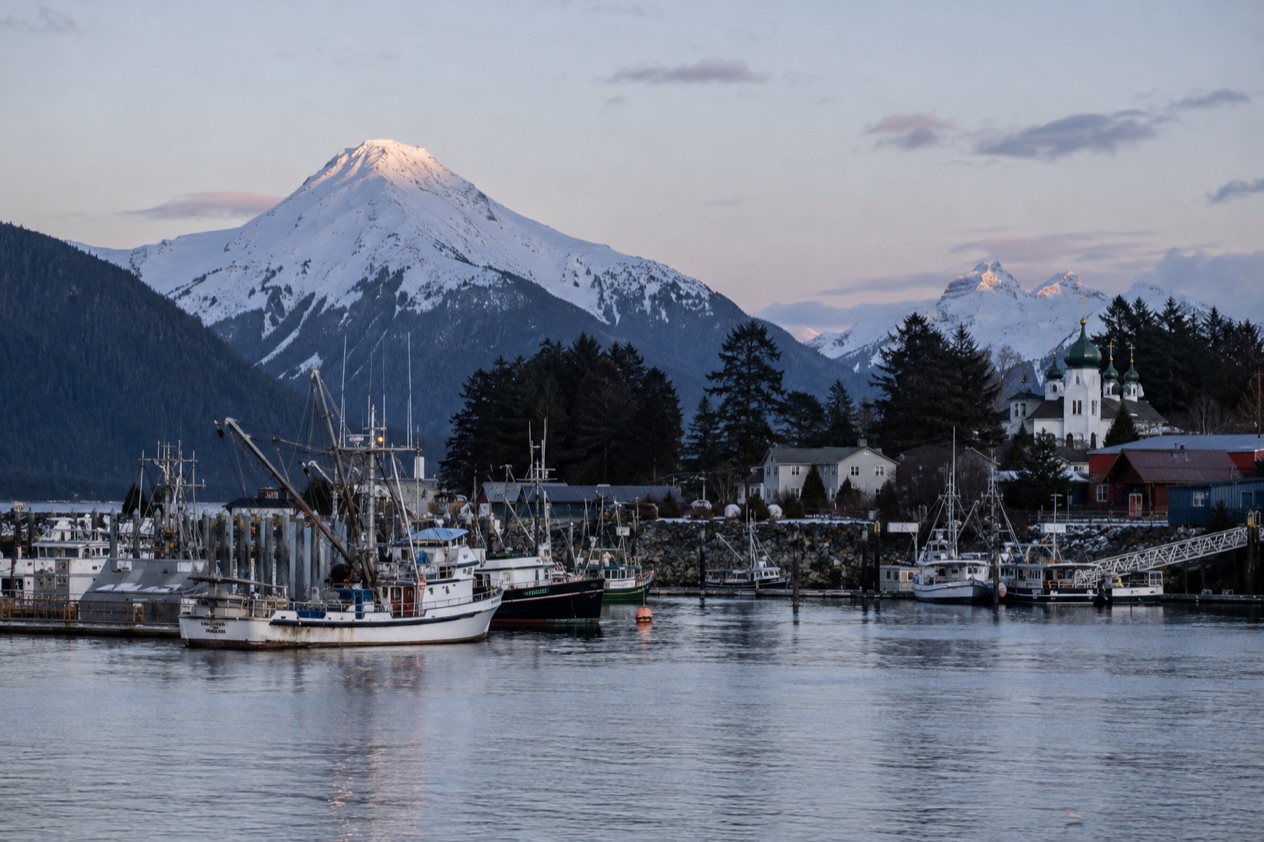
In November, Sitka smells of wet spruce and woodsmoke, and the harbor goes quiet except for the clank of rigging and the cries of gulls and eagles over the water. Rain drifts across Sitka Sound, the mountains behind town vanish into cloud and reappear without warning, and the onion dome of St. Michael’s Cathedral glows against a gray sky. This is a month for the town’s museums, its Tlingit and Russian history, its forest and its cafés, with the pace slowed to that of a place that belongs to its residents again.
What is the weather like in Sitka in November?
Sitka in November is cool, damp and gray, with rain on most days and daylight that is already shrinking fast. Temperatures hover above freezing even at night, so the weather feels more like persistent drizzle than hard winter.
| Month | Average high (°F) | Average low (°F) | Precipitation (in) | Days with precipitation | Daylight on the 15th |
|---|---|---|---|---|---|
| October | 50.8 | 41.9 | 11.78 | 19.1 | 10 h 30 min |
| November | 44.3 | 35.8 | 9.91 | 17.0 | 8 h 09 min |
| December | 41.5 | 33.4 | 8.43 | 16.1 | 6 h 46 min |
Sitka has a humid maritime climate, which means the range between seasons is small and the rain is the main character. Expect gray mornings that stay gray, showers that come and go, and the odd hour when the clouds lift and the peaks across the water show up sharply. Afternoons are cool rather than cold, and evenings feel colder mostly because the dark arrives so early.
Rain gear and layered clothing are what the National Park Service recommends for Sitka at any time of year, and November is the month that proves the point. A waterproof jacket with a hood, water-resistant shoes and a warm middle layer matter more than an umbrella. The short days shape the plan too: with only a little over eight hours of daylight in mid-month, you do your outdoor walking in the middle of the day and keep evenings for dinner, a museum talk or a book by a window.
Forecasts for Sitka National Historical Park come from the National Weather Service, and they are worth a glance each morning. The light, when it appears, is low and soft, and it turns the wet bark of the spruce and the stones of the shoreline a deep, saturated color that photographers tend to like.
What to do in Sitka in November
November in Sitka is about indoor history, forest walks in the rain and the unhurried rhythm of a small harbor town. The sights that anchor a visit are the Russian-era buildings downtown, the totem poles among the trees, and a sanctuary for injured birds of prey. Everything here suits damp weather, because the best of Sitka happens under a roof or under a canopy of old trees.
The town’s story is layered. The Tlingit have lived along this coast for a very long time, and Sitka later became a center of Russian America, so the same streets carry Tlingit names, Russian church bells and American storefronts. A slow walk through the center lets you read all three in the buildings, the signs and the objects in the museums.
The Russian Bishop’s House
The Russian Bishop’s House stands at 501 Lincoln Street and is a historic house museum and a National Historic Landmark. It was built in 1841 to 1843, and its weathered wooden walls, steep roof and upper-floor rooms recall the years when Sitka was the colonial capital. Inside, you move through living quarters, a chapel and exhibits about daily life under the Russian-American Company.
A rainy November day is the right time for it, because there is no reason to hurry back outside. Take your time with the furnishings, the icons and the small domestic objects, which say more about the era than any plaque.
Totem poles and the forest at Sitka National Historical Park
Sitka National Historical Park is where the rain-soaked forest and Tlingit art meet. Carved totem poles stand among tall spruce and hemlock along a trail near the water, and the moisture in November deepens the colors of the wood and the moss. The park is also where the National Weather Service forecasts we mentioned are tailored, so you can plan the walk around a break in the showers.
Go in the middle of the day, when the light is best under the canopy, and wear shoes that can handle puddles. The forest is hushed in this season, with the sound of dripping branches and the occasional raven. It suits anyone who likes atmosphere over spectacle, and it pairs naturally with a visit to the park’s cultural exhibits to learn what the carvings mean.
The Alaska Raptor Center
The Alaska Raptor Center is a sanctuary in the Tongass National Forest in Sitka, and it admits birds every year. Eagles, owls and other raptors that cannot return to the wild are cared for there, and you can see them up close, which is a very different experience from spotting a distant eagle on a piling. It gives a rainy day a purpose and a roof for part of it.
The setting among large trees feels right for the visit, and the quiet of the month means the grounds can feel calm. It suits families and anyone who wants to understand the wildlife of the coast rather than chase it. Afterward, a warm drink back in town makes a natural end to the outing.
Beyond these three, November is a good month for the small pleasures of a harbor town. Browse the shops and galleries on the main streets, watch fishing boats come and go from the harbor, and look for local seafood on menus, since salmon, halibut and other catches are the staples of a Southeast Alaska table. A bowl of chowder or a plate of fish on a wet evening is exactly what the weather asks for.
Bookstores, coffee shops and the town library become gathering spots when the weather closes in, and conversation with residents is easier now that the streets are quiet. If the clouds lift for an hour, head straight to the waterfront for the view of the sound and the peaks, then retreat indoors when the next shower rolls in.
A two-day itinerary for Sitka in November
Day 1 is for downtown and its history. Start late morning, once the light is best, with a slow walk through the center to St. Michael’s Cathedral and the harbor edge. Then settle into the Russian Bishop’s House for the heart of the day and take as long as the rooms deserve.
For lunch, choose a small café or a seafood spot in the center and order something hot. In the afternoon, wander the shops and galleries while the daylight lasts, then finish with an early dinner of local fish. Evenings are long and dark, so a bookstore, a quiet bar or an early night suits the mood.
Day 2 moves to the trees and the birds. Spend the late morning in Sitka National Historical Park among the totem poles, walking the forest in whatever the sky is doing, with a hood up if needed. The middle of the day offers the best light under the canopy.
After a warm lunch, give the afternoon to the Alaska Raptor Center and its resident eagles and owls, which keeps you mostly under cover if the rain turns heavy. The rain card for both days is simple: museums, cafés and the raptor center keep you dry, and the harbor can wait for a break in the clouds. Close with dinner somewhere warm in town.
Is Sitka busy in November?
No, November is a quiet month in Sitka, when the town feels like it belongs to its residents. Sitka is among the largest cities in Southeast Alaska, alongside Juneau and Ketchikan, yet in this month the streets, cafés and museums feel unhurried.
The pace is the draw. You can linger over a meal, take your time in a museum and talk with the people who run the shops. The short days and steady rain set the rhythm, and the town responds with a slower, more local mood than the warmer months would bring.
What to pack for Sitka in November
Rain and layers are the whole story, as the National Park Service advises for any time of year in Sitka. Pack for damp, cool days spent partly under trees and partly indoors.
- A waterproof jacket with a hood, because showers arrive on most days.
- Water-resistant shoes with good grip for wet forest trails and slick streets.
- Warm middle layers such as fleece or wool, since afternoons stay cool.
- A hat and light gloves for chilly mornings and evenings.
- A small daypack cover or dry bag to keep a camera and phone dry.
- A book or e-reader for the long, dark evenings.
Good to know before you go
Daylight is the main planning tool in November. With just over eight hours of light mid-month, build your outdoor time around the middle of the day and keep museums and meals for the margins. Rain is the norm rather than the exception, so treat a dry hour as a bonus and have an indoor alternative ready for each outing.
Check the National Weather Service forecast for Sitka each morning, then choose between the forest and the museums accordingly.
Sitka in November vs October and December
Moving the trip to October brings noticeably more daylight and slightly milder air, though it is the wetter of the two months. The extra hours of light make forest walks and harbor strolls more flexible, and the days feel less hemmed in. If long daylight matters to you, October is the better pick.
The town turns even more inward, and the plan becomes almost entirely about indoor warmth and early evenings. It suits travelers who want the deepest sense of winter on the coast and do not mind the dark.
November sits between the two. Choose it if you want a quiet town, moody light and the indoor history of Sitka without the darkest days of the year. Shift earlier if you want more hours outdoors, and later if the cold and the dark are part of what you are after.
Is November a good time to visit Sitka?
Yes, for travelers who love history, forest and a quiet harbor town and who do not mind rain. Museum lovers, birders, photographers of moody light and anyone who likes a slow pace will find it rewarding. It is not the month for those who want long days outdoors or dry, bright weather.
On arrival, head first to the Russian Bishop’s House and the cathedral, so the town’s layers of history are clear before you walk the forest and visit the raptors. Then let the weather decide the order of everything else. What makes November special here is the stillness: wet spruce, a quiet harbor, an eagle on a piling and a warm room with a window onto the rain.
Sources
- NOAA NCEI, U.S. Climate Normals 1991-2020, monthly (https://www.ncei.noaa.gov/access/services/data/v1?dataset=normals-monthly-1991-2020&stations=USW00025333), station Sitka Airport, elevation 14 feet, checked October 11, 2026
- Computed from the date and the latitude of the place (sunrise equation, solar elevation -0.833 degrees), October 11, 2026
- National Park Service, Sitka National Historical Park, plan your visit: weather (https://www.nps.gov/sitk/planyourvisit/weather.htm), checked October 11, 2026
- Alaska Raptor Center, Sitka (https://www.alaskaraptor.org/), checked October 11, 2026
- Wikipedia, Russian Bishop%27s House (https://en.wikipedia.org/wiki/Russian_Bishop%27s_House), checked October 11, 2026
- Wikipedia, Tlingit (https://en.wikipedia.org/wiki/Tlingit), checked October 11, 2026
- Wikipedia, Southeast Alaska (https://en.wikipedia.org/wiki/Southeast_Alaska), checked October 11, 2026
- Wikipedia, Climate of Alaska (https://en.wikipedia.org/wiki/Climate_of_Alaska), checked October 11, 2026
To plan your stay
- Things to Do in Sitka: Russian History, Totem Parks, Wildlife and Fresh Seafood
- Where to Stay in Sitka: Downtown, the Historical Park Side and the Airport Island
- Sitka from Juneau: Ferry, Flights and What to Do on Arrival
- Day Trips from Sitka: Totem Park, the Russian Bishop's House, the Raptor Center and Sitka Sound