
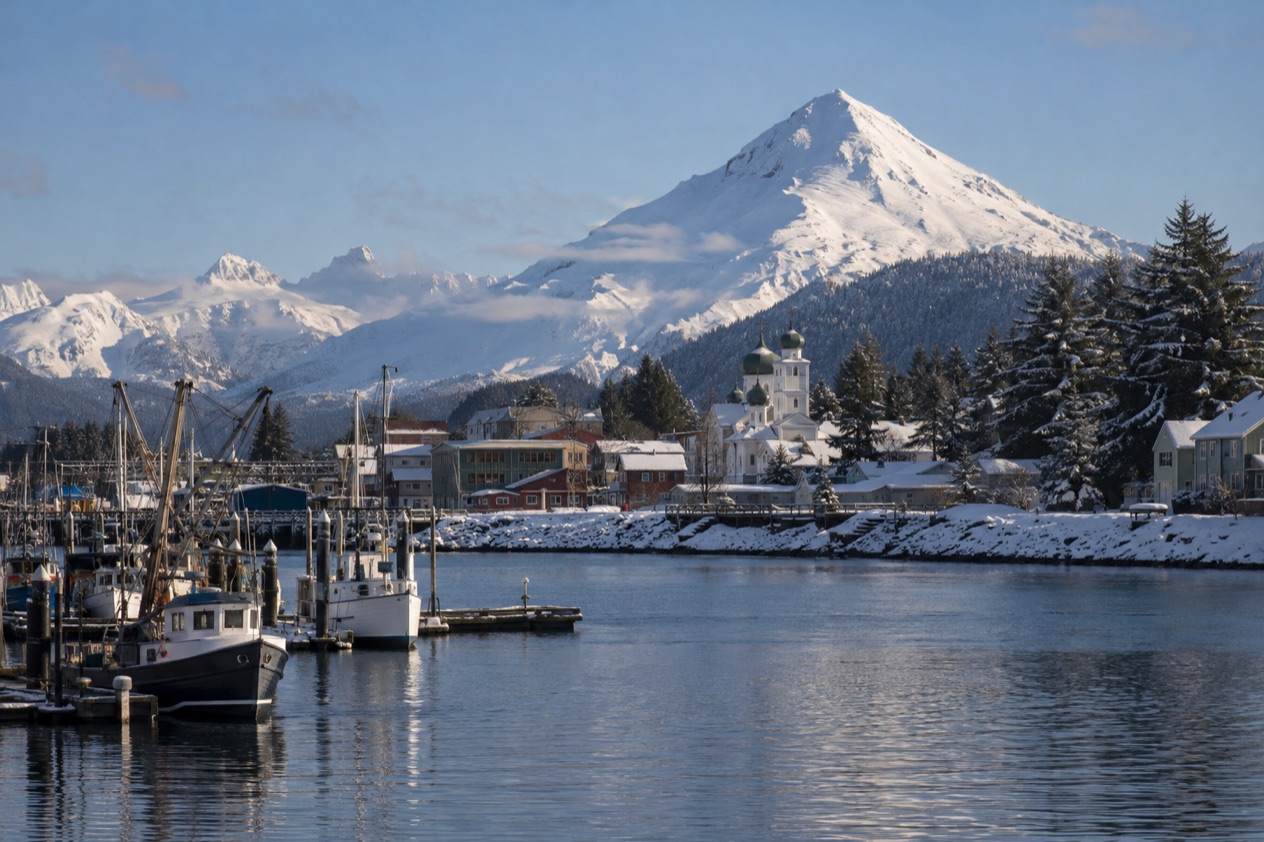
In April, Sitka wakes up slowly. Mornings start with mist hanging in the spruce and hemlock, ravens calling across the harbor, and the smell of wet cedar and salt on the streets around the Russian-built downtown. The light stretches longer each week, and the town feels like it has the place to itself again. It is a month for walking forest paths, wandering museums and settling into a quiet corner of the Inside Passage.
What is the weather like in Sitka in April?
April in Sitka is cool, damp and bright in turns, with temperatures that sit well above freezing by day and close to it at night.
| Month | Average high (°F) | Average low (°F) | Precipitation (in) | Days with precipitation | Daylight on the 15th |
|---|---|---|---|---|---|
| March | 42.5 | 32.5 | 5.60 | 12.6 | 11 h 42 min |
| April | 48.1 | 37.2 | 4.31 | 10.5 | 14 h 12 min |
| May | 53.3 | 43.0 | 3.81 | 9.7 | 16 h 27 min |
Afternoons are cool enough for a warm layer but pleasant for walking if the clouds break, and a sunny hour can feel almost mild out of the wind. Mornings are crisp, with lows near freezing in the coldest hours, so a hat and gloves are welcome before breakfast. Rain tends to arrive as showers and drizzle, with dry spells between them, and it is the kind of weather that settles in on the water and the forested slopes.
The light is the real gift of the month. Days are long enough to start late and still finish a trail or a museum visit in daylight, and the evenings stay bright well past dinner. Sitka has a humid maritime climate, and the National Park Service advises rain gear and layered clothing at any time of year. April is no exception: a waterproof shell matters more than a heavy coat.
What to do in Sitka in April
April is a month for the places that reward unhurried attention: a rain forest, a house full of Russian-era rooms, totem poles standing among old trees, and a sanctuary for injured birds. Nothing here needs sun to work, and the soft light often flatters the green of the forest.
Sitka National Historical Park
The grounds hold a temperate rain forest of towering spruce and hemlock, and the paths carry you among totem poles obtained from Haida and Tlingit communities. Kaasdahéen (Indian River) runs through the park, and tidelands along the shore hold sea stars and crabs for those who look closely.
The visitor center displays ceremonial and traditional objects from Tlingit and Russian Orthodox cultures. Many of the artifacts are owned by Tlingit clans and are still used for ceremonial purposes, which gives the cases a living quality rather than a museum hush. The park preserves a landscape that drew Tlingit, Russians and Americans, and sometimes led to conflict between them, and the walk makes that layered history easy to feel.
A cool, damp April morning suits the forest trails, when the moss is deep green and the mist sits among the trunks. Wear shoes that can handle wet ground, and give yourself time to stop at the poles rather than walking past them.
Russian Bishop’s House
At 501 Lincoln Street, the Russian Bishop’s House is a historic house museum and National Historic Landmark, built in 1841 to 1843. It belongs to Sitka National Historical Park, and it shows how Russian activities in Alaska were organized and lived day to day.
There are museum exhibits on the ground floor and a furnished second floor, where rooms are set as they would have been used. It is a good choice for a showery hour, because the interiors are the whole point and the weather outside hardly matters.
Alaska Raptor Center
The Alaska Raptor Center is a sanctuary set in the Tongass National Forest in Sitka. It admits birds each year, and a visit is a chance to see raptors up close and learn how injured birds are cared for.
It pairs well with a forest walk, since the setting among tall trees matches the subject. Cool, overcast April light is easy on the eyes and makes the birds’ plumage stand out against the green.
Beyond these three, Sitka rewards simply walking. Harbor edges, small shops, a bakery or café for a hot drink and the long evening light make a loose afternoon feel full. Seafood is the local table, and a chowder or a plate of fresh fish tastes right after a damp walk.
A two-day itinerary for Sitka in April
Day 1 begins in Sitka National Historical Park, early, while the forest is quiet and the mist is still low. Walk the trails among the spruce and hemlock, stop at the totem poles, and follow the river and the shoreline where sea stars and crabs sit in the tidelands. Come back to the visitor center around midday to look at the ceremonial objects, which makes a good indoor pause if the showers arrive.
For lunch, choose a harbor-side café or a casual seafood spot downtown. In the afternoon, walk to the Russian Bishop’s House on Lincoln Street and spend an hour in its exhibits and furnished upper floor. The long April daylight means you can wander the streets afterward and still have bright light for dinner.
Day 2 belongs to the Alaska Raptor Center, in the Tongass National Forest. Go in the morning, when you have energy for the grounds, and let the birds set the pace. Afterward, linger over a coffee and a slow lunch in town.
In the afternoon, take an unplanned stroll through the downtown streets, browse small shops and galleries, and watch the harbor. If the rain turns steady, shops, cafés and a long meal will fill the hours, and the evening light usually gives you a bright finish.
Is Sitka busy in April?
April is a quiet month in Sitka, with a calm, local feel along the streets and at the main sights. The town is not yet at full summer tempo, and the pace suits people who like to wander without a schedule.
Ferry service on the Alaska Marine Highway System runs on a schedule that you can look up in its Sailing Calendar, which sorts by month, port or vessel, and in its Sailing Search tool, where you enter a port and a date. Use those tools to see what is sailing on the days you want, and let the calm pace of the town shape the rest of the plan.
What to pack for Sitka in April
Sitka’s climate is humid and maritime, so the clothes you bring should handle wet and cool weather and let you add or remove layers through the day.
- A waterproof jacket, because showers come often and the National Park Service advises rain gear.
- Warm layers such as fleece or wool, for chilly mornings and evenings.
- Waterproof shoes with good grip for wet forest trails and the park paths.
- A hat and light gloves for the cold start of the day.
- A small daypack to carry layers as the weather shifts.
- An umbrella or hood for walks between museums and cafés.
Good to know before you go
Forecasts for Sitka National Historical Park are available from the National Weather Service, which is useful for deciding whether the forest or the museums come first on a given morning.
If you plan to arrive or leave by ferry, the Alaska Marine Highway System’s Sailing Calendar and Sailing Search tools show schedules by month, port and vessel. Look at them before you fix the dates of the trip.
Sitka in April vs March and May
Moving the trip earlier to March means colder days, more rain and much shorter daylight, so there is less time for outdoor walks and the forest feels grayer. Moving later to May brings warmer air, fewer wet days and long evenings, which makes the trails and the harbor more inviting.
April sits between them. It is cool but no longer wintry, and the daylight is already long enough for full days of sightseeing. The museum and park visits work in any of the three months, but the experience of being outdoors improves as the weeks go on.
Choose March if you want the quietest and most wintry feel and do not mind dark early evenings. Choose April for a balance of calm and usable light. Choose May if warmer air and the longest days matter most to you.
Is April a good time to visit Sitka?
Yes, April is a good time to visit Sitka for travelers who like history, forest walks and a quiet town, and who are happy to carry a rain jacket. It suits people who care more about atmosphere than sunshine.
Those who want warm days for long outdoor stretches may prefer a later month. If you come now, start with Sitka National Historical Park, where the totem poles and the rain forest set the tone for everything else. What stays with you from April in Sitka is the combination of soft light, green forest and a town that is not in a hurry, where a raven’s call and the wet scent of spruce are as much a part of the visit as any museum case.
Sources
- NOAA NCEI, U.S. Climate Normals 1991-2020, monthly (https://www.ncei.noaa.gov/access/services/data/v1?dataset=normals-monthly-1991-2020&stations=USW00025333), station Sitka Airport, elevation 14 feet, checked October 11, 2026
- Computed from the date and the latitude of the place (sunrise equation, solar elevation -0.833 degrees), October 11, 2026
- Alaska Department of Transportation, Alaska Marine Highway System, Schedules (https://dot.alaska.gov/amhs/schedules.shtml), checked October 11, 2026
- National Park Service, Sitka National Historical Park, plan your visit (https://www.nps.gov/sitk/planyourvisit/index.htm), checked October 11, 2026
- Alaska Raptor Center, Sitka (https://www.alaskaraptor.org/), checked October 11, 2026
- Wikipedia, Russian Bishop%27s House (https://en.wikipedia.org/wiki/Russian_Bishop%27s_House), checked October 11, 2026
- Wikipedia, Climate of Alaska (https://en.wikipedia.org/wiki/Climate_of_Alaska), checked October 11, 2026
To plan your stay
- Things to Do in Sitka: Russian History, Totem Parks, Wildlife and Fresh Seafood
- Where to Stay in Sitka: Downtown, the Historical Park Side and the Airport Island
- Sitka from Juneau: Ferry, Flights and What to Do on Arrival
- Day Trips from Sitka: Totem Park, the Russian Bishop's House, the Raptor Center and Sitka Sound