
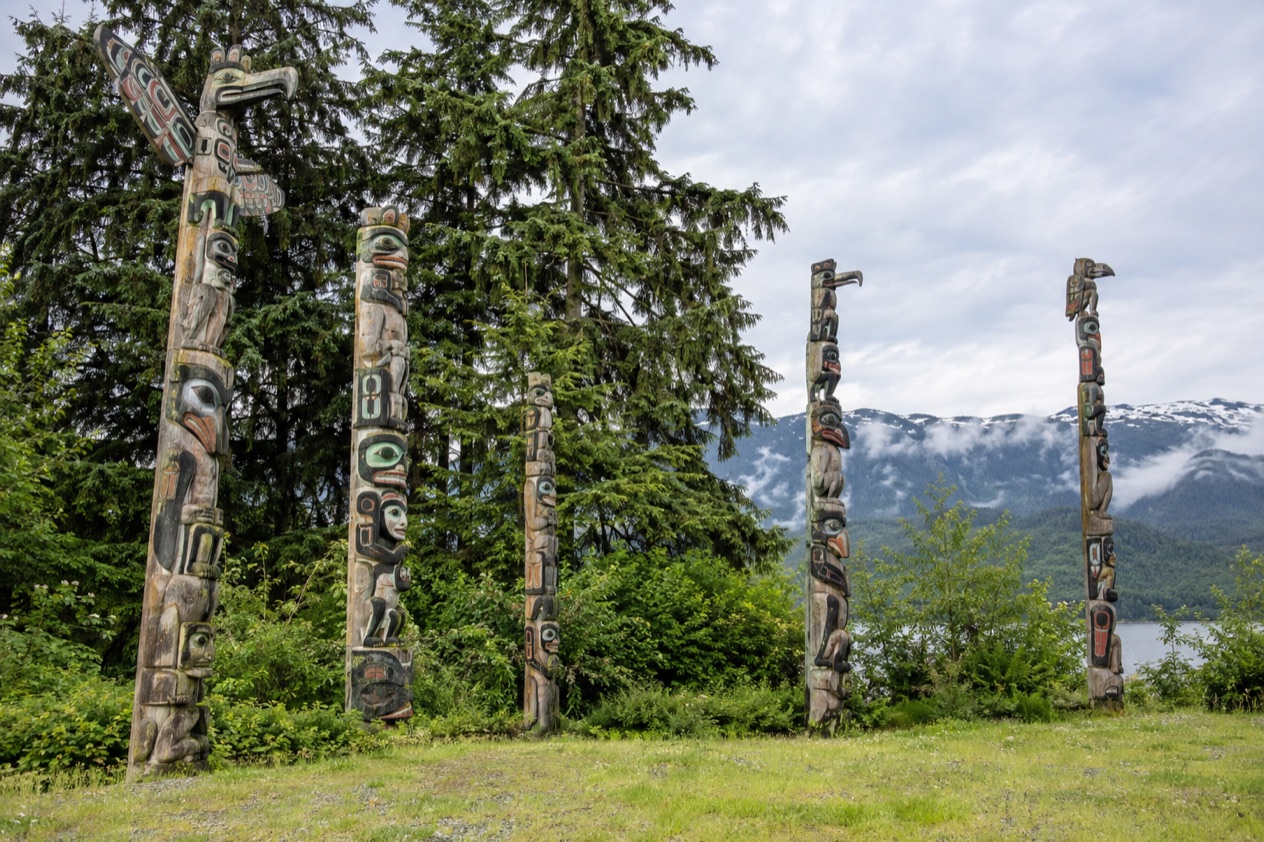
Carved cedar faces rise out of the Southeast Alaska rain forest, Raven, Eagle, Bear and Wolf stacked one above another, their paint dulled and brightened by the damp air. Around Ketchikan and in Sitka, the poles stand in parks, beside houses and along the paths between spruce and hemlock. A visit here is a slow walk among crests and family stories, and it works as a quiet cultural stop on any Inside Passage trip.
Is visiting Alaska’s totem poles worth it?
Yes, for anyone who wants to understand the people of Southeast Alaska rather than only look at the scenery. The poles are the visible part of a living culture, and standing among them gives you a way to read the region that a glacier or a whale-watching boat cannot.
The Tlingit, who have lived along this coast for generations, display clan crests on totem poles, and also on canoes, feast dishes, house posts, weavings and jewelry. Their society is divided into two moieties, the Raven and the Eagle, and children are born into the mother’s clan.
Once you know that, each carved figure starts to read as a family emblem instead of a decoration. Ketchikan is also home to Haida and Tsimshian cultures, so the carving traditions you see around town are not all the same.
What sets these places apart from a museum is the setting. At Saxman and Totem Bight the poles stand in the open air, in a Tlingit town and on the site of a former Native campground. In Sitka they line wooded pathways beside a salmon river. Each place tells a different part of the story, so it is worth seeing more than one if your route allows.
What to see at Alaska’s totem poles
Saxman Totem Park
Saxman is a small Tlingit town next to Ketchikan, the headquarters of the Organized Village of Saxman, and it is counted as one of the totem capitals of Alaska. Its Tlingit name is T’èesh Ḵwáan Xagu. Many historical totem poles are installed in the Saxman Totem Park, so this is the place to see a dense collection in a town that is still lived in.
Look at how the figures are arranged. Poles are read as a sequence of crests, and the animals you see tie back to the Raven and Eagle sides of Tlingit society. Notice the different states of the wood too: some poles look freshly painted, while others have weathered to soft gray.
Totem Bight State Historical Park
North of Ketchikan, Totem Bight sits on the former site of a traditional Native campground known as Mud Village and Mud Bight Village. The park holds a collection of totem poles and a replica of a traditional chieftain’s house. The carvings on that house were executed by Charles Brown, a Tlingit of Saxman.
The Civilian Conservation Corps project here built the community house and placed 15 totem poles, most of them replicas of 19th-century poles. That history is part of the interest: the park is a recreation, made with care, of the village poles that were once here. Look at the house front first, then walk among the poles with the forest behind them.
Sitka National Historical Park
In Sitka, on Baranof Island, the totem poles stand along wooded pathways beside Kaasdahéen (Indian River). You can wander among poles obtained from Haida and Tlingit, many of them replicas, with spruce and hemlock towering overhead. During spawning season you may see salmon swimming up the river, which adds a living detail to the walk.
The collection has an unusual story of how it came to be, and the visitor center displays artifacts, many of them owned by Tlingit clans and still used for ceremonial purposes. The Russian Bishop’s House, with museum exhibits and a furnished second floor, shows the Russian chapter of Alaska’s history, so the park gives both Native and Russian perspectives in one stop.
Hours, tickets and rules
Sitka National Historical Park offers free ranger-led programs, typically from May through September. Ranger-led programs in Sitka are the one scheduled activity with a season and a price.
| Site | Open | Admission |
|---|---|---|
| Sitka National Historical Park ranger-led programs | Typically May through September | Free |
Totem Bight is operated by the Alaska Department of Natural Resources, and Sitka National Historical Park is a national park unit with Junior Ranger activities for kids of all ages. Rangers lead scheduled activities about the historic Totem Park, the Battle of 1804 between Russians and Tlingit, and Russian exploration and settlement.
How to get to Alaska’s totem poles
Ketchikan, in Southeast Alaska on the Inside Passage, is the base for two of the three places. Saxman lies just southeast of Ketchikan on Revillagigedo Island. Totem Bight is at Mile 10.5 of the North Tongass Highway, north of Ketchikan, in the same borough.
Downtown Ketchikan is easy to walk, with historic buildings, galleries, shops and locally made goods, and hand-carved totems line the city’s streets and parks. That gives you a first look at the carving tradition before you go out to the two parks. Ketchikan also has wildlife tours, fishing charters and floatplane trips to Misty Fjords, which can fill the rest of a stay.
Sitka National Historical Park is at 106 Metlakatla Street in Sitka, on Baranof Island. Most of the park, including the Russian Bishop’s House, visitor center, Totem Trail loop, Riverview Trail and Russian Memorial Trail loop, is an easy walk from downtown Sitka. The pathways through the woods total two miles.
When to visit Alaska’s totem poles
Sitka’s ranger-led programs are typically offered from May through September, so that stretch is the clearest window if you want the poles explained by someone who knows their stories. Those programs cover the historic Totem Park, the Battle of 1804 and the Russian period, and they are free.
During spawning season, you may see salmon swimming upstream in the Indian River beside the pathways. The timing of a run varies, so treat it as a chance rather than a promise. The rain forest setting means the poles, the wet bark and the moss look their richest in damp light, and an overcast day suits the dark cedar well.
In Ketchikan and Saxman, the poles stand in the open air.
Tips for your visit
Go in with a little background. Knowing that Tlingit society divides into Raven and Eagle, and that children are born into their mother’s clan, helps place the carved figures in their cultural context. Look for the animals first, then for how they stack up the pole.
Combine places. In Ketchikan, pair Saxman and Totem Bight with a walk through downtown, where totems stand along the streets. The Tongass National Forest can also be explored from Ketchikan, and the forest around Totem Bight gives a taste of it. In Sitka, the trails in and around the park let you add a forest walk and the tidelands, where sea stars and crabs live, to your totem visit.
Families with children can look into the Junior Ranger program at Sitka National Historical Park, open to kids of all ages. Treat the carved artifacts with respect, since many of those in the Sitka visitor center are owned by Tlingit clans and still used in ceremonies. Sitka’s Totem Trail, Riverview Trail and Russian Memorial Trail loops are all an easy walk from downtown.
Good to know before you go
These poles belong to living Tlingit, Haida and Tsimshian cultures, and many are tied to clans that still use their crests today. Approach them as you would any place of heritage, looking closely and moving slowly. Plan the day around the weather of Southeast Alaska, a temperate rain forest where wet conditions are part of the setting, and let the damp light work in your favor.
Sources
- Wikipedia, Saxman, Alaska (https://en.wikipedia.org/wiki/Saxman,_Alaska), checked October 11, 2026
- Wikipedia, Totem Bight State Historical Park (https://en.wikipedia.org/wiki/Totem_Bight_State_Historical_Park), checked October 11, 2026
- Wikipedia, Tlingit (https://en.wikipedia.org/wiki/Tlingit), checked October 11, 2026
- Wikipedia, Sitka National Historical Park (https://en.wikipedia.org/wiki/Sitka_National_Historical_Park), checked October 11, 2026
- National Park Service, Sitka National Historical Park, plan your visit: things2do (https://www.nps.gov/sitk/planyourvisit/things2do.htm), checked October 11, 2026
- Visit Ketchikan, things to do (https://www.visit-ketchikan.com/things-to-do/), checked October 11, 2026
- Princess Cruises, Alaska cruises (https://www.princess.com/en-us/cruise-destinations/alaska-cruises), checked October 11, 2026
- Royal Caribbean, Alaska cruises (https://www.royalcaribbean.com/cruise-destinations/alaska-cruises), checked October 11, 2026
- National Park Service, Sitka National Historical Park, plan your visit: directions (https://www.nps.gov/sitk/planyourvisit/directions.htm), checked October 11, 2026