
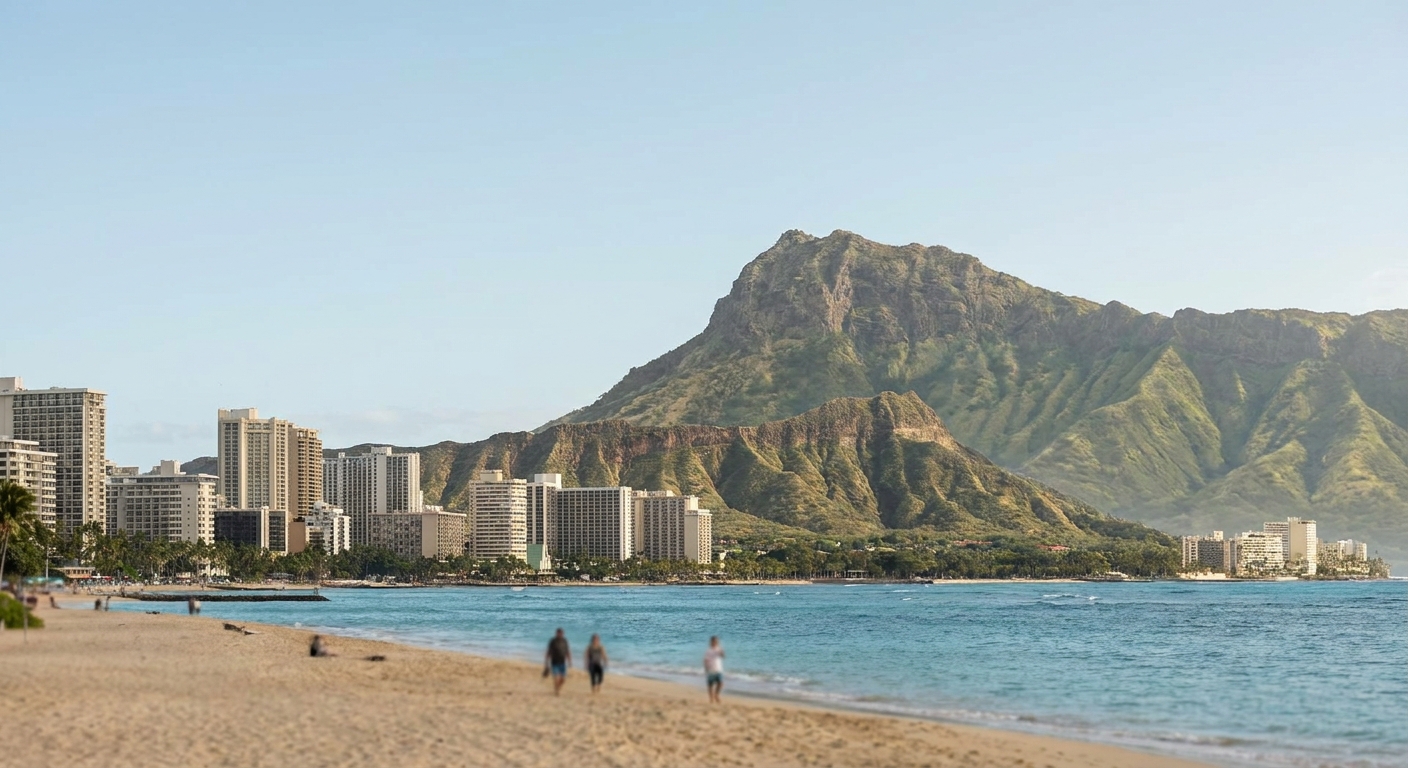
Early in the morning, joggers circle the base of Diamond Head while surfers paddle out past the reef at Waikiki, and the smell of malasadas and strong coffee drifts down Kalakaua Avenue. Honolulu is the rare big city that sits right on a beach, with a palace, a Chinatown and a war memorial a short ride from the sand. It suits first-time visitors who want island scenery without giving up restaurants, museums and an easy way around.
Where is Honolulu and what is it like?
Honolulu is the capital of Hawaii, spread along the south shore of Oahu between the Koolau mountains and the Pacific, with Waikiki at its beachfront end and downtown a short ride west. Pearl Harbor lies beyond the airport, the North Shore waits across the island, and the windward towns of Kailua and Lanikai sit on the far side of the ridge.
The pace shifts from block to block. Waikiki is busy and bright, full of surf lessons, shave ice and hotel towers. Downtown and Chinatown feel more like a working city, with lei stands, noodle shops and government buildings around a royal past. Back from the water, quiet neighborhoods climb into green valleys.
People who like to mix a beach day with a museum, a hike and a good plate lunch tend to love it. Those looking for empty shores and a sleepy village may prefer a quieter island, since Honolulu always has traffic, crowds and a city soundtrack.
What is there to do in Honolulu?
Honolulu gives you a beach, a volcano crater hike, a major piece of American history and a royal capital in one compact area, which is what sets it apart from the resort-only stretches elsewhere in the islands.
Diamond Head at sunrise
The trail climbs from the floor of an old volcanic crater up switchbacks, a tunnel and a steep set of stairs to a lookout over Waikiki and the coast. The path is short but steady, and the park says to allow between an hour and a half and two hours for it.
Go early, when the light is soft and the heat has not built up. Non-residents need an entry reservation and a parking reservation, and the hours and fees are here:
| Site | Open | Admission |
|---|---|---|
| Diamond Head State Monument | Daily, 6 a.m. to 6 p.m.; last entry 4:30 p.m. for the 4 p.m. reservation | $5 per person (children 3 and under free), $10 per vehicle |
Bring water and a hat, since the upper stretches have little shade. The view of the shoreline curving toward downtown is the reward.
Pearl Harbor
Pearl Harbor is a short drive from Waikiki and is a sober, moving visit. The USS Arizona Memorial is reached by boat, and the visitor center holds exhibits that set the attack of December 7 in context. Allow a good part of a morning.
The memorial programs run through the day, and tickets are reserved online with a small management fee. Leave bags behind, because none are allowed inside, and note the parking charge in the table.
| Site | Open | Admission |
|---|---|---|
| Pearl Harbor Visitor Center | Daily, 7 a.m. to 5 p.m. (closed Thanksgiving, Christmas, New Year’s Day) | No entrance fee; parking $7 per day |
| USS Arizona Memorial programs | First program 8 a.m., last boat 3:30 p.m. | $1 reservation fee on Recreation.gov |
Iolani Palace and Chinatown
Iolani Palace, downtown, was the home of the last Hawaiian monarchs, King Kalakaua and Queen Liliuokalani. Inside, you walk through throne room and staircase halls with audio or docent guidance, and the story of the monarchy’s end gives the visit its weight.
Chinatown is a few minutes away on foot or by bus, a grid of markets, lei stands, noodle shops and bars. Go in the morning for the produce and flower stalls, or in the evening when the restaurants fill.
| Site | Open |
|---|---|
| Iolani Palace | Tuesday to Saturday, ticket office 8:30 a.m. to 4 p.m. |
Beaches, snorkeling and the other side of the island
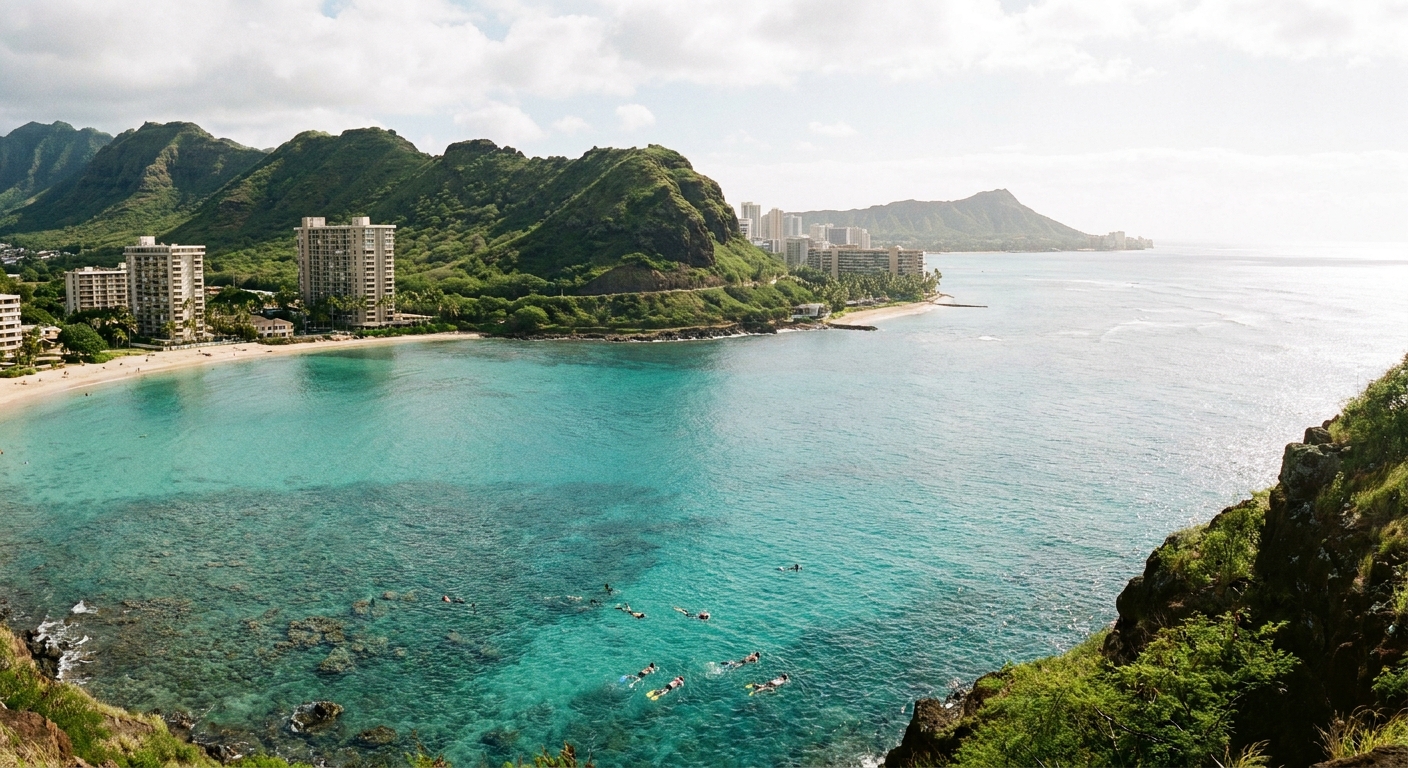
Waikiki is the easy beach, with surf lessons and sunset walks. For snorkeling, Hanauma Bay is a protected bay in a volcanic crater, and every visitor watches a short film about the reef before heading down. It is closed Mondays and Tuesdays.
| Site | Open | Admission |
|---|---|---|
| Hanauma Bay Nature Preserve | Wednesday to Sunday; entry 6:45 a.m. to 1:30 p.m. | $25 plus online fee for ages 13 and over; children 12 and under free; parking $3 |
Across the ridge, Kailua offers a long soft beach for kayaking and windsurfing, and Lanikai is a narrow strand reached by public paths between houses. The North Shore, with Haleiwa’s food trucks and shave ice, is a long day out, and the big waves there come in winter. Ko Olina’s sheltered lagoons on the west coast suit a calmer beach day.
How many days do you need in Honolulu?
A long weekend covers the essentials, though five or six days let the city and the island breathe.
A short stay fits Waikiki, a morning at Diamond Head, Pearl Harbor and an afternoon downtown with the palace and Chinatown. With more time, add a snorkeling morning at Hanauma Bay, a day on the windward side at Kailua and Lanikai, and a full day on the North Shore with Haleiwa and Waimea Valley.
Ko Olina works as a half day by the lagoons. Keep one slack day for the beach, because Honolulu rewards time spent doing very little.
Where to stay in Honolulu
Waikiki is the base for most visitors: walkable, close to the beach, lined with restaurants and well served by buses. It suits first-timers, families and anyone who wants to leave the car behind.
Downtown and the areas toward Ala Moana feel more local and sit near shopping and the bus line. Ko Olina is a resort enclave on the west coast with calm lagoons, good for a beach-focused stay. The North Shore has few hotels, mostly condo and house rentals plus one beachside resort, which suits surfers and those wanting a slower rhythm.
How do you get to Honolulu and get around?
Most visitors arrive at Daniel K. Inouye International Airport, about a half hour’s drive from Waikiki. TheBus W Line links the airport with downtown, Ala Moana Center and Waikiki, running every 10 to 30 minutes depending on the hour. Bags on the bus are limited to one medium suitcase and a smaller carry-on.
In town, Waikiki is easy on foot, and TheBus covers the rest. An adult fare is $3.00 with transfers allowed for a couple of hours, and fares cap at $7.50 a day. A HOLO card, bought at vending machines in Skyline stations or at an ABC Store in Waikiki, handles payment, and Skyline trains now serve the airport station.
A rental car pays off for the North Shore, Kualoa Ranch and the windward coast. Driving from Waikiki takes about 15 minutes to downtown, 30 minutes to Pearl Harbor or Hanauma Bay, 50 minutes to Kualoa Ranch and an hour to Haleiwa, traffic permitting.
When is the best time to visit Honolulu?
May, June and September are the easy picks for beach days, with sunny afternoons and very little rain, while April and October also work well. July and August are the driest and hottest, with highs near 90°F, and they bring family crowds.
Winter is milder and a touch wetter, with showers passing through in short bursts. From November through April, humpback whales pass offshore, with the peak from January to March. Big waves arrive on the North Shore from November to February, which is a spectacle to watch from the sand, while summer is calmer there. Snorkelers and swimmers on the south shore generally find summer easier.
The crowded weeks follow the mainland calendar: spring break, summer vacation and the winter holidays. The Honolulu Marathon in December fills hotels, and the hurricane season runs from June 1 to November 30.
Good to know before you go
There is no passport or visa to think about, and the emergency number, 911, covers police, fire, ambulance and ocean rescue. At the beach, check the posted warnings and the day’s surf and currents before you go in, since jellyfish can appear on any day of the year, and swim near a lifeguard only where one is on duty. Keep your distance from sea turtles and monk seals, and choose reef-friendly sunscreen, as Hawaii bans the sale of some formulas.
| Fee | Amount | Who pays |
|---|---|---|
| State transient accommodations tax | 11% | Hotel and rental guests |
| Oahu transient accommodations tax | 3% | Hotel and rental guests on Oahu |
Sources
- NPS, Pearl Harbor National Memorial, Fees & Passes (nps.gov/perl/planyourvisit/fees.htm), checked September 25, 2026
- NPS, Pearl Harbor National Memorial, Basic Information (nps.gov/perl/planyourvisit/basicinfo.htm), checked September 25, 2026
- Hawaii DLNR, Division of State Parks, Diamond Head State Monument (dlnr.hawaii.gov/dsp/parks/oahu/diamond-head-state-monument), checked September 25, 2026
- City and County of Honolulu, Department of Parks and Recreation, Hanauma Bay Nature Preserve (honolulu.gov/dpr/hanauma-bay-nature-preserve), checked September 25, 2026
- Iolani Palace, official site, Visit (iolanipalace.org/visit), checked September 25, 2026
- Hawaii DOT Airports, HNL, The Bus and Skyline (airports.hawaii.gov/hnl/the-bus-and-skyline), checked September 25, 2026
- TheBus, TheBus Fares effective January 7, 2024 (thebus.org/Fare/TheBusFares20240701.asp), checked September 25, 2026
- HOLO, For Visitors (holocard.net/for-visitors), checked September 25, 2026
- Hawaii Visitors and Convention Bureau, map Driving Times from Waikiki (gohawaii.com/sites/default/files/oahu_drive_map.pdf, edition 2010), checked September 25, 2026
- Hawaii Department of Taxation, Announcement 2025-03 (files.hawaii.gov/tax/news/announce/ann25-03.pdf) ; City and County of Honolulu, BFS, OTAT FAQ (honolulu.gov/bfs), checked September 25, 2026
- Waikiki Aquarium (Universite d'Hawaii), Box Jellyfish Calendar (waikikiaquarium.org/interact/box-jellyfish-calendar), checked September 25, 2026
- NOAA Fisheries, Viewing Marine Wildlife in Hawaii (fisheries.noaa.gov/pacific-islands/marine-life-viewing-guidelines), checked September 25, 2026
- Hawaii State Legislature, SLH 2018 Act 104 (data.capitol.hawaii.gov/sessions/sessionlaws/Years/SLH2018/SLH2018_Act104.pdf), checked September 25, 2026
- NOAA, Hawaiian Islands Humpback Whale National Marine Sanctuary, Responsible Recreation (hawaiihumpbackwhale.noaa.gov/visit/recreation.html), checked September 25, 2026
- 911.gov (National 911 Program, NHTSA), numero d urgence unique to the Etats-Unis, checked September 25, 2026
- Hawaii Tourism Authority, Go Hawaii, North Shore Oahu (gohawaii.com/islands/oahu/regions/north-shore), checked September 25, 2026
- Hawaii Tourism Authority, Go Hawaii ; HVCB, map Driving Times from Waikiki (edition 2010), checked September 25, 2026
- Hawaii DLNR, Division of Aquatic Resources, Oahu – Pupukea MLCD, checked September 25, 2026
- Waimea Valley, Tickets & Hours (waimeavalley.net/admission), checked September 25, 2026
- Waimea Valley, pages Waterfall and FAQ (waimeavalley.net), checked September 25, 2026
- Hawaii DLNR, Division of Forestry and Wildlife, Oahu Offshore Islet Seabird Sanctuaries (dlnr.hawaii.gov/wildlife/sanctuaries/oahuoffshoreislets), checked September 25, 2026
- U.S. Fish & Wildlife Service, « United States Celebrates World Wetlands Day », February 2005 (fws.gov/story/2005-02) ; Ramsar site 1460, checked September 25, 2026
- Ko Olina Resort, Lagoons (koolina.com/destination/lagoons), checked September 25, 2026
- Ko Olina Resort, press release « City and Ko Olina Partner To Launch New Public Access Plan for Lagoons », October 15, 2020, checked September 25, 2026
- Hawaii Tourism Authority, Go Hawaii, itineraire « 4 Days in Waikiki and 3 Days on the Leeward Coast » ; HVCB, map Driving Times from Waikiki (2010), checked September 25, 2026
- NWS Honolulu / Central Pacific Hurricane Center, « 2026 Central Pacific Hurricane Season Outlook », weather.gov/hfo/hurricaneOutlook2026, checked September 24, 2026
- NOAA NCEI, monthly normals 1991-2020, station USW00022521, checked September 8, 2026
All our pages
When to go
- Best Time to Visit Honolulu: Weather by Month, Surf Seasons, Crowds and Events
- Honolulu in January: Weather, Winter Swells, Whale Season and What to Do
- Honolulu in February: Whale Season, North Shore Surf, Weather and What to Do
- Honolulu in March: Weather, Whale Season, Swimming and What to Do
- Honolulu in April: Weather, Swimming, Things to Do and a Two-Day Plan
- Honolulu in May: Weather, Swimming, Things to Do and a Two-Day Plan
- Honolulu in June: Weather, Beaches, Kamehameha Day and a Two-Day Plan
- Honolulu in July: Weather, Swimming, Things to Do and a Two-Day Plan
- Honolulu in August: Weather, Swimming, Things to Do and a Two-Day Plan
- Honolulu in September: Warm Seas, Quiet Beaches and What to Do
- Honolulu in October: Weather, Warm Seas, Things to Do and a Two-Day Plan
- Honolulu in November: Weather, Swimming, North Shore Surf and a Two-Day Plan
- Honolulu in December: Weather, Winter Surf, Holiday Lights and What to Do
Things to do
- Things to Do in Honolulu: Diamond Head, Pearl Harbor, Hanauma Bay and Where to Eat
- Day Trips from Honolulu: Pearl Harbor, the North Shore, Kailua and Ko Olina
- 3 Days in Honolulu: Pearl Harbor, Diamond Head, Kailua and Where to Stay