
HONOLULU · JANUARY · 21.3° N
January in Honolulu runs at 80.5°F by day and 66.8°F at night, with 1.84 inches of rain across the whole month at the airport gauge. The ocean off the south shore averages 77.3°F, warmer than the air you walk back into after a swim. A week here needs a swimsuit, one long-sleeved layer and no coat.
The month gives that back on the evening side. January 15 carries 11 hours and 1 minute of daylight, and the sun is gone by 6:11 p.m., so an outdoor dinner starts after dark. The first days of the month still sit inside the winter holiday break. And the rain figure above is a leeward figure: the windward coast and the ridges behind town take several times as much.
THE MONTH AT A GLANCE · HONOLULU · JANUARY
January gives you 80.5°F days, a 77.3°F ocean and the lightest rain total of the three winter months, and it asks you to plan the evening around a 6:11 p.m. sunset.
AVG HIGH 80.5°F · SEA 77.3°F · 3.3 RAIN DAYS · 11H01 OF DAYLIGHT ON JAN 15
Go for: swimming without a second thought, warm nights at 66.8°F, and the lightest rain total of December, January and February on the leeward south shore.
Think twice before: booking the first week without checking the holiday calendar, or counting on the airport’s 1.84 inches if you are sleeping on the windward side.
Air: NOAA NCEI 1991-2020 normals, Honolulu airport station · Sea: Open-Meteo Marine, 2015-2024 · full sources at the end
On this page
- Honolulu weather in January80.5°F days, 66.8°F nights, 1.84 inches
- Can you swim in Honolulu in January?A 77.3°F ocean, measured as daily maxima
- Crowds, booking and taxes in JanuaryThe holiday week, the lead time and the lodging tax
- Things to do in Honolulu in JanuaryWaikiki, Lēʻahi, Ala Moana and Hanauma Bay
- A two-day Honolulu itineraryHour by hour, from 7:10 a.m. to a 6:11 p.m. sunset
- January vs December and FebruaryHow the three months compare, in five measures
- Is January a good time to visit Honolulu?Yes for swimmers, with February as the fewest-wet-days option
Every figure here is dated and sourced, and the air numbers all come from a single thermometer rather than a model grid cell. What the calendar does not date, where to sleep and how many nights Oahu deserves, sits in the best-time guide with the twelve-month view.
Honolulu weather in January: average highs, lows and rain days
| January at the Honolulu airport gauge | Value |
|---|---|
| Average high | 80.5°F (26.9°C) |
| Average low | 66.8°F (19.3°C) |
| Day-night spread | 13.7°F |
| Total rainfall | 1.84 in |
| Days with 0.10 in or more | 3.3 |
| Days with 1 in or more | 0.4 |
| Daylight on January 15 | 11h01 · 7:10 a.m. to 6:11 p.m. |
| Sea surface (daily maxima) | 77.3°F (25.2°C) |
NOAA NCEI’s 1991-2020 monthly normals, recorded at station USW00022521 at the airport on the leeward south shore, give January an average high of 80.5°F and an average low of 66.8°F, with 1.84 inches of precipitation. That is a real gauge and a real thermometer, not a reanalysis grid square, and it sits on the dry flank of the island. The windward coast and the mountains behind town take several times that rain, and this instrument never records a drop of it.
Measurable rain falls on 3.3 days in an average January, roughly one day in nine. Spread the month’s 1.84 inches across those days and a typical wet day carries a little over half an inch, which on the arithmetic reads as showers passing through rather than an afternoon written off, though a monthly total cannot tell you how the water arrived.
Between the two normals sits 13.7°F, and that spread is what goes in the bag: one long-sleeved layer, a light rain shell for the three or four wet days, and nothing heavier. A 66.8°F dawn in a wet swimsuit feels less generous than it reads on paper. The same 66.8°F on a terrace at eight in the evening is a T-shirt.
Sunrise on January 15 comes at 7:10 a.m. Hawaii Standard Time and sunset at 6:11 p.m., 11 hours and 1 minute apart, calculated from sunrise-sunset.org. A trailhead start at half past seven is a daylight start with a low sun on it. Anything you want to do on the water should be underway by four, and dinner outdoors is a dinner after dark.
Can you swim in Honolulu in January? Sea temperature and what the water feels like
Sea surface off Honolulu averages 77.3°F in January in the Open-Meteo Marine record, taken as the mean of daily maxima over 2015 to 2024. That is the warmest reading of each day, averaged across ten Januaries, so it runs a shade warmer than a round-the-clock mean. A table that publishes a 24-hour average for the same water will print a slightly lower number, and both are describing the same ocean.
Put that against the air and the practical answer falls out: 77.3°F is 10.5°F above the month’s average night low and 3.2°F below its average daytime high. For most adults it is a walk-in rather than a count-to-three, and getting cold takes a long swim. Children and anyone who chills easily will feel it first, and a rash guard handles that.
We could not obtain a January wind or swell series for Oahu, so no surf or clarity ranking is made here. Waikiki and Ala Moana face south on the leeward side, a different exposure from the north-facing coast, and conditions on one shore say little about the other. Read the National Weather Service forecast for Oahu and the lifeguard flags on the morning you plan to get in.
How busy is Honolulu in January? The holiday week, booking and the lodging tax
The calendar splits the month in two. The first days still belong to the winter holiday break that began in December, and everything from the second week on falls outside school vacation. No monthly occupancy or room-rate series for Oahu could be obtained, so no cheapest-month or busiest-month claim is made here, with or without a number attached.
Let that split drive the booking. For dates inside the holiday week, lock lodging and a car as early as the plan allows, with six to eight weeks as a working floor (est.). After the second week no fixed date is pulling on the calendar, and a shorter lead of two to three weeks (est.) is a reasonable assumption. Both figures are estimates and neither comes from a measured series.
On accommodation taxes, we hold no verified rate for Hawaii or for the City and County of Honolulu, and an unverified percentage is worse than none, so no figure appears above or below. Check the rate published by the Hawaii Department of Taxation, then read whether the quote in front of you includes it before comparing two properties.
A rental car is the line item worth defending this month. With 3.3 wet days on the leeward gauge and a windward coast taking several times the rain, the car is what lets you drive out from under a gray morning instead of watching it from a balcony. Paying more for a room does not move a single figure in the table above, and on the one wet day the view is the same either way.
Things to do in Honolulu in January
Of the three winter months, January is the one that pairs the lightest rain total, 1.84 inches, with water still above 77°F. December’s ocean runs 0.8°F warmer and its month carries 0.34 inch more rain. February’s rain arrives on fewer days but its water drops to 76.1°F. That pairing is what an early-morning swimmer is buying by coming in January rather than four weeks either side.
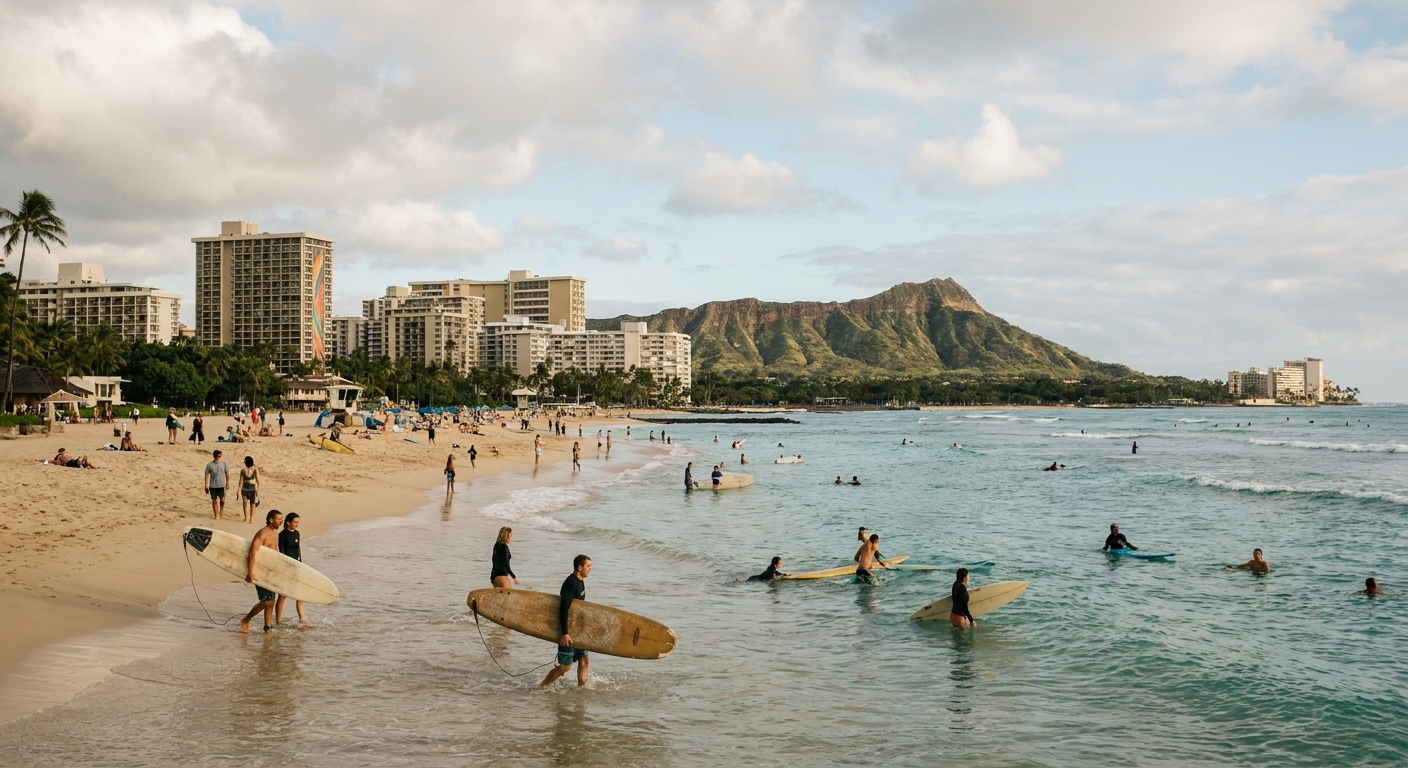
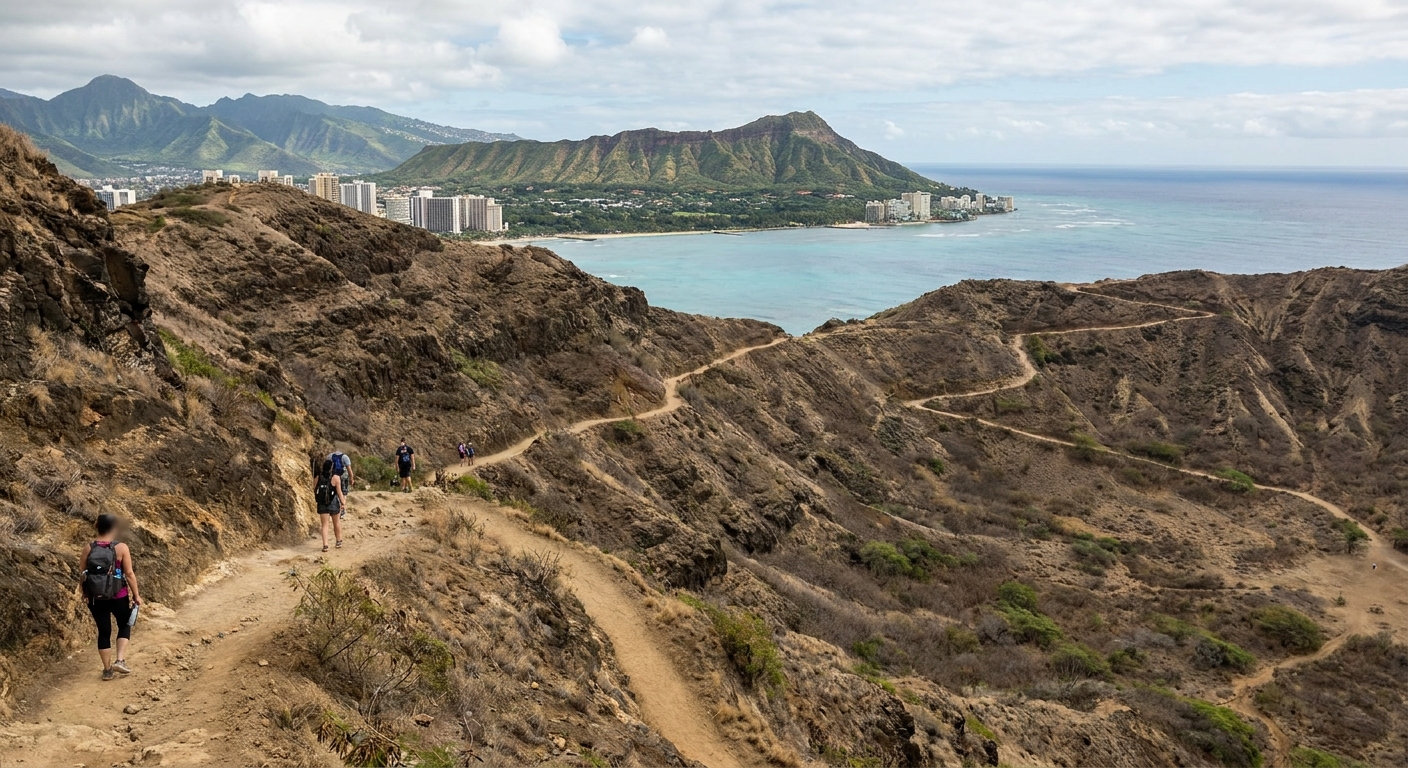
Waikiki Beach is the default and needs no plan beyond a towel. Ala Moana Regional Park, along the same south-facing shore, gives a calmer swim behind its reef. Lēʻahi, the crater the maps label Diamond Head, is the short climb almost everyone does, and Hanauma Bay Nature Preserve is the snorkel that has to be organized in advance. Mānoa sits inland under the ridge that catches the rain the airport gauge never sees. No verified fee, opening hour or reservation rule is carried here for any of them, so check each operator before you drive out.
None of those places changes with the month, and the air around them barely does either: 80.5°F in January against 81.8°F in December is 1.3°F of difference. What actually shifts is the water, 77.3°F now against 78.1°F four weeks earlier, and the light, which ends the outdoor day at 6:11 p.m. Plan the crater for the morning and the beach for the middle of the afternoon, and the month behaves.
Shoreline access is public in Hawaii, so the swim, the walk along the sand and the 6:11 p.m. sunset cost nothing at all. Parking near the water generally does not come free, and we hold no verified rate for the lots. The best-value hour of a January day is the one starting at 7:10 a.m., before the air climbs toward its 80.5°F normal.
Honolulu in January: a two-day itinerary
Day one. Swim at Waikiki between 7:10 and eight, while the air still sits nearer the 66.8°F low than the 80.5°F high. Climb Lēʻahi from around half past eight, with the sun low on the crater floor. Eat lunch indoors around noon. Take a second, calmer swim at Ala Moana Regional Park from two. Be back on the sand by half past five for the 6:11 p.m. sunset, and book dinner for seven, after the light has gone.
Day two goes east: Hanauma Bay for the snorkel if a slot is secured, then the windward coast, accepting that the ridge line takes several times the airport’s 1.84 inches. If the wet card turns up, and it does about one day in nine, move indoors to Pearl Harbor or the Bishop Museum, both of which want their hours checked first. A shower does not close the water at 77.3°F, so keep the swimsuit in the bag.
Honolulu in January vs December and February
| Measure | December | January | February |
|---|---|---|---|
| Average high | 81.8°F | 80.5°F | 80.5°F |
| Average low | 69.2°F | 66.8°F | 67.1°F |
| Monthly rainfall | 2.18 in | 1.84 in | 1.94 in |
| Days with 0.10 in or more | 3.2 | 3.3 | 3.0 |
| Sea surface (daily maxima) | 78.1°F | 77.3°F | 76.1°F |
December runs 1.3°F warmer by day and 2.4°F warmer at night, with 2.18 inches of rain against January’s 1.84. February matches January’s 80.5°F ceiling, adds 0.3°F to the night, and brings 0.10 inch more rain. One count runs against the others: January collects the most wet days of the three, 3.3 against 3.2 and 3.0, while carrying the least water overall, which on the arithmetic makes its wet days the lightest of the winter.
Shift four weeks back and you gain 0.8°F of ocean at 78.1°F and the warmest nights of the three, paying 0.34 inch more rain and the holiday calendar for it. Shift four weeks forward and you keep the 80.5°F day, get the fewest wet days at 3.0, and give up 1.2°F of sea. Anyone building a trip around the water should note that the ocean falls month after month across these three, from 78.1°F to 76.1°F.
Is January a good time to visit Honolulu?
Yes for anyone whose trip is mostly water and walking. Days at 80.5°F, an ocean at 77.3°F and 1.84 inches of rain across 31 days make a working outdoor month by any mainland winter standard. The answer softens for two people: whoever wants long evenings, since the light goes at 6:11 p.m., and whoever books the first week without looking at the holiday dates first.
If the answer comes out no, December is the shift for warmth in the water, 78.1°F sea and 69.2°F nights, on condition you accept 2.18 inches of rain and a holiday calendar. February is the shift for the fewest wet days, 3.0 of them, and the same 80.5°F ceiling, at the cost of an ocean 1.2°F cooler.
Among the three, only January puts the lightest rain total together with water above 77°F, and that is the reason to take it over either neighbor.
The last word
Pick the dates before the hotel, because the normals do not move across the month while the holiday calendar does, and the second week buys the same 80.5°F and the same 77.3°F water as the first. One figure worth keeping in proportion: an average January logs 0.4 days with an inch of rain or more, a genuine soaking in roughly two Januaries out of five. Put a light shell in the daypack and leave the itinerary where it is.
Sources & data for this guide
- January air normals (80.5°F / 66.8°F / 1.84 in) and rain-day counts (3.3 days ≥ 0.10 in, 0.4 day ≥ 1 in) · NOAA NCEI monthly normals 1991-2020, station USW00022521, Honolulu · checked Sep 15, 2026
- December and February air normals (81.8/69.2/2.18 in and 80.5/67.1/1.94 in) · same NOAA NCEI 1991-2020 series, same station · checked Sep 15, 2026
- Sea surface 77.3°F, with 78.1°F in December and 76.1°F in February, taken as the mean of daily maxima over 2015-2024 · Open-Meteo Marine API · checked Sep 15, 2026
- Daylight on January 15 (7:10 a.m. to 6:11 p.m., 11h01) · sunrise-sunset.org, UTC values converted to Hawaii Standard Time · checked Sep 15, 2026
- Editorial admission: the gauge sits on the leeward south shore and does not represent the windward coast or the mountains, where rainfall is several times higher. No monthly occupancy, room-rate or accommodation-tax figure could be verified for Oahu in time, so none is quoted. Attraction hours, fees and reservation rules change · check operators before you book.