
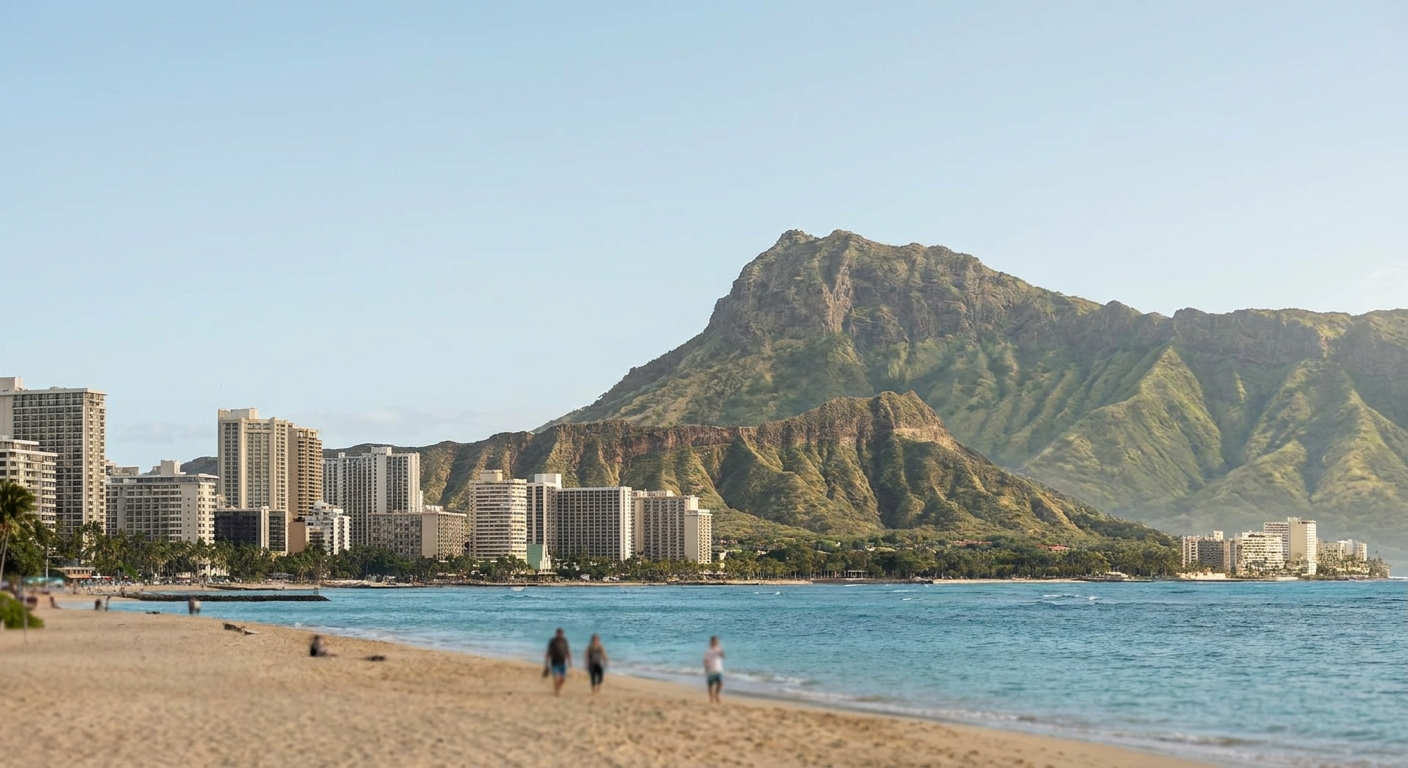
Early in Waikiki, surfers carry their boards down Kalakaua Avenue while the first joggers circle the base of Diamond Head. If you’re coming from another state and want to hike Diamond Head, keep in mind that entry requires a reservation made ahead of time on the state parks reservation site, and you must show up within 30 minutes of the start of your reserved time. Across the island, Kailua wakes slowly over coffee and a quiet shoreline, and Ko Olina’s lagoons are still glassy at sunrise. Honolulu offers very different bases within one island, and the choice comes down to how much beach, city and calm you want outside your door.
What is the best area to stay in Honolulu?
For a first visit, Waikiki is the easiest answer, with the beach, restaurants and buses all within a short walk. Families who want sheltered water do well at Ko Olina, couples and travelers who prefer local life often choose Kailua, and surfers in winter gravitate to the North Shore. Downtown suits people who care more about the city than the sand.
The areas differ mostly in pace and distance. Waikiki is busy from morning to late night and puts you close to everything. Downtown is a working city that quiets down after dark. Kailua, Ko Olina and the North Shore each ask for a car or a longer drive, and reward you with space and a slower rhythm.
The best areas to stay in Honolulu
Waikiki
Waikiki is where most visitors land, and it is easy to see why. Towers of hotels line the beachfront, and behind them streets are packed with shave ice stands, open-air bars and shops. Evenings bring live music and a lively crowd, so this is the best choice for nightlife and for anyone who wants to step out and have everything at hand.
Lodging runs from large beachfront resorts to smaller boutique hotels and apartment-style condos a few blocks inland. The airport is about 30 minutes by car, and downtown is around 15. The W Line bus connects the airport to the neighborhood, and many outings, including Diamond Head and Hanauma Bay, are about a 30-minute drive. One thing to keep in mind ahead of any other booking: non-residents need a reservation in advance for Hanauma Bay, which stays closed on Mondays and Tuesdays.
Waikiki’s south-facing water is gentle for much of the year, but jellyfish do turn up on the south shore. About 8 to 10 days after a full moon, these jellyfish commonly show up, so look at the beach warning signs and the Waikiki Aquarium calendar. Walking works for most of your days here, and a car often adds parking costs without much benefit.
Downtown and Chinatown
Downtown Honolulu feels like a real city: office workers at lunch, historic landmarks, and a Chinatown that fills with market shoppers in the morning and diners in the evening. Staying here suits travelers who prefer neighborhoods with local rhythms over resort polish, and it is a smart base for history and food.
Choices lean toward business-style hotels and city apartments, with fewer beachfront options. The airport is along the same Nimitz Highway corridor the W Line follows, and Waikiki is about 15 minutes away by car. Buses and the Skyline rail line make it simple to get around without a vehicle.
The tradeoff is that it is not a beach stay. You will head to Waikiki by bus or ride share for a swim. Evenings outside the restaurant blocks can be quiet, which suits some travelers and not others.
Kailua
Kailua is a residential beach town on the windward side, with a long soft-sand beach where kayakers and windsurfers launch. Lanikai, next door, is a narrow strip reached by public access paths between houses. Mornings here are for paddling toward the Mokulua islets, which are a seabird sanctuary, so visitors keep to the shoreline.
Lodging is mostly vacation rentals, guesthouses and small bed-and-breakfasts rather than big hotels. That gives the area a relaxed, lived-in feel, with cafés and farmers’ stalls instead of towers. It is a good base for couples, longer stays and travelers who want a quieter pace than Waikiki.
You will want a car for most things, since public transit is thinner than in town. Waikiki is a drive over the Koolau mountains, with traffic making the time vary. A short walk to the marsh behind town, a recognized wetland of international importance, makes a nice slow morning.
Ko Olina
Ko Olina is a planned resort district on the dry west coast, centered on four man-made lagoons. The rock breakwaters make the water calmer than the open coast, so families favor it, while paths along the shore connect the lagoons for easy sunset strolls. Everything feels tidy, sunny and self-contained.
Expect resort hotels and condo-style suites, many with pools and kids’ activities, so it is the nearest thing in Honolulu to an all-inclusive-style stay, though you still pay for meals as you go. It is about 26 miles and 45 minutes from Waikiki, and a rental car or transfer makes the trip simple.
The cost of the calm is distance. Evenings tend to be quiet, with fewer places to wander for dinner outside the resort. Public parking at the lagoons is limited, so staying on site is the easiest way to enjoy the water.
The North Shore
The North Shore is surf country, with Haleiwa’s food trucks, shave ice and surf shops setting the tone. In winter the big-wave season draws crowds to watch the swells, and in summer the water calms and beginners come to learn. The mood is rural and laid back, a world away from Waikiki.
Lodging is limited. Most people rent a condo or house, and the one beachside resort is Turtle Bay. From Waikiki, getting to Haleiwa takes about an hour, while Waimea Bay and Turtle Bay are roughly 1 hour 15 minutes away when traffic cooperates, so a car is a must.
At Pupukea, the ocean tends to stay gentle from roughly May through October, then turns perilously hazardous in winter, which makes the time of year important for swimming. Book early for the winter surf months, when the few rooms fill up.
Honolulu areas compared
| Area | Best for | Feel | Getting around |
|---|---|---|---|
| Waikiki | First visit, nightlife | Busy and lively | Walk, bus, W Line |
| Downtown and Chinatown | Food, history | Urban and local | Bus, Skyline, walk |
| Kailua | Couples, slow stays | Residential beach town | Car |
| Ko Olina | Families, calm water | Tidy resort district | Car or transfer |
| North Shore | Surf, rural escape | Laid back, rustic | Car |
The main tradeoff is beach against local life. Waikiki and Ko Olina put you on the water, while Downtown and Kailua give you neighborhoods that feel lived in. Quiet and nightlife pull opposite ways too: the North Shore and Ko Olina are calm after dark, and Waikiki is where evenings stay lively.
How to choose your hotel in Honolulu
Start with how you like to eat. Resorts in Ko Olina and Waikiki come with restaurants on site, while apartments in Kailua or the North Shore suit people who cook or wander for meals. Honolulu does not really run on the all-inclusive model, so think of it as choosing a base, not a package.
Beachfront or a few blocks back is a question of budget and noise. Rooms facing Kalakaua Avenue or the beach bars can be lively late, so ask for a higher floor or the quiet side. Winter brings the North Shore surf crowds and the holiday weeks fill rooms everywhere, and humpback whale season runs from November through April, so book early for those stretches.
Families usually do best with a pool, kitchen and sheltered water nearby, which points to Ko Olina or a Waikiki condo. Check elevator access and distance to the beach if anyone has trouble walking. Before you book, also weigh transfers, since an outlying base usually means a rental car, and the hurricane season runs from June 1 to November 30.
Good to know before you go
From the airport, the W Line bus runs to Waikiki, and Skyline rail serves the airport too. Fares are paid by card or HOLO pass, with no currency to change since this is U.S. soil.
| Fee | Amount | Who pays |
|---|---|---|
| State transient accommodations tax | 11% | Guests of hotels and rentals |
| Oahu transient accommodations tax | 3% | Guests of hotels and rentals on Oahu |
Sources
- NPS, Pearl Harbor National Memorial, Fees & Passes (nps.gov/perl/planyourvisit/fees.htm), checked September 25, 2026
- NPS, Pearl Harbor National Memorial, Basic Information (nps.gov/perl/planyourvisit/basicinfo.htm), checked September 25, 2026
- Hawaii DLNR, Division of State Parks, Diamond Head State Monument (dlnr.hawaii.gov/dsp/parks/oahu/diamond-head-state-monument), checked September 25, 2026
- City and County of Honolulu, Department of Parks and Recreation, Hanauma Bay Nature Preserve (honolulu.gov/dpr/hanauma-bay-nature-preserve), checked September 25, 2026
- Iolani Palace, official site, Visit (iolanipalace.org/visit), checked September 25, 2026
- Hawaii DOT Airports, HNL, The Bus and Skyline (airports.hawaii.gov/hnl/the-bus-and-skyline), checked September 25, 2026
- TheBus, TheBus Fares effective January 7, 2024 (thebus.org/Fare/TheBusFares20240701.asp), checked September 25, 2026
- HOLO, For Visitors (holocard.net/for-visitors), checked September 25, 2026
- Hawaii Visitors and Convention Bureau, map Driving Times from Waikiki (gohawaii.com/sites/default/files/oahu_drive_map.pdf, edition 2010), checked September 25, 2026
- Hawaii Department of Taxation, Announcement 2025-03 (files.hawaii.gov/tax/news/announce/ann25-03.pdf) ; City and County of Honolulu, BFS, OTAT FAQ (honolulu.gov/bfs), checked September 25, 2026
- Waikiki Aquarium (Universite d'Hawaii), Box Jellyfish Calendar (waikikiaquarium.org/interact/box-jellyfish-calendar), checked September 25, 2026
- NOAA Fisheries, Viewing Marine Wildlife in Hawaii (fisheries.noaa.gov/pacific-islands/marine-life-viewing-guidelines), checked September 25, 2026
- Hawaii State Legislature, SLH 2018 Act 104 (data.capitol.hawaii.gov/sessions/sessionlaws/Years/SLH2018/SLH2018_Act104.pdf), checked September 25, 2026
- NOAA, Hawaiian Islands Humpback Whale National Marine Sanctuary, Responsible Recreation (hawaiihumpbackwhale.noaa.gov/visit/recreation.html), checked September 25, 2026
- 911.gov (National 911 Program, NHTSA), numero d urgence unique to the Etats-Unis, checked September 25, 2026
- Hawaii Tourism Authority, Go Hawaii, North Shore Oahu (gohawaii.com/islands/oahu/regions/north-shore), checked September 25, 2026
- Hawaii Tourism Authority, Go Hawaii ; HVCB, map Driving Times from Waikiki (edition 2010), checked September 25, 2026
- Hawaii DLNR, Division of Aquatic Resources, Oahu – Pupukea MLCD, checked September 25, 2026
- Waimea Valley, Tickets & Hours (waimeavalley.net/admission), checked September 25, 2026
- Waimea Valley, pages Waterfall and FAQ (waimeavalley.net), checked September 25, 2026
- Hawaii DLNR, Division of Forestry and Wildlife, Oahu Offshore Islet Seabird Sanctuaries (dlnr.hawaii.gov/wildlife/sanctuaries/oahuoffshoreislets), checked September 25, 2026
- U.S. Fish & Wildlife Service, « United States Celebrates World Wetlands Day », February 2005 (fws.gov/story/2005-02) ; Ramsar site 1460, checked September 25, 2026
- Ko Olina Resort, Lagoons (koolina.com/destination/lagoons), checked September 25, 2026
- Ko Olina Resort, press release « City and Ko Olina Partner To Launch New Public Access Plan for Lagoons », October 15, 2020, checked September 25, 2026
- Hawaii Tourism Authority, Go Hawaii, itineraire « 4 Days in Waikiki and 3 Days on the Leeward Coast » ; HVCB, map Driving Times from Waikiki (2010), checked September 25, 2026
- NOAA NCEI, monthly normals 1991-2020, station USW00022521, checked September 8, 2026
- Open-Meteo Marine API, average 2015-2024, checked September 8, 2026
- sunrise-sunset.org, sunrise and sunset calculated for the 15th of the month, checked September 8, 2026
- NWS Honolulu / Central Pacific Hurricane Center, « 2026 Central Pacific Hurricane Season Outlook », weather.gov/hfo/hurricaneOutlook2026, checked September 24, 2026
To plan your stay
- Best Time to Visit Honolulu: Weather by Month, Surf Seasons, Crowds and Events
- Things to Do in Honolulu: Diamond Head, Pearl Harbor, Hanauma Bay and Where to Eat
- Honolulu Airport to City: TheBus W Line, Driving to Waikiki and Getting Around Town
- Know Before You Go to Honolulu: Reservations, Fees, Getting Around and Ocean Habits