
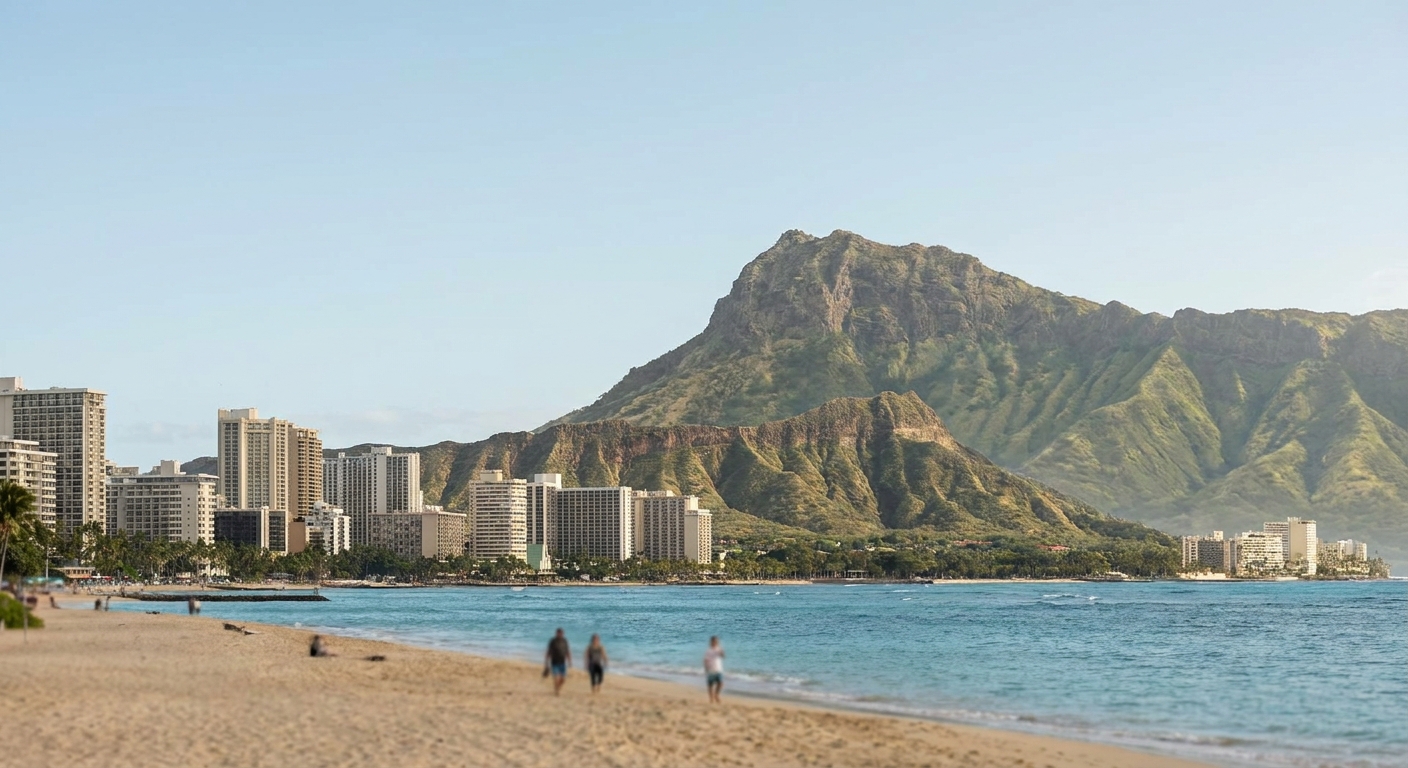
The first morning in Honolulu starts early, with joggers along the Waikiki seawall, surfers paddling out toward the break off Queens, and the smell of coffee and fresh malasadas drifting from the corner bakeries. Trade winds rattle the palms and the light turns the crater of Diamond Head a soft gold. Three days here give you a Pacific history lesson, a volcanic hike, a royal palace, a beach town on the windward side and a few very good plates of food.
Is three days enough in Honolulu?
Three days is enough for a first visit if you want the essentials of Honolulu and one change of scenery, and it suits travelers who like a full but unhurried pace. You can stand over the USS Arizona, climb the rim of an old crater, walk through the rooms of a royal palace, eat your way through Chinatown and still spend an afternoon on a beach without watching the clock.
What three days leave out is the rest of Oahu. The North Shore, with its surf town of Haleiwa, its food trucks and shave ice, deserves a full day of its own, and in winter the big waves there are a show in themselves. The resort lagoons of Ko Olina on the leeward coast, snorkeling at Hanauma Bay and the long drive up to Kualoa Ranch all fit better into a four or five day stay.
Several of the best stops work on reservations or fixed hours, so the order of the days follows what is open when, not just geography. Hanauma Bay is closed on Mondays and Tuesdays, and Iolani Palace gives tours only from Tuesday to Saturday.
A smart plan builds the days around those limits and leaves the flexible things, like beaches and food, for the gaps. That is why the plan below puts the palace on a weekday and keeps the beach day for the end.
Day 1 in Honolulu
Start at Pearl Harbor, because it opens early and is calmer in the first hours. The visitor center opens at 7 a.m., and the USS Arizona Memorial programs begin at 8 a.m. The drive from Waikiki takes about 30 minutes.
Entry to the memorial is free, but bags are not allowed in the memorial or the visitor center, so travel light with a phone and a wallet. Allow the whole morning, because the museum galleries and the shoreline walk deserve slow attention.
After lunch, head downtown, about 15 minutes from Waikiki. Iolani Palace was the home of the last Hawaiian monarchs, King Kalakaua and Queen Liliuokalani, and walking through its koa staircase and throne room is the best way to understand Hawaii before statehood. Tours run Tuesday through Saturday, with guided and audio options. Afterward, stroll past the statue of Kamehameha and the old government buildings in the shade of banyan trees.
| Site | Open |
|---|---|
| Pearl Harbor Visitor Center | Daily 7 a.m. to 5 p.m. |
| USS Arizona Memorial programs | 8 a.m. to last boat 3:30 p.m. |
| Iolani Palace | Tuesday to Saturday, ticket office 8:30 a.m. to 4 p.m. |
Spend the evening in Chinatown, a grid of markets, lei stands, noodle shops and bars that comes alive after dark. Order a bowl of noodles or a plate of dim sum, then browse the lei makers if they are still open.
A good tip is to eat early, before the restaurants fill, and finish with a drink at one of the small bars. Taking a ride-hail back to Waikiki at the end of the night is simple and easy.
Day 2 in Honolulu
Begin with Diamond Head at opening time, when the air is cool and the light is soft. The hike from the trailhead to the summit is 0.8 mile and climbs 560 feet, and the park suggests allowing 1.5 to 2 hours.
The path winds up the inside of the crater, through a tunnel and up steep stairs, to a view over Waikiki and the coast. Non-residents need an entry reservation, and the park opens at 6 a.m.
By late morning, you will want a beach and a plate lunch. Hanauma Bay is the classic choice for snorkeling, about 30 minutes from Waikiki, but it is closed Mondays and Tuesdays, so this day works best if it falls Wednesday through Sunday.
Reservations open two days ahead at 7 a.m. Hawaii time, and every visitor watches a short video about protecting the reef. Keep a respectful distance from any turtle you see. If Hanauma is closed, spend the afternoon on Waikiki itself, where the water is often gentle for a first swim, though the lifeguard and the signs decide.
| Site | Open | Admission |
|---|---|---|
| Diamond Head State Monument | Daily 6 a.m. to 6 p.m., last entry 4:30 p.m. | $5 per person, children 3 and under free, $10 per vehicle |
| Hanauma Bay Nature Preserve | Wednesday to Sunday, entry 6:45 a.m. to 1:30 p.m. | $25 for ages 13 and over, plus an online fee, $3 parking |
In the evening, walk the beachfront at Waikiki as the sun goes down. Surf schools bring in their last lessons, torches are lit along the promenade, and musicians play slack-key guitar in open-air bars. Dinner can be poke, grilled fish or a shave ice for dessert. It is an easy end to an active day, and your legs will thank you for staying close to the hotel.
Day 3 in Honolulu
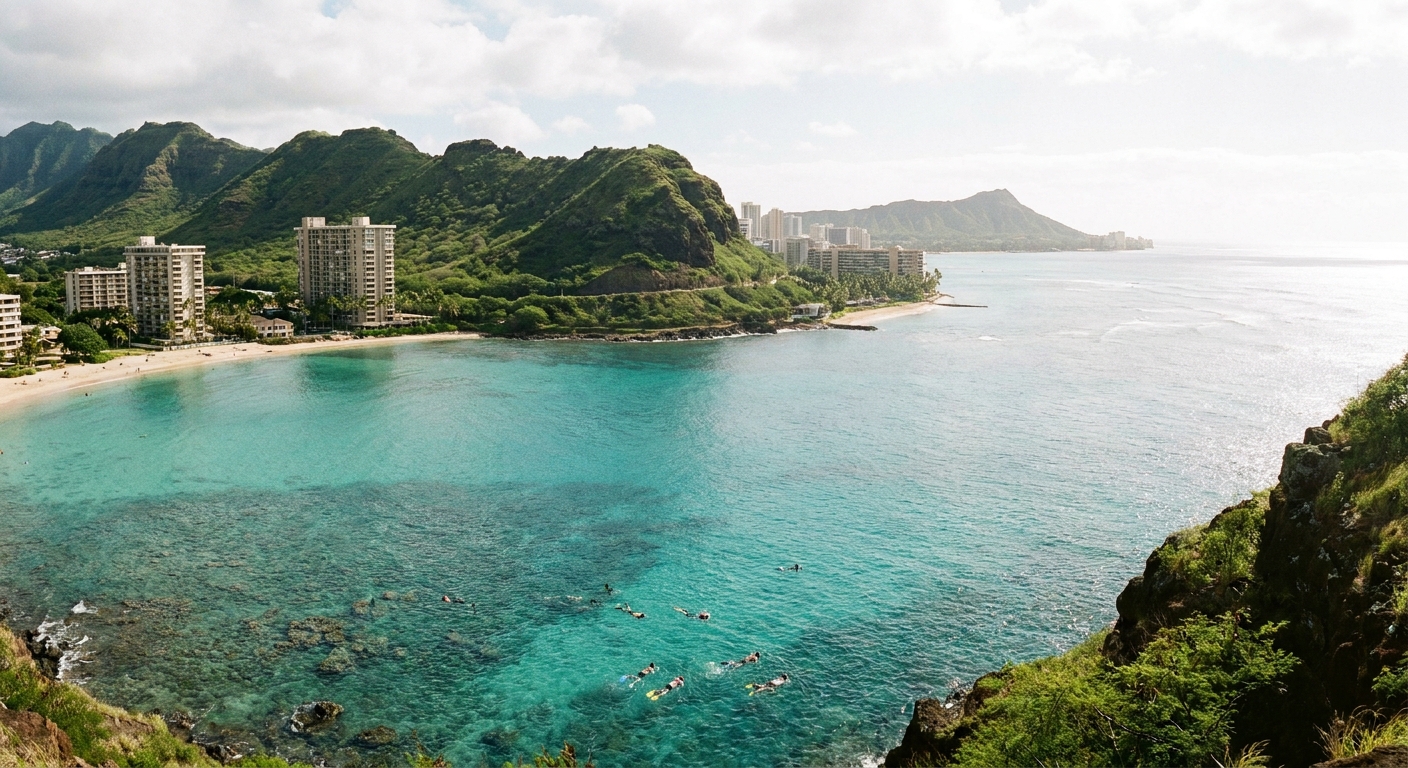
Day 3 is for the windward side. Kailua and Lanikai lie across the Koolau mountains from Honolulu, and the change in mood is striking, with fewer high-rises and more beach houses. Kailua Beach is long and soft, a base for kayaking and windsurfing, while Lanikai is a narrow residential beach reached by public paths between houses. Plan on a relaxed day there rather than a rush of sights.
Offshore, the two Mokulua islets form a state seabird sanctuary where wedge-tailed shearwaters nest and monk seals sometimes rest, so they are best admired from the beach. Behind town, the Kawainui marsh is a wetland of international importance, the first of its kind in Hawaii. A coffee, a smoothie or a plate of fish tacos in Kailua town makes a good midday pause.
Back in town, keep the evening slow. Sit at a seaside table in Waikiki for a final dinner, perhaps a luau-style meal or a simple fish plate, and take a last walk along the sand. Pick up gifts such as Hawaiian coffee or macadamia nuts at a local shop, and pack bags tonight so the morning is calm. Sunset from the shoreline is a fitting end to the trip.
Where to stay for three days in Honolulu
Waikiki is the best base for this plan. Pearl Harbor, downtown, Diamond Head and Hanauma Bay are all roughly 15 to 30 minutes away by road, and the neighborhood has the widest choice of restaurants, rooms and evening walks. You can step out of your hotel to a beach in minutes, which makes the early starts of this itinerary far easier.
The eastern end of Waikiki, near Diamond Head, is quieter and greener, while the central strip around Kalakaua Avenue is livelier and louder. If you want a more local feel, the Kakaako area between Waikiki and downtown has murals, breweries and newer condo towers, and it sits on the bus line that serves the airport.
Travelers who prefer a resort setting with calmer lagoons might choose Ko Olina on the west coast, about 45 minutes from Waikiki by car, though it puts you farther from the sights. Those who want a beach-house feel might pick Kailua. For a first visit with this itinerary, however, Waikiki keeps the driving short and the dinners easy.
What to skip if you only have three days in Honolulu
Skip the full North Shore circuit. Haleiwa, Waimea Bay and the beaches in between are about an hour or more from Waikiki each way, and the drive eats most of a day. In winter the surf is spectacular but swimming is dangerous, and in summer the water is calmer. Save it for a longer trip and spend the time in town instead.
Skip Ko Olina as a day excursion. The lagoons are lovely and sheltered by breakwaters, but the drive of about 45 minutes each way is a lot for a short stay, and Kailua gives you a beach day without a long ride.
Also skip a second museum after the palace and Pearl Harbor, since two heavy history stops in a day are plenty. Use that time for a slow lunch, an extra hour on the sand or a walk through the Waikiki neighborhoods.
Finally, skip trying to add a far-flung attraction like Kualoa Ranch to a day that is already full. It is about 50 minutes from Waikiki, and a good visit takes hours. If you have a free half day in a longer trip, that is the moment to go.
Getting around Honolulu in three days
You can do much of this plan without a rental car. Waikiki is walkable, and TheBus covers the rest. The W Line links the airport to downtown, Kakaako, Ala Moana Center and Waikiki, running every 10 to 30 minutes depending on the hour.
The adult fare is $3.00 with transfers included, and a 3-day pass costs $20, which suits this itinerary well. A HOLO card can be bought at Skyline stations or an ABC Store in Waikiki.
Pearl Harbor, Diamond Head and Hanauma Bay are each about 30 minutes by car from Waikiki, so ride-hailing or a taxi saves time on those mornings, especially for early starts. Kailua is easiest by car or ride-hail as well. Traffic can stretch drive times, so give yourself a margin on the way to timed entries.
Luggage on TheBus must fit between your feet or on your lap, with one medium suitcase and one smaller carry-on allowed, so heavy bags are better in a taxi on arrival day. Skyline trains have luggage racks and an airport station called Lelepaua.
Good to know before you go
The Central Pacific hurricane season runs from June 1 to November 30. Sunscreen sold in Hawaii must be free of oxybenzone and octinoxate, so pick a reef-safe bottle before you arrive. At the beach, check the signs and ask a lifeguard, since jellyfish can appear any day of the year. In an emergency, dial 911, which covers police, fire, ambulance and ocean rescue.
| Fee | Amount | Who pays |
|---|---|---|
| State transient accommodations tax | 11% | Hotel and rental guests |
| Oahu transient accommodations tax | 3% | Hotel and rental guests |
Sources
- NPS, Pearl Harbor National Memorial, Fees & Passes (nps.gov/perl/planyourvisit/fees.htm), checked September 25, 2026
- NPS, Pearl Harbor National Memorial, Basic Information (nps.gov/perl/planyourvisit/basicinfo.htm), checked September 25, 2026
- Hawaii DLNR, Division of State Parks, Diamond Head State Monument (dlnr.hawaii.gov/dsp/parks/oahu/diamond-head-state-monument), checked September 25, 2026
- City and County of Honolulu, Department of Parks and Recreation, Hanauma Bay Nature Preserve (honolulu.gov/dpr/hanauma-bay-nature-preserve), checked September 25, 2026
- Iolani Palace, official site, Visit (iolanipalace.org/visit), checked September 25, 2026
- Hawaii DOT Airports, HNL, The Bus and Skyline (airports.hawaii.gov/hnl/the-bus-and-skyline), checked September 25, 2026
- TheBus, TheBus Fares effective January 7, 2024 (thebus.org/Fare/TheBusFares20240701.asp), checked September 25, 2026
- HOLO, For Visitors (holocard.net/for-visitors), checked September 25, 2026
- Hawaii Visitors and Convention Bureau, map Driving Times from Waikiki (gohawaii.com/sites/default/files/oahu_drive_map.pdf, edition 2010), checked September 25, 2026
- Hawaii Department of Taxation, Announcement 2025-03 (files.hawaii.gov/tax/news/announce/ann25-03.pdf) ; City and County of Honolulu, BFS, OTAT FAQ (honolulu.gov/bfs), checked September 25, 2026
- Waikiki Aquarium (Universite d'Hawaii), Box Jellyfish Calendar (waikikiaquarium.org/interact/box-jellyfish-calendar), checked September 25, 2026
- NOAA Fisheries, Viewing Marine Wildlife in Hawaii (fisheries.noaa.gov/pacific-islands/marine-life-viewing-guidelines), checked September 25, 2026
- Hawaii State Legislature, SLH 2018 Act 104 (data.capitol.hawaii.gov/sessions/sessionlaws/Years/SLH2018/SLH2018_Act104.pdf), checked September 25, 2026
- NOAA, Hawaiian Islands Humpback Whale National Marine Sanctuary, Responsible Recreation (hawaiihumpbackwhale.noaa.gov/visit/recreation.html), checked September 25, 2026
- 911.gov (National 911 Program, NHTSA), numero d urgence unique to the Etats-Unis, checked September 25, 2026
- Hawaii Tourism Authority, Go Hawaii, North Shore Oahu (gohawaii.com/islands/oahu/regions/north-shore), checked September 25, 2026
- Hawaii Tourism Authority, Go Hawaii ; HVCB, map Driving Times from Waikiki (edition 2010), checked September 25, 2026
- Hawaii DLNR, Division of Aquatic Resources, Oahu – Pupukea MLCD, checked September 25, 2026
- Waimea Valley, Tickets & Hours (waimeavalley.net/admission), checked September 25, 2026
- Waimea Valley, pages Waterfall and FAQ (waimeavalley.net), checked September 25, 2026
- Hawaii DLNR, Division of Forestry and Wildlife, Oahu Offshore Islet Seabird Sanctuaries (dlnr.hawaii.gov/wildlife/sanctuaries/oahuoffshoreislets), checked September 25, 2026
- U.S. Fish & Wildlife Service, « United States Celebrates World Wetlands Day », February 2005 (fws.gov/story/2005-02) ; Ramsar site 1460, checked September 25, 2026
- Ko Olina Resort, Lagoons (koolina.com/destination/lagoons), checked September 25, 2026
- Ko Olina Resort, press release « City and Ko Olina Partner To Launch New Public Access Plan for Lagoons », October 15, 2020, checked September 25, 2026
- Hawaii Tourism Authority, Go Hawaii, itineraire « 4 Days in Waikiki and 3 Days on the Leeward Coast » ; HVCB, map Driving Times from Waikiki (2010), checked September 25, 2026
- NOAA NCEI, monthly normals 1991-2020, station USW00022521, checked September 8, 2026
- Open-Meteo Marine API, average 2015-2024, checked September 8, 2026
- sunrise-sunset.org, sunrise and sunset calculated for the 15th of the month, checked September 8, 2026
- NWS Honolulu / Central Pacific Hurricane Center, « 2026 Central Pacific Hurricane Season Outlook », weather.gov/hfo/hurricaneOutlook2026, checked September 24, 2026
To plan your stay
- Best Time to Visit Honolulu: Weather by Month, Surf Seasons, Crowds and Events
- Where to Stay in Honolulu: Waikiki, Downtown, Kailua, Ko Olina and the North Shore
- Honolulu Airport to City: TheBus W Line, Driving to Waikiki and Getting Around Town
- Know Before You Go to Honolulu: Reservations, Fees, Getting Around and Ocean Habits