
HONOLULU · JULY · 21.3° N
July runs dry and bright on Oahu’s south shore. The official gauge logs 0.52 inches of rain for the entire month, the sun is up for thirteen hours and twenty minutes in mid-July, and the sea off Waikiki averages 79.3°F. What the month takes back is elbow room: the northern school break lands on these same weeks, and the flights, rooms and rental cars you want are the ones every other family is booking.
Two caveats travel with those numbers. The thermometer sits at Honolulu International Airport, on the leeward south shore, and the windward coast plus the mountains behind it take several times the rain it records. The 79.3°F ocean figure is an average of daily maxima rather than a 24-hour mean, so it reads a shade warm. Both are stated again where they matter below.
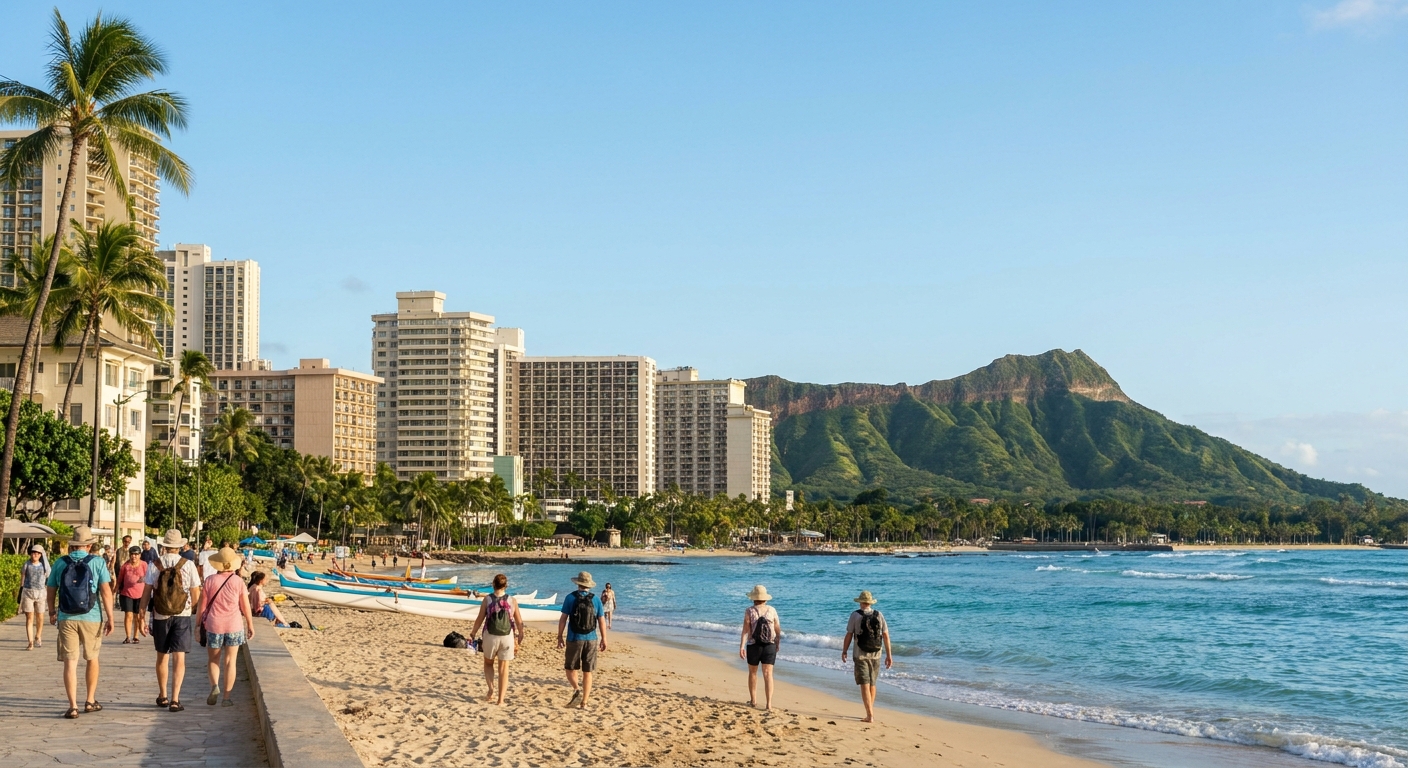
HONOLULU AT A GLANCE · JULY
July hands you warm water, long evenings and half an inch of rain for the whole month, and asks for an early booking in return.
AVG HIGH 88.1°F · 0.52 IN OF RAIN · SEA 79.3°F · SCHOOL-BREAK DEMAND
Go for: water at 79.3°F, a swim that still has light at 6 p.m., and a rain total of 0.52 inches across thirty-one days.
Think twice before: booking late. July sits inside the summer school break on both sides of the water, and a one-week shift is a simple edit in April and a scramble in June.
Air: NOAA NCEI 1991-2020, station USW00022521 · Sea: Open-Meteo Marine, 2015-2024 · full sources at the end
On this page
- Honolulu weather in July88.1°F highs, 0.52 inches of rain, from the airport gauge
- Can you swim in July?Sea at 79.3°F, and what that reading is
- How busy Honolulu is in JulyBooking lead time, and the tax lines to ask about
- Things to do in JulyWaikiki, Diamond Head, Hanauma Bay, Kailua
- A two-day Honolulu itineraryHour by hour, from 5:57 a.m. to sunset
- July vs June and AugustHow the three months compare, measure by measure
- Is July a good time to go?Who should book it, who should shift
Before the numbers start: the air figures for June, July and August come from the same station and the same 1991-2020 period, so the three months compare cleanly and none of them is estimated. Anything not dated by the month, where to stay and how many nights Oahu needs, sits elsewhere. The twelve-month view is in our Honolulu best-time guide, and where to go by month widens it past Hawaii.
Honolulu weather in July: average highs, lows and rain days
| Measure | July | Period and source |
|---|---|---|
| Average high | 88.1°F | NOAA NCEI 1991-2020, station USW00022521 |
| Average low | 75.1°F | NOAA NCEI 1991-2020 |
| Day-night spread | 13.0°F | derived from the two lines above |
| Monthly rain | 0.52 in | NOAA NCEI 1991-2020 |
| Days with 0.10 in or more | 1.3 | NOAA NCEI 1991-2020 |
| Days with 1 in or more | 0.1 | NOAA NCEI 1991-2020 |
| Daylight, July 15 | 13h 20m · 5:57 a.m. to 7:17 p.m. | sunrise-sunset.org, converted to Hawaii time |
| Sea surface | 79.3°F | Open-Meteo Marine, mean of daily maxima 2015-2024 |
Every figure here comes from a real thermometer rather than a grid cell: NOAA NCEI monthly normals for 1991-2020, station USW00022521, the gauge at Honolulu International Airport. July averages a high of 88.1°F and a low of 75.1°F there, with 0.52 inches of rain for the month. That station stands on the leeward south shore, the dry side of the island. The windward coast and the mountains behind it take several times as much rain, so a morning in Kailua or a drive over the Pali is not described by half an inch.
In an average July, 1.3 days collect at least a tenth of an inch. Call it one day in twenty-four. Stretch that across a week’s vacation and the arithmetic says most visitors get no measurable rain at all. What the normals cannot say is when those tenths fall inside a day, and no hourly breakdown of July rain came with our data, so keep one indoor option loose on each day rather than scheduled on a particular one.
Thirteen degrees separate the average high from the average low, 88.1°F down to 75.1°F, and the low arrives just before dawn. Evenings stay above that 75.1°F figure, which settles the packing question in one line: a jacket is dead weight in a July bag. A brimmed hat is not, and a dry second shirt for the walk back from dinner will be the most used thing in the suitcase.
On July 15 the sun rises at 5:57 a.m. and sets at 7:17 p.m. Hawaii time, thirteen hours and twenty minutes of daylight (the published times are UTC, and Hawaii runs ten hours behind it all year with no clock change in summer). That leaves a cool hour before seven for anything uphill and light on the water long after most people have eaten. Sunset, not a closing time, is what ends a July day outdoors here.
Can you swim in Honolulu in July? Sea temperature and what it feels like
Sea surface off Honolulu averages 79.3°F in July in the Open-Meteo Marine record, taken as the mean of daily maxima over 2015-2024. That qualifier matters: it is the warmest reading of each day, averaged across ten Julys, so it sits a shade above a true 24-hour mean. Tables built on 24-hour averages will print a slightly cooler July for the same water, and both versions are defensible.
Air at 88.1°F over water at 79.3°F puts the sea just under nine degrees below the afternoon, which is why the first step in registers as cool and the fifth does not. Nobody needs neoprene at that temperature, children stay in until they are called out, and a long snorkel ends because the light went, not because anyone is shivering. The limiting factor in a July swim is sun exposure, not cold.
Nothing in our sources measures July trade winds or south-shore swell off Honolulu, so this guide puts no number on either. Do the practical version instead: read the posted lifeguard flags at Waikiki or Ala Moana before you go in, and pull the National Weather Service marine forecast for Oahu on the morning you plan to snorkel rather than the night before.
How busy is Honolulu in July? Crowds, prices and the demand peak
July falls inside the summer school break, the weeks when mainland families and local families travel at once. That is a calendar fact, and it is as far as our data reaches: no hotel rate series and no occupancy figures arrived with the climate normals. So you will not read here that July is the most expensive month of the year on Oahu. We cannot check that, and a ranking nobody measured is worth nothing to a reader holding a credit card.
Treat the flight as the scarce item. For July dates, book three to four months ahead (est.), set a fare alert to HNL as soon as your dates firm up, and reserve the rental car in the same sitting rather than after landing. A specific room, in Waikiki or anywhere you can walk to sand, goes in at that same moment. Deciding early beats deciding perfectly: a one-week shift in your trip is easy to make in April and painful to make in June.
Hawaii’s lodging taxes did not come with our data set, and we are not going to print a percentage we have not verified. The usable version: ask the property for the all-in nightly total before you confirm, and have them spell out every tax and fee line, resort charge and parking included. On a seven-night July stay, those lines are the gap between the rate you remembered and the bill you sign at checkout.
One upgrade changes this month more than any other: how far you sleep from the water. With afternoons averaging 88.1°F, a room ten minutes on foot from the sand buys an early swim, a midday retreat indoors and a second swim at six with light to spare. A cheaper room a drive away converts each of those into a parking decision, and you will make it twice a day for a week.
Things to do in Honolulu in July
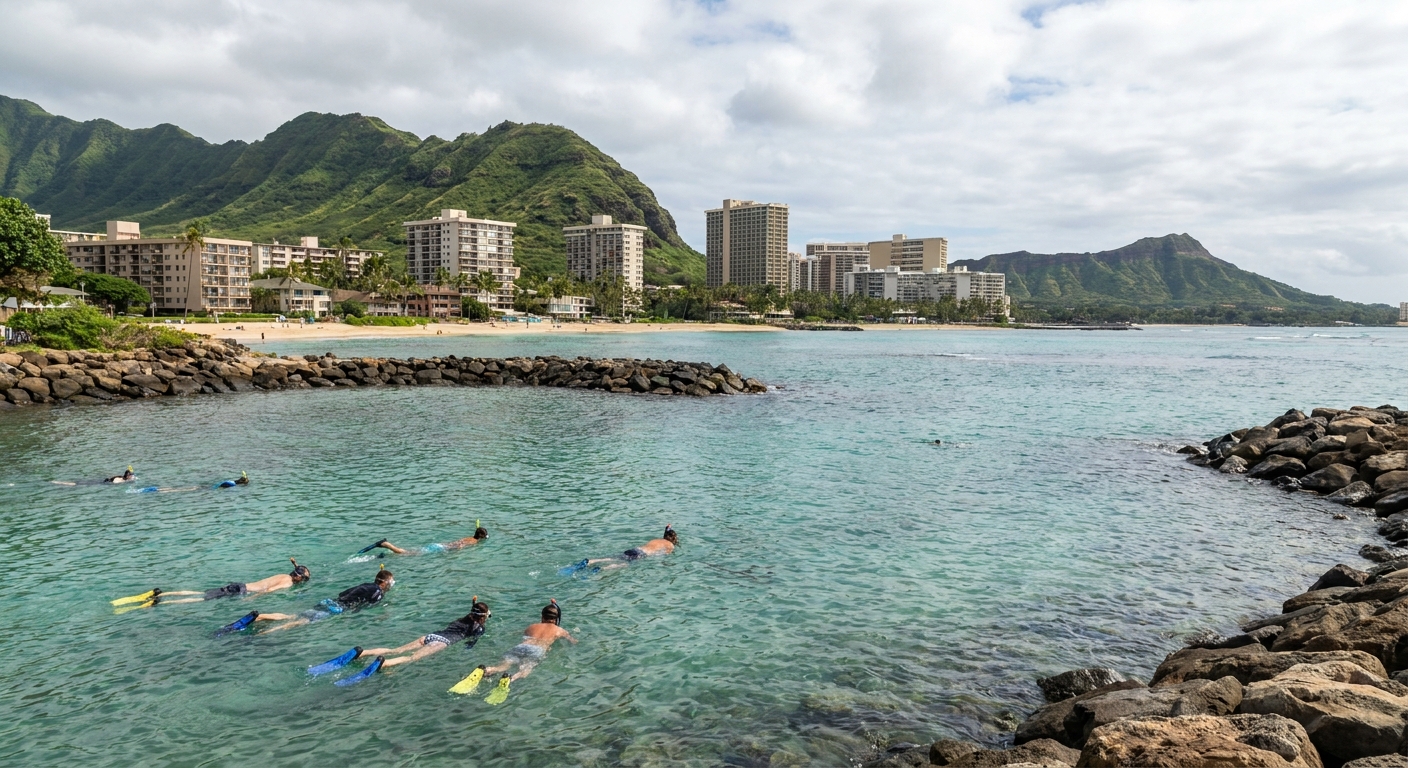
July puts water at 79.3°F, nearly a full degree above June’s 78.4°F, under a sun that stays up thirteen hours and twenty minutes in mid-month. That combination makes it an evening-water month: a swim at six, dry by seven, dinner after that, and none of it done in the dark. Plans that want warm water and a late finish work better now than in the shoulder months around it.
Names, then. Waikiki Beach for the swim those numbers describe, Ala Moana Beach Park for calmer water and shade, Diamond Head for the climb, Hanauma Bay for the snorkel, Pearl Harbor for the memorial, and Kailua or Lanikai on the windward side, where the airport’s 0.52 inches does not apply. No admission price, opening hour or reservation rule for any of them sits in our sources, and inventing one would be worse than admitting the gap: read each operator’s official page the week you book.
What this month changes is the air, not the water. From June to August the sea moves 1.2°F in total, 78.4 to 79.6, so the snorkel at Hanauma is the same outing in any of the three. The air’s average high climbs from 86.9°F to 88.8°F over the same stretch, and that difference lands entirely on dry land: the Diamond Head climb at 6:30 a.m. in July is a different event from the identical climb at noon.
Free in July is mostly the ocean. Waikiki, Ala Moana and the windward beaches take no ticket, and neither does the 7:17 p.m. sunset or a walk along the Ala Wai before the heat builds. What we cannot tell you is what the ticketed sites charge this month, because no fee figure came with our data. Ask at the desk, or check the operator, before you build a morning around one of them.
Honolulu in July: a two-day itinerary
Day one stays on the south shore. Out the door by 6:15, with sunrise at 5:57, and climb Diamond Head while the air is nearest its 75.1°F overnight low. Down for a swim at Waikiki by nine, water at 79.3°F. Eat and go indoors from noon to three, the hottest stretch of a day averaging 88.1°F, and let the Bishop Museum or the Honolulu Museum of Art absorb it. Back to the sand at four, and hold a terrace table for 7:17 p.m.
Day two goes windward, which is exactly where the airport gauge stops applying, since that coast takes several times its rain. Kailua and Lanikai in the morning, lunch in town, then Pearl Harbor or Hanauma Bay in the afternoon depending on which reservation you secured. If a shower moves in, it costs an hour more often than a day: only 1.3 days in an average July record even a tenth of an inch. Swap the beach hour for the museum you skipped and carry on.
Honolulu in July vs June and August
| Measure | June | July | August |
|---|---|---|---|
| Average high | 86.9°F | 88.1°F | 88.8°F |
| Average low | 73.8°F | 75.1°F | 75.6°F |
| Monthly rain | 0.50 in | 0.52 in | 0.84 in |
| Days with 0.10 in or more | 0.7 | 1.3 | 1.2 |
| Sea surface (daily maxima) | 78.4°F | 79.3°F | 79.6°F |
Line the three up and July sits in the middle on almost every measure. Its 88.1°F high runs 1.2°F above June and 0.7°F below August, and its 75.1°F low falls between June’s 73.8 and August’s 75.6. Rain goes 0.50 inches in June, 0.52 in July, 0.84 in August, which means August takes roughly 60 percent more than July. The sea climbs steadily through all three. The one exception is wet days: July’s 1.3 is the highest of the trio, just above August’s 1.2.
Move four weeks earlier and you give up 1.2°F of afternoon warmth and 0.9°F of water, and you pick up the fewest wet days of the three, 0.7 against July’s 1.3. Move four weeks later and August returns the warmest water at 79.6°F along with the most rain, 0.84 inches, still under an inch for a whole month. Across the trio the total spread is 1.9°F of air and 1.2°F of water. For a beach week that is no decision at all, so let the airfare and the school calendar make it.
Is July a good time to visit Honolulu?
Yes, for anyone whose trip is built around water and daylight. Sea at 79.3°F, afternoons at 88.1°F, half an inch of rain over thirty-one days and light until 7:17 p.m. is about as close to a guarantee as a climate normal will ever give you. No, for anyone booking six weeks out, traveling on a tight budget during a school-holiday month, or hoping for a quiet Waikiki morning.
If the answer is no, June is the closer swap than August. Its air runs only 1.2°F cooler, its water only 0.9°F below July’s, and it records 0.7 wet days against 1.3, the driest of the three on that measure. August moves the wrong way on rain, adding a third of an inch for water that is warmer by 0.3°F. The full twelve-month picture, shoulder months included, is in the best-time guide.
What July does that June cannot: put the ocean at 79.3°F, nearly a degree warmer, while the month’s rain still stops at 0.52 inches, which is the thing August gives up when its total jumps to 0.84.
The last word
Book first, pack later. A July trip to Honolulu turns on the lead time you give the flight and the room, because the weather has almost nothing left to surprise you with: a soaking of an inch or more shows up on 0.1 days in an average July, which is about one July in ten. Give the trip five nights at a minimum, put Diamond Head on the first morning while your body clock is still running on mainland time, and let the 7:17 p.m. sunset choose your dinner reservation.
Sources & data for this guide
- July air normals (high 88.1°F, low 75.1°F, 0.52 in) · NOAA NCEI monthly normals 1991-2020, station USW00022521, Honolulu International Airport · checked Sep 15, 2026
- Rain days (1.3 days at 0.10 in or more, 0.1 day at 1 in or more) · NOAA NCEI 1991-2020, same station · checked Sep 15, 2026
- Station siting caveat: the gauge is on the leeward south shore and does not see windward or mountain rainfall · NOAA NCEI station metadata · checked Sep 15, 2026
- Sea surface 79.3°F, mean of daily maxima 2015-2024 · Open-Meteo Marine API · checked Sep 15, 2026
- Daylight 13h 20m on July 15, sunrise 5:57 a.m. and sunset 7:17 p.m. Hawaii time, converted from published UTC · sunrise-sunset.org · checked Sep 15, 2026
- June and August normals and sea figures (86.9/73.8/0.50/0.7 and 88.8/75.6/0.84/1.2; sea 78.4°F and 79.6°F) · NOAA NCEI 1991-2020 for air, Open-Meteo Marine 2015-2024 for sea · checked Sep 15, 2026
- Editorial admission: no hotel rate series, no occupancy data, no lodging tax rate and no site admission price was available for this guide. Where a number is missing we say so rather than estimate it. Fees, hours and reservation rules change · check operators when you book.