
THE DOURO VALLEY · NORTHERN PORTUGAL · PINHÃO · 41.2° N
The Douro was demarcated for wine before any other region on earth, a date our Portugal guide keeps on hand. What that history looks like on the ground is a river running low between steep schist slopes, vineyard terraces stacked up the sun-facing sides, some built by hand over centuries and some rebuilt wide enough for a tractor, and white-walled quintas parked above them with their names painted on the roof tiles.
A common plan is a day out of Porto: coach or train in the morning, two estates, a short cruise, back in the city for dinner. It works. It also puts you in the valley during its flattest hours. The Douro’s better ones sit outside that window, in the late afternoon when low light picks out every terrace line, at dinner on the property where you are also sleeping, and the next morning before the first boats come upriver.
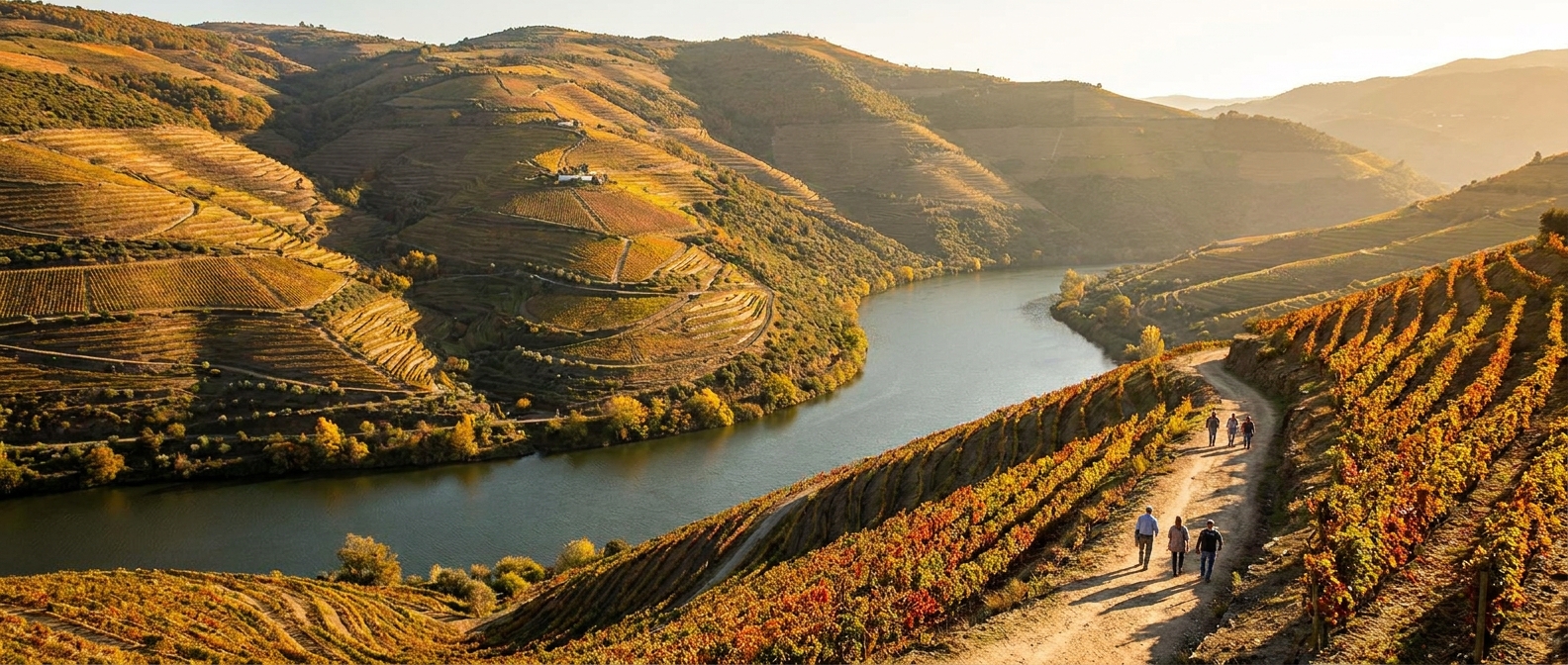
THE REGION AT A GLANCE · THE DOURO VALLEY
Give the valley a night, and two if the calendar allows (TTC’s recommendation): late afternoon and early morning are the hours a day trip from Porto structurally misses.
OLDEST DEMARCATED WINE REGION · UNESCO: ALTO DOURO WINE REGION · GENERALLY QUIETER IN WINTER
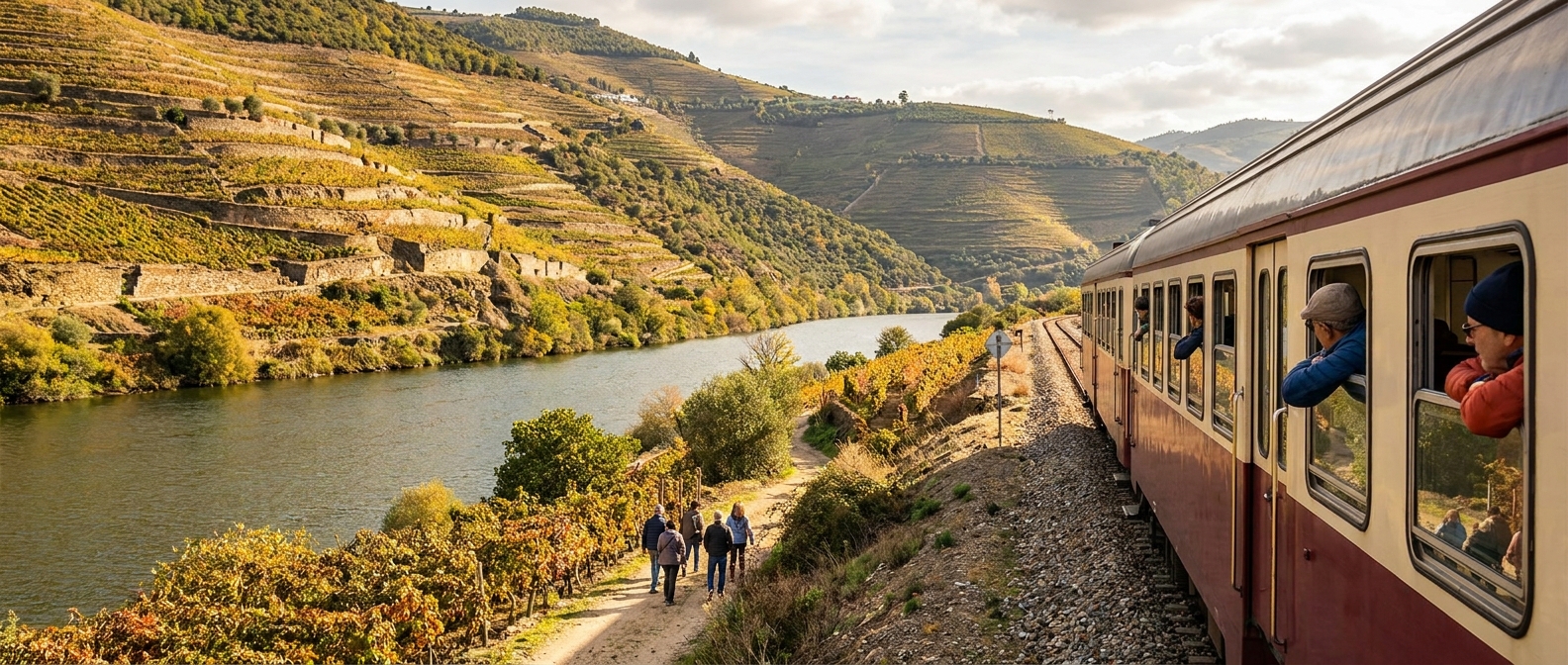
Go for: the terraced river landscape, quinta stays with dinner and breakfast in place, tastings poured by people who worked the vines, and the river-hugging ride on the Linha do Douro.
Think twice before: building a driving day around tastings, or expecting town life after dark anywhere but Régua and Lamego.
UNESCO Alto Douro listing · Turismo de Portugal · CP (Comboios de Portugal) · full sources at the end
Douro Valley sub-regions: Baixo Corgo, Cima Corgo and Douro Superior
Baixo Corgo, the western third. From Mesão Frio east to the Corgo confluence, the slopes are generally greener and the traffic heavier than further upriver. Peso da Régua anchors it, a working river town with the rail junction, the bus links and the Douro Museum. Uphill to the south sits Lamego. The viewpoint at São Leonardo de Galafura gives a broad view across the terraces. UNESCO’s Alto Douro Wine Region listing covers a delimited core of this cultivated landscape rather than every mile of the river.
Cima Corgo, the picture-book stretch. Pinhão sits at its center, a village of a few streets whose train station is lined with azulejo panels showing the harvest as it looked a century ago. The port houses keep their best-known quintas on both banks here, several within a short drive or a walk of the village, and the N222 threads the south side of the river between Régua and Pinhão. If you have seen one photograph of the Douro, it was probably taken within a few bends of this stretch.
Douro Superior, the far east. Past the Tua confluence toward Pocinho and Vila Nova de Foz Côa, the gorge opens out, the vineyards spread wider, the villages thin and the driving gets long. The Côa Valley’s open-air Paleolithic rock engravings are out here with their own museum, and the Douro Internacional park runs the Spanish border with vultures over the cliffs. It rewards a full day, not a detour squeezed onto the end of one.
Where to stay in the Douro Valley: Régua, Pinhão, Lamego or a quinta
| Base | What it gives | Best for | The drawback | Car? |
|---|---|---|---|---|
| Peso da Régua | Trains, buses, riverside quays, the Douro Museum, restaurants that stay open | Arriving without a car, first visits | Working town first, postcard second | Not required |
| Pinhão | The heart of the photographed stretch, tiled station, quintas close by | Couples, tasting-led trips | Small and quiet after dinner, rooms can sell out at harvest | Optional |
| Lamego | A real town uphill from the river, the Remédios sanctuary stairway, generally cheaper rooms | Travelers who want cafés at night | Off the river, so you drive or bus down to it | Helpful |
| An isolated quinta | Vineyard at the door, dinner and breakfast in place, terrace views | Anniversaries, slow travelers | Everything requires driving, and dinner is where you sleep | Yes |
| Porto, as a day trip | The valley through a window, one or two estates, a short cruise | Very short trips | You leave the valley before its best light | No |
The pattern that works for most first visits: Régua for logistics, Pinhão for the picture, with one night on a quinta if the trip is a celebration. Our Portugal honeymoon guide takes that splurge decision further.
Getting around the Douro: the Linha do Douro train, the river boats, the N222
The train. Services on the Linha do Douro leave Porto’s Campanhã station and swing inland before meeting the river, which they then follow east through Régua and Pinhão to the line’s end at Pocinho. The last stretch runs close enough to the water that passengers cross to whichever side has the view. No tolls, no parking, no arithmetic about who is driving home.
The river. Cruise boats built on the lines of the old rabelos run short trips out of Régua and Pinhão, and longer day boats work up from Porto with a train or coach return. The passages through the dam locks are part of the show, a slow rise inside concrete walls with the valley waiting above. Ask which direction your ticket runs: upriver and downriver are different afternoons.
The roads. The N222 between Régua and Pinhão is the drive people come for, and the smaller roads that climb from it to the viewpoints are narrower still, single-lane in places, blind on the bends. In the harvest weeks you will meet tractors and grape trucks on those corners. Quinta driveways are steep gravel. None of this is difficult, but it is slower than a map suggests, and our car rental guide covers the rest of the rulebook.
Tastings and the driver’s seat. This is the practical question nobody raises at the first estate and everybody feels at the third. Portuguese law sets the blood-alcohol limit, roadside checks happen, and the limit is not a matter of how you feel on a mountain road. Check the current figure before you plan the day, use the spit bucket the estate puts in front of you, appoint a driver who tastes nothing, or hire one for the afternoon.
Without a car at all. Plenty of visitors do the valley on rails and water: train to Régua or Pinhão, walk or taxi to a nearby estate, cruise, sleep, repeat. Many quintas will arrange a pickup from the station if you ask when you book, and guided small-group days run out of both towns. Getting Around Portugal lays out how the pieces connect nationally.
On this page
- Arriving by train, no car at allThe Linha do Douro to Régua and Pinhão
- The stretch in the photographsCima Corgo and Pinhão
- Cafés at night and cheaper roomsLamego, uphill from the river
- Autumn harvest, treading and the vindimaOur Douro harvest guide
- How the Douro joins the rest of the northPorto and the North
- How many nights, and what the second one buysNights in the valley
- Harvest, and the month-by-month numbersWhen to come
Not for: a rushed half-day. If the schedule allows only a few hours out of Porto, spend them on the river and the train window rather than trying to fit two estate visits around them.
Douro Valley trip cost: hotel, wine tasting and meal prices
Three relative tiers, no quotes. Lean: a guesthouse in Régua or Lamego, town restaurants, train and taxi, tastings booked one at a time. Middle: a small hotel in or near Pinhão with a river view, a shared rental car, a proper lunch at an estate. High: the wine hotels, where the room, the dinner and the cellar visit arrive as one bill and the terrace is the reason you paid it.
Two levers move the number more than any booking trick. Rooms in the valley are finite and rates and availability tighten through the harvest season, so early dates matter there more than they do on the coast.
And a tasting-and-dinner day at one estate often costs less than driving between three of them. Country-wide orders of magnitude live in what a Portugal trip costs.
Best time to visit the Douro Valley
| Season | The valley | Wine calendar | The catch |
|---|---|---|---|
| Winter | Bare vines, mist sitting low in the gorge, soft light | Pruning on the terraces | Some estates and restaurants reduce hours, confirm directly |
| Late winter | Almond blossom on the slopes above the river | Quiet cellars | Short days, cold mornings, river fog |
| Spring | Green terraces, wildflowers on the walls, full river | Vines leafing out | Rain is part of the deal, pack a shell |
| Summer | Hard sun in an enclosed valley, water like glass | Ripening, cellars calm | The gorge holds heat, plan mornings and pool afternoons |
| Early autumn | Pickers, tractors, crates, treading lagares | Vindima, the working season | Rooms can sell out, book well ahead |
| Late autumn | Vine leaves turning red, gold and rust | New wine in tank | Weather turns, some places wind down |
Harvest is the one season with its own rules, its own pace and its own bookings, from foot treading to the question of whether visitors get to join in. We keep all of that on the Douro harvest guide rather than compressing it here.
For temperatures, rain days and the national crowd curve, the numbers sit on our month-by-month guide, with October the page most Douro-bound readers open first. One local note that no national average conveys: the valley is a trench, and it behaves like one. Summer afternoons run hotter here than in Porto, and winter mornings sit under fog long after the coast has cleared.
Douro Valley from Porto: how to get there and how many nights to stay
Porto is the gateway, by road east along the A4 and then down into the valley, by rail on the Linha do Douro, or by boat with a return on the train.
The city and the wine region are two halves of one northern trip, and our guide to Porto and the North handles the urban half, the port lodges in Gaia included.
Coming from Lisbon, the sensible move is rail north first, then east.
On nights, TTC’s recommendation is two. One night gets you an evening, a dinner and a morning, which is already a different trip from the coach version. The second night is what lets you cross to the other bank, drive out toward Foz Côa or spend a slow afternoon doing nothing above the river. Our seven-day route shows the tight version and the ten-day one the comfortable one.
The last word
What the Douro offers that no other Portuguese region does is a landscape made entirely of work. The Alentejo has space, the Algarve has coast, Porto has the city. Here, every line drawn across a hillside was put there for wine, by hand or by machine, and it is still being farmed: pruning crews in February, tractors on the bends in autumn, dogs asleep in the shade of a quinta gate all summer.
The hour that makes the case comes late. The day boats have gone back down the river, the light drops along the terrace lines, and the valley sounds like farmland again. Dinner arrives on a terrace where the wine list is one estate long, and at breakfast the fog is still sitting on the water below the vines. That hour does not appear on any coach schedule.
Sources & data for this guide
- UNESCO World Heritage · Alto Douro Wine Region · the inscribed property is a delimited core of the cultivated valley, not the whole river · checked Sep 14, 2026
- Region, quintas and wine tourism · visitportugal.com (Turismo de Portugal) · checked Sep 14, 2026
- Demarcation and appellation rules · IVDP, Instituto dos Vinhos do Douro e do Porto · checked Sep 14, 2026
- Linha do Douro services and stations, Porto Campanhã to Pocinho · CP, Comboios de Portugal · checked Sep 14, 2026
- Road rules and the blood-alcohol limit · ANSR, Autoridade Nacional de Segurança Rodoviária · check the current figure before a tasting day · checked Sep 14, 2026
- Editorial note: this page deliberately carries no temperatures, prices or journey times. Seasonal figures live on our month pages, driving rules on the car guide, and estate hours change year to year, so we point you at the source instead of freezing a number here.