
PORTUGAL · DOURO VALLEY · JULY
On July 15 the sun clears the terraces at 6:09 am and stays up until 9:04 pm local time, giving 14 hours 54 minutes of light. The month’s rain normal at Vila Real is half an inch, spread across 2.3 wet days. That pairing is the whole case for a July trip up the valley, and also its catch, because afternoons average 83.8°F on the high ground and run hotter down on the water.
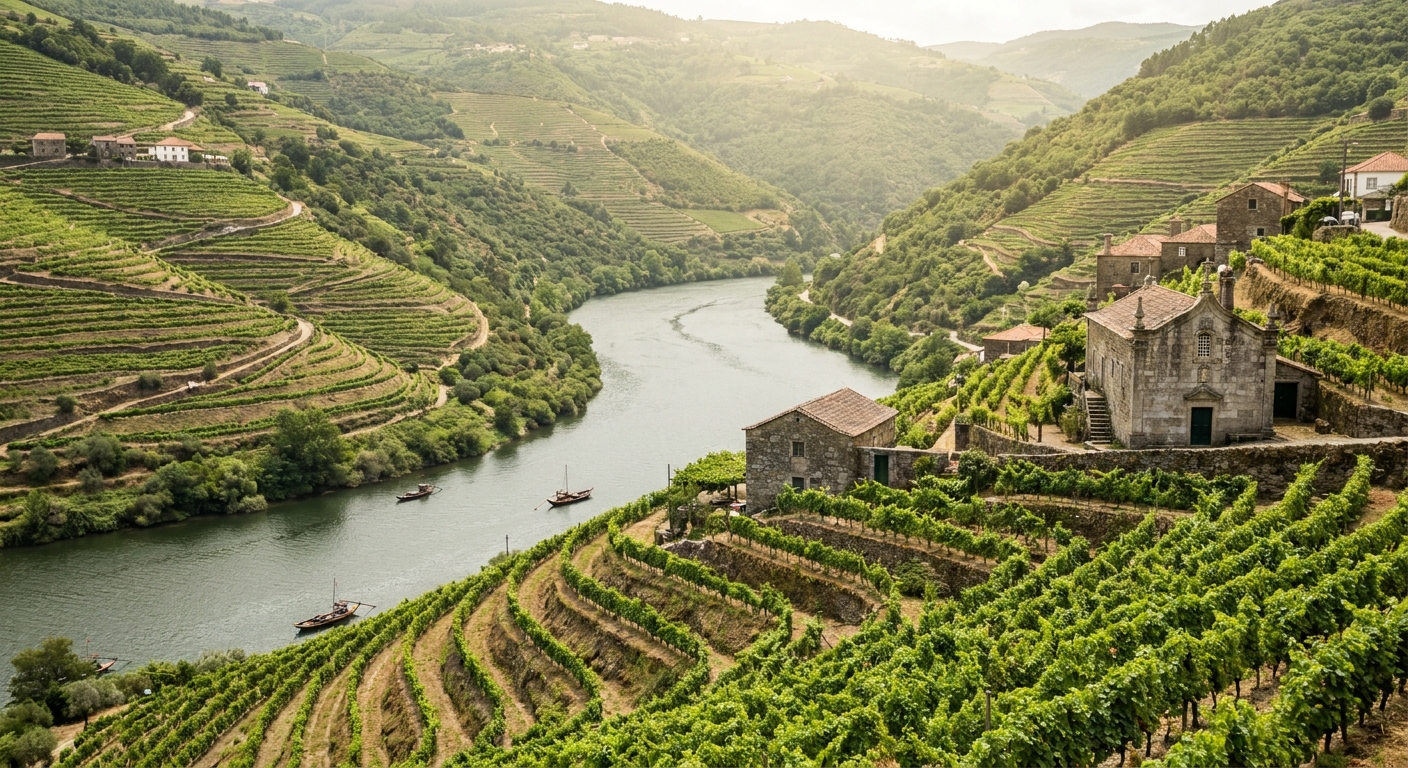
Very little else about the Douro moves with the calendar. Wine has been made here by traditional landholders for some 2,000 years, the quintas keep their white houses above the Corgo, and the harvest belongs to a later season. July changes three things only: the heat, the light and the company. So every answer here is a dated one, including whether four weeks in either direction would suit your trip better.
THE MONTH AT A GLANCE · DOURO VALLEY · JULY
July is the driest of the three summer months by the IPMA normals, and it asks you to plan the day around a 25.3°F swing between dawn and mid-afternoon.
HIGH 83.8°F · 2.3 WET DAYS · SUNSET 9:04 PM ON THE 15TH · SLEEP IN THE VALLEY
Go for: long evenings on the terraces, the driest normals of the summer, and a valley road you can drive twice in one day of light.
Think twice before: planning a midday walk on the schist. The station reading of 83.8°F is taken at 561.5 m, and the valley floor is hotter than that.
Climate: IPMA station 567, Vila Real, 1991-2020 · Landscape: UNESCO file 1046 · full sources at the end
On this page
- Douro Valley weather in July83.8°F highs, 0.50 inch of rain
- How hot the valley gets in JulyA 25.3°F swing, dawn to afternoon
- Crowds, prices and booking in JulyWhat we can date, and what we cannot price
- Things to do in the Douro Valley in JulyQuintas, the Corgo and the Pinhão
- A two-day Douro itineraryTwo days built around the 9:04 pm sunset
- July vs June and AugustHow the three months compare
- Is July a good time to visit?Who should go, who should shift
Everything undated lives elsewhere. Porto, where most Douro trips start and where the flights land, has its own guide. The picking season gets the harvest page. Whether you need a car for the valley roads is settled in our rental guide, and the twelve-month view sits in the best-time verdict.
The Douro Valley weather in July: average highs, lows and rain days
| July normal, 1991-2020 | Value |
|---|---|
| Average high | 83.8°F |
| Average low | 58.5°F |
| Monthly rain | 0.50 in |
| Days with 1 mm (0.04 in) or more | 2.3 |
| Days with 10 mm (0.39 in) or more | 0.4 |
| Daylight on July 15 | 14h 54m |
Every figure here comes from IPMA, the Portuguese national weather service, and from one specific instrument: station 567 at Vila Real, a real thermometer at 561.5 m, on the 1991-2020 normals. Where it stands matters more in the Douro than anywhere else in Portugal. Vila Real sits inside the wine country rather than on the coast, the valley floor beside the river is considerably hotter than Porto, and the high ground north of the station is colder and far wetter. The month averages 83.8°F by day, 58.5°F at night, 0.50 inch of rain.
Those 2.3 wet days are a small number with a clear meaning: measurable rain on roughly one July day in thirteen. A real soaking is rarer still, since only 0.4 day in an average July reaches 10 mm, which works out to one such day in two Julys out of five. One caution before you compare notes with a US forecast page. IPMA counts at 1 mm, or 0.04 inch, not at the 0.10-inch line American tables use, so the two counts are not interchangeable.
The gap between those two normals is 25.3°F, and it lands inside a single day. Dawn on a terrace at 58.5°F is cool enough for sleeves, and the same terrace at four in the afternoon is not. Pack for both ends: something light and long for the early hours and the 9 pm river air, plus a hat you will actually wear at midday. Our packing guide covers the rest of the country.
Light is July’s real gift. Sunrise on the 15th falls at 05:09 UTC and sunset at 20:04 UTC, which in Portuguese summer time reads 6:09 am and 9:04 pm, a fraction under 15 hours. Practically, a tasting that ends at seven still leaves two hours of low gold on the schist, and dinner at nine happens outdoors in daylight. It also means an early start costs you nothing in sleep worth having.
How hot does the Douro Valley get in July? Average highs, lows and heatwave days
July’s ceiling and floor at Vila Real are 83.8°F and 58.5°F, a spread of 25.3°F. August adds almost nothing to the top (84.2°F) and June sits well below it (77.5°F), so this is the valley’s hot plateau. Remember the altitude behind the number. The thermometer is at 561.5 m, and the terraces that drop to the water are lower, more enclosed and backed by stone walls that hold the afternoon.
In clothing terms, that means two outfits in one day. Mornings before nine want a light long sleeve, especially on a boat or in the shade of a north-facing slope. From one o’clock onward you want linen, water and a plan that involves a cellar, a long lunch or a roof. The Marão and Montemuro mountains shelter the valley from the harsh Atlantic winds, which is excellent for the vines and no help at all to you at three in the afternoon.
We could not verify a count of days above 90°F or 95°F at Vila Real, so we give no heatwave figure and no threshold. What the normals do carry is a July night at 58.5°F on average, and we found no frost figure for the month at this station. Treat the afternoon as the constraint and the night as the reward.
How busy is the Douro Valley in July? Crowds, prices and the demand peak
We found no occupancy series and no room-rate series for the Douro municipalities, so we crown no month expensive and quote no nightly rate. What the calendar does hand us is position: July sits between a wetter June (4.0 wet days, 1.15 inches) and an August within 0.4°F of it, and it falls well before the picking season, which fills the quintas and has its own page. Summer beds in a valley of small properties are finite, and that is the pressure to plan around.
Our working rule, offered as judgment rather than measurement: book a July room about eight weeks out (est.), and book any quinta visit that requires a reservation at the same time as the bed. The valley’s lodging stock is made of converted farmhouses and a handful of hotels, so a weekend in the middle of the month closes earlier than a Tuesday. If your dates flex, move the two nights midweek before you move the month.
On the tourist tax, we have to leave a gap: we could not verify a rate for any Douro municipality, so no percentage and no per-night figure appear. Budget the rest of the trip with our Portugal cost breakdown, and expect the car and the fuel, not the bed, to be the line that surprises first-timers on these switchback roads.
One upgrade genuinely changes July: sleeping inside the valley instead of commuting from Porto. With sunset at 9:04 pm, a room among the terraces buys you the two best hours of the day, when the heat breaks and the light goes long, rather than spending them on the drive back downstream. Flights and the Porto arrival are covered in our flights guide.
Things to do in the Douro Valley in July: quintas to visit and river trips
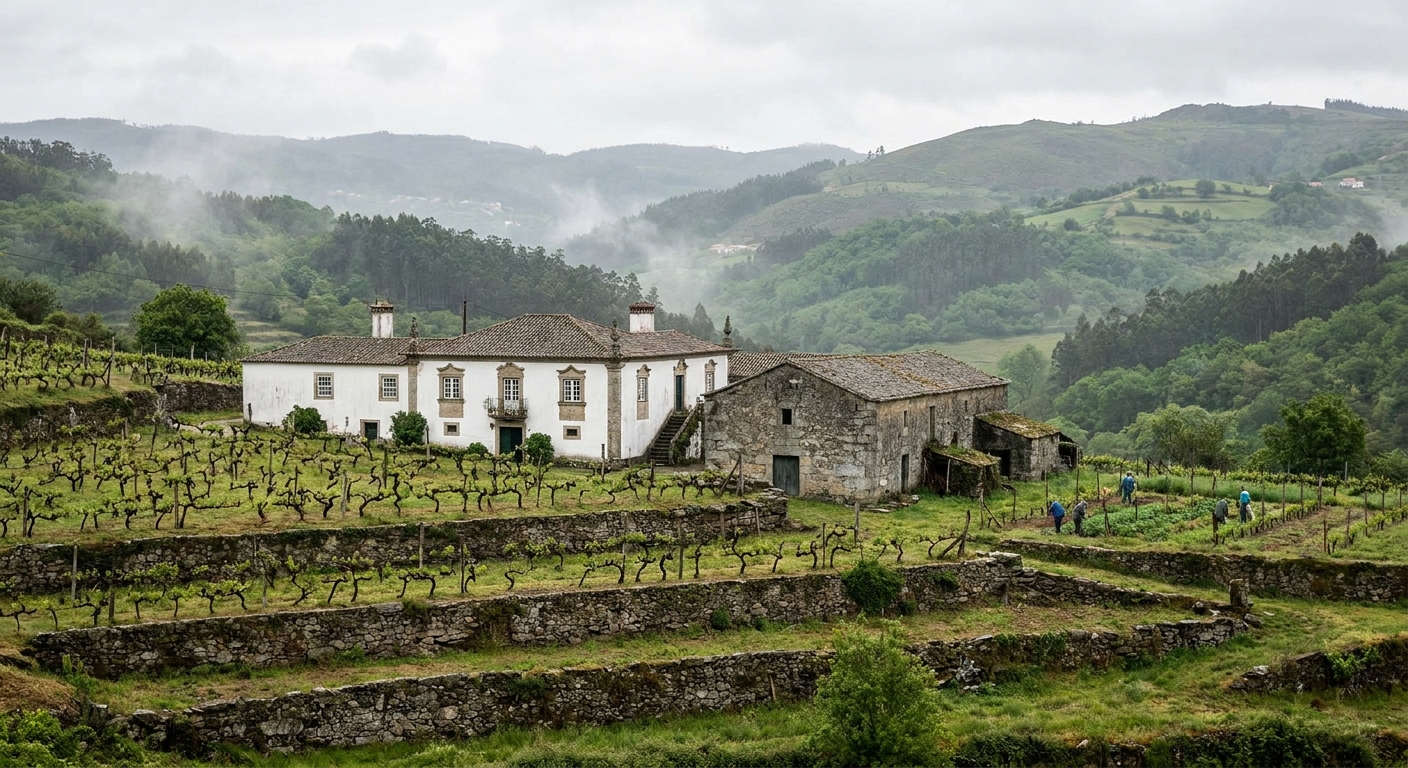
Two July numbers unlock things the shoulder months cannot promise: 2.3 wet days and nearly 15 hours of light. An evening walk on a terrace at eight, with the stone still warm and the river turning metallic below, is a July and August activity. In June you would be planning around 4.0 wet days and more than twice the rainfall, and in the harvest weeks the same tracks belong to the pickers.
The named geography is easy to hold. The Douro and five tributaries, the Varosa, Corgo, Távora, Torto and Pinhão, form the backbone of the landscape. The quintas, a main house with its farm buildings and winery around it, stand thickest in the Upper Corgo and the Upper Douro, with white-walled villages midway up the slopes around an often imposing 18th-century parish church. The World Heritage property covers 24,600 hectares, inside a buffer zone of 225,400, nine times the size, a ratio UNESCO itself calls difficult to manage.
July changes the air around those stones, never the stones themselves. The oldest terraces, the socalcos, predate the phylloxera of 1860: narrow, irregular, carrying one or two rows of vines behind schist walls that need constant maintenance. The wider, slightly sloping terraces built after the replanting, at the end of the 19th century and the start of the 20th, tilt the vines toward more sun, which in July means they take the full 83.8°F and pass it back at you off the wall.
The free half of a July day is the landscape itself: the village streets and their churches, the roads along the Corgo, the orange groves, sometimes walled, that grow on the lower banks and beside the hillside watercourses among brushwood and coppices. For the paid half, a warning we would rather state than dodge: we verified no quinta opening hour, no tasting price and no fare for river boats or the valley train, so none are quoted here. Confirm with each estate when you reserve.
The Douro Valley in July: a two-day itinerary
Day one runs early and stops at noon. Be outside by 7:30, while the air is nearer the 58.5°F low, and give the first two hours to a terrace walk or the drive along the Corgo, when the shadows still lie across the vines. Reserve a late-morning cellar visit, then let lunch run from one o’clock until at least four, indoors or under vines. Take the river or a viewpoint from six, and hold the last hour for the 9:04 pm sunset before dinner.
Day two goes upstream into the Upper Corgo and the Upper Douro, where the quintas cluster, with a village and its 18th-century church as the midday shade stop. If one of July’s 2.3 wet days lands on you, swap the terrace hours for cellar hours and the viewpoint for a long table, and keep off the schist walls while they are slick. Rain of 10 mm or more shows up in only two Julys out of five, so a full washout day is the exception you plan for lightly.
The Douro Valley in July vs June and August
| Normal, 1991-2020 | June | July | August |
|---|---|---|---|
| Average high | 77.5°F | 83.8°F | 84.2°F |
| Average low | 54.7°F | 58.5°F | 58.8°F |
| Monthly rain | 1.15 in | 0.50 in | 0.85 in |
| Days with 1 mm (0.04 in) or more | 4.0 | 2.3 | 2.3 |
Read across and the summer sorts itself. June runs 6.3°F cooler by day and 3.8°F cooler at night, but pays with 1.15 inches of rain over 4.0 wet days. August matches July’s wet-day count exactly at 2.3 while adding 0.35 inch of rain and a token 0.4°F of afternoon heat. July is the driest of the three on the monthly total. There is no sea reading to weigh here, and we verified no river water temperature for the Douro, so we give none.
Shifting four weeks back costs you dry days and buys cooler walking: nearly double the rain-day count, in exchange for afternoons that stay in the 70s. Our June page has that month in full. Shifting four weeks forward changes the weather barely at all, since August’s normals sit within half a degree of July’s, so the reason to choose August is a school calendar or a flight price, not the thermometer.
Is July a good time to visit the Douro Valley?
For a two or three night trip built on tastings, long lunches and evening light, July is a strong month: 0.50 inch of rain, 2.3 wet days, and almost 15 hours of daylight to spend. For anyone who wants to be on their feet among the vines between noon and four, or who travels badly in heat, it is the wrong fortnight, because 83.8°F on the station means more on the valley floor.
Those readers should shift to June. It brings afternoons at 77.5°F and nights at 54.7°F, six degrees of relief where it counts, and charges 1.15 inches of rain across 4.0 wet days for the privilege. That trade suits walkers and photographers who would rather dodge a shower than a heat index, and it keeps the same terraces, the same quintas and a longer usable middle of the day.
What July holds over its neighbors is narrow and real: the driest monthly total of the three, 0.50 inch against June’s 1.15 and August’s 0.85, with 14 hours 54 minutes of light on the 15th to use it in.
The last word
Book the bed in the valley, keep the car, and give the hours between one and four to a table rather than a hillside. One piece of context for the walls you will be photographing at nine in the evening: torrential rain in late January 2001 damaged terraces badly enough that UNESCO flagged a special effort to bring parts of the vineyards back into working order, and Portugal created the Douro Mission in 2006 to look after the landscape, five years after an Intermunicipal Spatial Plan took charge of it. Those schist walls carry one or two rows of vines each, and they are rebuilt by hand.
Sources & data for this guide
- July normals (83.8°F / 58.5°F, 0.50 in), wet-day counts and neighboring months · IPMA, climatological normals 1991-2020, station 567 Vila Real, 561.5 m · checked Sep 23, 2026
- Sunrise 05:09 UTC, sunset 20:04 UTC and 14h 54m of daylight on July 15, converted to Portuguese summer time · sunrise-sunset.org · checked Sep 23, 2026
- Property of 24,600 ha, buffer of 225,400 ha, inscription 2001 under criteria (iii), (iv) and (v), socalcos and post-phylloxera terraces, tributaries, quintas and villages · UNESCO World Heritage Centre, file 1046 (Alto Douro Wine Region) · checked Sep 23, 2026
- January 2001 storm damage, the 2003 Intermunicipal Spatial Plan and the Douro Mission (2006) · UNESCO World Heritage Centre, file 1046 · checked Sep 23, 2026
- We could not verify quinta opening hours, tasting prices, boat or train fares, a tourist-tax rate, an occupancy series, a room-rate series, a count of days above 90°F, or a river water temperature. None of those figures are given · confirm hours and prices with each operator when you book.
To plan your stay
- Things to Do in the Douro Valley: Quinta Tastings, the River Train, Boats and Miradouros
- Douro Valley vs Alentejo: Monthly Temperatures, Rain Days and Daylight
- Best Time to Visit the Douro Valley: Month-by-Month Weather, Harvest Season and the Quiet Months
- The Douro Valley in June: Weather, Crowds and a Two-Day Itinerary