
DOURO VALLEY · AUGUST · IPMA VILA REAL, 561.5 M
August hands the Douro its long, dry afternoons. The IPMA station at Vila Real, a real thermometer 561.5 meters up in the wine country, puts the month’s average high at 84.2°F and the whole month’s rain at 0.85 inch, and on the 15th the sun stays up 13 hours 52 minutes. On terraces that have grown wine for some 2,000 years, that buys an evening which simply refuses to end.
What it costs you is the middle of the day. The station sits on the hillside; the valley floor beside the river runs hotter still, and both run hotter than Porto, so a coastal forecast will lie to you by a wide margin. Where to sleep and how many nights the valley needs belong to our Douro Valley guide. What August itself gives and takes is below.
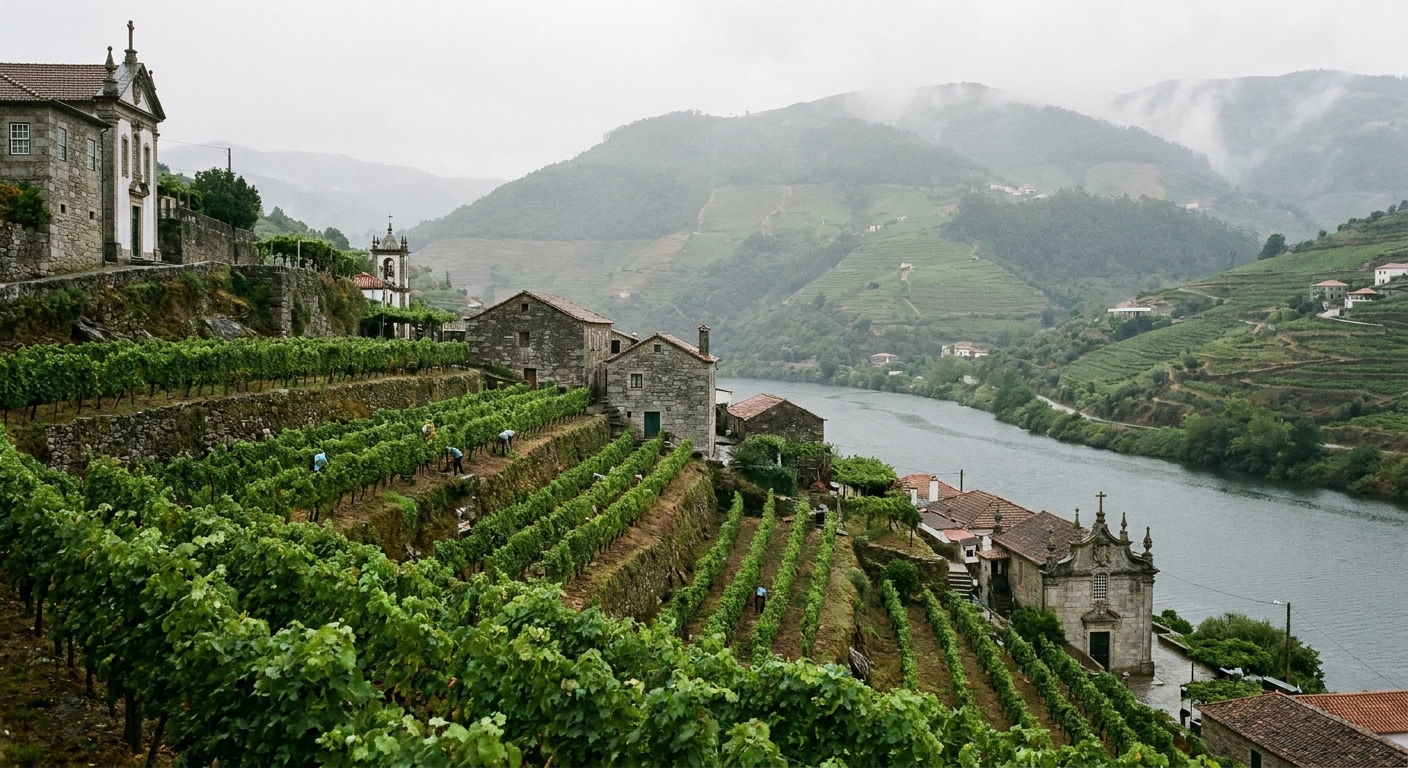
THE MONTH AT A GLANCE · DOURO VALLEY · AUGUST
August gives the Douro 13 hours 52 minutes of daylight and just 0.85 inch of rain for the month, and asks you to hand the middle of the day back to the shade.
AVG HIGH 84.2°F · 2.3 RAIN DAYS · SUNSET 8:31 PM ON AUG 15
Go for: dry roads on the terraced river valleys, quinta visits in stone-walled cellars, and dinner outdoors while the light is still on the vines at half past eight.
Think twice before: planning hillside walks between one and five, or renting a car without working air conditioning: the valley floor is hotter than the 84.2°F station figure.
Normals: IPMA station 567, 1991-2020 · Daylight: sunrise-sunset.org · Landscape: UNESCO fiche 1046 · full sources at the end
On this page
- Douro Valley weather in August84.2°F highs, 0.85 inch of rain, 2.3 wet days
- How hot August afternoons getThe 25.4°F swing between day and night
- Crowds, booking and the lodging taxWhat we can price and what we cannot
- Things to do in AugustQuintas, socalco terraces and the river roads
- A two-day plan built around the heatOut at seven, indoors at one, back out at five
- August or September in the DouroHow July, August and September compare
- Is August a good month to go?Our verdict, with the mismatch named
One reading frame before the numbers start: August is a date question, not a place question. Distances, tolls and the drive up from Porto sit in our car guide, and the national calendar argument sits in when to visit Portugal.
The Douro Valley weather in August: average highs, lows and rain days
| What | August figure |
|---|---|
| Average high | 84.2°F (29.0°C) |
| Average low | 58.8°F (14.9°C) |
| Rain, whole month | 0.85 in |
| Days with 0.04 in or more | 2.3 |
| Days with 0.39 in or more | 0.8 |
| Daylight, Aug 15 | 13 h 52 min |
Every figure here comes from one instrument: IPMA station 567 at Vila Real, altitude 561.5 meters, 1991-2020 normals. That is a real thermometer in the Douro country, not a model grid cell averaged over a coastline, and the distinction matters more here than anywhere else in Portugal. The station stands on high ground; the vineyard floor beside the water is hotter, and the same reading would be unrecognizable on a Marão trail. Read 84.2°F as the hillside, and add for the river.
Rain reaches 0.04 inch or more on 2.3 days in an average August, about one day in thirteen. A heavier fall, 0.39 inch or more, comes 0.8 day per month. Those thresholds are the Portuguese service’s own, not the 0.10-inch line American tables use, so the counts do not swap between sources. Translated into a week on the ground: most Augusts hand you one damp afternoon and nothing that redraws a plan.
Between the 84.2°F afternoon and the 58.8°F night there are 25.4°F, and the drop arrives fast once the sun leaves the schist. A sleeveless day genuinely needs a sweater on a terrace at ten. Add shoes with grip, because the old vineyard walls are stone and the tracks between them are loose. Our packing guide has the rest of the suitcase.
On August 15 the sun rises at 6:39 am and sets at 8:31 pm local time, 13 hours 52 minutes of usable light. The practical consequence is the shape of the day: two long cool ends and a hot core. Nobody in the valley eats dinner while the terraces are still lit, and by nine you can still read a map outside.
How hot is the Douro Valley in August?
August is the warmest month of the three around it, though only just: its 84.2°F average high beats July’s 83.8°F by four tenths of a degree, and its nights sit at 58.8°F against July’s 58.5°F. September gives that back in a hurry, dropping to 77.4°F by day. So the answer to how hot it gets is that August and July are effectively twins, and September is a different summer.
Dressing for a 25.4°F daily swing means two outfits inside one bag. Mornings before nine want long sleeves in the car and a jacket you will resent by ten. Afternoons want linen, a hat and water, because the sun-facing walls hold heat and there is little shade between the river and the ridge. Evenings return to the morning layer, and the terrace tables stay comfortable well past sunset.
Freezing nights are not part of this month: the IPMA normals we read carry no count of them for August, and a mean minimum of 58.8°F is nowhere near the mark. As for swimming, the Douro is a river, not a coast, and we found no verified water-temperature series for it, so we give no figure. Any sea-surface number published for the Portuguese coast is an average of daily maxima, a touch warmer than a round-the-clock mean, and it describes the Atlantic rather than these terraces.
How busy is the Douro Valley in August? Crowds, prices and booking
August is the month Europe takes off work, and the Douro sits at the end of a short drive from Porto, so the valley shares in the national high season without having a single crowd-counting turnstile to prove it. We found no occupancy series and no monthly room-rate series for the Alto Douro municipalities, so we crown no month expensive and no month cheap. What we can say with a calendar rather than a price list: this is the busiest holiday stretch of the Portuguese year.
That changes the order of operations more than the budget. Sleeping stock here is small, scattered across farmhouses and river towns rather than concentrated in one resort strip, so the room decides the trip and the trip follows the room. Book the bed before the flight, not after. We could not verify how many weeks ahead quinta rooms fill in August, so we give no lead time, and our accommodation guide covers the rest of the country’s stock.
On the tourist tax, our cards are on the table: we could not verify a lodging-tax rate for the Douro municipalities, so we quote no percentage and no per-night amount. If a property adds one at checkout, it will be a municipal charge, and the operator states it at booking.
There is one upgrade that genuinely changes August here, and it is not a larger room. It is a room with shutters and working air conditioning, plus a rental car whose air conditioning has been tested before you leave the lot. On a day running to 84.2°F on the hillside and hotter on the floor, the difference between a cool car and a warm one is the difference between three valleys and one.
Things to do in the Douro Valley in August: quinta visits, wine tasting and river trips
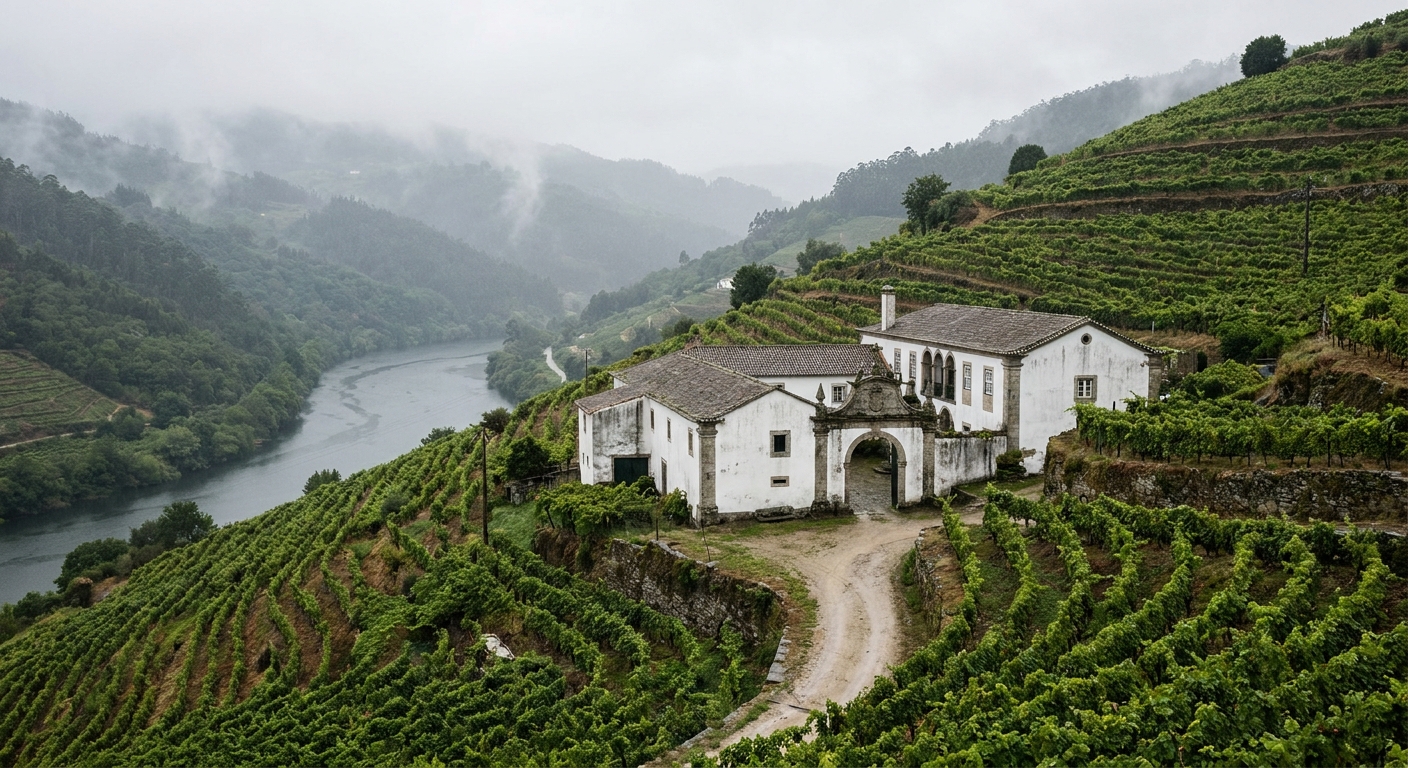
With 0.85 inch of rain in the whole month and 13 hours 52 minutes of daylight in mid-August, nothing outdoors gets canceled and everything outdoors gets postponed to five o’clock. That is the month’s real gift: a second half-day after the heat breaks, with the sun still on the east-facing walls at eight. No other month in this calendar combines light that long with rain that scarce.
The landscape you are driving through is the Alto Douro Wine Region, on the UNESCO list since 2001 under criteria three, four and five: 24,600 hectares of terraced vineyard inside a buffer zone of 225,400 hectares, a buffer nine times the size of the property that UNESCO itself calls hard to manage. The landmarks are the quintas, a main house with its winery and farm buildings, thickest on the ground in the Upper Corgo and the Upper Douro. Smaller holdings are called casais. UNESCO describes a landscape and does not organize visits, so we quote no quinta opening hour and no tasting price.
The stone does not follow the calendar, the air does. The oldest terraces, the socalcos, predate the phylloxera of 1860: narrow, irregular, buttressed with schist walls that need constant repair, each carrying one or two rows of vines. The wider, gently sloping terraces that replaced them after phylloxera were built so the vines catch more sun, and in August those same walls give the afternoon its furnace quality. Shade is where the water is: walled orange groves on the lower banks, coppices and brushwood beside the hillside watercourses.
Plenty of the month costs nothing. The river roads along the Varosa, the Corgo, the Távora, the Torto and the Pinhão are public, so are the white-walled villages midway up the slopes with their imposing 18th-century parish churches, and so are the viewpoints over the socalcos. Our sources carry no admission for any of it. For the September event that everyone asks about, we keep it where it belongs, in the Douro harvest guide.
The Douro Valley in August: a two-day itinerary
Day one runs on the light, not on a list. Be driving by seven, an hour after the 6:39 sunrise, and take the terraced road up one of the tributary valleys while the air is still on the cool side of the 25.4°F swing. Late morning belongs to a quinta visit, where the working buildings are stone and cool. Lunch long and indoors from one to four, the hours the 84.2°F average is talking about. Out again at five, and end the day looking west at 8:31.
Day two crosses the river for the villages and their 18th-century churches, then works back over the Marão and Montemuro, the ridges that shelter this valley from the Atlantic winds. If the 0.8-day storm is your day, give it an hour under a roof and keep the driving: rain at this latitude clears. Rain can also do damage here, and the valley remembers it. Torrential rain in late January 2001 wrecked terraces badly enough that UNESCO flagged the repair effort needed to bring them back into working order.
The Douro Valley in August vs July and September
| Month | Average high | Average low | Rain | Days with 0.04 in+ |
|---|---|---|---|---|
| July | 83.8°F | 58.5°F | 0.50 in | 2.3 |
| August | 84.2°F | 58.8°F | 0.85 in | 2.3 |
| September | 77.4°F | 55.4°F | 1.93 in | 5.2 |
Set the three side by side and the break is obvious, and it falls between August and September rather than between July and August. July and August share a night temperature within three tenths of a degree and the same 2.3 wet days; July is the drier of the two, at 0.50 inch against 0.85. September changes the season: 6.8°F off the afternoon, 1.93 inches of rain, and 5.2 wet days, more than twice August’s count.
Shifting four weeks later buys you afternoons at 77.4°F, walkable middays and a valley at work. It costs you a bit over an inch of extra rain and three more wet days in the month, plus the long evenings, since the light shortens fast after mid-August. Moving four weeks earlier into July buys almost nothing in temperature and a third less rain, which is a fair trade only for travelers who hate a damp afternoon.
Is August a good time to visit the Douro Valley?
Yes, for anyone willing to run the day in two halves. If your Douro is a car, a cellar, a long lunch and a terrace at sunset, August delivers it with 2.3 wet days and light until half past eight. No, if your Douro is hiking the vineyard tracks at noon, or traveling with small children who will spend the hot hours in a car seat. The heat is not a rumor on the valley floor.
If that mismatch is yours, September is the month to buy: 77.4°F afternoons make the middle of the day usable again, and the price is 1.93 inches of rain across 5.2 days rather than 0.85 inch across 2.3. Travelers who want the warmth without August’s holiday traffic should look at July instead, where the thermometer barely moves and the rain halves.
The one thing August owns outright: 13 hours 52 minutes of daylight over a landscape that gets 0.85 inch of rain all month, which is the only combination in the calendar that lets you finish a drive through the terraces with the sun still up.
The last word
Decide the bed first, with shutters and air conditioning, and the rest of August falls into place around a hot middle and two beautiful ends. Then remember what you are drinking on that terrace at 8:31: Port has been a defined, regulated quality wine since 1756, made on slopes people have worked for some 2,000 years, and the region has been governed as a landscape since the Intermunicipal Spatial Plan of 2003 and the Douro Mission of 2006. The walls holding those vines up need repointing every year. Somebody was doing it the morning you arrived.
Sources & data for this guide
- August normals (84.2°F / 58.8°F, 0.85 in), rain-day counts at 1 mm and 10 mm · IPMA, climatological normals 1991-2020, station 567 Vila Real, altitude 561.5 m · checked Sep 23, 2026
- July and September normals used in the comparison · same IPMA station and period, not estimates · checked Sep 23, 2026
- Daylight 13 h 52 min, sunrise 05:39 UTC and sunset 19:31 UTC on Aug 15, converted to local time · sunrise-sunset.org · checked Sep 23, 2026
- Inscription 2001, criteria (iii)(iv)(v), 24,600 ha property and 225,400 ha buffer, terraces, quintas, casais, tributaries, 2001 storm damage, 2003 plan and 2006 Douro Mission · UNESCO World Heritage Centre, file 1046 · checked Sep 23, 2026
- Our reserve, stated plainly: we found no quinta opening hour, no tasting price, no boat or train fare and no lodging-tax rate for the Douro, and no occupancy or room-rate series, so we quote none of them · reading note, Sep 23, 2026
- IPMA measures at Vila Real on high ground, not on the valley floor and not on the coast · check operators for hours and tickets when you book.
To plan your stay
- Things to Do in the Douro Valley: Quinta Tastings, the River Train, Boats and Miradouros
- Douro Valley vs Alentejo: Monthly Temperatures, Rain Days and Daylight
- Best Time to Visit the Douro Valley: Month-by-Month Weather, Harvest Season and the Quiet Months
- The Douro Valley in July: Weather, Crowds, Prices and a Two-Day Plan