
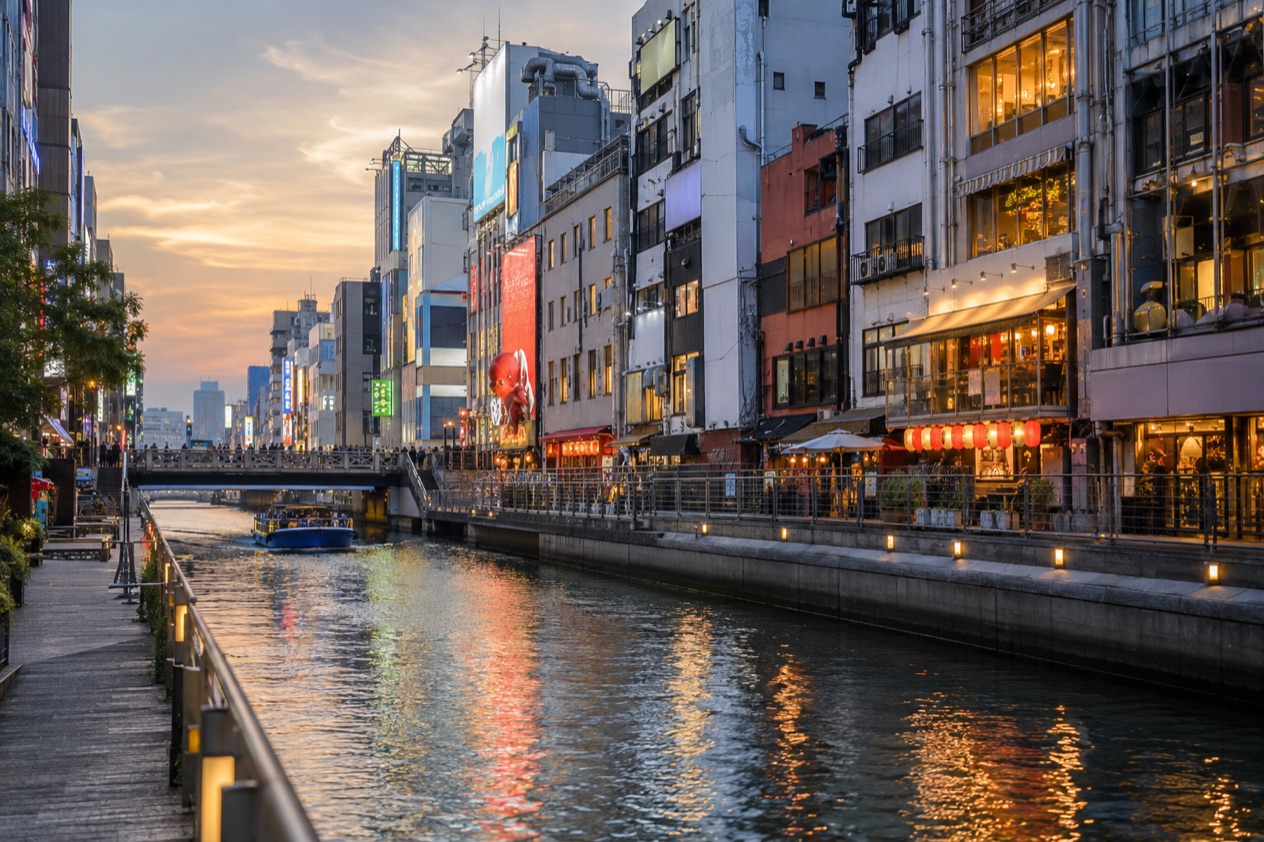
By August the cicadas are loud in the trees around Osaka Castle, and the evening canal at Dotonbori glows with neon and steam from the takoyaki griddles. People carry paper fans, buy shaved ice in colors that look painted on, and drift from air-conditioned arcades back out into the thick night air. It is a hot, humid, lively month in Japan’s big western city, built for eating, wandering after dark and spending the worst of the afternoon indoors.
Osaka feels like a place that has always lived by trade and appetite, and August suits that character. Food stalls, covered shopping arcades and big museums all give you somewhere to go when the sun is too much.
What is the weather like in Osaka in August?
August in Osaka is hot, sultry and sunnier than the months on either side of it, with fewer wet days than July or September.
| Month | Average high (°F) | Average low (°F) | Precipitation (in) | Days with 1 mm or more of precipitation | Hours of sunshine | Daylight on the 15th |
|---|---|---|---|---|---|---|
| July | 89.2 | 76.3 | 6.87 | 10.0 | 184 | 14 h 17 min |
| August | 92.7 | 78.4 | 4.45 | 7.2 | 222 | 13 h 30 min |
| September | 85.1 | 71.4 | 6.02 | 9.5 | 162 | 12 h 27 min |
Honshu summers are described as very humid, hot and sultry, and Osaka fits that description. Nights hardly cool the city, so you will still be warm walking back to the hotel at ten. Humidity stays high, which makes the heat feel heavier than the thermometer suggests, and a shirt that looked fresh at breakfast will not look so by lunch.
Rain is less frequent than in July, yet it still turns up, and the month’s total is nowhere near zero. Plan on a few wet spells rather than a dry stretch, and keep a compact umbrella that doubles as shade. Lightweight, breathable clothes do most of the work here, with something dry to change into if a downpour catches you.
The days are long, with light lasting well into the evening. That leaves room for a late dinner or a slow walk along the river after the worst of the heat has eased, and the city keeps running long after dark.
What to do in Osaka in August
The big date of the month is Obon, the Buddhist custom of honoring the spirits of one’s ancestors. It lasts three days, and people return to ancestral family places and visit and clean their ancestors’ graves. In Osaka you feel it as a change of rhythm around the middle of August, when many residents head to their hometowns and the usual weekday routine loosens.
August is also the season of hanabi, the Japanese word for fireworks. Summer fireworks nights bring out yukata, the light cotton kimono worn for festivals, and food stalls along river banks across the Kansai region. If you see crowds in cotton robes heading the same way at dusk, follow them.
Summer is festival time across the country. The Awa Dance Festival runs from August 12 to 15 in Tokushima Prefecture on Shikoku, where dancers fill the streets, and it is billed as the largest dance festival in Japan. Osaka makes a base for that trip, but it is a different part of the country from the city itself.
Dotonbori, Shinsekai and eating after dark
Osaka’s reputation rests on its food, and August evenings are when the food streets feel at home in the heat. At Dotonbori, along the canal, you can eat takoyaki (battered octopus balls), okonomiyaki (a savory griddled pancake) and gyoza from counters and stalls under giant signs. Shinsekai, a neighborhood of retro neon, is known for kushikatsu, skewers of meat and vegetables dipped in a sauce shared at the table.
The season also asks for cold things. Look for kakigori, the shaved ice drenched in fruit syrup, cold somen noodles on ice, chilled soba and beer served very cold.
Walk first, snack as you go, and sit down for a proper meal once the evening is well along. Shops in urban areas of Japan are generally open from 10:00 a.m. to 8:00 p.m. every day, so a browse through the arcades fits comfortably into the hours before dinner.
Osaka Castle and its park
Osaka Castle is one of the city’s landmarks, and its museum stands 55 meters above the ground with five floors outside and eight stories within. The park around it has broad paths, stone walls and moats, and you pass wide lawns with a good deal of shade from the trees.
In August the sensible shape of the visit is a walk around the grounds and the moats, then time inside the museum, where the exhibits give you something cool to do after the outdoor part. The tower rises above the green of the park and gives the skyline some of its character. From the upper floors you look out across the modern city, a useful reminder that Osaka was the capital of Japan under the name Naniwa from 683 to 745.
Theme parks, aquariums and other indoor days
Super Nintendo World recreates the world of Nintendo games with remarkable quality and scale, and it sits inside Universal Studios Japan. Pack a hat and a bottle of water if you go, and expect to be outside for much of it.
When the heat or the rain wins, Osaka has plenty of roofed space. The covered shopping arcades run for blocks, department stores keep long hours, and the aquarium by the bay offers a cool, dim afternoon among the fish. Museums and the underground shopping streets around Umeda are good for the same reason.
Day trips to Kyoto, Nara and Kobe are also part of the Osaka routine. Kyoto’s temples and Nara’s park of deer are open-air outings, so in August they ask for a hat, water and a slower pace than the same trip would in spring.
A two-day itinerary for Osaka in August
Day 1 starts at Osaka Castle, with the walk through the park and around the moats coming first so the outdoor stretch is done while the day is young. Take the museum next, since it gives you a cool, roofed hour before the lunch break. For lunch, pick a kind of place that serves cold noodles, an okonomiyaki counter or a simple set-meal shop near the park.
In the afternoon move indoors, to the covered arcades and department stores of the Umeda area, or an aquarium visit if you want something longer. Come evening, head to Dotonbori for the canal, the signs and the street food. Stay for dinner there, then walk the bridges when the neon is at full strength and the heat has loosened a little.
Day 2 is for Shinsekai and its kushikatsu counters, followed by a different part of the city’s food life: a long, slow lunch with something chilled, like cold somen or kakigori for dessert. If the weather is dry and you have the energy, spend the afternoon on a day trip to Kyoto or Nara. If rain arrives, the rain card is a covered arcade, a museum or Super Nintendo World, which keeps the day full whatever happens overhead.
End the evening with a fireworks night if one is on, or with an izakaya, a casual Japanese pub, where small plates and cold beer suit the late hours. Osaka stays awake well past dinner, and the long August light makes a slow finish easy.
Is Osaka busy in August?
August in Osaka is a hot-season month, and what shapes the pace of the city is Obon more than any cherry or leaf season. For three days around the middle of the month, people return to ancestral places to visit and clean the graves of their ancestors, and that movement changes how the city feels.
The city’s big attractions work year-round, and the shopping arcades and food streets keep their evening life through the summer. Urban shops are generally open from 10:00 a.m. to 8:00 p.m. every day, which means Osaka does not shut down in the heat. Outside the cities, shops often close earlier, sometimes as early as 6:00 p.m., which is worth remembering on a day trip.
There is one more thing to remember about the calendar. When a national holiday falls on a Sunday, the next working day becomes a public holiday, and a day falling between two other national holidays also becomes one. Those rules can add an extra day off around a holiday and change how a long weekend feels.
The practical result is a month where the pace follows the sun. Mornings and evenings are for walking, the middle of the day for roofed places, and the nights stay lively with food and light.
What to pack for Osaka in August
Pack for heat, humidity and the odd downpour, with clothes that dry fast and shoes you do not mind getting wet.
- Light, breathable shirts, because the humidity makes cotton and linen far more comfortable than heavy fabrics.
- A compact umbrella, which works against both showers and strong sun on the castle grounds.
- A hat and sunglasses for the park and day trips, where there is less shade than in the arcades.
- A reusable water bottle for long walks between the food streets.
- A spare shirt in a daypack, for evenings after a long day in the heat.
- Comfortable walking shoes that cope with wet pavement.
Good to know before you go
August sits in the hot, sultry part of the Japanese year, and the weather is the main thing to plan around. Rain in the month can arrive in sudden spells, so keep an indoor option in your day. Obon, lasting three days, is the main holiday period, and a national holiday that falls on a Sunday moves to the next working day.
The Osaka e-Pass gives free admission to more than 25 tourist spots with one QR code, but it does not include transportation. The Enjoy Eco Card is a one-day pass for unlimited travel on all Osaka Metro and Osaka City Bus lines, excluding some buses. It does not cover buses to IKEA Tsuruhama, Universal Studios Japan, airport buses or on-demand buses.
| Pass | Category | Amount |
|---|---|---|
| Enjoy Eco Card | Adult | 820 yen |
| Enjoy Eco Card | Adult, weekends and holidays | 620 yen |
| Enjoy Eco Card | Child | 310 yen |
Osaka in August vs July and September
Moving the trip four weeks earlier brings you to July, when the days run longer and the rain falls more often. The wetter weather makes the humidity feel more oppressive and gives you more gray afternoons, while the summer festival season is in full swing. You trade a sunnier August for more cloud and showers.
Four weeks later, in September, the highs ease and the nights cool a little, though the rain returns more often than in August and the daylight shortens. The Obon days are behind you, and the heat is less intense for long days of walking, which suits anyone who wants to do more on foot. Mount Fuji’s climbing season also ends in early September, which matters if you pair Osaka with an ascent.
Choose August if you want the sunniest of the three months and the festival mood of summer, with the food streets at full volume in the evening. Shift to September if the heat is a worry and you prefer cooler nights. Stay with July only if you want the longest days and are comfortable with the extra rain.
Is August a good time to visit Osaka?
Yes, for travelers who love food, neon and summer festivals and can live with heat and humidity. August rewards people who eat their way through the city, who are happy to spend the afternoon in an air-conditioned museum or arcade, and who like the idea of Obon and fireworks nights. It suits families heading for the theme parks as well.
It is a poorer fit for anyone who struggles with sultry weather or wants long outdoor days of sightseeing. Those travelers will do better in a cooler month.
On arrival, the airport to the city is covered by the JR Kansai Airport Rapid and Nankai Railways, along with limousine buses, with a ride of approximately 40 to 60 minutes. From there, start with a cold drink and a walk to the nearest canal or park, then let the evening decide the rest. What stays with you about August in Osaka is the evening: canal reflections, hot griddles, cold beer and a city that stays awake long after dark.
Sources
- Japan Meteorological Agency (JMA), Normal values 1991-2020, monthly (https://www.data.jma.go.jp/stats/etrn/view/nml_sfc_ym.php?prec_no=62&block_no=47772), station Osaka, elevation 23 m, checked October 11, 2026
- Computed from the date and the latitude of the place (sunrise equation, solar elevation -0.833 degrees), October 11, 2026
- Japan National Tourism Organization, shop and attraction hours, national holidays (https://www.japan.travel/en/plan/business-hours-and-holidays/), checked October 11, 2026
- Wikipedia, Obon (https://en.wikipedia.org/wiki/Obon), checked October 11, 2026
- Wikipedia, Public holidays in Japan (https://en.wikipedia.org/wiki/Public_holidays_in_Japan), checked October 11, 2026
- Japan National Tourism Organization, summer in Japan (https://www.japan.travel/en/guide/summer-guide/), checked October 11, 2026
- Japan National Tourism Organization, festivals and events (https://www.japan.travel/en/see-and-do/festivals-and-events/), checked October 11, 2026
- Wikipedia, Hanabi (https://en.wikipedia.org/wiki/Hanabi), checked October 11, 2026
- Japan Meteorological Agency, Emergency Warnings (https://www.jma.go.jp/jma/en/Emergency_Warning/ew_index.html), checked October 11, 2026
- Japan National Tourism Organization, safety information (https://www.japan.travel/en/japan-safe-travel-information/), checked October 11, 2026
- Japan National Tourism Organization, weather and seasons in Japan (https://www.japan.travel/en/plan/weather/), checked October 11, 2026
- Wikipedia, Awa Odori (https://en.wikipedia.org/wiki/Awa_Odori), checked October 11, 2026
- Wikipedia, Climate of Japan (https://en.wikipedia.org/wiki/Climate_of_Japan), checked October 11, 2026
- Japan National Tourism Organization, Mount Fuji guide (https://www.japan.travel/en/fuji-guide/), checked October 11, 2026
- Official website for Mt. Fuji climbing, about the climb (https://www.fujisan-climb.jp/en/about/), checked October 11, 2026
- Wikipedia, Nebuta (https://en.wikipedia.org/wiki/Nebuta), checked October 11, 2026
- Osaka official tourism guide, FAQ (https://www.osaka-info.jp/en/information/osaka-faq/), checked October 11, 2026
- Osaka official tourism guide, travel passes (https://www.osaka-info.jp/en/information/ticket/travel-passes/), checked October 11, 2026
- Wikipedia, Osaka (https://en.wikipedia.org/wiki/Osaka), checked October 11, 2026
- Wikivoyage, Osaka (https://en.wikivoyage.org/wiki/Osaka), checked October 11, 2026
To plan your stay
- Things to Do in Osaka: Osaka Castle, Dotonbori Street Food, Universal Studios Japan and Day Trips
- Where to Stay in Osaka: Kita, Minami, Tennoji, the Castle Area and the Bay
- Osaka from Tokyo: Shinkansen Services, Shin-Osaka Station and Where to Go on Arrival
- Know Before You Go to Osaka: Entry, Money, Getting Around, Weather and Etiquette