
ALGARVE · DAY TRIPS · 37.0° N
By the second morning the beach in front of your rental has been thoroughly investigated, and the question turns to what a single day can reach from it. The Algarve makes that harder than it looks. The coast runs about 150 km, the west end takes the full Atlantic while the east end dissolves into a lagoon, and a base in Albufeira sits between two completely different days out.
The shape of a day here is decided before you leave the hotel. The cave everybody wants is now entered under maritime regulation, timed to the minute, with the swim-in banned outright. And lifeguard cover is fixed by law council by council, which means a May or October swim is supervised in exactly one place on the coast.
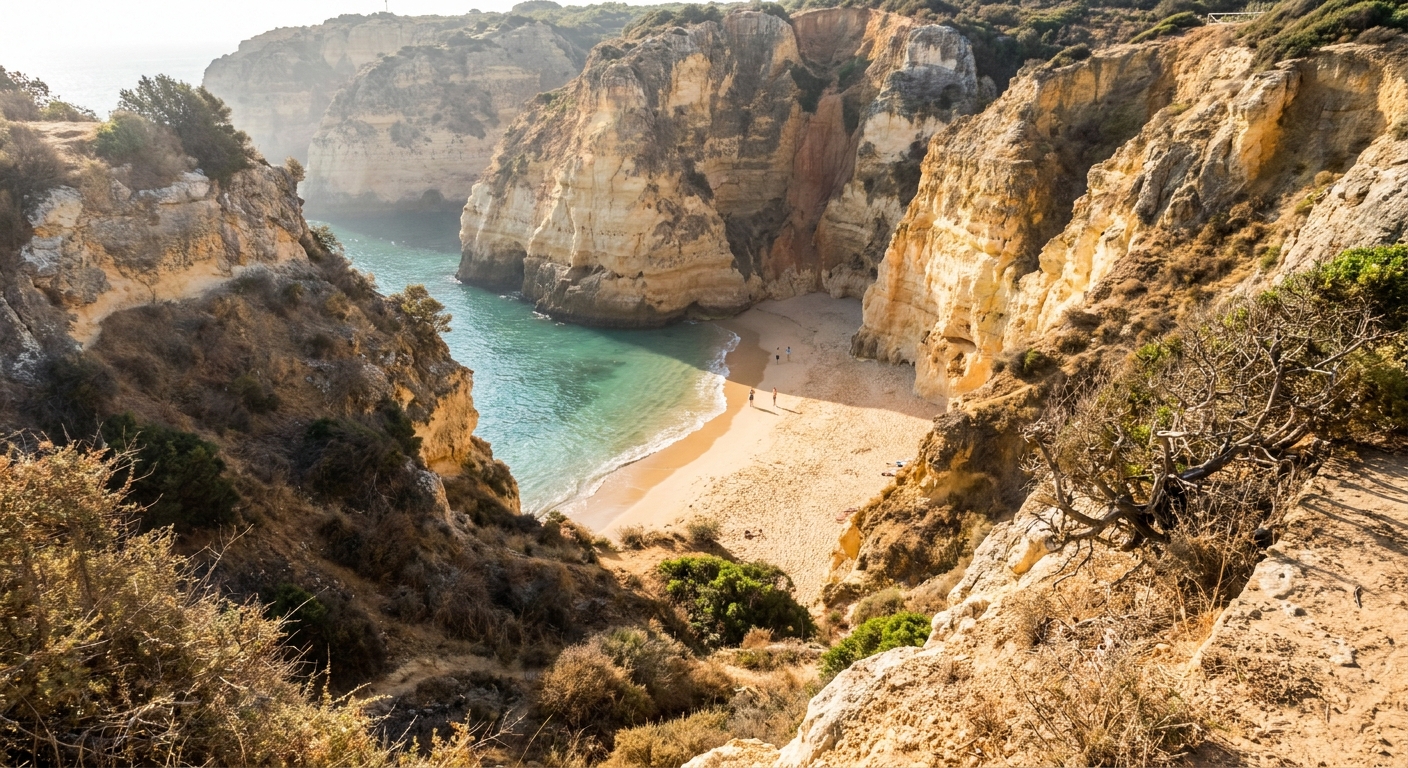
THE DAY TRIPS AT A GLANCE · ALGARVE
Pick one direction a day: west for the cape and the cave, east for the lagoon ferries, north into the hills when the wind cancels the beach.
LIFEGUARDS: ALBUFEIRA 15 MAY TO 15 OCT · MOST COUNCILS 1 JUN TO 30 SEP · DRIVE TIMES NOT READ AT SOURCE
Go for: the sea arches at Benagil with a licensed paddle guide, the southwest corner of Europe at Cape St Vincent, barrier-island sand reached only by boat, and a castle town inland that no swell can ruin.
Think twice before: driving to Seville and back in one day, or booking the cave for your last morning: the entry is skipped whenever the Atlantic is up.
Lifeguard season: Diário da República · Cave rules: Autoridade Marítima Nacional · Normals: IPMA station 554 Faro · full sources at the end
On this page
- Benagil cave without swimming inHow long you can stay inside the cave
- Cape St Vincent and the fortressHours 09:30 to 17:30, and the price we could not read
- Sand islands by ferryRia Formosa from Faro and Tavira
- A day inland from the beachSilves castle and the Monchique hills
- Is Seville doable in a day?The border, the clock and the missing drive time
- When do the boats stop for winter?The lifeguarded season, council by council
- Where to sleep for these tripsWhich base puts you nearest each trip
Every figure here that describes weather comes from one thermometer: IPMA station 554 at Faro, 5.0 m, at the eastern end of that 150 km coast. It reads the east, not the cape and not the hills, where high ground runs colder and far wetter. Drive times are missing on purpose, because we could not read them at a source a machine can check. Ask the rental desk, which quotes them daily.
Benagil cave from the Algarve: how to get in
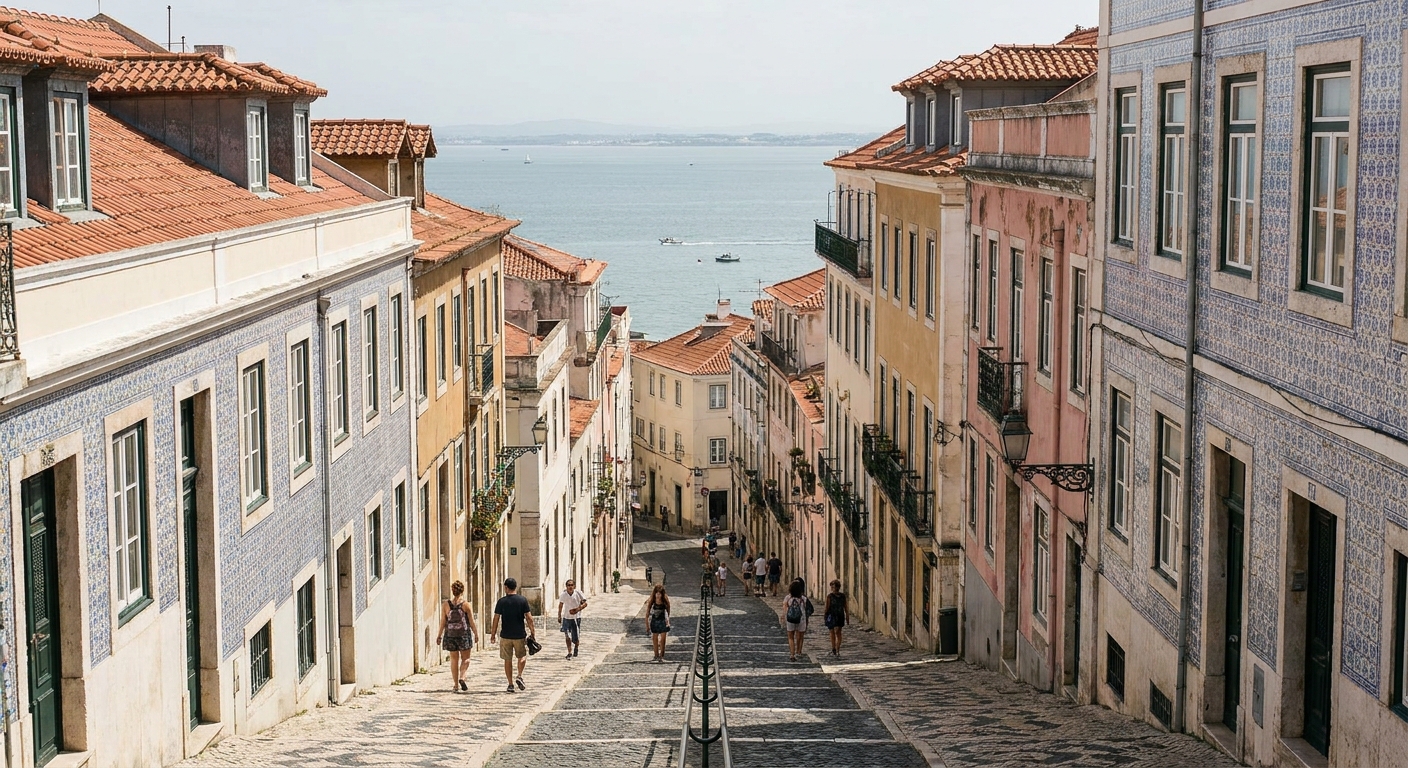
Swimming into the sea cave is over. The national maritime authority’s Edital 019/2024, in force since 13 August 2024 and amended by Edital 009/2025, bans swimming in from the beach or from a boat, with or without a float, and bans boats and kayaks from landing on the sand inside. The guide requirement falls on the paddlers: kayaks and paddleboards enter with a licensed guide, and renting one to go in alone has been off the table since July 2025. The cave’s own page carries the rules in full.
So there are two ways in, both metered. A guided paddle group gets up to eight minutes inside, with a cap on how many craft share the chamber at once. A motorized tour boat gets two, stays 15 meters off the arches and goes in by the western arch, while paddlers use the eastern one. Operator prices and departure times are not something we read at source, and neither is the drive from your base. Both come from the harbor desk at Portimão or Carvoeiro, in one question.
The swell decides the rest of it. On a day when the Atlantic is working, the boats still run the cliffs and the entry is simply skipped, and those timed minutes inside become a pass by the arch from open water. That outcome is ordinary rather than rare, which is the argument for booking the cave on your first free morning instead of your last.
Sagres and Cape St Vincent: the fortress and what it costs
The Fortaleza de Sagres opens 09:30 to 17:30, with the last entry half an hour before closing, and one ticket covers the fortress and the walk out across the promontory. Sundays and public holidays are free until 14:00, though only for people resident in Portugal: a visitor pays. The full adult price is the number we could not read. The monument’s own page serves its price table in JavaScript and the regional ticket shop was unreachable when we tried, so ask at the gate.
Past the walls the land runs out. Cape St Vincent is the southwest corner of Europe, a lighthouse on a cliff with nothing but ocean beyond it, and the wind up there behaves like a separate climate from the sheltered cove you left after breakfast. Faro’s thermometer, 150 km away at the other end of the coast, has nothing useful to say about it. Bring a layer you would not have packed for a beach week.
From a central base such as Albufeira or Lagos this is the long westward run, and the one we cannot time for you. The A22, the motorway that runs the length of the province, is reported to have been toll-free since 1 January 2025, but we could not confirm that on an operator or government page a machine can read. Check it before you drive. Your rental desk answers the drive time and the toll question together.
Sunset is the reason to stay past closing. On July 15 the sun rises at 06:23 and sets at 20:52 Lisbon time, roughly 14 hours 30 minutes of daylight. On January 15 the same calculation gives 07:42 and 17:39, about 9 hours 57 minutes. Both are computed at the coast’s eastern end, so the cape goes dark a touch later than the clock says. Either way the fortress shuts at 17:30, and the sunset is a second stop.
Ria Formosa island ferries from Faro and Tavira
East of the cliffs the coast turns into lagoon, and the beaches move offshore onto barrier islands: Ilha Deserta and Ilha do Farol out of Faro, Ilha de Tavira out of Tavira. The crossing is the outing. You get sand with water on both horizons, a boardwalk, a beach bar, and no way off until the boat returns, which is either the appeal or the problem. Faro and Tavira councils both run lifeguards from 1 June to 30 September, so a crossing outside that window is an unsupervised swim.
Timetables and fares are a gap. We did not read a ferry schedule or a ticket price at source for either town, and the sailings shift with the season, so no number goes here. Ask at the ticket window on the quay itself, or at the tourist office the evening before. The figure that governs the whole day is the last boat back.
Silves and the Algarve interior in a day
When the coast saturates, the inside of the province is where the crowd is not. The land climbs off the coast road into orange groves, cork oak and the Arade valley, and the towns up there keep ordinary prices for a coffee. Silves is the anchor: a hill town under a red sandstone castle, once the Moorish capital of this whole region.
The Faro station reads an average high of 84.9°F in July and 61.3°F in January, with an average low of 67.3°F and 46.9°F. Those are coastal readings at 5.0 m, and we did not read a station in the hills, where the pattern turns colder and far wetter. For the seasonal picture take the month pages, which set it out in full for July and January.
The castle is the visit: walls you walk, a cistern underneath, the cathedral next door and the Cruz de Portugal, a carved stone cross on the edge of the old center. The Arade riverbank and the municipal market supply lunch. Push further and Monchique adds hill villages and spa water, while Loulé, on the other axis, has its covered market building and a Saturday crowd of locals.
A north wind or a heavy swell wrecks a beach day and does nothing at all to a fortress. That is why this trip belongs in the plan before you need it. The morning the Benagil boats cancel their entry is the morning the interior earns its place, and it asks for no booking and no sea state.
What you give up inland is supervised swimming. Silves council does hold a strip of coast, and its listed beaches carry lifeguards from 1 June to 30 September, but that cover sits down on the shore, not up the valley. No ferry, no sea cave, no boat tour, and no lifeguard anywhere in sight of the castle.
Can you day-trip to Seville from the Algarve?
Seville is in another country. You cross the Guadiana at the eastern end of the coast, past Castro Marim, into Spain, which does not keep Portuguese time. Every opening hour, lunch service and return departure you plan over there runs on the Spanish clock, and the shift works against you in both directions. There is no routine border check for most travelers, and the Schengen entry rules apply on either side of the river.
What the day costs in road hours, we cannot tell you: no source we could read gives the drive time, and the A22’s toll status since 1 January 2025 is reported rather than confirmed. Ask the rental desk or the bus operator’s counter before committing a whole day. The light, at least, has a number. On January 15 the sun is up at 07:42 and gone by 17:39 at this end of the coast, and a round trip to Spain spends most of that on asphalt.
When do Algarve boat trips stop running?
The lifeguarded season is set by law, beach by beach, and it is not one season. For 2026 the official gazette puts Albufeira at 15 May to 15 October across its 25 listed beaches, while Lagos, Lagoa, Loulé, Faro, Olhão, Tavira, Silves, Aljezur and Vila do Bispo all run 1 June to 30 September. One beach in Castro Marim is shorter again, 1 July to 31 August. The same order designates which beaches count as bathing beaches at all, and any beach left off the list had no assured cover when it was published.
Boat operators are not bound by that calendar, and we did not read their winter dates at source, so a December trip starts with a phone call to the harbor. What the law does settle is the swim. Through May and October, Albufeira is the only council on the coast with lifeguards on duty, whatever the water says, and the water says 66.8°F in July against 62.0°F in January, measured as the mean of daily maxima offshore over 2015 to 2024. Bathing-water quality during the season is published by the national environment agency.
Some of the famous names are not day trips from this coast at all. Sintra and Óbidos are outings from a Lisbon base, the Douro Valley belongs to Porto, and Madeira and the Azores are flights with hotel nights attached. What the Algarve reaches in a day is its own shoreline plus the hills behind it. In January, plan that around the light: sunrise at 07:42, dark by 17:39 at the eastern end, and rain on 6.0 days in an average month, counted at the national service’s 1 mm threshold rather than the 0.10 inch one US tables use.
Sources & data for this guide
- Lifeguarded season 2026, council by council · Diário da República, Portaria n.º 204-A/2026/1 of 30 April 2026, annex I · checked Sep 10, 2026
- Bathing-beach designation and water-quality publication · same order, article 2 and annex II note · checked Sep 10, 2026
- Benagil cave rules, timed stays, end of unguided rentals in July 2025 · Autoridade Marítima Nacional Edital 019/2024, amended by Edital 009/2025, relayed via Capitania do Porto de Portimão · the edital’s own text was not read here · checked Sep 10, 2026
- Fortaleza de Sagres hours and resident free-entry rule · Monumentos do Algarve / DRC Algarve official listing · the adult ticket price is served in JavaScript and was NOT read, and loja.cultalg.gov.pt was unreachable · checked Sep 10, 2026
- A22 toll status since 1 January 2025 · reported, not confirmed: vialivre.pt and Infraestruturas de Portugal serve their pages in JavaScript · attempted Sep 9, 2026
- January and July normals, rain-day counts at the 1 mm and 10 mm thresholds · IPMA 1991-2020, station 554 Faro, 5.0 m · checked Sep 10, 2026
- Sea surface temperatures, mean of daily maxima 2015-2024 · Open-Meteo Marine API · checked Sep 10, 2026
- Sunrise, sunset and daylight on the 15th, converted to Europe/Lisbon · sunrise-sunset.org · checked Sep 10, 2026
- Drive times, ferry timetables and boat-tour fares are deliberately absent: we found no source for them that a machine can read · ask at the quay or the rental desk.