
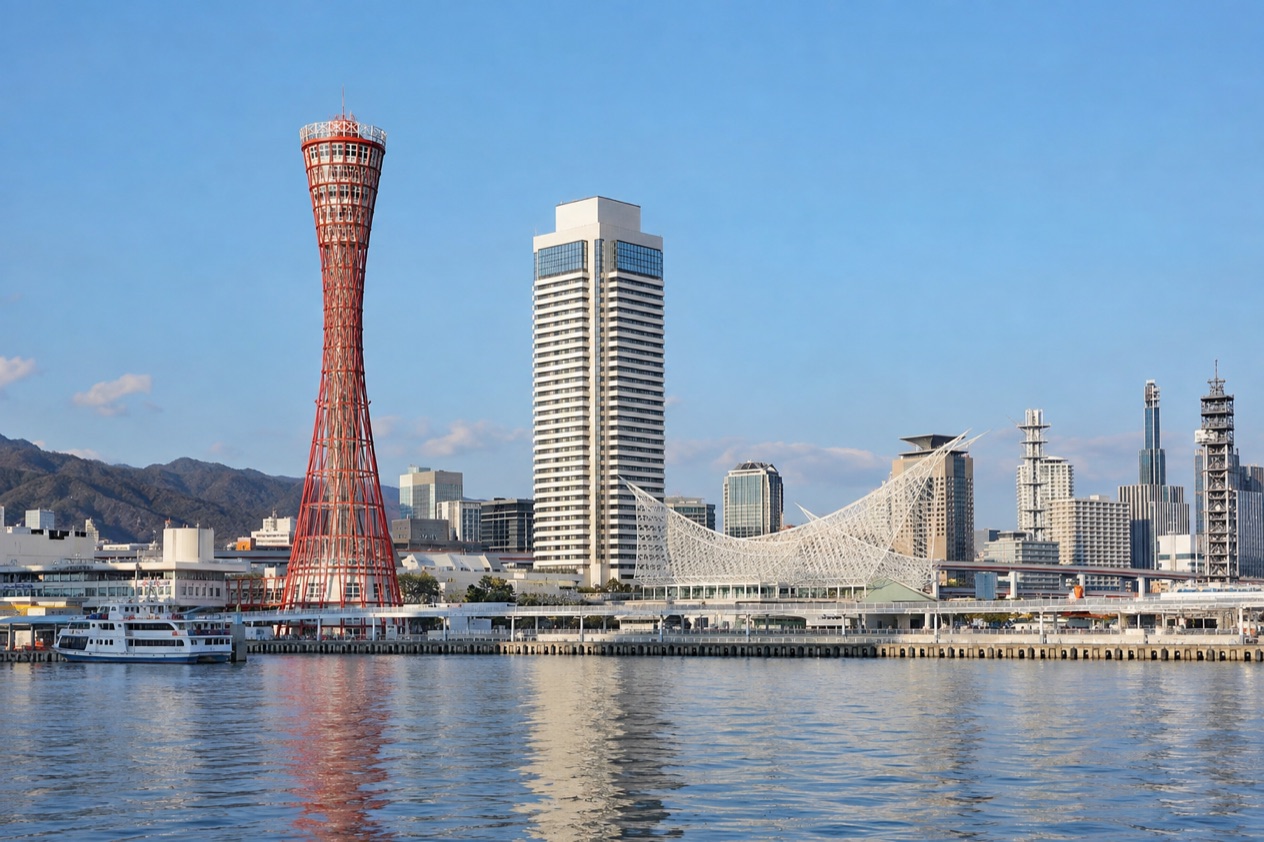
Ships sound their horns out on Osaka Bay, gulls wheel above the red lattice of the Kobe Port Tower, and the glass-fronted malls along the quay catch the light off the water. Kobe Harborland is the city’s waterfront playground, a district built for strolling, shopping, eating and watching the harbor change color as the day goes on. It suits anyone who wants an easygoing few hours by the sea in a port city, with Kobe’s history close at hand.
Is visiting Kobe Harborland worth it?
Yes, if you like a waterfront that mixes shopping, food, harbor views and a little history, and it fits couples, families with young children and travelers who want a break from temples. It is less a single sight than a stretch of shore where you drift from one thing to the next, with a mall on one side and the bay on the other.
What sets it apart from other waterfronts in the Kansai region is the city behind it. Kobe is a port city, the third largest in Japan after Tokyo and Yokohama, and Harborland is where that seafaring character shows.
You see the tower built for the port, a museum devoted to its maritime story, and a memorial that keeps a piece of the shoreline as it was left by the 1995 earthquake. Across the bay lies Osaka, whose own waterfront has a different mood.
The district also pairs well with the rest of Kobe. Kobe beef, which takes its name from the city, is a reason people come, and Harborland has the kind of dining streets where you can sit down to a meal after a walk. If you want shrines, hot springs or mountain views, they sit elsewhere in the city, so Harborland works best as the relaxed part of a Kobe day rather than the whole of it.
What to see at Kobe Harborland
Mosaic and the shopping malls
Mosaic is the lively heart of Harborland, a waterfront complex of shops, cafés and restaurants with terraces facing the bay. The architecture is meant to feel like a European harbor town, with warm lighting, boardwalks and little squares, and that fits a city that opened early to foreign trade. A Ferris wheel turns beside it and gives you a different angle on the harbor and the city’s hillside.
Beyond Mosaic, the neighboring umie malls add fashion, household goods and food courts, and the restaurants range from casual noodle counters to sit-down dinners with a view. This is a good place to try Kobe’s local flavors, from beef to the bakeries and sweets that the city is known for. Come hungry and let your plans stay loose.
Kobe Port Tower and Meriken Park
The red steel tower, with its curved, hourglass profile, is the shape people associate with Kobe’s waterfront. It stands in Meriken Park, a wide green promenade that runs out to the water and gives you open sky, a view back at the city and the mountains behind it. The park is a place to walk slowly, sit on the edge of the quay and watch ferries and ships move across the bay.
At night the tower is lit and its reflection spreads across the harbor, which draws couples and photographers. Mount Rokko rises behind the city, and in autumn its forests are known for their rich change of colors, so a clear day at the park can include a glimpse of that hillside above the rooftops.
Kobe Maritime Museum and the earthquake memorial
Near the tower, the Kobe Maritime Museum has a white roof shaped like the sails of a ship, so it reads as a ship from far away. Inside, the displays follow the port’s growth and the ships that shaped it, with models that make the story easy to picture. It suits anyone curious about why Kobe became a gateway to the world.
On January 17, 1995, a magnitude 6.9 earthquake struck near Kobe, and the memorial keeps a section of the damaged waterfront as it was left, with cracked and tilted paving and lamp posts. It is a quiet, serious corner of an otherwise cheerful district, and it explains why the city lights up every December for the Luminarie, the illuminated archways that mark its recovery.
Anpanman Children’s Museum and Mall
Families with young children will recognize Anpanman, the bread-headed hero of a long-running Japanese cartoon and picture-book series. The museum and the shopping mall around it are set up around his world, with play areas, characters and a shop stocked with themed goods and sweets.
Even if your children do not know the show, the bright colors and hands-on rooms hold attention. Adults who are not traveling with kids can skip it without missing the rest of the district, which carries on perfectly well along the waterfront.
How to get to Kobe Harborland
You reach Harborland by first reaching Kobe, and the city has good links for that. Kobe sits in the Kansai region on the north shore of Osaka Bay, across the water from Osaka. The city center lies about 22 miles west of Osaka and about 43 miles southwest of Kyoto, which makes it a straightforward addition to a Kansai itinerary based in either city.
By Shinkansen and rail
The JR West Sanyo Shinkansen stops at Shin-Kobe Station, and Kobe is directly connected to Tokyo by the JR Tokaido and Sanyo Shinkansen. The journey from Tokyo to Shin-Kobe Station takes between 2 hours 40 minutes and 3 hours 15 minutes.
Within the city, Sannomiya Station is the main transport hub, the transfer point for the major intercity rail services. For visitors it is the natural base for sorting out the last leg toward the waterfront, and the area around it holds shops, restaurants and hotels.
By air
Kobe Airport stands on a reclaimed island south of Port Island and handles mostly domestic and charter flights. Kansai International Airport in Osaka mainly serves international flights in the area, so travelers arriving from the United States will most likely land there and continue to Kobe by land.
Once you are in Kobe, the waterfront is where the city meets the bay, so you can follow the sea and the signs for the port. Plan the transfer from your hotel or from Sannomiya on the day, using the station maps and signs.
When to visit Kobe Harborland
Autumn and spring are the gentlest seasons for a waterfront stroll. Mid-October, for example, brings highs in the low 70s and cooler evenings, with plenty of sunshine between a few rainy days. That is comfortable for walking the length of Meriken Park, sitting on a terrace or riding the Ferris wheel without feeling the heat.
| Month | Average high (°F) | Average low (°F) | Rain days | Precipitation (in) | Sunshine (hours) |
|---|---|---|---|---|---|
| January | 48.9 | 37.6 | 4.7 | 1.51 | 146 |
| April | 66.0 | 52.5 | 9.0 | 3.96 | 195 |
| July | 86.7 | 76.5 | 10.0 | 7.40 | 189 |
| October | 73.8 | 62.1 | 7.8 | 4.65 | 170 |
Seasons by the water
Spring is mild, with temperatures in Kobe averaging between 50°F and 68°F from March to May. April brings rain on about a third of its days, so a day at Harborland can mix open air with indoor stops in the malls and museums.
July is hot and humid, and the rain days are frequent. The waterfront can feel heavy then, but the malls are an indoor refuge and the evening breeze off the bay helps. Winter is the cold season, with January the coldest of the months in the table, and a coat is useful on the open quay.
Special dates
In December the city holds the Luminarie, an event to commemorate Kobe’s recovery from the 1995 earthquake, when the city center is decorated with illuminated metal archways. It is held in the city center rather than at the harbor, but it makes a December trip to Kobe more memorable and fits easily with an evening at the waterfront.
In autumn, Mount Rokko above the city is known for the rich change of color in its forests, so a trip to Harborland in the season can be paired with a look at that hillside from the park.
Tips for your visit
Dress in layers, since the open quay can feel cooler than the streets behind it, and bring a compact umbrella, because rain falls on a good share of days in most months. Comfortable shoes help, as the visit is mostly on foot between the malls, the park and the museums.
Pairing Harborland with the rest of Kobe
Ikuta Shrine, said to have been founded by Empress Jingu in AD 201, is one of the city’s oldest sites and a contrast to the modern shoreline.
Kobe beef is a draw for many diners, and the city is the origin and namesake of the dish, which is raised in the surrounding Hyogo Prefecture. For a different mood, Arima Onsen, one of Japan’s most famous hot spring resorts, belongs to the same city, and a bath there makes a calm counterpart to a day at the harbor.
Families and slower days
With children, the Anpanman museum and the Ferris wheel give the day a focus, and the park gives them room to run. The malls offer places to sit down and rest, which helps on a wet day when the quay is less inviting.
If the weather turns, shift your order: start with the museums and malls, then go out to the park when the rain eases. The tower and the harbor look good in damp, silvery light too, so a gray day does not ruin the visit.
Good to know before you go
Harborland is a place to wander at a slow pace, with shops and restaurants to dip into as you go and the bay as a backdrop. Bring a small bag for purchases, keep an eye on the forecast in the wetter months, and carry layers in winter when the wind off the water can bite.
Typhoon season can bring rough weather to the coast in late summer and early autumn, so a flexible plan helps then. The earthquake memorial is a reminder of the city’s past, and visitors tend to treat it as a place for quiet reflection.
Sources
- Wikipedia, Kobe (https://en.wikipedia.org/wiki/Kobe), checked October 11, 2026
- Japan National Tourism Organization, Kobe (https://www.japan.travel/en/destinations/kansai/hyogo/kobe-and-around/), checked October 11, 2026
- Visit Kobe, the official travel guide (https://www.feel-kobe.jp/en/), checked October 11, 2026
- Japan Meteorological Agency (JMA), Normal values 1991-2020, monthly (https://www.data.jma.go.jp/stats/etrn/view/nml_sfc_ym.php?prec_no=63&block_no=47770), station Kobe, elevation 5 m, checked October 11, 2026