
The first morning in Kanazawa can begin with the sound of gravel under your shoes and the sight of sculpted pines reflected in the ponds. Behind the garden walls stand the pale roofs of a castle that was once the seat of a powerful Edo-period lord. Kanazawa is a city of gardens, craft workshops and old merchant and samurai streets, and three days here let you see its main sights and still have an evening to spare.
Is three days enough in Kanazawa?
Yes, three days is a comfortable length for a first visit, especially for travelers who like gardens, crafts and slow city wandering more than a checklist. Kanazawa sits on a narrow strip of land along the Sea of Japan on Honshu, and during the Edo period it was one of the most important cultural and artistic centers in the country. That heritage is why it belongs to the UNESCO Creative Cities Network as a City of Crafts and Folk Art, and it explains why so much of what you see here is made by hand.
Three days cover the garden and the castle, a contemporary art museum, the old districts and a day outside the city. They leave out the slower pleasures: sitting through a long lunch at a craft workshop, lingering in a second museum, or following the coast. With a fourth or fifth day you could add more of the mountain villages that the Kanazawa Tourist Information Guide builds itineraries around, Gokayama and Takayama among them, or simply spend a day with no plan at all.
The plan below is built for a first trip, with each day gathered around a different part of town so you never cross the city twice. It suits travelers who like to see a few places properly, and it suits couples, friends and solo travelers equally well.
Day 1 in Kanazawa
Start with Kenrokuen Garden, the reason people come to Kanazawa at all. Its name means Garden of Six Attributes, and it is a strolling garden, meant to be seen from a path that keeps changing its mind.
Japanese gardens are designed to feel larger than they are, with sudden turns, changes in the width of the path and layered views, and Kenrokuen uses all of these tricks across its 25 acres. It opened to the public in 1875 and is counted among the three great gardens of Japan, together with Kairaku-en and Koraku-en.
| Site | Open |
|---|---|
| Kenrokuen Garden | 7:00 to 18:00 in summer, 8:00 to 17:00 in winter (mid-October to the end of February) |
It is a large, partially restored flatland castle, which means you see wide walls, gates and lawns rather than a tower on a mountaintop.
Take your time among the stone walls and the restored structures, then drift toward the 21st Century Museum of Contemporary Art, established on October 9, 2004. Its galleries give the day a very different second half, and the building itself is as much a part of the visit as the art.
For the evening, choose a sushi counter or a small seafood restaurant. Dinner can be a sushi counter or a small seafood restaurant, since the city faces the Sea of Japan. A tip for the day: put the garden first, while your energy is highest, and let the museum, which you can pace as you like, take the afternoon.
Day 2 in Kanazawa
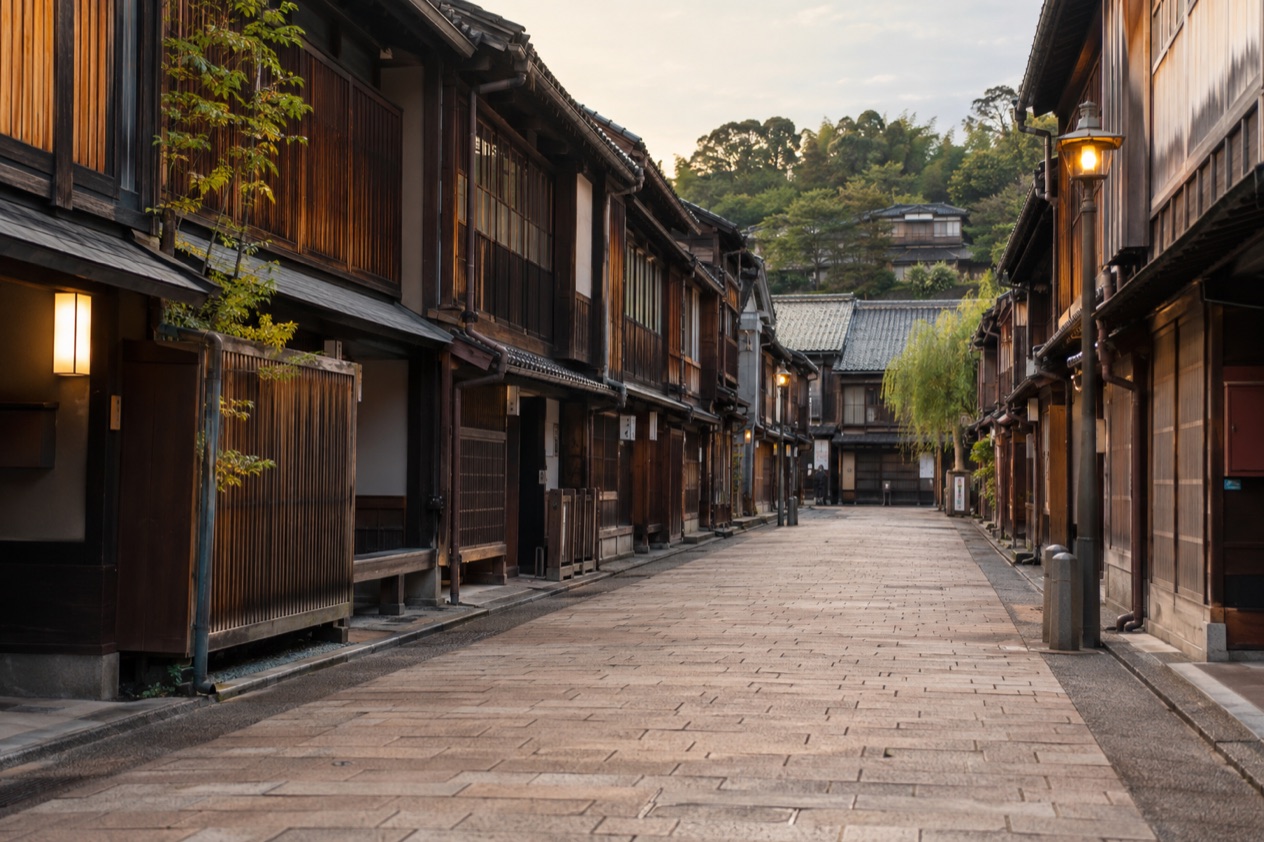
Day 2 turns to the older streets and to the crafts that earned Kanazawa its UNESCO title. A morning in the Higashi Chaya district, with its lattice-fronted teahouses, is a good way to begin, and shops there sell sweets, gold-leaf goods and tea.
Midday is a good time for Omicho Market, the city’s fresh food market, where seafood from the Sea of Japan is the main attraction. Stalls and small counters serve sushi, grilled shellfish and rice bowls topped with sashimi, and it is an easy place to stand and eat before moving on. Afterward, wander the samurai quarter of Nagamachi, where earthen walls line narrow lanes and old residences show how the warrior class lived under the lords of Kanazawa.
In the late afternoon, return to a teahouse for matcha with a seasonal sweet, or visit a small museum devoted to a single craft. Dinner can be an izakaya, a casual Japanese pub, where small plates come one after another and local sake is poured. If you want a quiet end to the day, a walk along one of the city’s rivers does well, and nothing about it needs planning.
Day 3 in Kanazawa
The third day suits an excursion, and the Kanazawa Tourist Information Guide offers sample itineraries from the city to Gokayama, Shirakawa-go and Takayama. These are mountain villages and old towns, a change of scene after two days of gardens and teahouses, and they fit well into a single day out and back. Pick one rather than all three, and let the guide’s sample itineraries set the order of the stops.
Back in Kanazawa for the evening, you have time for the things the first two days left open. A second look at the lit grounds of the castle park and Kenrokuen is one option, since both are illuminated at night. Another is to return to a shop you passed in Higashi Chaya, where a piece of gold-leaf work or Kutani ceramic makes a lasting souvenir of the trip.
For a last dinner, try Kaga cuisine such as jibuni, or choose Kanazawa oden or sushi made with seafood from the Sea of Japan. Finish with a stroll through the lanes you already know. By the third night they feel familiar, and that is the best sign that three days was the right length.
Where to stay for three days in Kanazawa
Staying near Kanazawa Station simplifies arrival and departure on the Hokuriku Shinkansen. Staying close to the station keeps your arrival and departure simple, and the places on Days 1 and 2 are all parts of the same city. A room here also gives you a wide choice of restaurants for the evenings, so you are never tied to the hotel dinner.
Travelers who care more about atmosphere than convenience might prefer a guesthouse or small inn near the teahouse districts or the samurai lanes. These areas put you close to the places that make Kanazawa distinctive. If your plans center on the garden and the castle, a stay near Kenrokuen also works, and it puts the morning of Day 1 almost at your door.
Think about what your three days are for. If it is gardens, history and crafts in an unhurried way, a room near the old districts suits you. If you are arriving by rail late or leaving early for a day trip, the station area is the better choice, and it still gives you everything the plan needs.
What to skip if you only have three days in Kanazawa
The first thing to leave for another trip is a second day excursion. Choose one village, one town or one day out, and keep the rest of the days for Kanazawa.
Skip a second city as well. Kanazawa is reachable from Tokyo on the Hokuriku Shinkansen, from Osaka and Kyoto by the Thunderbird and a transfer, and it is tempting to add a stop in Toyama or Nagano along the way. That can be a trip of its own. On a short stay, the same hours are better spent in Kanazawa’s gardens, markets and lanes.
A third thing to skip is a long museum visit beyond the contemporary art museum and the castle grounds. Kanazawa has many small museums, and trying to see them all turns the plan into an exhausting list. Instead, use the free time for a teahouse, a craft workshop or an evening walk under the illuminated castle park. These small pleasures are what visitors remember from the city.
Finally, leave out any plan that depends on a single day of weather, such as a long outdoor excursion with no fallback. Kanazawa faces the Sea of Japan, and the weather can shift. Keeping the garden and the castle on a flexible day, and the museum and market for a gray one, protects the whole plan.
Getting around Kanazawa in three days
Getting to Kanazawa is the longest leg of the trip. From Tokyo Station it takes approximately 2 hours 30 minutes on the Hokuriku Shinkansen, with stops at Nagano and Toyama. From Osaka or Kyoto, the Limited Express Thunderbird runs to Tsuruga, where you transfer to the Hokuriku Shinkansen, for a total journey of about 2 hours. The nearest airport is Komatsu Airport, in the city of Komatsu.
Once you are in the city, the places of Day 1 sit side by side, since the castle is adjacent to Kenrokuen, so you can walk from one to the other. For the districts of Day 2 and the museum of Day 1, you can travel by road, and an IC card is useful here.
These cards work on trains, buses and boats, and also in vending machines, convenience stores and some taxis. Although most regions have their own cards with different names and characters, they can be used throughout Japan.
For the day trip on Day 3, the guide’s sample itineraries to Gokayama, Shirakawa-go and Takayama describe how to reach each one from Kanazawa. If you are also traveling between Tokyo, Kyoto and Osaka, the JR Hokuriku Arch Pass offers unlimited travel between those cities via Toyama and Kanazawa for seven consecutive days.
Good to know before you go
Kanazawa has a wet side to its climate. In winter, snow or sleet falls on most days of an average January and the sky is often gray, while October brings about a dozen days with rain.
A compact umbrella and a layer you can add or remove make the trip more pleasant in almost any month. Kenrokuen keeps shorter hours in winter, from mid-October to the end of February, so plan the garden early in the day in those months.
An IC card in your wallet takes care of small payments, from vending machines to convenience stores. The garden, the castle grounds and the old districts are places where people walk slowly and speak quietly, and following that rhythm makes the visit more pleasant.
Sources
- Japan National Tourism Organization, Kanazawa (https://www.japan.travel/en/destinations/hokuriku-shinetsu/ishikawa/kanazawa-and-around/), checked October 11, 2026
- Kanazawa Tourist Information Guide (https://www.kanazawa-tourism.com/), checked October 11, 2026
- Wikipedia, Kanazawa, Ishikawa (https://en.wikipedia.org/wiki/Kanazawa,_Ishikawa), checked October 11, 2026
- Wikivoyage, Kanazawa (https://en.wikivoyage.org/wiki/Kanazawa), checked October 11, 2026
- Japan National Tourism Organization, Japanese gardens (https://www.japan.travel/en/see-and-do/japanese-garden/), checked October 11, 2026
- Wikipedia, Kenroku-en (https://en.wikipedia.org/wiki/Kenroku-en), checked October 11, 2026
- Wikipedia, Kanazawa Castle (https://en.wikipedia.org/wiki/Kanazawa_Castle), checked October 11, 2026
- Wikipedia, 21st Century Museum of Contemporary Art, Kanazawa (https://en.wikipedia.org/wiki/21st_Century_Museum_of_Contemporary_Art,_Kanazawa), checked October 11, 2026
- Japan Meteorological Agency (JMA), Normal values 1991-2020, monthly (https://www.data.jma.go.jp/stats/etrn/view/nml_sfc_ym.php?prec_no=56&block_no=47605), station Kanazawa, elevation 6 m, checked October 11, 2026
- Japan National Tourism Organization, IC cards, Suica, Pasmo, ICOCA, how to use (https://www.japan.travel/en/plan/ic-card/), checked October 11, 2026
- Japan National Tourism Organization, Japan Rail Pass and regional passes (https://www.japan.travel/en/plan/jr-rail-passes/), checked October 11, 2026
To plan your stay
- Best Time to Visit Kanazawa: Cherry Blossoms, Autumn Color, Winter Snow and Festivals
- Where to Stay in Kanazawa: Station Area, Tea House Streets, Downtown and Ryokan Choices
- Kanazawa from Tokyo: Hokuriku Shinkansen, Komatsu Airport and a Day in the Gardens
- Know Before You Go to Kanazawa: Entry, Money, Getting Around and Local Etiquette