
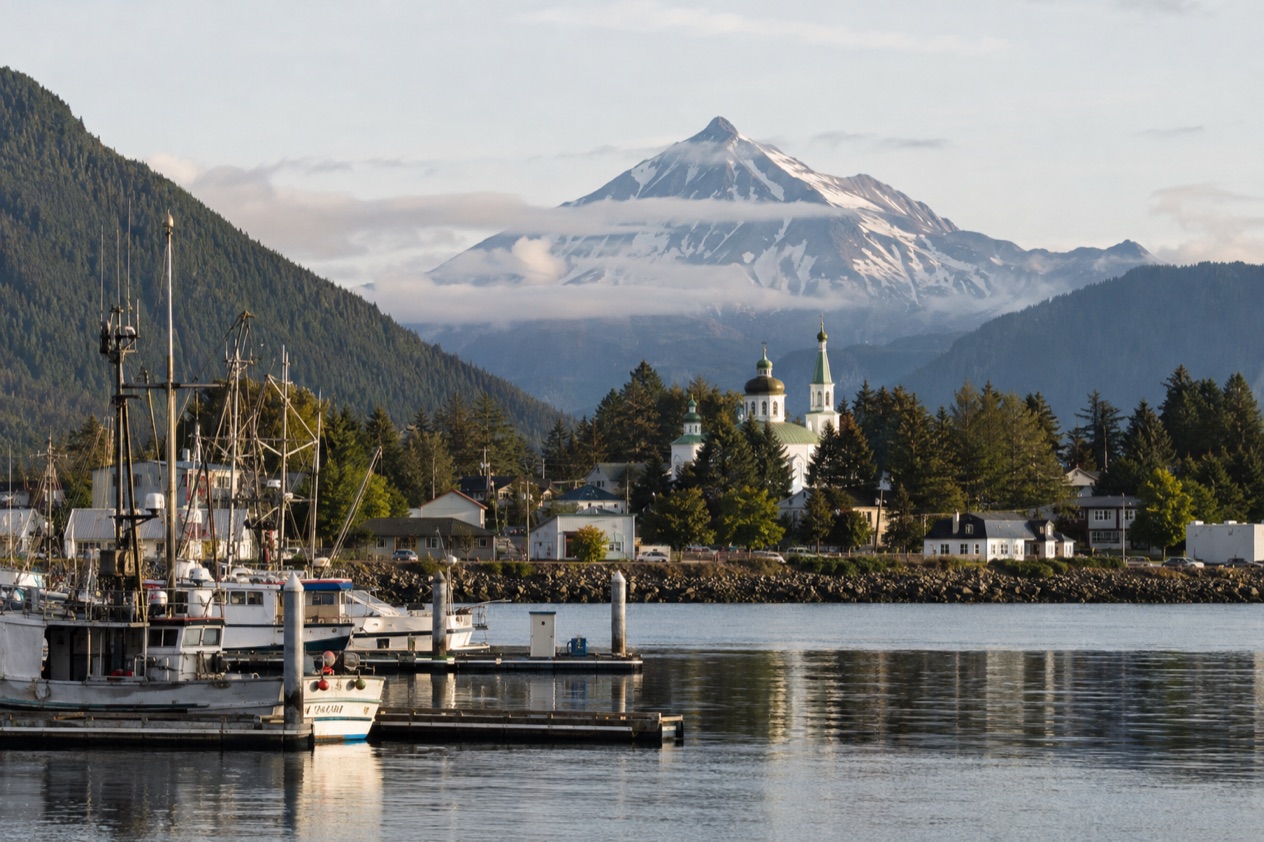
Rain drums on the hemlocks, the totem poles along the Indian River path turn dark and glossy, and the Russian Bishop’s House stands plain and square against a wall of wet green. Sitka lives with its weather rather than around it, and the year here swings between long bright evenings, a soaked and salmon-rich fall, and a dim, mild winter. This is a town on Baranof Island, reached only by air and by sea, and each season gives it a different face.
When is the best time to visit Sitka?
Late spring through summer, roughly May to August, suits most trips to Sitka, because the days are long, the temperatures are at their mildest and the rain is lightest in early summer. If you want to see the town on foot, with time left after dinner for another walk, this is the stretch to aim for.
For sightseeing, the draw is Sitka National Historical Park, where wooded pathways wind among totem poles obtained from Haida and Tlingit carvers, and the Russian Bishop’s House, a historic house museum with a furnished second floor. These can be visited in any month, but a long, dry-ish day lets you linger on the forest trail, watch the tidelands for sea stars and crabs, and then cross town to the museum without racing the dusk.
For wildlife and parks, timing is about nature’s calendar. Salmon swim up the Indian River during spawning season, and the Alaska Raptor Center, a sanctuary in the Tongass National Forest, takes in injured birds and gives you a close look at eagles and owls whatever the weather. Sightings in the wild are chances, never promises, so build your days around places rather than animals.
The quiet seasons have their own pull. Late fall and winter are for travelers who like moody light, steaming coffee and museum afternoons, and who accept that rain is part of the deal. Families can plan around indoor stops such as the raptor sanctuary and the Bishop’s House, with rain gear for everyone, which the National Park Service recommends at any time of year.
Sitka weather by month
Sitka has a humid maritime climate with heavy precipitation and a small temperature range from season to season, and the airport figures give the shape of the year.
| Month | Average high (°F) | Average low (°F) | Precipitation (in) | Days with precipitation | Daylight on the 15th |
|---|---|---|---|---|---|
| January | 40.5 | 32.4 | 8.22 | 15.4 | 7 h 21 min |
| February | 41.2 | 32.1 | 5.93 | 11.6 | 9 h 27 min |
| March | 42.5 | 32.5 | 5.60 | 12.6 | 11 h 42 min |
| April | 48.1 | 37.2 | 4.31 | 10.5 | 14 h 12 min |
| May | 53.3 | 43.0 | 3.81 | 9.7 | 16 h 27 min |
| June | 57.6 | 48.3 | 2.92 | 8.8 | 17 h 51 min |
| July | 60.4 | 52.5 | 4.62 | 11.4 | 17 h 19 min |
| August | 61.8 | 52.9 | 7.25 | 13.3 | 15 h 19 min |
| September | 57.9 | 48.5 | 11.69 | 17.5 | 12 h 54 min |
| October | 50.8 | 41.9 | 11.78 | 19.1 | 10 h 30 min |
| November | 44.3 | 35.8 | 9.91 | 17.0 | 8 h 09 min |
| December | 41.5 | 33.4 | 8.43 | 16.1 | 6 h 46 min |
The year has two clear halves. Highs reach only the low 60s even at the warmest, so a fleece and a waterproof shell belong in the bag in every month.
From September to December the picture changes. Rain falls on most days, often in steady, gray spells, and the late-fall months are the wettest of the year.
Winter highs sit in the 40s and lows hover near freezing, so you need warm layers more than heavy parkas, and the town sees some snow, with seasonal totals around thirty inches. Daylight in December is brief, so plan outdoor stops for the middle of the day and keep evenings for restaurants and museums.
What is there to do in Sitka in each season?
Summer: long days on the water and in the forest
Summer is the season for being outside from morning to late evening. Sitka National Historical Park is the natural start: its wooded pathways, about two miles of them, run through spruce and hemlock past replica totem poles, and the tidelands show sea stars and crabs when the tide is out. The path follows Kaasdahéen, the Indian River, so you hear water through much of the walk.
The Russian Bishop’s House, built in the early 1840s, shows how Russian life in Alaska looked from the inside, and the park’s visitor center displays ceremonial and traditional objects from Tlingit and Russian Orthodox cultures, many of them owned by Tlingit clans and still used in ceremony. The Alaska Raptor Center is the other natural stop, set in the Tongass National Forest.
Fall: salmon, rain and Alaska Day
Fall is the wet season in Sitka, and it rewards people who like their travel atmospheric. During spawning season you may see salmon working up the Indian River, a spectacle that comes with the season and not on a fixed day, so treat it as a chance. The forest is saturated and loud with dripping water, and the museums feel warmer after an hour outside.
The calendar highlight is Alaska Day on October 18, marked by the week-long Alaska Day Festival, which includes a reenactment of the signing of the Alaska purchase and interpretive programs. It is a good moment to be in town if you care about the layers of history here, Tlingit, Russian and American, that the national historical park preserves.
Winter and the spring thaw
Winter days are short and mild, and the town slows down. The ferries of the Alaska Marine Highway and Alaska Airlines both serve Sitka year-round, so a winter visit is possible, and what you get is a cozy stay built around indoor stops, long dinners and walks timed for the few hours of light.
Spring brings the thaw. Days lengthen fast between March and May, rain becomes less frequent, and the forest begins to green. It is a good time for travelers who want longer light than winter offers without waiting for summer, as long as they bring layers for cool mornings.
When is Sitka cheapest and least crowded?
Sitka is quietest when daylight is short and rain is frequent, which means roughly November through February. Those are the months when the town belongs most to its residents, and the museums, forest paths and cafés feel unhurried. Flights and ferries keep running in those months, so getting there is not the obstacle that the weather might suggest.
Early summer pulls travelers toward the long light, so that is when rooms and tours are in the most demand, and the weeks around Alaska Day add their own draw for those who follow the festival. Fall outside that week has a different rhythm: rain, empty trails and a town that has caught its breath. It suits visitors with flexible plans who care more about atmosphere than sunshine.
Spring, from March into May, sits between the two. The days are lengthening, rain is easing, and the town is waking up for the busy months. If you want some light and some calm at once, this is the season to look at.
Which months should you avoid in Sitka?
No month is off limits, but October and November ask the most of a visitor, since they bring rain on nearly every day and the light shrinks quickly. If you want dry hours for the forest trail, the tidelands or a long outdoor day, other months serve you better.
December and January are the darkest, with the day lasting under eight hours, and the early dusk limits what you can do outdoors. They suit travelers who want museums, long meals and a town at its most reflective, and who treat daylight as something to schedule around.
The long days of May through July are the other end of the year, with the driest weather and light that stretches far into the evening. Sitka is reached only by air and sea, and both services run year-round, so the transport is there in every month. What changes with the seasons is the light, the rain and the pace of the town, not whether you can reach it.
Festivals and events in Sitka through the year
Winter and spring: holidays and the return of the light
The darkest months bring the town together around the holidays. Christmas on December 25 is a time of lights against the early dusk and gatherings indoors, and Sitka’s Russian Orthodox heritage means the church calendar is part of the town’s identity, with Russian Christmas falling on January 7. It is a quiet, atmospheric moment to be in a town shaped by Tlingit, Russian and American history.
As the light returns in spring, the pace picks up. This is the season when the town prepares for the busy months and the forest trails begin to dry out, and it suits travelers who like to arrive just before the crowds do.
Summer: the Fourth of July and long evenings
The Fourth of July is the fixed summer vacation, and in a small town with long light, the celebration can run into the evening. Beyond that, summer is the season for the Alaska Raptor Center, where the sanctuary in the Tongass National Forest continues its work admitting birds each year, and for the outdoor loops of the national historical park.
Summer is also when you feel the Tlingit presence most plainly, in the totem poles along the park path and the objects in the visitor center that clans still use in ceremony. The Greater Sitka Chamber of Commerce, founded in December 1903 and the first in Alaska, speaks to how long this town has organized itself around visitors and commerce.
Fall: Alaska Day Festival and the salmon run
The Alaska Day Festival is the signature event of the year, a week-long program that includes a reenactment ceremony of the signing of the Alaska purchase, interpretive programs and other activities. The first recorded festival was held in 1949, so it is a long-standing local tradition. The date to remember is October 18, which is Alaska Day itself.
At the same season, the Indian River can show salmon in spawning season, a natural event that ties the fall to the forest. Together they make fall a good time for travelers who care about history and landscape more than about sunshine, and who arrive with rain gear and a willingness to be outdoors in wet weather.
Sources
- NOAA NCEI, U.S. Climate Normals 1991-2020, monthly (https://www.ncei.noaa.gov/access/services/data/v1?dataset=normals-monthly-1991-2020&stations=USW00025333), station Sitka Airport, elevation 14 feet, checked October 11, 2026
- Computed from the date and the latitude of the place (sunrise equation, solar elevation -0.833 degrees), October 11, 2026
- Greater Sitka Chamber of Commerce (https://www.sitkachamber.com/), checked October 11, 2026
- Wikivoyage, Sitka (https://en.wikivoyage.org/wiki/Sitka), checked October 11, 2026
- Wikipedia, Sitka, Alaska (https://en.wikipedia.org/wiki/Sitka,_Alaska), checked October 11, 2026
- Wikipedia, Sitka National Historical Park (https://en.wikipedia.org/wiki/Sitka_National_Historical_Park), checked October 11, 2026
- Wikipedia, Sitka Rocky Gutierrez Airport (https://en.wikipedia.org/wiki/Sitka_Rocky_Gutierrez_Airport), checked October 11, 2026
- Wikipedia, Sitka Sound (https://en.wikipedia.org/wiki/Sitka_Sound), checked October 11, 2026
- National Park Service, Sitka National Historical Park, plan your visit (https://www.nps.gov/sitk/planyourvisit/index.htm), checked October 11, 2026
- Alaska Raptor Center, Sitka (https://www.alaskaraptor.org/), checked October 11, 2026
- Wikipedia, Russian Bishop%27s House (https://en.wikipedia.org/wiki/Russian_Bishop%27s_House), checked October 11, 2026
- Wikipedia, Tlingit (https://en.wikipedia.org/wiki/Tlingit), checked October 11, 2026
- Wikipedia, Southeast Alaska (https://en.wikipedia.org/wiki/Southeast_Alaska), checked October 11, 2026
- Wikipedia, Climate of Alaska (https://en.wikipedia.org/wiki/Climate_of_Alaska), checked October 11, 2026
To plan your stay
- Things to Do in Sitka: Russian History, Totem Parks, Wildlife and Fresh Seafood
- Where to Stay in Sitka: Downtown, the Historical Park Side and the Airport Island
- Sitka from Juneau: Ferry, Flights and What to Do on Arrival
- Day Trips from Sitka: Totem Park, the Russian Bishop's House, the Raptor Center and Sitka Sound