
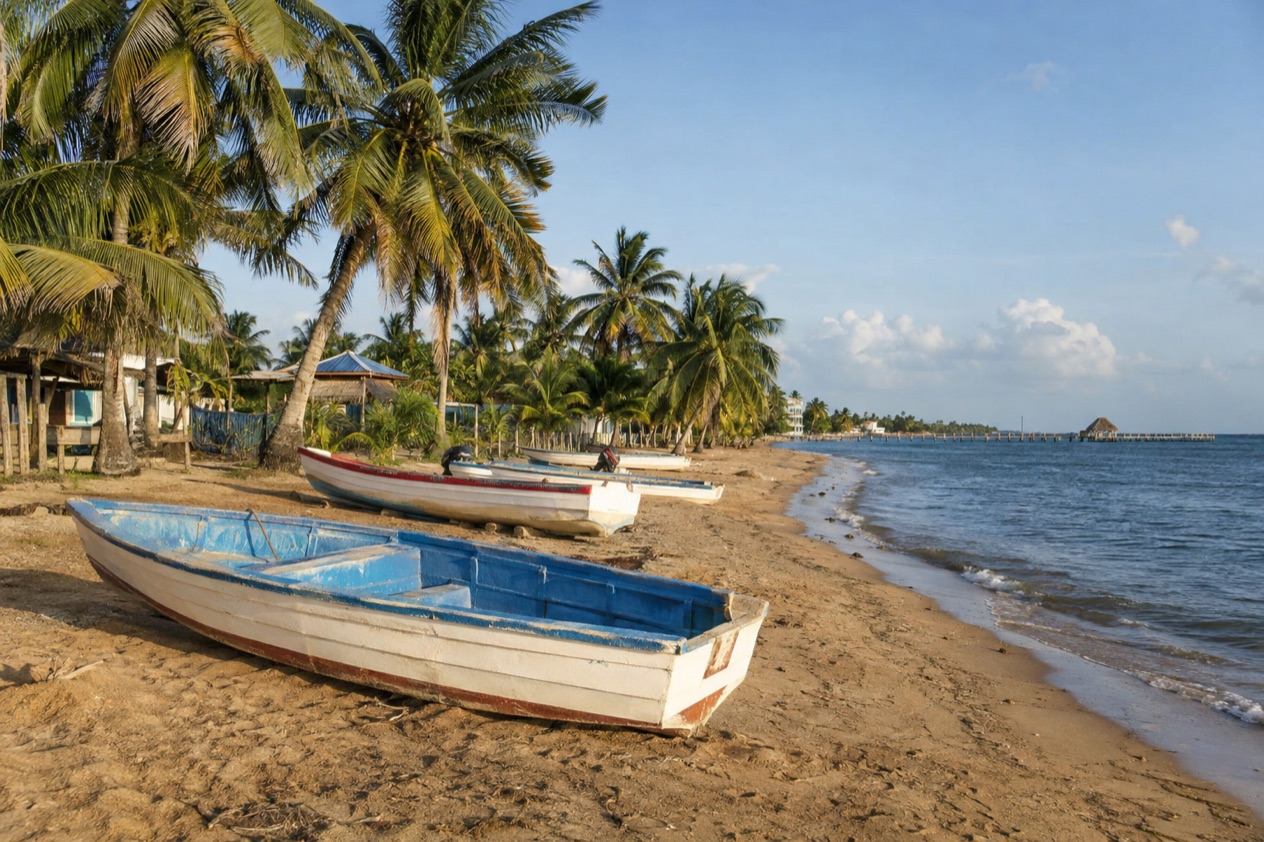
Hopkins is a place where drumbeats drift down the village road after dark and the smell of coconut stew comes out of kitchen doors at midday. Palms lean over a Caribbean shore, and the forested ridges of the Maya Mountains rise behind the houses. This is a small Garifuna village on the coast of southern Belize, made for travelers who want culture, rainforest and reef outings without a big resort scene.
Where is Hopkins and what is it like?
Hopkins is a coastal village in the Stann Creek District of southern Belize, on the Caribbean shore with the Maya Mountains and the Cockscomb Range rising inland and the Sittee River very close by. Dangriga, the district capital, is the nearest town, a drive of about 40 minutes away. In size and spirit Hopkins is a village, not a resort strip.
At the last census the village counted 1,610 people, and a little over two thirds of them were Garifuna. That shapes everything you notice. You hear the Garifuna language in conversation, you see cassava, fish and coconut on the table, and you find drumming and punta rhythms at the center of village life. UNESCO proclaimed the language, dance and music of the Garifuna a Masterpiece of the Oral and Intangible Heritage of Humanity in 2001, and Hopkins is one of the places where those traditions are lived rather than staged for a stage.
The village itself has a short history. It was created in 1942 to replace Newtown, a settlement further up the coast that a hurricane had devastated. The people who built Hopkins chose a spot between the sea and the foothills, and you still feel that double pull today: mornings at the water, afternoons looking at the green wall of forest to the west.
The pace is slow and the setting is simple. Roads are quiet, people greet you as you pass, and a day often revolves around one outing and one long meal. Travelers who like nightlife, shopping streets and a long list of restaurants may find it too quiet. Those who like to learn a little about a culture, hike to a waterfall, look for birds and then sit by the sea will feel at home.
The district around Hopkins is richly varied. Inland lie the jungle parks, and offshore lie the cayes and the Belize Barrier Reef. Hopkins sits in the middle of all of it, which is the real reason people choose it as a base.
What is there to do in Hopkins?
The things to do around Hopkins fall into three families: Garifuna culture in the village and in Dangriga, jungle and waterfall outings inland, and boat trips to the cayes and the reef. Neighboring Placencia is known for its beaches and its large selection of resorts, guest houses and hotels. Hopkins offers something different, a place where the culture of the people who live here is as much of an attraction as the shore.
Garifuna music, food and village life
Start with the people. Garifuna drumming and dance are the heart of the village, and evenings can bring the sound of hand drums and call-and-response singing. Punta, the dance music that has made Dangriga known as the culture capital of Belize, grew out of this tradition. Musicians such as Andy Palacio, Mohobub Flores and Aurelio Martinez have helped bring Garifuna music back to wide attention in Belize.
At the table, look for hudut, a fish stew in coconut broth served with mashed plantain, and for cassava bread, flat and crisp, made from grated cassava. These are the dishes of Garifuna homes, and a meal built around them is as much a part of a visit as any hike. Take your time over it and ask what is cooking that day.
Cockscomb Basin Wildlife Sanctuary
Cockscomb Basin is the big inland reason to come. It was established in 1986 as the first protected area for the jaguar, and it is recognized internationally as the world’s first jaguar preserve. It lies off the Southern Highway, about 20 miles south of Dangriga, and it holds Victoria Peak, the second highest point in Belize, at 3,670 feet. The name comes from the Cockscomb ridge, whose outline resembles a rooster’s comb.
Walking its forest trails, you may hear howler monkeys, spot birds and see tracks in the mud, and with luck more. Jaguars are shy, so a sighting is a chance, never a promise, and the forest itself is the reward. The sanctuary is run by the Belize Forest Department and the Belize Audubon Society.
| Site | Open | Admission |
|---|---|---|
| Cockscomb Basin Wildlife Sanctuary | 8:00am to 4:30pm | BZD 10 for non-nationals, BZD 2.50 for Belizean nationals |
Mayflower Bocawina National Park
Mayflower Bocawina National Park sits at mile six on the Southern Highway and covers an estimated 7,000 acres of dense tropical forest. It was established in 2001 and is managed by the Friends of Mayflower Bocawina National Park. Here visitors can go ziplining, rappel down waterfalls and hike to Antelope Falls.
The park suits people who want to move rather than only look. Between the canopy views and the sound of falling water, it adds an active side to a stay that might otherwise be built around drums and meals. In Dangriga, a three hundred foot waterfall inland also draws hikers.
The cayes and the reef
Offshore lies the southern end of the Belize Barrier Reef. From Dangriga, travelers can take a short boat ride to South Water Caye, Tobacco Caye and Glover’s Reef Atoll. Tobacco Caye is a tiny island about 10 miles east of Dangriga, with a permanent population of about 20 and five small lodges.
It lies within the South Water Caye Marine Reserve, which was designated in 1996 and is part of the Belize Barrier Reef World Heritage Site. Fishing there carries a range of restrictions. A day among the cayes gives you a very different Belize from the village and the forest, and it is the third pillar of a stay here.
How many days do you need in Hopkins?
A long weekend gives you a first taste of Hopkins, and a week lets you do justice to the village, the forest and the sea. The area is spread out over a district of highways, parks and cayes, so each outing is its own trip, and the more nights you give it, the less you have to choose.
With three or four nights, pair one inland outing with one evening of Garifuna music and a good meal. Cockscomb Basin or Mayflower Bocawina are the obvious choices, and which suits you depends on whether you want to look for wildlife along forest trails or to zipline and rappel. Spend the remaining hours simply in the village, where the slow pace is part of what you came for.
With a week, add the water. A boat trip from Dangriga to South Water Caye, Tobacco Caye or Glover’s Reef Atoll brings you to the reef, and an overnight at one of the small lodges on Tobacco Caye shows you island life at its smallest scale.
You can also give the village a day of its own, then use Dangriga as a second stop. It is the largest settlement in southern Belize and the place where Garifuna dancers can be seen.
If you arrive or leave by road from Belmopan, the Hummingbird Highway offers worthwhile stops along the way, including Blue Hole National Park, Barquidier Waterfall, Kropf’s Bakery and Casita de Amour. Building those into your arrival or departure day adds a good deal without adding a night.
A stay timed to November 19 earns a place of its own in the calendar. Garifuna Settlement Day is the holiday of the year here, and anyone with the flexibility should plan around it.
Where to stay in Hopkins
Where to stay depends on what you want from the district, and there are four natural bases: the village of Hopkins itself, the town of Dangriga, the island lodges and the forest parks inland. Each gives you a different version of the same coast.
Staying in Hopkins village puts you on the Caribbean shore in a Garifuna community, with the forested ridges at your back. It suits travelers who want the culture on their doorstep, who like to wander out for dinner and hear drums, and who plan to take day trips to the parks and the cayes. It is a quiet base and a small one.
Dangriga is a real town, the capital of the Stann Creek District with a population of roughly 9,500, and it is the cultural center of the Garifuna people. It makes sense if you want more going on around you, if you plan to take a boat to the cayes, or if you will fly in. Its airport is served by Maya Island Air and Tropic Air.
For the sea, Tobacco Caye offers five small lodges on three acres of sand, with the reserve and the reef all around. It suits travelers who want a night or two with almost nothing to do but look at the water, and who are happy with a simple setting. Hopkins and Dangriga remain on the mainland for everything else.
Inland, the forest parks around Cockscomb Basin and Mayflower Bocawina draw people who want to wake up to birdsong and walk into the trees. Placencia, with its beaches and resorts, is the other major coastal base in the district, a different kind of place from Hopkins and one to consider if you want a resort feel.
How do you get to Hopkins and get around?
You reach Hopkins by road, usually through Dangriga, which is about a 40-minute drive away. Dangriga Airport (DGA, the Pelican Beach Airstrip) is served by Maya Island Air and Tropic Air several times daily, with flights to Belize City, Placencia and Punta Gorda.
By road from the interior, the Hummingbird Highway is the main route to Dangriga from Belmopan. It cuts through the Belizean mountains, is known for its scenery, and is completely paved along its 49 miles. The district is also served by the Thomas Vincent Ramos Highway, and both connect to Belize City by way of the George Price Highway at Belmopan.
The stops along the Hummingbird Highway turn the drive into part of the trip. Blue Hole National Park, Barquidier Waterfall, Kropf’s Bakery and Casita de Amour all lie along the way. Plan your stops around the time you want to arrive.
Once you are in the district, the major sights are spread out. Cockscomb Basin Wildlife Sanctuary lies off the Southern Highway and Mayflower Bocawina National Park sits at mile six on the same road. Boats to South Water Caye, Tobacco Caye and Glover’s Reef Atoll run from Dangriga.
Hopkins is a village of modest size, so most of what you do within it happens on the spot. For the parks and the boats, you will be heading out along the highways and through Dangriga.
When is the best time to visit Hopkins?
January and November are the two months that stand out. In January the sea near Hopkins averages in the low 80s Fahrenheit, which is warm enough for a long boat day, and Belize City records just over ten rain days. In July the sea warms to the upper 80s and rain days climb to nearly twelve, so the water is warmer but the sky is a little wetter.
January highs average in the low 80s and July highs near 90, and rain falls in both months, about five inches in January and a little more in July. Neither month is a dry one, so plan for showers whichever you choose.
November brings the biggest event on the calendar. Garifuna Settlement Day, celebrated each year on November 19, is a public holiday in Belize that marks the settlement of the Garifuna people after they were exiled from the Grenadines by the British.
Created by civil rights activist Thomas Vincent Ramos in 1941, it was recognized in the southern districts in 1943 and declared a national holiday in 1977. In Dangriga and the villages around it, the day is marked with drumming, dance and the arrival of the Garinagu retold.
The Atlantic hurricane season runs from June 1 to November 30, so a Settlement Day visit falls on its closing days. The village itself owes its location to a hurricane that destroyed Newtown, and the season is part of coastal life here. A trip planned inside those dates deserves flexibility, and one outside them does not carry the same weight.
Good to know before you go
The U.S. State Department rates Belize Level 2, “Exercise increased caution”, because of crime, and says the south side of Belize City has historically had the highest concentration of violent crime.
Hopkins runs on Central Standard Time (UTC-6), and park fees are quoted in Belize dollars, so keep a few small bills for entrances and village meals. The sanctuary and the parks keep their own opening hours, so build your day around them.
The hurricane season runs through the end of November, and a rainy afternoon is as likely as a clear one in any month. Pack for both, bring a light rain jacket, and leave room in your plans for the pace of the village.
Sources
- Wikipedia, Hopkins, Belize (https://en.wikipedia.org/wiki/Hopkins,_Belize), checked October 11, 2026
- Wikipedia, Dangriga (https://en.wikipedia.org/wiki/Dangriga), checked October 11, 2026
- Wikivoyage, Dangriga (https://en.wikivoyage.org/wiki/Dangriga), checked October 11, 2026
- Wikipedia, Cockscomb Basin Wildlife Sanctuary (https://en.wikipedia.org/wiki/Cockscomb_Basin_Wildlife_Sanctuary), checked October 11, 2026
- Belize Audubon Society, Cockscomb Basin Wildlife Sanctuary (https://belizeaudubon.org/cbws/), checked October 11, 2026
- Wikipedia, Garifuna (https://en.wikipedia.org/wiki/Garifuna), checked October 11, 2026
- Wikipedia, Mayflower Bocawina National Park (https://en.wikipedia.org/wiki/Mayflower_Bocawina_National_Park), checked October 11, 2026
- Tropic Air, Dangriga and Hopkins (https://www.tropicair.com/dangriga-hopkins-dga/), checked October 11, 2026
- Maya Island Air, Dangriga and Hopkins flights (https://www.mayaislandair.com/belize-flights-dangriga-hopkins/), checked October 11, 2026
- Wikipedia, Stann Creek District (https://en.wikipedia.org/wiki/Stann_Creek_District), checked October 11, 2026
- Wikipedia, South Water Caye Marine Reserve (https://en.wikipedia.org/wiki/South_Water_Caye_Marine_Reserve), checked October 11, 2026
- Belize Fisheries Department, South Water Caye Marine Reserve (https://fisheries.gov.bz/swcmr/), checked October 11, 2026
- Wikipedia, Tobacco Caye (https://en.wikipedia.org/wiki/Tobacco_Caye), checked October 11, 2026
- Wikipedia, Climate of Belize (https://en.wikipedia.org/wiki/Climate_of_Belize), checked October 11, 2026
- Open-Meteo Marine API, average 2015-2024, checked October 11, 2026
- NOAA NCEI, GHCN-Daily station BHM00078583 (Philip S. W. Goldson International Airport, Belize City), normals 1991-2020 computed from the daily record (https://www.ncei.noaa.gov/access/services/data/v1?dataset=daily-summaries&stations=BHM00078583), checked October 11, 2026
- U.S. Department of State, Belize Travel Advisory, Level 2, March 11, 2026 (https://travel.state.gov/), checked October 11, 2026
- NOAA National Hurricane Center, Climatology (https://www.nhc.noaa.gov/climo/), checked October 11, 2026
All our pages
When to go
- Best Time to Visit Hopkins: Weather, Sea Temperatures, Garifuna Festivals and Seasons
- Hopkins in January: Garifuna Drumming, Warm Sea, Cockscomb and Weather
- Hopkins in February: Warm Sea, Bocawina Waterfalls and Garifuna Village Life
- Hopkins in March: Warm Sea, Garifuna Drumming, Cockscomb and Marine Reserves
- Hopkins in April: Weather, Sea, Garifuna Culture and What to Do
- Hopkins in May: Warm Sea, Garifuna Culture and What to Do
- Hopkins in June: Weather, Sea, Garifuna Culture and Forest Outings
- Hopkins in July: Weather, Sea Temperature, Garifuna Culture and the Lobster Season
- Hopkins in August: Warm Sea, Garifuna Culture, Cockscomb Basin and Hurricane Season
- Hopkins in September: Warm Sea, Independence Day Celebrations and Garifuna Culture
- Hopkins in October: Weather, Warm Sea, Garifuna Culture and Things to Do
- Hopkins in November: Garifuna Settlement Day, Drumming, Weather and What to Do
- Hopkins in December: Warm Sea, Garifuna Culture and Reef Outings
Things to do
- Things to Do in Hopkins: Garifuna Drumming, Cockscomb Jaguar Preserve, Waterfalls and the Cayes
- Day Trips from Hopkins: Cockscomb Jaguar Preserve, Mayflower Bocawina Waterfalls, Dangriga and the Southern Cayes
- 3 Days in Hopkins: Garifuna Culture, Cockscomb, Bocawina and the Cayes