
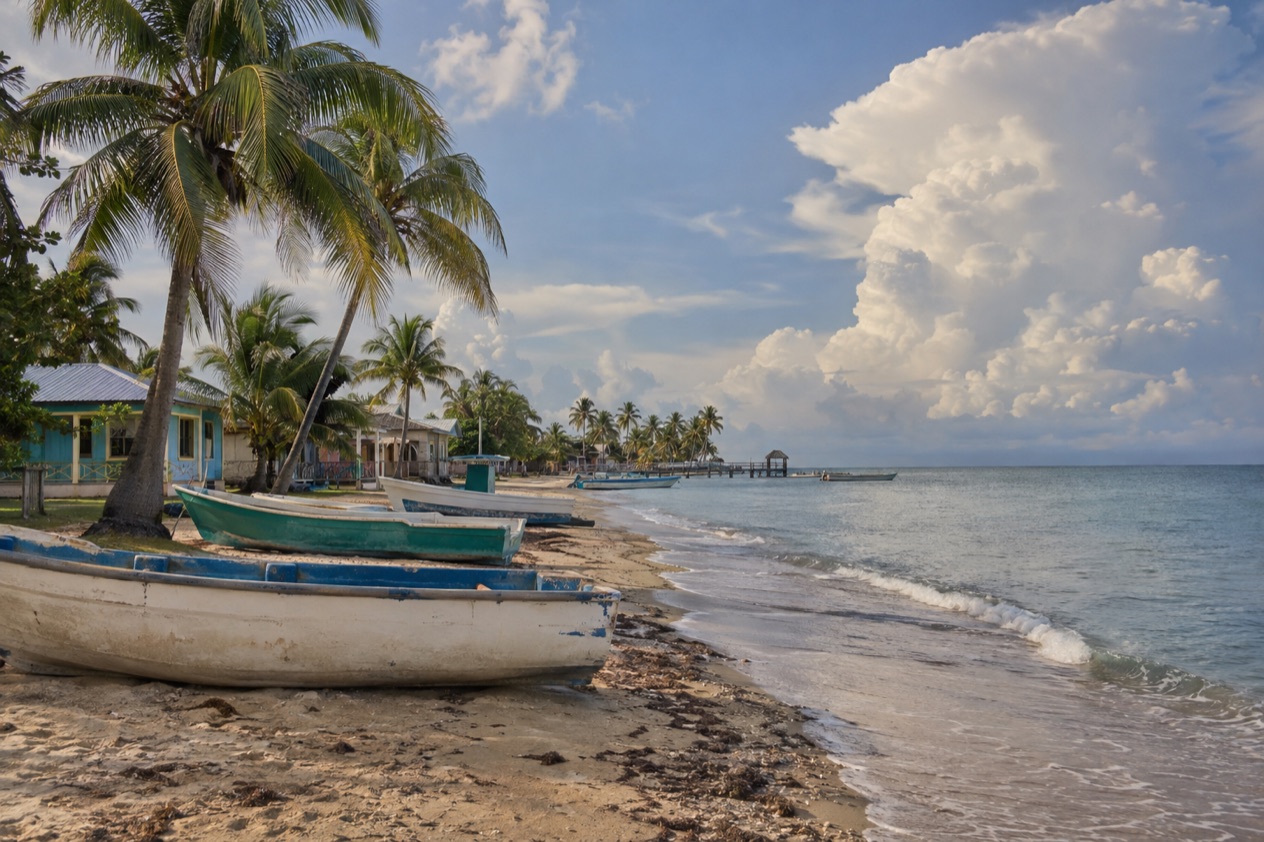
On a July evening in Hopkins, the drums start up somewhere along the village’s sandy streets, deep and unhurried, and children drift toward the sound while the last light settles over the Caribbean. Cassava bread is baking, fish is simmering in coconut broth, and the palms behind the beach are as green as they get. This is Hopkins in July: a Garifuna village on the Stann Creek coast in the green season, for travelers who want warm water, drumming, and rainforest trails within reach.
What is the weather like in Hopkins in July?
July in Hopkins is hot, humid and very green, with a sea warm enough that stepping into it brings no shock at all. The days are long, the vegetation behind the beach is thick and glossy, and the heat is the kind you plan around rather than fight.
| Month | Sea at Hopkins (°F) | Daylight on the 15th (hours and minutes) |
|---|---|---|
| June | 88.3 | 13 h 10 min |
| July | 86.7 | 13 h 04 min |
| August | 87.9 | 12 h 43 min |
In Belize City, highs average about 89°F in July. For a traveler in Hopkins, that means dressing for heat from the first coffee onward: thin cotton, loose linen, and a hat that stays on in a breeze off the water. Evenings stay warm enough to eat outside in a T-shirt, and a fan in the room matters more than a blanket.
The light is generous. Mid-July gives a little over thirteen hours between sunrise and sunset, so the early hours on the sand are bright and the evening drums can begin while the sky is still pink. The sea sits in the upper 80s, a shade below its June warmth, and it feels more like a tepid pool than a cool relief from the heat.
July also falls inside the Atlantic hurricane season, which runs from the first of June to the end of November. The peak comes later, around the second week of September, so July sits in the early stretch of the season. Keeping an eye on the forecast is simply part of planning a trip to the Belize coast in the summer months.
Can you swim in Hopkins in July?
Yes, the sea is warm enough for a long swim, at 86.7°F in July, and it invites you to stay in the water well past the point you would in cooler seas.
The outing that gives the sea its purpose lies offshore. South Water Caye Marine Reserve, in Stann Creek District, covers 117,875 acres of mangrove and coastal ecosystems, and it sits on the inner side of the Barrier Reef. It was established in 1996 and is the second largest marine protected area in Belize.
The reserve is part of the Belize Barrier Reef System, a World Heritage Site named the same year the reserve was created. For snorkelers and divers, that is the draw of the district: a reef protected as part of a listed system, with mangroves along the cayes and shallows that shelter young fish. Farther out, Glover’s Reef Atoll and the cayes of the southern chain, including South Water Caye and Tobacco Caye, are the names that come up for island days on the water from this part of the coast.
What to do in Hopkins in July
July in Hopkins starts with a quiet piece of news for anyone who loves seafood. The closed season for lobster in Belize runs from the first of March to the last day of June, so July opens with lobster back on the menu. Restaurants and kitchens along the beach put it on the grill or in coconut sauce, and the size rules for what may be taken (a minimum carapace length and a minimum tail weight) are the reason the tails on your plate are generous.
The rest of the month is about the village itself. Hopkins is a Garifuna community, and its rhythm is built from drums, cassava, and the sea. Mornings can begin with the smell of bread from an outdoor oven, afternoons drift toward the shade of a porch or a hammock, and evenings belong to music. The green season gives the setting a lush backdrop, with the rainforest pressing close to the coast.
Garifuna drumming, dance and the kitchen
The Garifuna drum is the sound of Hopkins. Large hand-played drums carry the rhythm of punta and other traditional dances, and the songs are sung in the Garifuna language. In the evening a drumming session on the beach or in a village hall is the best way to hear it, and listening from a few steps back is a good place to start before anyone invites you into the circle.
The food is part of the same tradition. Look for ereba, the flat cassava bread, and hudut, fish simmered in coconut milk and served with mashed plantain. A seafood lunch in a beachside kitchen, with a cold drink and a fan turning overhead, suits the heat of July better than almost anything else.
Bocawina National Park
Inland from the coast, Bocawina National Park in Stann Creek District is the rainforest outing for the green season. Visitors can go ziplining, rappel down waterfalls, or hike to Antelope Falls. The forest is most lush in July, and the trails run through dense green with the sound of water never far away.
It is an outing for those who want to trade the beach for a day among trees and cascades. Wear shoes that can get wet and muddy, and carry a swimsuit under your clothes if the waterfall hike is on the plan.
Reef and cayes
The marine reserve and the cayes off the Stann Creek coast are the water-side counterpart. South Water Caye, Tobacco Caye, and Glover’s Reef Atoll are the island names that anchor a day of snorkeling or diving, and the Barrier Reef is the reason people travel here for the water. Turneffe Atoll Marine Reserve, farther north, is a nursery ground for Queen conch, Caribbean spiny lobster, and many reef fishes, which tells you what the reef is for: it is a living system as well as a place to look at fish.
A two-day itinerary for Hopkins in July
Day 1 belongs to the village and the sea. Start at first light on the beach, when the air is as cool as it will get and the sky is already bright, and take a swim in the warm water before breakfast. Eat at a small beachside kitchen, where fry jacks, eggs and fruit are the sort of thing you will find on a morning table.
Spend midday in the shade, with lunch of fish in coconut broth, a cold drink, and a long rest while the heat is highest. Later, walk the village streets and look for ereba baking. As the evening comes on, long July light stretches well into the evening, so you can watch the sun go down over the water and then follow the sound of drums to a session in the village.
If rain turns the afternoon gray, stay under a roof with a plate of hudut and listen to the drumming from a covered porch. The warm sea is still there when the shower passes.
Day 2 heads inland to Bocawina National Park. The rainforest is thick and green in July, and the park’s activities, ziplining, waterfall rappelling and the hike to Antelope Falls, fill the day. Go in the morning, when the forest air is freshest, and plan the hike before the ziplining or the rappelling.
Return to the coast for a late lunch and a swim to wash off the trail. Dinner can be lobster, back on the menu now that the closed season has ended, grilled or in coconut sauce at a restaurant on the beach. If rain comes, a long meal under a thatched roof is a good plan for the evening.
Is Hopkins busy in July?
July is not the month of the great Garifuna celebration, which falls on November 19, so the village runs at its everyday pace rather than around a festival.
What fills a Hopkins day in July is the village’s own rhythm: the morning fish, the evening drums, the long light. The beach stays a place of hammocks, small restaurants and slow strolls, and the pace of the village sets the mood more than any crowd would.
The season itself shapes the trip. July sits inside the Atlantic hurricane season, so keeping flexible dates and watching the forecast is a sensible habit for the summer months. Travelers who like to plan around a festival will find that this month offers other things: lobster back on the menu, a warm sea, and green forests.
For the outings that matter, Bocawina National Park for its zipline, rappelling and the Antelope Falls hike, and the cayes and reef for the water, plan ahead as you would for any outing that depends on a boat or a guide, and keep a rainy-day alternative in your pocket, such as a drumming session or a long meal.
What to pack for Hopkins in July
Pack for heat, water, and the occasional wet trail. The season is warm and green, and your days will split between the beach, the table, and the forest.
- Light cotton or linen clothes, because the air stays hot and humid from morning to night.
- A wide-brimmed hat and sunglasses, for long days of bright light that stretches past thirteen hours.
- A swimsuit or two, so one can dry while you wear the other in the warm sea.
- A snorkel mask, for the reef and the cayes of the Stann Creek coast.
- Shoes that can get wet and muddy, for the trails and waterfalls of Bocawina National Park.
- A light rain jacket, for the green season showers.
- Insect repellent, for evenings near the forest and the mangroves.
Good to know before you go
The U.S. State Department rates Belize Level 2, “Exercise increased caution”, because of crime, and says the south side of Belize City has historically had the highest concentration of violent crime.
July falls inside the Atlantic hurricane season, which runs from June 1 to November 30. An average season brings 14 named storms, 7 hurricanes and 3 major hurricanes, and the busiest stretch comes later, from mid-August to mid-October. Hurricane Earl came ashore in Belize on August 4, 2016, a reminder that summer storms are part of the Belize coast calendar.
Lobster is back on the menu from July 1, after the closed season ends on June 30. If you plan to eat it, you will be eating a seafood that has had four months of rest. Keep your itinerary flexible and your plans for the reef and the rainforest ready to swap if the weather turns.
Hopkins in July vs June and August
Moving the trip four weeks earlier brings you to June, when the sea is a shade warmer and the days are a few minutes longer. Lobster is still under its closed season through June 30, so the menu is different.
In Belize City, June brings more rain in total than July, so the green season is already at work. Anyone who wants the longest evenings and the warmest water might lean toward June, though lobster lovers will prefer to wait until July.
Four weeks later brings August, when the days shorten to a little over twelve hours and the sea stays warm. August is also the month Hurricane Earl came ashore, on August 4, 2016, and the mid-August to mid-October stretch is when most Atlantic hurricane activity occurs. The lobster season is open, so the table is the same as in July.
July sits in the middle: lobster is on the menu, the days are long, and the sea is warm. Choose June for the longest light, August if you prefer the later calendar, and July for the combination of open lobster season and an early point in the hurricane season.
Is July a good time to visit Hopkins?
Yes, for travelers who love warm water, green forests, and a village with a strong musical tradition, and who are happy to plan around the hurricane season.
It suits those who want to swim in a warm sea, snorkel the reserve and the cayes, and spend an evening listening to Garifuna drums. It also suits lobster lovers, since the closed season ends the day before July begins. It is less suited to travelers who want a festival at the center of the trip, because the great Garifuna celebration falls in November.
On arrival, start with the sea and the table: a swim in the warm water, a plate of hudut or grilled lobster, and an evening listening for the drums. Then plan the Bocawina day and the reef day, and keep an eye on the forecast. What sets July in Hopkins apart is the sound of the drums over a warm sea, with the rainforest green behind and lobster back on the grill.
Sources
- Open-Meteo Marine API, average 2015-2024, checked October 11, 2026
- sunrise-sunset.org, sunrise and sunset calculated for the 15th of the month, checked October 11, 2026
- NOAA NCEI, GHCN-Daily station BHM00078583 (Philip S. W. Goldson International Airport, Belize City), normals 1991-2020 computed from the daily record (https://www.ncei.noaa.gov/access/services/data/v1?dataset=daily-summaries&stations=BHM00078583), checked October 11, 2026
- NOAA National Hurricane Center, Climatology (https://www.nhc.noaa.gov/climo/), checked October 11, 2026
- Wikipedia, Hurricane Hattie (https://en.wikipedia.org/wiki/Hurricane_Hattie), checked October 11, 2026
- Wikipedia, Hurricane Keith (2000) (https://en.wikipedia.org/wiki/Hurricane_Keith_(2000)), checked October 11, 2026
- Wikipedia, Hurricane Dean (https://en.wikipedia.org/wiki/Hurricane_Dean), checked October 11, 2026
- Wikipedia, Hurricane Lisa (2022) (https://en.wikipedia.org/wiki/Hurricane_Lisa_(2022)), checked October 11, 2026
- Wikipedia, Hurricane Earl (2016) (https://en.wikipedia.org/wiki/Hurricane_Earl_(2016)), checked October 11, 2026
- Wikipedia, Hurricane Iota (https://en.wikipedia.org/wiki/Hurricane_Iota), checked October 11, 2026
- San Pedro Belize Express Water Taxi, Caye Caulker (https://belizewatertaxi.com/destinations/caye-caulker/), checked October 11, 2026
- Belize Fisheries Department, Bacalar Chico Marine Reserve (https://fisheries.gov.bz/bcmr/), checked October 11, 2026
- Belize Fisheries Department, Turneffe Atoll Marine Reserve (https://fisheries.gov.bz/tamr/), checked October 11, 2026
- Belize Fisheries Department, Regulations (https://fisheries.gov.bz/regulations/), checked October 11, 2026
- Belize Tourism Board, Sargassum resource (https://www.belizetourismboard.org/tourism-resources/sargassum-resource/), checked October 11, 2026
- Tropic Air, Dangriga and Hopkins (https://www.tropicair.com/dangriga-hopkins-dga/), checked October 11, 2026
- Maya Island Air, Dangriga and Hopkins flights (https://www.mayaislandair.com/belize-flights-dangriga-hopkins/), checked October 11, 2026
- Wikipedia, Stann Creek District (https://en.wikipedia.org/wiki/Stann_Creek_District), checked October 11, 2026
- Wikipedia, South Water Caye Marine Reserve (https://en.wikipedia.org/wiki/South_Water_Caye_Marine_Reserve), checked October 11, 2026
- Belize Fisheries Department, South Water Caye Marine Reserve (https://fisheries.gov.bz/swcmr/), checked October 11, 2026
- Wikipedia, Climate of Belize (https://en.wikipedia.org/wiki/Climate_of_Belize), checked October 11, 2026
- U.S. Department of State, Belize Travel Information, Entry and exit requirements (https://travel.state.gov/), checked October 11, 2026
- U.S. Department of State, Belize Travel Advisory, Level 2, March 11, 2026 (https://travel.state.gov/), checked October 11, 2026
To plan your stay
- Things to Do in Hopkins: Garifuna Drumming, Cockscomb Jaguar Preserve, Waterfalls and the Cayes
- Where to Stay in Hopkins: Beachfront Resorts, Village Life and the Sittee River
- Hopkins from Belize City: Flights, Rental Cars, the Road South and Cockscomb
- Know Before You Go to Hopkins: Entry, Money, Getting Around and Garifuna Culture