
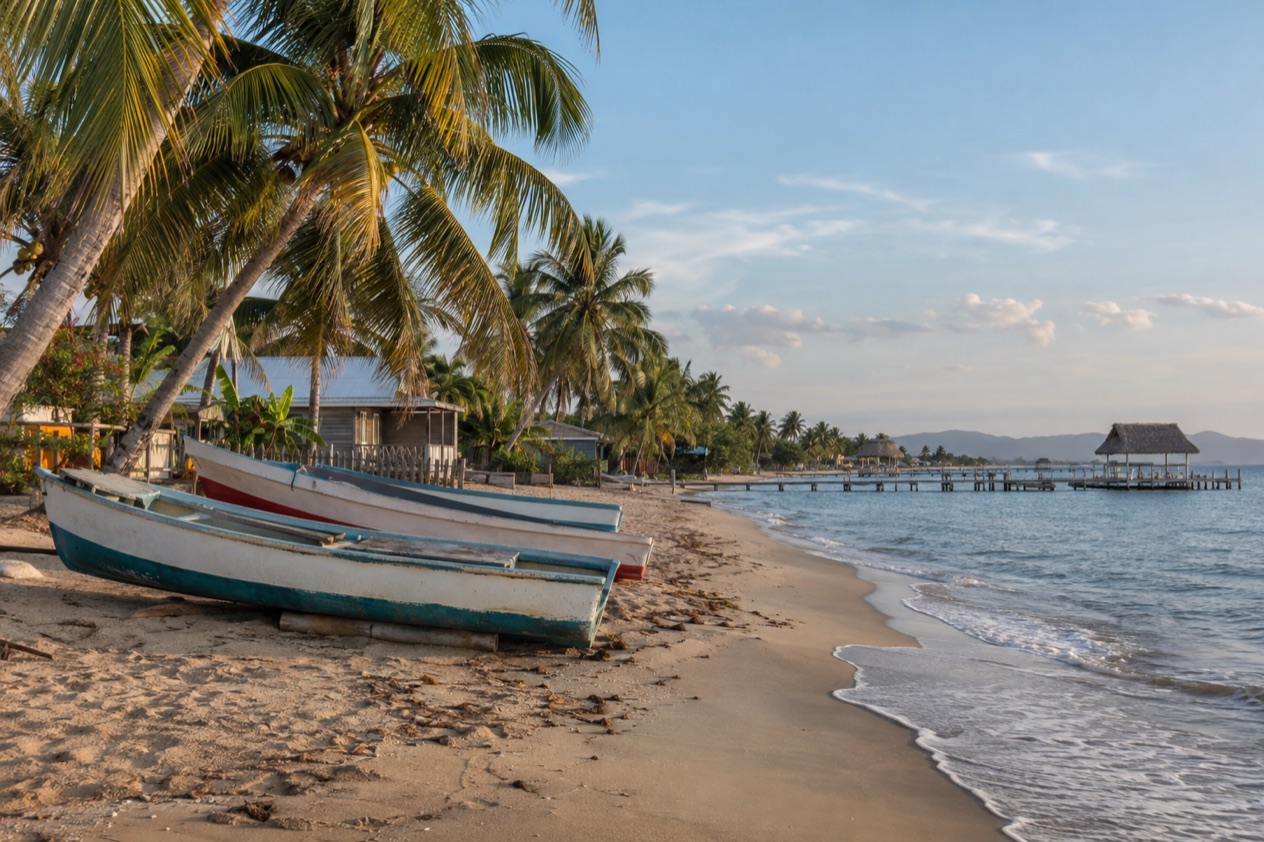
Hopkins announces itself with drums. Somewhere along the single main road, a Garifuna drummer is working out a rhythm, and the smell of fried fish and coconut bread drifts from a kitchen near the shore.
The village sits between the Maya Mountains and the Caribbean Sea, small and unhurried. A few practical things are worth knowing before you arrive: the paperwork, the money, the roads and the medical reality of a place this far from a hospital.
What should you know before visiting Hopkins?
Four things matter most in Hopkins: the Garifuna character of the village, the entry paperwork that applies to every visitor to Belize, the thin medical infrastructure, and the fact that Belize dollars are pegged to U.S. dollars. Get those straight and the rest of the trip is mostly about drumming, beaches and the rainforest behind the village.
Hopkins is a small place. At the last census it had a population of 1,610, and a large majority of residents were Garifuna.
That shows in the village in ways a first-time visitor notices quickly: Garifuna is spoken alongside English and Creole, drumming and dance are part of daily life, and the pace is set by the sea rather than by a schedule. Stann Creek District, where Hopkins lies, is a place where Creole is the main language, so you may hear it more than you expect, though English is Belize’s official language and is what you will use for ordering, asking directions and paying.
What tends to surprise people is how much of the surrounding landscape is wild. The Maya Mountains and the Cockscomb Range rise inland, the Sittee River runs close by, and the sea is right on the shore. Cockscomb Basin Wildlife Sanctuary, recognized as the world’s first jaguar preserve, lies in the same district.
Hopkins feels like a village at the edge of a great deal of forest, and that is part of its appeal. It also means services you might take for granted at home, from advanced medical care to roadside help, are not around the corner.
The other early surprise is how simple the money is. Prices may be quoted in either currency, and the exchange rate never moves, so the arithmetic is easy once you have done it once. Pay attention to which currency a price is in, and the rest follows.
Entry, fees and paperwork
U.S. citizens entering Belize need a U.S. passport valid for the length of their stay, and no Belizean visa is required for a visit of less than 30 days. Travelers must also show proof of an onward or return ticket and have sufficient funds to cover the whole stay. Belize does not require special immunizations for visitors.
Visitors are usually given a 30-day stay. Anyone who wants longer can apply for a Visitor’s Permit Extension at the nearest Immigration Office in Belize, which adds a further 30 days as long as the visitor does not work or engage in business without consent.
The Immigration Office is also where you find out whether you qualify. For longer stays, the passport is re-stamped at a local immigration office with an extra fee for each additional month, up to a maximum of six months.
Children traveling without both parents are a special case. Immigration officials ask for proof of consent and identification from the parent who is not traveling, along with the children’s birth certificates. Anyone arriving by land pays different fees depending on whether the stay is shorter or longer than 24 hours.
If you fly home from Philip S. W. Goldson International Airport, departure costs are listed in the table. Overnight parking at the airport is a separate charge.
| Fee | Amount | Who pays |
|---|---|---|
| Passenger Service Fee, Philip S. W. Goldson International Airport | US$53.50 | Departing passengers |
| Protected Areas Conservation Trust (PACT) fee, Philip S. W. Goldson International Airport | US$20.00 | Departing passengers |
| Overnight parking, Philip S. W. Goldson International Airport | US$9.00 | Anyone leaving a vehicle overnight |
| Visitor’s Permit Extension | BZ$200.00 | Visitors extending their stay by 30 days |
| Cockscomb Basin Wildlife Sanctuary entrance | BZD 10 | Non-nationals |
Money and cards
The Belize dollar is pegged at BZ$2 to US$1, and that is the whole story of the exchange rate. A price of BZ$20 is ten U.S. dollars, whether you pay in Hopkins or anywhere else in the country. The currency is issued under the authority of the Central Bank of Belize, which was established on January 1, 1982.
Because the peg is fixed, the simplest habit is to ask or check which currency a price is quoted in before paying. Fees you will meet on your trip use both. The airport charges and the parking fee are given in U.S. dollars, while the Visitor’s Permit Extension is set in Belize dollars. The entrance to Cockscomb Basin Wildlife Sanctuary for non-nationals is BZD 10.
Keeping the two currencies straight is a small mental exercise and quickly becomes automatic. Halve a Belize dollar price to get U.S. dollars, double a U.S. dollar price to get Belize dollars. That is all the arithmetic Hopkins will ask of you.
Getting around
Road conditions in Belize range from two-lane paved roads to dirt or gravel tracks, and roadside assistance is frequently unavailable. Driving at night is strongly discouraged. Valid U.S. or international driver’s permits are accepted only for three months after initial entry. These are the road rules that count for anyone who plans to drive in the Stann Creek District.
Dangriga is the nearest town of note. It is the capital of the Stann Creek District, a Garifuna town on the Caribbean coast at the mouth of the North Stann Creek River. Dangriga Airport, also called the Pelican Beach Airstrip (DGA), is served several times daily by Maya Island Air and Tropic Air, with flights to Belize City, Placencia and Punta Gorda.
By road, the Hummingbird Highway is the main route to Dangriga from Belmopan. It is known for its scenic beauty as it cuts through the Belizean mountains. Cockscomb Basin Wildlife Sanctuary lies off the Southern Highway, approximately 20 miles south of Dangriga Town, and is operated by the Belize Forest Department and the Belize Audubon Society.
If you are flying out of Belize City, passengers departing from Philip S. W. Goldson International Airport are expected to arrive at least 3 hours before the scheduled departure.
Health and the sun
Medical care in and around Hopkins is something to take seriously before you go. Emergency services in Belize are usually unavailable or significantly delayed, and serious injuries or illnesses normally require evacuation to another country.
Advanced medical treatment is scarce in Belize City and Belmopan, and in rural and remote areas even basic medical care is hard to find or not available at all. Travel insurance that covers evacuation is a sensible companion for a village this size.
On vaccines, the CDC recommends Hepatitis A for unvaccinated travelers one year old or older, and infants 6 to 11 months old should also be vaccinated. Travelers allergic to a vaccine component should receive a single dose of immune globulin.
Hepatitis B is recommended for unvaccinated travelers younger than 60, and those 60 and older may get vaccinated. Typhoid vaccine is recommended for travelers who might visit rural areas with poor sanitation, spend a month or more, or visit friends or relatives. Belize itself does not require special immunizations for entry.
The sun in a seaside village on the Caribbean is strong, and the shore has little shade in places. A hat, sunglasses and sunscreen belong in the bag, and long sleeves are useful on the river and in the forest.
Local customs and etiquette
Greetings matter in Hopkins. A friendly hello when you pass someone on the road or enter a shop is the norm, and conversation often starts before business does. English is widely spoken, and a few words in Garifuna are received warmly. Garifuna language, dance and music were proclaimed by UNESCO in 2001 as a Masterpiece of the Oral and Intangible Heritage of Humanity, and the community takes real pride in that heritage.
Music is a living part of the village rather than a performance. Drumming, singing and dance are part of Garifuna life, and there has been a resurgence of Garifuna music in recent years, popularized by musicians such as Andy Palacio, Mohobub Flores and Aurelio Martinez. If you are invited to listen, listen. If you are invited to dance, expect to be taught.
Dress is relaxed in a beach village, but covering up when you walk into a church or into the middle of a town is a courtesy. Swimwear belongs at the beach, not in the shops. Meals tend to be unhurried, with fish, rice and beans, and coconut in many forms, and a long lunch is part of the day rather than an interruption. Ask before photographing people, especially during ceremonies.
There are no legal restrictions on consensual same-sex relations in Belize, but there continues to be significant hostile sentiment toward people based on real or perceived sexual orientation. Discretion is something LGBTQ travelers may want to weigh.
Good to know before you go
The U.S. State Department rates Belize Level 2, “Exercise increased caution”, because of crime, and says the south side of Belize City has historically had the highest concentration of violent crime.
The Atlantic hurricane season runs from June 1 to November 30, and an average season brings 14 named storms. Keep that window in mind when you pick dates.
Hold on to your onward or return ticket and your proof of funds, since both are part of the entry requirements, and carry your passport and children’s documents where you can reach them. If you bring home souvenirs, remember that counterfeit and pirated goods can lead to fines and seizure on return to the United States. The last habit worth building is simple: be back at your lodging before dark, because night driving is strongly discouraged.
Sources
- U.S. Department of State, Belize Travel Information, Entry and exit requirements (https://travel.state.gov/), checked October 11, 2026
- U.S. Department of State, Belize Travel Information, Health (https://travel.state.gov/), checked October 11, 2026
- U.S. Department of State, Belize Travel Information, Traveling and transportation (https://travel.state.gov/), checked October 11, 2026
- U.S. Department of State, Belize Travel Information, Local laws and special circumstances (https://travel.state.gov/), checked October 11, 2026
- U.S. Centers for Disease Control and Prevention, Belize traveler view (https://wwwnc.cdc.gov/travel/destinations/traveler/none/belize), checked October 11, 2026
- Wikipedia, Belize dollar (https://en.wikipedia.org/wiki/Belize_dollar), checked October 11, 2026
- Wikipedia, Languages of Belize (https://en.wikipedia.org/wiki/Languages_of_Belize), checked October 11, 2026
- Philip S. W. Goldson International Airport (Belize), FAQ (https://www.pgiabelize.com/about-us/faq/), checked October 11, 2026
- Belize Immigration Department, Visitor's permit (https://immigration.gov.bz/permits/visitors-permit/), checked October 11, 2026
- Tropic Air, Belize immigration and visas (https://www.tropicair.com/belize-immigration-visas/), checked October 11, 2026
- Maya Island Air, Belize visa requirements (https://www.mayaislandair.com/belize-visa-requirements/), checked October 11, 2026
- NOAA National Hurricane Center, Climatology (https://www.nhc.noaa.gov/climo/), checked October 11, 2026
- Wikipedia, Hopkins, Belize (https://en.wikipedia.org/wiki/Hopkins,_Belize), checked October 11, 2026
- Wikipedia, Dangriga (https://en.wikipedia.org/wiki/Dangriga), checked October 11, 2026
- Wikivoyage, Dangriga (https://en.wikivoyage.org/wiki/Dangriga), checked October 11, 2026
- Wikipedia, Cockscomb Basin Wildlife Sanctuary (https://en.wikipedia.org/wiki/Cockscomb_Basin_Wildlife_Sanctuary), checked October 11, 2026
- Belize Audubon Society, Cockscomb Basin Wildlife Sanctuary (https://belizeaudubon.org/cbws/), checked October 11, 2026
- Wikipedia, Garifuna (https://en.wikipedia.org/wiki/Garifuna), checked October 11, 2026
- U.S. Department of State, Belize Travel Advisory, Level 2, March 11, 2026 (https://travel.state.gov/), checked October 11, 2026
To plan your stay
- Best Time to Visit Hopkins: Weather, Sea Temperatures, Garifuna Festivals and Seasons
- Things to Do in Hopkins: Garifuna Drumming, Cockscomb Jaguar Preserve, Waterfalls and the Cayes
- Where to Stay in Hopkins: Beachfront Resorts, Village Life and the Sittee River
- Hopkins from Belize City: Flights, Rental Cars, the Road South and Cockscomb