
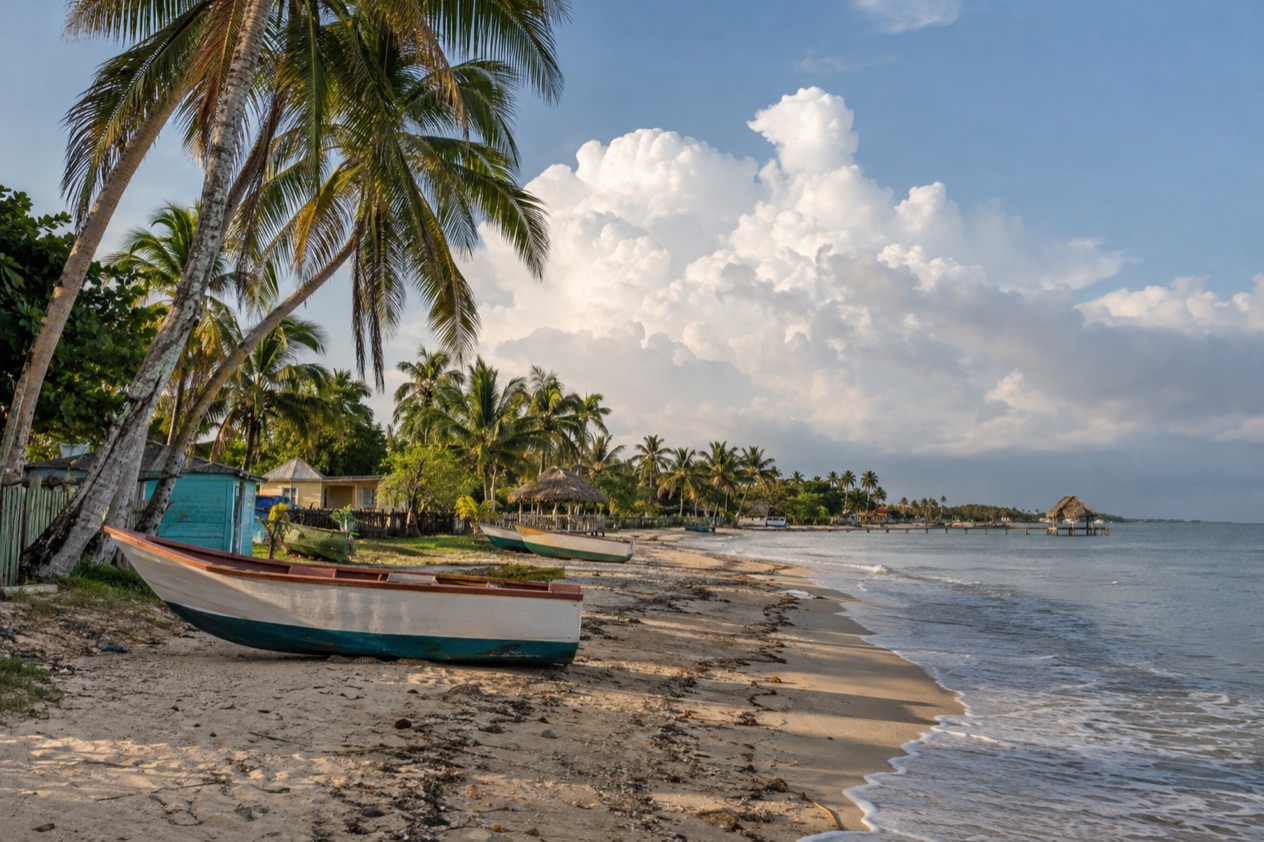
On an August evening in Hopkins, a drum starts up somewhere along the beach road, deep and unhurried, and the smell of fish simmering in coconut milk drifts out of the kitchens. Palm fronds clatter in the sea breeze, and the Garifuna village settles into the rhythm of a summer night.
August here means a very warm Caribbean sea, green forest inland and the middle of the hurricane season. It suits travelers who want to spend their days in the water, in the rainforest and at the table.
What is the weather like in Hopkins in August?
August in Hopkins is hot, humid and green, with a sea warm enough to feel like part of the air. It is the wet half of the year, so expect rain to be part of the picture, and expect it to keep the palms, the lagoon edges and the forest bright.
| Month | Sea at Hopkins (°F) | Daylight on the 15th (hours and minutes) |
|---|---|---|
| July | 86.7 | 13 h 04 min |
| August | 87.9 | 12 h 43 min |
| September | 88.6 | 12 h 16 min |
In Belize City, highs in August average close to 90°F. Rain falls there on about eleven days of the month, and the same wet-season pattern shapes the whole Belizean coast. Pack for heat and for the occasional soaking, and plan your outdoor hours around both.
The sea is the steadier part of the weather story. It has warmed a little since July and keeps warming toward September, so a dip never starts with a gasp. Light cotton and linen are the clothes you will live in, and a wet swimsuit dries quickly on a porch rail.
The daylight is generous but starting to shorten. Dawn over the water comes early, and the evening light on the beach still stretches long enough for a walk after dinner. By the end of the month the days are noticeably tighter than they were in July, which is worth knowing if you like to fit a trail and a swim into the same day.
Can you swim in Hopkins in August?
The sea is warm enough for a long swim, at about 88°F, which is the temperature of a very mild bath. It is the warmest stretch of the year in the water, so a swim is a way to cool off rather than a test of nerve.
Beyond the village shoreline, the outing people talk about is Tobacco Caye, a tiny island about ten miles east of Dangriga. It covers only about three acres and has a permanent population of about twenty, so it is the opposite of a busy resort. It sits out on the barrier reef side of the Stann Creek coast, and it is the kind of place you go to see how small a Caribbean island can be.
Sargassum, a brown algae that floats in clumps and gives off a rotten-egg smell when it washes ashore, is a feature of Caribbean beaches in some seasons. It is the one thing that can change the look and smell of a stretch of sand, so it is a reason to keep a flexible mind about which beach you spend a given morning on.
What to do in Hopkins in August
Hopkins is a Garifuna village, and August is a good month to spend time on that culture. The Garifuna language, dance and music were proclaimed by UNESCO a Masterpiece of the Oral and Intangible Heritage of Humanity, and the village keeps them going in daily life. Drumming sessions, dance evenings and cooking lessons are the ways visitors meet that heritage.
Music is the thread. Garifuna drums, the deep primera and the higher segunda, carry the rhythms of punta and paranda, and a new generation of Belizean musicians, among them Andy Palacio, Mohobub Flores and Aurelio Martinez, has brought that sound back into everyday listening. An evening of drumming under a palm roof is one of the plainest and best things Hopkins offers.
Garifuna food in the wet season
Hudut is the dish to order first, a fish simmered in a coconut broth and served with mashed green plantain that you break off and dip. Cassava bread, or ereba, is the other staple, a flat round made from grated cassava and baked or toasted. Both come from kitchens where the cook will often tell you how long a pot has been on the fire.
In August, seafood is on every menu along the beach road, and a plate of fried fish with rice and beans and cold fruit juice fits the weather. Coconut shows up in sweets and in drinks. A village kitchen on a rainy afternoon, with a pot on the fire and the rain on the roof, is its own small pleasure.
Cockscomb Basin Wildlife Sanctuary
Cockscomb Basin Wildlife Sanctuary is in the Stann Creek District of south-central Belize, off the Southern Highway, about twenty miles south of Dangriga. It was designated a wildlife sanctuary in 1984 and is recognized internationally as the world’s first jaguar preserve. The Belize Forest Department and the Belize Audubon Society operate it.
August is the wet season, and the forest shows it in thick greens, running streams and loud insect and frog chorus at dusk. A jaguar is a rare sight, and no one should plan a day around one. What you can plan around is the forest itself, the birds in the canopy and the trails that wind under it.
| Site | Admission |
|---|---|
| Cockscomb Basin Wildlife Sanctuary (non-nationals) | BZD 10 |
Dangriga and Tobacco Caye
Dangriga is the Garifuna town of the Stann Creek district, and it is the natural place to browse markets and see another face of the culture. Its airstrip is served by Maya Island Air and Tropic Air, with flights to Belize City, Placencia and Punta Gorda, which is useful if your itinerary reaches beyond Hopkins.
From the Dangriga side, Tobacco Caye sits about ten miles out to sea. It is tiny, quiet and offers a very different view of the coast than the village does. A day there is a good use of August sunshine when the sky has opened up.
Back in the village, the slower pleasures are the best. A walk along the beach road at sunrise, a coconut bought from a vendor, a long lunch on a porch and an evening of drumming make a day by themselves. In the wet season, the light between showers is soft and the village is at its greenest.
A two-day itinerary for Hopkins in August
Day 1 belongs to the village and the sea. Start at sunrise on the beach, when the air is at its mildest and the light on the water is soft. Take a swim before the heat builds, then settle into a long breakfast of fry jacks or eggs and fresh fruit at a beachfront place.
Spend the middle of the day in the shade, with a cold drink and a book, or wander the village road past the small shops and painted houses. For lunch, order hudut with mashed plantain at a Garifuna kitchen. In the late afternoon, return to the water while the light is golden. At night, find a drumming session or a restaurant with live music, and let the evening run long.
Day 2 is for the forest. Head to Cockscomb Basin Wildlife Sanctuary for the trails and the birds, starting early so you have time on the paths before the heat and the humidity set in. Return to the village for a late lunch and an afternoon of rest.
If the weather turns, switch to a cooking lesson, a drum workshop or a long meal. August rain is part of the month, and a village kitchen is a fine place to wait it out. In the evening, walk the beach road once more and finish where the music is.
Is Hopkins busy in August?
Hopkins is a small village, so it keeps a village pace in August. There is one main road along the beach, with guesthouses, small restaurants and a handful of resorts, and the scale of the place means even a few arrivals are noticeable.
It is a morning at the sanctuary, an afternoon on the water or an evening in front of the drums. The pace of those things is set by the weather and the light rather than by a rush of visitors.
August sits inside the hurricane season, which runs from June 1 to November 30, and the most active stretch begins in mid-August. That is a reason to keep your plans loose and to watch the forecast as you get closer to your dates. Rooms and tables are a small-village matter, and a quick message to a guesthouse you like is a sensible habit at any time of year.
At Cockscomb Basin Wildlife Sanctuary, the entrance fee for non-nationals is collected at the gate, and the sanctuary is a place to be taken at its own pace. On the beach, you will find the village hums quietly through the day and then livens around dinner, when the restaurants fill and the music starts.
What to pack for Hopkins in August
Pack for heat, humidity and the chance of rain, and choose things that dry quickly. The village is casual, and the forest is wet, so comfort matters more than style.
- Light cotton or linen clothes, for the heat and the humidity.
- Two swimsuits, so one can dry while you wear the other.
- A light rain jacket, since August is part of the wet season.
- Sturdy sandals or water shoes for the beach and the village road.
- Closed shoes with grip for the forest trails at Cockscomb.
- Binoculars, for the birds in the canopy.
Good to know before you go
The U.S. State Department rates Belize Level 2, “Exercise increased caution”, because of crime, and says the south side of Belize City has historically had the highest concentration of violent crime.
August falls inside the Atlantic hurricane season, and the peak of the season is September 10, with most activity between mid-August and mid-October. An average season brings 14 named storms, seven of them hurricanes. Hurricane Earl made landfall in Belize about six miles south of Belize City on August 4, 2016, so an August storm is a real part of the picture here, and it is wise to follow the forecast before and during your trip.
Sargassum can also reach Caribbean shores, and the Belize Tourism Board describes it as a brown algae that floats in clumps and smells like rotten eggs when it washes up. It is a seasonal feature of the region rather than a fixed one, so treat it as something that may or may not touch the stretch of coast you choose.
Hopkins in August vs July and September
Going four weeks earlier brings a slightly cooler sea and longer evenings. July has the longest days of the three months, which is a gift if you like to fit a forest morning and a beach afternoon into the same day. Rain days in Belize City run a little higher in July than in August, and the hurricane season is still near its early stage.
Going four weeks later puts you in the warmest water of the three months. The days are shorter, and rain days in Belize City edge up. September also brings the official peak of the hurricane season, so it is the month to watch the forecast most closely.
Travelers who care most about long days and the early-season feel should shift toward July. Those who want the warmest sea can accept September’s shorter days and its place in the storm calendar. August sits in the middle, with a warm sea, a green forest and the most active part of the season only just beginning.
Is August a good time to visit Hopkins?
Yes, August is a good time for travelers who love warm water, green forest and a village where music and food carry the evenings. It suits people who are comfortable with heat and humidity and who can be flexible when the rain comes.
It is a poorer fit for anyone who wants guaranteed dry days or cannot adjust plans around a forecast. The hurricane season runs through the month, and travelers who need certainty should choose another time of year.
On arrival, head to the beach road, find a place that serves hudut and listen for the drums. Then plan your day at Cockscomb Basin Wildlife Sanctuary, so the forest is on your list from the start. What makes August special in Hopkins is the combination of a sea at its warmest, a rainforest at its greenest and a Garifuna village that fills its evenings with drums, fish in coconut broth and the sound of rain on a tin roof.
Sources
- Open-Meteo Marine API, average 2015-2024, checked October 11, 2026
- sunrise-sunset.org, sunrise and sunset calculated for the 15th of the month, checked October 11, 2026
- NOAA NCEI, GHCN-Daily station BHM00078583 (Philip S. W. Goldson International Airport, Belize City), normals 1991-2020 computed from the daily record (https://www.ncei.noaa.gov/access/services/data/v1?dataset=daily-summaries&stations=BHM00078583), checked October 11, 2026
- NOAA National Hurricane Center, Climatology (https://www.nhc.noaa.gov/climo/), checked October 11, 2026
- Wikipedia, Hurricane Hattie (https://en.wikipedia.org/wiki/Hurricane_Hattie), checked October 11, 2026
- Wikipedia, Hurricane Keith (2000) (https://en.wikipedia.org/wiki/Hurricane_Keith_(2000)), checked October 11, 2026
- Wikipedia, Hurricane Dean (https://en.wikipedia.org/wiki/Hurricane_Dean), checked October 11, 2026
- Wikipedia, Hurricane Lisa (2022) (https://en.wikipedia.org/wiki/Hurricane_Lisa_(2022)), checked October 11, 2026
- Wikipedia, Hurricane Earl (2016) (https://en.wikipedia.org/wiki/Hurricane_Earl_(2016)), checked October 11, 2026
- Wikipedia, Hurricane Iota (https://en.wikipedia.org/wiki/Hurricane_Iota), checked October 11, 2026
- Belize Tourism Board, Sargassum resource (https://www.belizetourismboard.org/tourism-resources/sargassum-resource/), checked October 11, 2026
- Wikipedia, Tobacco Caye (https://en.wikipedia.org/wiki/Tobacco_Caye), checked October 11, 2026
- Wikivoyage, Dangriga (https://en.wikivoyage.org/wiki/Dangriga), checked October 11, 2026
- Wikipedia, Cockscomb Basin Wildlife Sanctuary (https://en.wikipedia.org/wiki/Cockscomb_Basin_Wildlife_Sanctuary), checked October 11, 2026
- Belize Audubon Society, Cockscomb Basin Wildlife Sanctuary (https://belizeaudubon.org/cbws/), checked October 11, 2026
- Wikipedia, Garifuna (https://en.wikipedia.org/wiki/Garifuna), checked October 11, 2026
- Wikipedia, Climate of Belize (https://en.wikipedia.org/wiki/Climate_of_Belize), checked October 11, 2026
- U.S. Department of State, Belize Travel Information, Entry and exit requirements (https://travel.state.gov/), checked October 11, 2026
- U.S. Department of State, Belize Travel Advisory, Level 2, March 11, 2026 (https://travel.state.gov/), checked October 11, 2026
To plan your stay
- Things to Do in Hopkins: Garifuna Drumming, Cockscomb Jaguar Preserve, Waterfalls and the Cayes
- Where to Stay in Hopkins: Beachfront Resorts, Village Life and the Sittee River
- Hopkins from Belize City: Flights, Rental Cars, the Road South and Cockscomb
- Know Before You Go to Hopkins: Entry, Money, Getting Around and Garifuna Culture