
On a February evening in Naha, the sweet smell of fried sata andagi doughnuts drifts out of shop doorways, and people stroll Kokusai-dori in a light jacket while bowls of Okinawa soba steam on the tables. Elsewhere in Japan, winter means snow and ski lifts.
Here it means mild afternoons, gray spells that come and go, and a sea that stays in the low 70s. February suits travelers who want island food, Ryukyu culture and a coastline in the middle of the Japanese winter.
What is the weather like in Okinawa in February?
February in Okinawa is mild and often cloudy, with cool mornings and afternoons that feel closer to spring than to winter. January is nearly the same, and March is a step warmer and brighter.
| Month | Average high (°F) | Average low (°F) | Precipitation (in) | Days with 1 mm or more of precipitation | Hours of sunshine | Daylight on the 15th | Sea (°F) |
|---|---|---|---|---|---|---|---|
| January | 67.6 | 58.8 | 4.00 | 10.2 | 93 | 10 h 40 min | 71.7 |
| February | 68.4 | 59.2 | 4.51 | 9.9 | 93 | 11 h 16 min | 71.4 |
| March | 71.4 | 62.1 | 5.62 | 10.9 | 115 | 11 h 58 min | 71.1 |
What this means in practice is layers. A light jacket or a cardigan over a T-shirt covers most days, and nights stay mild enough that nobody needs a winter coat. With humidity close to 70 percent, the air can feel damp and a little heavy, and a breeze off the water makes a shaded terrace feel cooler than the thermometer says.
Rain falls on roughly one day in three. It tends to arrive as gray, drizzly stretches rather than tropical downpours, so a compact umbrella or a light rain shell handles it. Sunshine appears in between the clouds, but this is not a month for planning every hour around blue sky.
The light is gentler than in summer and the days are lengthening, with a little more daylight each week as March approaches.
Can you swim in Okinawa in February?
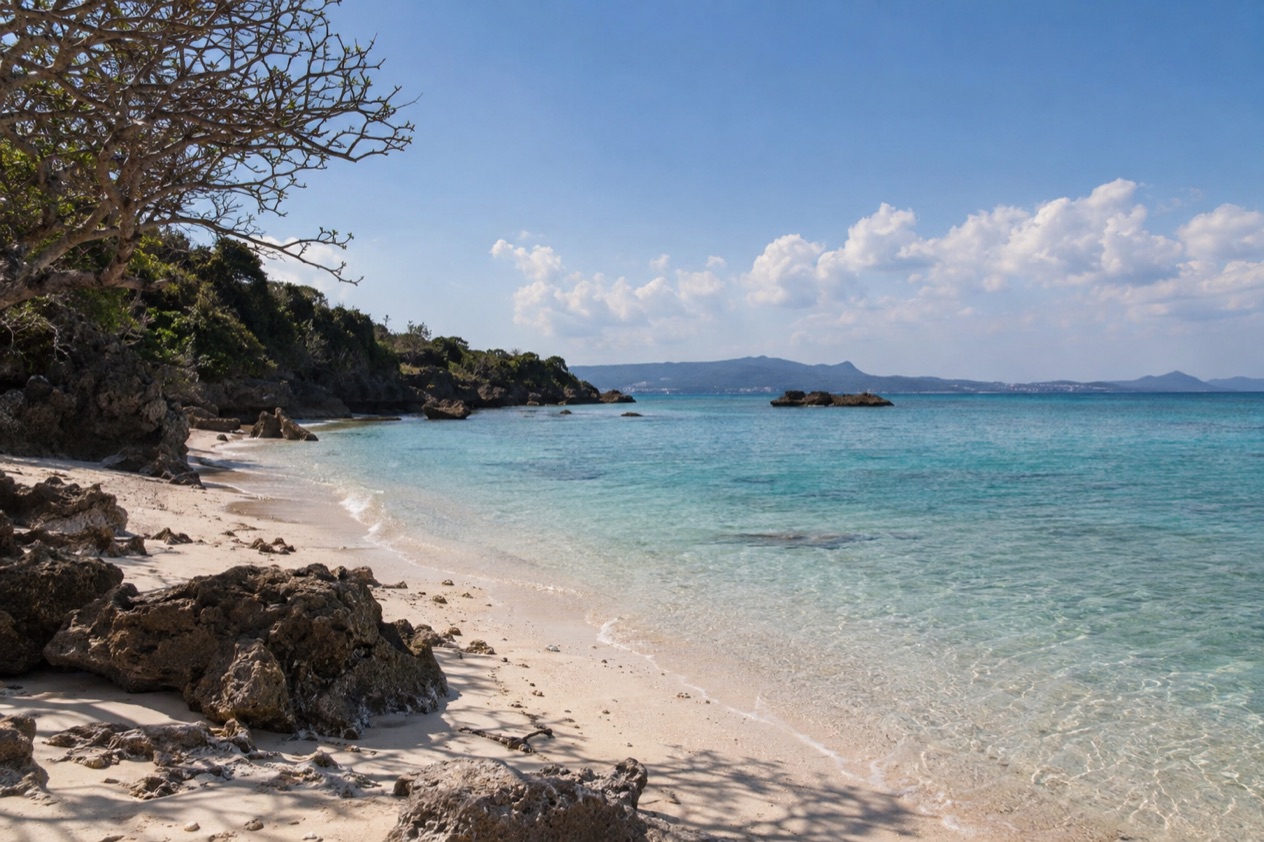
The sea is cool rather than warm in February, in the low 70s, which makes it a quick dip rather than a long swim for people. It is a little warmer than the air at night and close to the temperature of the afternoon air, so the first step in is the hard part.
Okinawa Island has several beaches, and a winter walk along any of them is pleasant even if you stay dry. Manza Beach, Emerald Beach, Okuma Beach and Zanpa Beach each have their own stretch of sand. Moon Beach and Sunset Beach in Chatan complete the list. Because waves and currents vary from one beach to the next and from one week to the next, look at what the sea is doing on the day before you decide to go in.
If the water feels too cool, the reef life of the islands is on show at Okinawa Churaumi Aquarium, where you can look at the sea without getting wet. A new female Japanese sawshark has arrived there as part of an effort to breed the species, a reminder that the aquarium also works with rarer animals.
What to do in Okinawa in February
The first thing to know about February is that Setsubun falls in the first days of the month. It marks the eve of the traditional beginning of spring, and the main ritual is mamemaki.
Roasted soybeans called fukumame are thrown out the front door, or at someone wearing an oni (demon) mask, while everyone shouts “Oni wa soto! Fuku wa uchi!”, meaning devils out, fortune in. Afterward, people eat one bean for each year of their life plus one extra for luck. Look for the bags of beans in supermarkets and the oni masks in shop windows.
Okinawa was once the Ryukyu Kingdom, with its own language and culture, and that heritage runs through everything on a winter trip: the three-stringed sanshin you hear in small bars, the eisa drumming and dancing of the island’s festivals, and the red-tiled roofs with shisa lion-dogs guarding the gables. The mild weather suits days spent walking between museums, markets and castle ruins, with plenty of stops for food.
Food is a good reason to come in winter. Okinawa soba is made with wheat noodles in a pork-and-bonito broth, topped with stewed pork ribs called soki.
Goya champuru stir-fries bitter melon with tofu and egg, rafute is pork belly braised in awamori and brown sugar, and taco rice is a local invention of spiced meat, lettuce and cheese over rice. Awamori, the island’s distilled rice spirit, and Orion beer are the usual drinks to go with them.
Okinawa Churaumi Aquarium
A rainy or gray day is a good day for the aquarium, and in February it fits the weather. Its biggest tank is a view into the open sea, where you may see whale sharks and manta rays glide past, and smaller tanks show off coral reef fish in brilliant colors. The sawshark breeding effort adds a reason to look at the quieter, deeper-water displays.
Allow a long visit and plan a meal before or after, since the building holds you for hours. It suits families, couples, and anyone who prefers an indoor day when clouds hang low.
| Site | Open |
|---|---|
| Okinawa Churaumi Aquarium | 8:30 a.m. to 6:30 p.m., last admission 5:30 p.m. |
Naha: Kokusai-dori, markets and the monorail
Naha is the largest city on Okinawa and home to about a fifth of the main island’s residents. It is also the only place with a public rail network, the Okinawa Urban Monorail, known as Yui Rail, which runs above the city streets and lets you look down on rooftops and laundry lines as you go.
Kokusai-dori is the shopping street for souvenirs: Ryukyu glass, red-and-blue bingata cloth, and awamori in clay bottles. The market streets nearby are where you eat.
Counters sell fried snacks, pork cuts of every kind, tropical fruit and, in the covered public market, fish that you can have cooked upstairs. In February the mild air makes the open-air stretches comfortable to walk without overheating, and a short rain just sends you under the arcades.
Beyond the markets, Naha’s old Ryukyu quarter has castle walls and royal gardens that tell the story of the kingdom.
Beaches and winter whales
A beach in February is for walking, for picnics, for watching the light change, and for a brief wade if you feel like it. Pick any of the beaches named above for a coast walk, and stay on the sand if the swell looks up.
Winter is also the season when humpback whales may pass through the waters around Okinawa, and boat trips from some ports go out in search of them. You may see a blow or a tail, or you may see only open sea, since wildlife keeps its own schedule. Even then, a day on the water in mild winter air is a pleasure of its own.
Inland, Okinawa Island’s highest point is Mount Omoto, and the northern forests are green all year. With sunshine limited in February, they are good for slow drives and short stops at roadside stands for fresh juice, rather than for a big climb.
A two-day itinerary for Okinawa in February
Day 1 belongs to Naha. Start with a bowl of Okinawa soba at a small shop near the monorail, then take Yui Rail across the city to the old quarter and its castle grounds, where the stone walls and the red buildings are easy to read in soft winter light. By midday you are ready for goya champuru or a set meal at an izakaya (a casual pub-restaurant).
In the afternoon, walk Kokusai-dori for souvenirs and sata andagi, then step into the covered market streets for fruit and pork. If rain sets in, stay under the arcades and linger over coffee, since the arcades keep you dry. At dinner, find a small place with live sanshin music, and try awamori with a plate of rafute.
Day 2 goes to the aquarium and the coast. Reach Okinawa Churaumi Aquarium as soon as it opens at half past eight, spend the morning with the whale sharks and reef tanks, and have lunch nearby on a local set meal. The aquarium is open until half past six, but the last admission is earlier, so plan to be inside well before then.
After lunch, drive or ride to one of the beaches, such as Emerald Beach or Okuma Beach, for a walk on the sand and a decision about a wade. Daylight lasts a little over eleven hours, so the walk fits before dusk. If it rains, trade the beach for a museum or a cafe, and end the evening with taco rice and an Orion beer.
Is Okinawa busy in February?
February in Okinawa is a winter month with a gentle pace, marked more by the weather and the festivals around it than by any rush. Much of Japan’s winter energy goes north, where heavy snow covers the mountains and the Sapporo Snow Festival fills Odori Park, Susukino and Tsudome over seven days.
Okinawa offers the opposite. Naha Airport is the gateway to all of Okinawa’s islands, with flights from dozens of cities across Japan, including low-cost carriers. That connection keeps the city lively, and the street food stalls, the monorail and the beaches keep their usual rhythm.
February is a season of in-between. The cherry blossoms of the early year have come first, the plum trees flower in this part of winter across East Asia, and the long days of spring are only starting to show in the light. For a trip built around food and culture and slow days, that in-between feeling is the mood of the month.
What to pack for Okinawa in February
Pack for mild, changeable days that can turn damp, and for a mix of indoor and outdoor time.
- A light jacket or cardigan, for cool mornings and breezy evenings.
- A compact umbrella or rain shell, since showers come on roughly one day in three.
- Comfortable walking shoes for markets, castle grounds and the long aquarium visit.
- Short sleeves to layer, for the afternoons when the sun comes out.
- A swimsuit and a quick-dry towel, in case the sea tempts you for a short dip.
- Sunglasses, because the light off the water can be bright between clouds.
Good to know before you go
The New Year closures that empty many restaurants and attractions across Japan are behind you by February, so shops and eating places in Naha are back to their usual routines. Setsubun comes in the first days of the month, a good moment to join in the bean-throwing at a home, a shrine or a shop.
Okinawa is a chain of islands, and Naha is the hub, so plan each day around where you sleep and how you will move. Within Naha, Yui Rail connects the city, while the aquarium and the beaches call for separate planning.
Okinawa in February vs January and March
Going four weeks earlier brings you to January, which is almost identical in temperature and sunshine, with a sea a touch warmer. The difference is blossom. The early-flowering hikan-zakura cherry first opens at Naha around the middle of January, a deep pink that falls before February begins, so a cherry-blossom trip belongs to the earlier month. The days are also shorter, and the New Year closures can still affect restaurants and attractions.
Four weeks later, March is warmer, brighter and a little wetter, with more sunshine hours and the days stretching to nearly twelve hours of daylight. The sea is about the same, so swimming does not change much. Beach walks and boat outings are likelier to feel like spring, and the whale-watching season, which belongs to winter, begins to close.
Travelers who want cherry blossom should aim for January. Those who want food, culture, aquarium days and the Setsubun tradition fit February well, and anyone who would rather have warmer afternoons and more sun should consider March.
Is February a good time to visit Okinawa?
Yes, for travelers who want a mild winter escape built around food, culture and indoor-outdoor days, rather than a beach vacation. It is a good fit for couples, families who like the aquarium, and anyone who wants to leave snow behind without leaving Japan.
It is less right for swimmers who want warm water, or for sun seekers who need long hours of brightness, since gray days are part of the month. Those travelers should look at March.
On arrival, start in Naha with a bowl of Okinawa soba and a ride on Yui Rail, then plan the aquarium for the first day with low clouds. February in Okinawa is the month of bean-throwing at Setsubun, a sea still in the low 70s, and a plate of rafute with a glass of awamori at the end of a damp evening.
Sources
- Japan Meteorological Agency (JMA), Normal values 1991-2020, monthly (https://www.data.jma.go.jp/stats/etrn/view/nml_sfc_ym.php?prec_no=91&block_no=47936), station Naha, elevation 28 m, checked October 11, 2026
- Open-Meteo Marine API, average 2015-2024, checked October 11, 2026
- Computed from the date and the latitude of the place (sunrise equation, solar elevation -0.833 degrees), October 11, 2026
- Wikipedia, Setsubun (https://en.wikipedia.org/wiki/Setsubun), checked October 11, 2026
- Japan National Tourism Organization, festivals and events (https://www.japan.travel/en/see-and-do/festivals-and-events/), checked October 11, 2026
- Sapporo Snow Festival official website (https://www.snowfes.com/english/), checked October 11, 2026
- Wikipedia, Sapporo Snow Festival (https://en.wikipedia.org/wiki/Sapporo_Snow_Festival), checked October 11, 2026
- Japan National Tourism Organization, winter in Japan (https://www.japan.travel/en/guide/winter-guide/), checked October 11, 2026
- Japan National Tourism Organization, skiing and snowboarding in Japan: regions, resorts, seasons (https://www.japan.travel/en/sports/snow/), checked October 11, 2026
- Wikipedia, Climate of Japan (https://en.wikipedia.org/wiki/Climate_of_Japan), checked October 11, 2026
- Japan National Tourism Organization, flowers by season: cherry blossom, plum, wisteria, hydrangea, where and when (https://www.japan.travel/en/see-and-do/flowers/), checked October 11, 2026
- Wikipedia, Prunus mume (https://en.wikipedia.org/wiki/Prunus_mume), checked October 11, 2026
- Japan National Tourism Organization, skiing guide (https://www.japan.travel/en/guide/skiing/), checked October 11, 2026
- Wikipedia, List of ski areas and resorts in Japan (https://en.wikipedia.org/wiki/List_of_ski_areas_and_resorts_in_Japan), checked October 11, 2026
- Japan National Tourism Organization, weather and seasons in Japan (https://www.japan.travel/en/plan/weather/), checked October 11, 2026
- Japan Meteorological Agency, 2026 cherry blossom first-bloom status (https://www.data.jma.go.jp/sakura/data/sakura_kaika.html), checked October 11, 2026
- Japan Meteorological Agency, biological season observations (https://www.data.jma.go.jp/sakura/data/index.html)
- Japan National Tourism Organization, Okinawa (https://www.japan.travel/en/destinations/okinawa/okinawa/naha-and-the-main-island/), checked October 11, 2026
- Okinawa Churaumi Aquarium (https://churaumi.okinawa/en/), checked October 11, 2026
- Wikipedia, Okinawa Island (https://en.wikipedia.org/wiki/Okinawa_Island), checked October 11, 2026
- Wikipedia, Okinawa Prefecture (https://en.wikipedia.org/wiki/Okinawa_Prefecture), checked October 11, 2026
- Wikivoyage, Okinawa (https://en.wikivoyage.org/wiki/Okinawa), checked October 11, 2026
To plan your stay
- Things to Do in Okinawa: Churaumi Aquarium, Shuri Castle, Kerama Reefs and Okinawan Food
- Where to Stay in Okinawa: Naha, Chatan, the Aquarium Coast and Beach Resorts
- Okinawa from Tokyo: Flying to Naha, Why No Train Goes There and a First Day on the Island
- Know Before You Go to Okinawa: Entry, Money, Getting Around and Local Etiquette