
In March, the covered arcades around Makishi Public Market in Naha smell of grilled fish and simmering pork, and a sanshin, the three-stringed Okinawan lute, drifts out of an izakaya as the light fades. Winter has loosened its grip on the island, the air is soft, and the cherry blossoms that opened here in January are already a memory. March in Okinawa is a month for walking Naha’s streets, visiting the Churaumi Aquarium, eating the island’s own cooking and dipping a toe, or more, into the sea.
What is the weather like in Okinawa in March?
March in Okinawa is mild and slightly damp, warm enough for short sleeves in the sun and cool enough for a light layer once it clouds over. At Naha, the air is a step warmer than in February and a step cooler than in April, and the sea is only a touch cooler than the air by day.
| Month | Average high (°F) | Average low (°F) | Precipitation (in) | Days with 1 mm or more of precipitation | Hours of sunshine | Daylight on the 15th | Sea (°F) |
|---|---|---|---|---|---|---|---|
| February | 68.4 | 59.2 | 4.51 | 9.9 | 93 | 11 h 16 min | 71.4 |
| March | 71.4 | 62.1 | 5.62 | 10.9 | 115 | 11 h 58 min | 71.1 |
| April | 75.7 | 66.4 | 6.34 | 10.3 | 121 | 12 h 45 min | 74.2 |
Rain in March comes on about every third day, and the humidity stays high all month, so a gray, muggy spell is as much a part of the month as a bright one. Days are not a washout from start to finish. Think of showers that pass and sunny hours that return, with enough sun in total to make beach walks and open-air sights worth planning.
A light jacket or a simple sweater is the right companion for the evenings, over a T-shirt that will do for most of the day. The nights stay mild rather than cold, so you will not need a winter coat. A compact umbrella or a thin rain shell earns its place in the bag.
Day and night are almost evenly split in mid-March, and the days lengthen quickly as April approaches. That gives you a full day of sightseeing without rushing, and an evening still long enough for dinner in the market streets after you come in from the coast.
Can you swim in Okinawa in March?
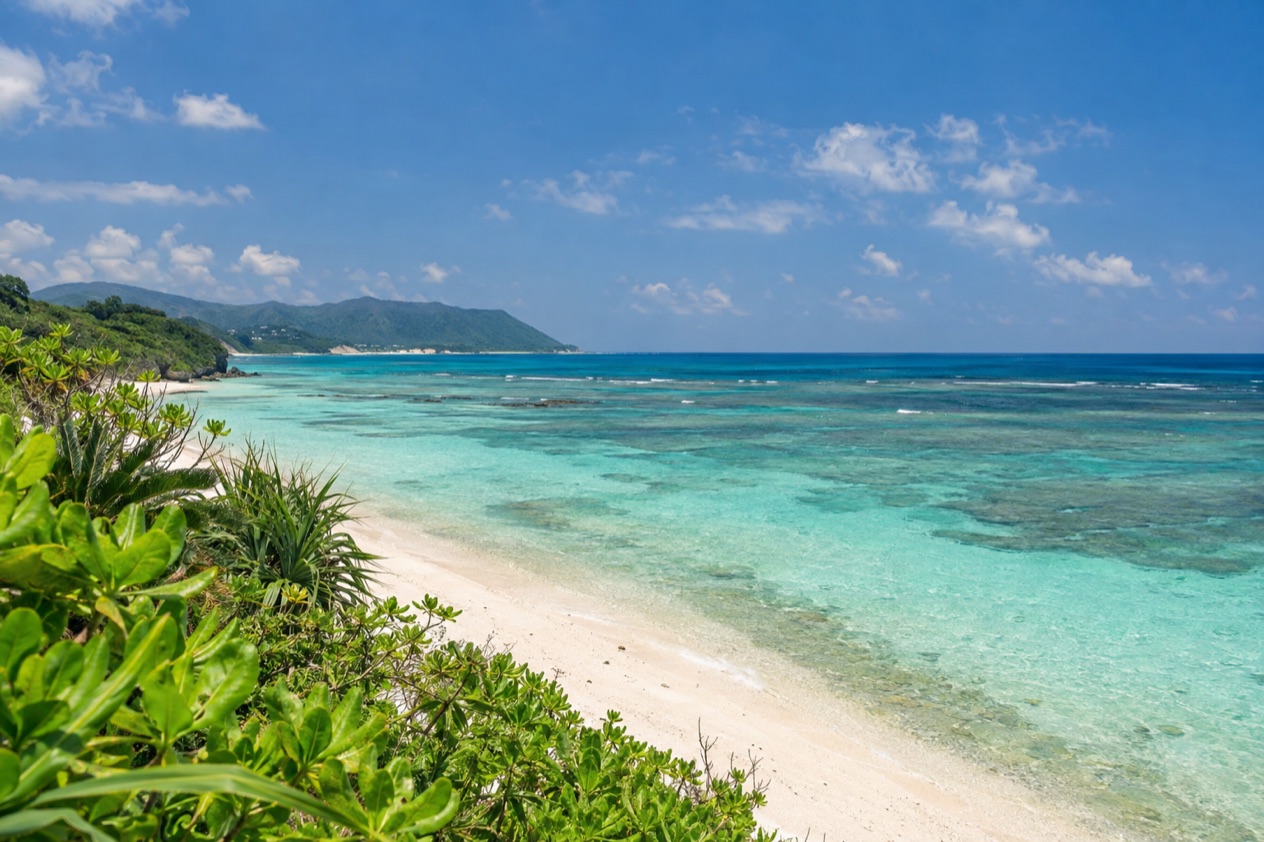
A swim is possible, though the sea is cooler than in summer: at 71.1°F near Naha, it suits a refreshing dip more than a long soak. Plenty of visitors keep to the sand and the water’s edge, and that is a fine way to spend an hour here too.
Okinawa Island has several named beaches, and they make a good list for a day by the water. Manza Beach and Emerald Beach are among them, as are Okuma Beach, Zanpa Beach and Moon Beach. Sunset Beach lies in Chatan-cho, a town on the main island. Each gives you a different stretch of coast to walk, even if you only wade in.
Since the sea is cool rather than warm, many travelers pair the beach with something dry, such as a lunch of Okinawa soba in a seaside town or an afternoon at the aquarium. That keeps the day from depending on the water alone.
What to do in Okinawa in March
March has no single headline event to organize the trip around, which leaves room for the island’s everyday pleasures. The cherry blossoms here are the early kind, the Hikan-zakura, which begin to open around mid-January, so the island’s own bloom comes well before the Somei-Yoshino that reach Kyushu in late March. What March gives you is a pleasant, damp-edged spring, food worth building the day around and a city with its own history.
Okinawa cooking is a distinct cuisine, shaped by the Ryukyu Kingdom, with its own language and culture before it became a prefecture. Look for goya champuru, a stir-fry of bitter melon with tofu and egg, and rafute, pork belly braised until it yields to a spoon.
Okinawa soba arrives in a pork broth over wheat noodles, and sata andagi, the dense fried doughnuts, make a good snack on the street. Umibudo, the “sea grapes” of bead-like seaweed, and mozuku are among the island’s sea flavors.
In the evening, awamori, the local distilled spirit, and Orion beer come with small plates in the izakaya. Some places add live sanshin music after dark, which fits the mood of a mild March night. Taco rice, a local favorite that grew out of the island’s history, rounds out the menu if you want something filling after a day on your feet.
Naha: Kokusai-dori, Makishi market and Tsuboya
Naha is the capital of Okinawa Prefecture and the largest city on the main island, with about a fifth of its residents. It is also the one place with a public rail network, the Okinawa Urban Monorail, known as Yui Rail. Most visitors spend at least a day here, and March suits it: the air is mild for walking, and the market arcades are a good refuge when a shower arrives.
Kokusai-dori is the main shopping street, lined with souvenir shops selling shisa, the lion-dog guardians that sit on Okinawan rooftops, along with Ryukyu glass and bingata, the stenciled and dyed textiles of the old kingdom. Makishi Public Market is the place to see the island’s fish and pork, and you can have what you buy cooked upstairs. The Tsuboya district is known for its pottery, and its stone-paved lanes make a quiet change of pace from the arcades.
Shuri Castle and the Ryukyu Kingdom
Shuri Castle was the seat of the Ryukyu Kingdom, and it explains much of what you taste and see elsewhere on the island. The main castle is closed after the fire in 2019, but the grounds are partly open to the public. You walk through the gates and courtyards that remain and look out over the city.
A visit here gives the rest of the island a frame. The shisa on the rooftops, the dyed cloth, the awamori and the dishes all come from a kingdom that traded across the sea and kept its own customs. March weather is good for the open-air parts of the visit, with a layer for the cloudier stretches.
Okinawa Churaumi Aquarium
The Churaumi Aquarium opened on November 1, 2002, and it fills most of a day for travelers who like to watch the sea through glass. In March it also works as the indoor card when the sky turns gray. The staff have brought in a new female Japanese Sawshark in an effort to breed the species, a detail for anyone who likes the quieter tanks.
The aquarium also cautions visitors about an increase in bite-wound injuries from white-banded triggerfish during their breeding season, so follow the signs near the water. Pair it with a beach stop afterward, keeping in mind that the sea in March is cool rather than warm.
| Site | Open |
|---|---|
| Okinawa Churaumi Aquarium | 08:30 to 18:30, last admission 17:30 |
A two-day itinerary for Okinawa in March
Day 1 belongs to Naha, and the order follows the weather: open-air sights first, the covered arcades when the clouds thicken. Begin at Shuri Castle, walking the parts of the grounds that are open and looking over the city from the heights. The morning light is a good time for the courtyards, and a light jacket is enough for the walk.
Come down into town for lunch, with Okinawa soba or a goya champuru set meal at a local diner. The afternoon fits Tsuboya, where the pottery lanes reward slow wandering, and then Kokusai-dori for shisa and glass. If a shower comes, the market arcades and the shops are the dry plan.
At dusk, make for Makishi Public Market and the lanes around it. Choose an izakaya for dinner, with rafute, umibudo and a glass of awamori, and stay for sanshin if the place has music. The monorail is there when your feet have had enough.
Day 2 is for the main island’s coast and the Churaumi Aquarium. Start with the aquarium when it opens, taking in the big tanks before the afternoon. Because it is indoors, the visit holds up whatever the sky is doing, and that makes it the rain card for the whole trip.
Spend the afternoon at one of the beaches of the main island, such as Emerald Beach or Okuma Beach. A walk along the sand suits the cool sea, and a dip is there for anyone who wants it. Finish the day with dinner in a seaside town, with a bowl of soba or a plate of fried fish and a sata andagi for dessert.
Is Okinawa busy in March?
March falls in a gentle in-between stretch on the island: the Hikan-zakura bloom that began in January has passed, and the warmer weeks of April are still ahead. That makes it a month with its own calm rhythm, though no figure here tells you how full the streets or the rooms will be.
What you can count on is the weather’s pace. Showers pass and sun returns, so travelers tend to spread their outings across the day rather than pack them in. Naha moves at its usual city rhythm, with the arcades, the market and the monorail all part of daily life.
On the mainland, the Somei-Yoshino cherry trees reach Kyushu and much of western and central Japan in late March, and that blossom season is part of how travelers shape their spring plans. Okinawa’s own cherry season has long since passed, so a visit here is about the island’s food, its history and its coast rather than blossoms.
What to pack for Okinawa in March
Pack for mild days and damp edges, with layers that come on and off quickly. A few items cover most of what the month asks for:
- A light jacket or a simple sweater, for the cooler evenings.
- T-shirts and a light long-sleeved top, for the sunny hours.
- A compact umbrella or thin rain shell, because showers come often.
- Comfortable walking shoes, for Shuri Castle’s grounds and Naha’s stone lanes.
- A swimsuit and a towel, for a dip in the cool sea.
- Sunscreen and sunglasses, for the sunny stretches on the coast.
Good to know before you go
March is not part of the typhoon or rainy season the way the summer months are, but the damp, changeable weather is real, with showers on about a third of the days. Plan your open-air time in flexible blocks and keep the aquarium and the market arcades in mind as indoor options.
Shuri Castle’s main building is closed after the 2019 fire, though parts of the site are open, so treat the visit as a walk through the grounds. The Churaumi Aquarium keeps its own hours, and it asks visitors to follow the posted caution about triggerfish near the water.
Okinawa in March vs February and April
Move the trip four weeks earlier and the air is cooler, the days are shorter and the sun appears less. The sea is about the same, barely warmer than in March, so a February dip feels much like a March one. The island’s cherry blossoms, which began in mid-January, are closer in time, and the evenings call for a sweater a little more often.
Four weeks later, April is warmer, with longer days, more sun and a noticeably warmer sea that makes a swim more inviting. Rain is a little heavier, and the air turns more humid. Beach days start to look better, while the cool-weather walks of Naha get a bit sticky by comparison.
Choose March if you want mild weather for walking and eating, with the aquarium and the market as your backups. Shift to April if the sea matters most. Shift to February if you prefer cooler air and the blossom season nearer, and do not mind the shorter days.
Is March a good time to visit Okinawa?
Yes, for travelers who want a mild, food-led trip with city sights, an aquarium and a beach walk, and who are happy with a cool sea and the odd shower. Those who want a long, warm swim should aim for April or later.
On arrival, start in Naha: Shuri Castle’s grounds, the Tsuboya lanes and Makishi Public Market give you the island’s history and flavors in a day. Keep the Churaumi Aquarium for the day the sky turns gray, and save a beach afternoon for a brighter spell. What marks March here is a quiet turn: the island’s own blossoms already behind it, the sea just starting to warm and the table full of goya, rafute and sea grapes.
Sources
- Japan Meteorological Agency (JMA), Normal values 1991-2020, monthly (https://www.data.jma.go.jp/stats/etrn/view/nml_sfc_ym.php?prec_no=91&block_no=47936), station Naha, elevation 28 m, checked October 11, 2026
- Open-Meteo Marine API, average 2015-2024, checked October 11, 2026
- Computed from the date and the latitude of the place (sunrise equation, solar elevation -0.833 degrees), October 11, 2026
- Japan Meteorological Agency, cherry blossom first-bloom dates 2021-2026 and 1991-2020 normal (https://www.data.jma.go.jp/sakura/data/sakura003_07.html), checked October 11, 2026
- Japan Meteorological Agency, cherry blossom full-bloom dates 2021-2026 and 1991-2020 normal (https://www.data.jma.go.jp/sakura/data/sakura004_07.html), checked October 11, 2026
- Japan Meteorological Agency, sakura2020.pdf (https://www.data.jma.go.jp/sakura/data/sakura2020.pdf), checked October 11, 2026
- Japan National Tourism Organization, flowers by season: cherry blossom, plum, wisteria, hydrangea, where and when (https://www.japan.travel/en/see-and-do/flowers/), checked October 11, 2026
- Wikipedia, Prunus mume (https://en.wikipedia.org/wiki/Prunus_mume), checked October 11, 2026
- Japan National Tourism Organization, spring in Japan (https://www.japan.travel/en/guide/spring-guide/), checked October 11, 2026
- Japan National Tourism Organization, autumn in Japan (https://www.japan.travel/en/guide/autumn-guide/), checked October 11, 2026
- Japan National Tourism Organization, summer in Japan (https://www.japan.travel/en/guide/summer-guide/), checked October 11, 2026
- Japan National Tourism Organization, Okinawa (https://www.japan.travel/en/destinations/okinawa/okinawa/naha-and-the-main-island/), checked October 11, 2026
- Okinawa Churaumi Aquarium (https://churaumi.okinawa/en/), checked October 11, 2026
- Wikipedia, Okinawa Island (https://en.wikipedia.org/wiki/Okinawa_Island), checked October 11, 2026
- Wikipedia, Okinawa Prefecture (https://en.wikipedia.org/wiki/Okinawa_Prefecture), checked October 11, 2026
- Wikivoyage, Okinawa (https://en.wikivoyage.org/wiki/Okinawa), checked October 11, 2026
- Wikipedia, Shuri Castle (https://en.wikipedia.org/wiki/Shuri_Castle), checked October 11, 2026
- Wikipedia, Naha (https://en.wikipedia.org/wiki/Naha), checked October 11, 2026
To plan your stay
- Things to Do in Okinawa: Churaumi Aquarium, Shuri Castle, Kerama Reefs and Okinawan Food
- Where to Stay in Okinawa: Naha, Chatan, the Aquarium Coast and Beach Resorts
- Okinawa from Tokyo: Flying to Naha, Why No Train Goes There and a First Day on the Island
- Know Before You Go to Okinawa: Entry, Money, Getting Around and Local Etiquette