
JAMAICA · MONTEGO BAY · 18.5° N
Montego Bay makes the decision look easy, and that is the trap. The water is warm in every month of the year, the average high never drops below 80.8°F, and a brochure will tell you any week works. The calendar disagrees on one point that matters: rain. February records 1.65 inches across 3.8 rainy days. September records 8.07 inches across 21.0 of them. Same sea, nearly the same air temperature, an entirely different vacation.
So the question was never whether Montego Bay will be warm. It is which weeks buy dry mornings, which buy an empty beach, and what each one costs in the other currency. The hurricane calendar sits across five and a half months of the year, from June 1 to November 30, and it decides more of this than the thermometer does.
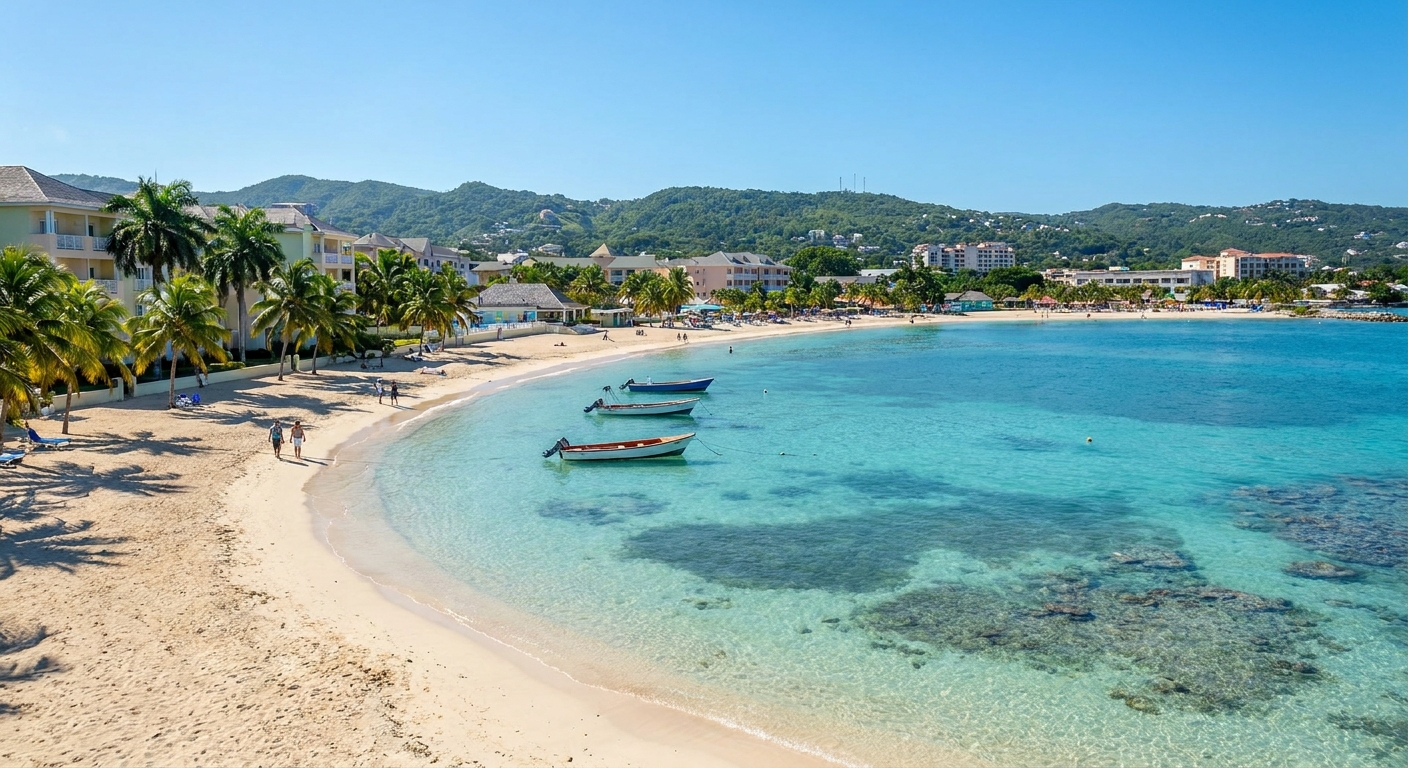
THE YEAR AT A GLANCE · MONTEGO BAY
February is the driest month of the year at 1.65 inches and 3.8 rainy days, with the sea still at 81.1°F: take it if your dates are free, and book September only on a rate you can move.
BEST OVERALL: FEBRUARY · WARMEST SEA: SEPTEMBER 88.7°F · HURRICANE SEASON: JUN 1 – NOV 30
Go for: February and early March, when the sea holds 81 to 83°F and rain falls on fewer than six days in the month.
Think twice before: locking non-refundable September dates, the month with 21.0 rainy days and the September 10 hurricane peak.
Normals: Open-Meteo / ERA5 reanalysis, 1991-2020 · Sea: Open-Meteo Marine, 2015-2024 · Hurricanes: NOAA NHC · full sources at the end
On this page
- The best month overallFebruary: 81.7°F and 3.8 rainy days
- Sea temperature month by monthNever below 81.1°F
- When Montego Bay is quietestThe low-season calendar, Easter to early December
- The month to avoidSeptember: 21.0 rainy days and the hurricane peak
- Is April or November worth it?The two shoulder months and their gap to February
- All twelve months in one tableHighs, lows, rain and sea
Montego Bay sits at 18.5° north, which keeps the thermometer from doing much work: 80.8°F is the coolest average high of the year, 87.1°F the warmest. Rain does the sorting instead, from 1.65 inches in February to 8.48 in May, and the storm calendar sorts what rain leaves over.
Montego Bay weather month by month: highs, lows, rain and sea
| Month | Avg high | Avg low | Rain | Days ≥ 0.10 in | Sea |
|---|---|---|---|---|---|
| January | 80.8°F | 71.1°F | 1.79 in | 4.2 | 82.0°F |
| February | 81.7°F | 70.8°F | 1.65 in | 3.8 | 81.1°F |
| March | 82.8°F | 71.1°F | 2.18 in | 5.9 | 82.6°F |
| April | 84.5°F | 72.5°F | 3.53 in | 9.9 | 84.1°F |
| May | 85.1°F | 74.3°F | 8.48 in | 18.4 | 86.1°F |
| June | 86.6°F | 76.1°F | 5.82 in | 15.5 | 86.5°F |
| July | 87.1°F | 76.6°F | 5.17 in | 14.9 | 86.4°F |
| August | 87.1°F | 76.8°F | 6.54 in | 18.7 | 88.0°F |
| September | 86.4°F | 76.3°F | 8.07 in | 21.0 | 88.7°F |
| October | 84.7°F | 75.4°F | 7.28 in | 18.4 | 88.2°F |
| November | 82.4°F | 74.0°F | 3.55 in | 9.1 | 85.1°F |
| December | 81.2°F | 72.5°F | 2.12 in | 4.9 | 82.8°F |
The year has a dry core and a long wet half. From December through March the monthly totals stay under 2.2 inches, on 3.8 to 5.9 days recording 0.10 inch or more. From May onward nothing falls below 5 inches until November arrives. Air temperature barely participates: the spread between the coolest average high, 80.8°F in January, and the warmest, 87.1°F in July and August, is 6.3°F for the whole year.
Two months do the switching. April is still manageable at 3.53 inches over 9.9 rainy days, then May takes it to 8.48 inches over 18.4 days, nearly two and a half times the rain across nearly twice the days, the largest single step of the twelve. November runs the same move in reverse, cutting October’s 18.4 rainy days to 9.1 and its 7.28 inches to 3.55. December halves the count again, down to 4.9 days.
September is the hardest month, though not for the reason most people assume. Its 8.07 inches are not the year’s heaviest, since May’s 8.48 take that, but its 21.0 rainy days are the most of any month, and the Atlantic hurricane season peaks on September 10, inside the mid-August to mid-October window that carries most of the activity. For a couple with movable dates that combination is a bargain. For a family locked to a school break, it is exposure, and the monthly storm risk is worth reading before you pay.
One caveat changes how you should read every figure here. These normals come from a model reanalysis for the Montego Bay grid cell at 18.48° N, 77.89° W, averaged over 1991 to 2020, not from a run of readings at a thermometer at Sangster International. Reanalysis smooths terrain, and it does not know that the hills behind Rose Hall get a different afternoon from the flat ground by the airport. Take the numbers as the shape of a month rather than a forecast for your Tuesday.
When is the best time to visit Montego Bay?
February. Average high 81.7°F, average low 70.8°F, 1.65 inches of rain spread over 3.8 days that record 0.10 inch or more, sea at 81.1°F, and 11 hours 35 minutes of daylight on the 15th. It is the driest month of the twelve, it falls well outside the June 1 to November 30 hurricane season, and it asks nothing at all of your rain plan.
March is the tempting alternative, and it is a genuine trade. It offers a warmer sea, 82.6°F against 81.1°F, and a slightly warmer day, 82.8°F against 81.7°F, then charges 2.1 extra rainy days for both, 5.9 against February’s 3.8, plus half an inch more rain. January is the neighbor on the other side and close enough to be a coin flip: 0.9°F cooler by day, 0.4 more rainy days, but a sea 0.9°F warmer at 82.0°F.
The island as a whole runs on this same calendar, and the wider verdict lives in our Jamaica guide, where the north coast around Montego Bay comes out drier in winter than the eastern parishes near Port Antonio. If February is gone, the first ten days of December do most of the same work: 2.12 inches, 4.9 rainy days, sea at 82.8°F, and the storm season shut on November 30.
When can you swim in Montego Bay? Sea temperature month by month
There is no month when the sea off Montego Bay is too cool to swim. The coldest average is February at 81.1°F, the warmest September at 88.7°F, a spread of 7.6°F across the whole year, and every month clears the 80°F line most swimmers treat as the comfort threshold. For bathwater, August at 88.0°F, September at 88.7°F and October at 88.2°F deliver it. For water that still registers as a swim, the four winter months sit between 81 and 83°F.
Those figures carry one asterisk. Each is a mean of daily maxima over 2015 to 2024 from a marine model, so it describes the warmest part of the day at the surface rather than a flat 24-hour average. Water at seven in the morning runs a shade cooler than the printed number, and a shallow sheltered cove warms faster than open water off the reef line. Nobody has ever cut a Jamaican swim short over a degree.
When is Montego Bay quietest?
The quiet stretch is set by a calendar rather than a price list. The Caribbean high season is built around the northern winter, running roughly from mid-December to mid-April, and Montego Bay thins out once the Easter holidays end. The lull runs through the summer and reaches its floor in September and October, the weeks when the storm season is most active and a number of properties take their annual maintenance closures. It fills again in the first half of December.
What you gain is water and room. September and October hold the year’s warmest sea at 88.7°F and 88.2°F, which is 7.6°F above the February water, and daylight is still respectable at 12 hours 16 minutes on September 15. Reservations stop being a strategy. The rest of the island opens up at the same time, which is when a Blue Mountains detour or a night in Kingston stops competing with everyone else’s plans.
What you lose sits in the same twelve rows. September records 21.0 days with 0.10 inch or more and October 18.4, against February’s 3.8. The season stays open through November 30 and peaks on September 10, so a refundable rate and real travel insurance move from optional to structural. Small hotels and kitchens shut for weeks at a stretch, and an afternoon squall can take a reef trip off the board on the morning of, with no second slot that week.
Which month should you avoid in Montego Bay?
September, and the problem is repetition rather than volume. Twenty-one days of an average September record measurable rain, more than any other month, and the hurricane peak lands on September 10 with the mid-August to mid-October window carrying most of the Atlantic’s activity. If your dates are fixed, your rooms prepaid and the trip built around boat days, that is a poor month to gamble. Someone holding a movable ticket and an indoor plan B reads the identical numbers as an opportunity.
It is not a washout either. Only 0.7 days in an average September record an inch or more, so most of those rainy days are bursts between long bright stretches rather than gray afternoons. The sea is at its annual best, 88.7°F. And the named storms that make the news are rare events sitting on a calendar of ordinary showers, a distinction drawn in detail in our reporting on the recovery.
Is the shoulder season worth it in Montego Bay?
April and November are the shoulders, one on each side of the wet half. April runs 84.5°F by day, 3.53 inches of rain, 9.9 rainy days, sea at 84.1°F. November runs 82.4°F, 3.55 inches, 9.1 rainy days, sea at 85.1°F. Measured against February, each costs about six extra rainy days, 6.1 for April and 5.3 for November, and roughly 1.9 inches more rain in the month.
They hand back warmer water and longer days. April’s sea runs 3.0°F above February’s and November’s 4.0°F above, and April brings 12 hours 37 minutes of daylight on the 15th against February’s 11 hours 35, close to an extra hour of usable afternoon. April also sits clear of the storm calendar, the last full month before June 1, which November cannot claim.
What goes is the guarantee. February’s 3.8 rainy days make a wet morning the exception. April’s 9.9 work out at roughly one day in three, and November’s 9.1 fall inside a season that does not formally close until November 30, even though the active window has usually passed by mid-October. April carries a second wrinkle: Easter moves, and when it lands in April it drags the high-season calendar and the crowds along with it.
Take April if the swim matters more than the dry morning. Take the back half of November if you want the shoulder with fewer wet days of the two, 9.1 against 9.9, and the storm window already behind you. Skip both if the trip has one fixed outdoor day it cannot afford to lose. On free dates and a first visit, February still takes it, and it takes it on 1.65 inches rather than on anything softer.
The last word
Book February if the calendar allows it, April if the water is the point, and keep September for travelers who can move a flight. Carry one more number off with you: on February 15 the sun comes up around 6:38 and drops at 6:13 in the afternoon, 11 hours 35 minutes with no long dusk on either end. At 18° north the light quits fast, so the beach day starts early, the drive back from Dunn’s River happens in the dark, and dinner lands an hour sooner than anyone planned. Pack for that as carefully as you pack for rain.
Sources & data for this guide
- Monthly normals 1991-2020, highs, lows, precipitation and days at 0.10 inch or more · Open-Meteo / ECMWF ERA5, grid cell 18.4762° N, 77.8939° W · a model reanalysis for that cell, not a station record at Sangster International · checked Sep 10, 2026
- Sea surface temperature, mean of DAILY MAXIMA 2015-2024 · Open-Meteo Marine API · warmer than a 24-hour mean by construction · checked Sep 10, 2026
- Sunrise, sunset and daylight length on the 15th of each month · sunrise-sunset.org, converted to America/Jamaica · checked Sep 10, 2026
- Atlantic hurricane season dates, the September 10 peak and the mid-August to mid-October window · NOAA National Hurricane Center · checked Sep 10, 2026
- Season labels (high, shoulder, low) are calendar conventions of the Caribbean resort trade, not a price series: we hold no rate data for Montego Bay and rank no month as the cheapest of the year.
- The 80°F comfort threshold for swimming, and remarks on closures for maintenance, are editorial · operators set their own dates, so confirm before you book.